Newton's law of cooling
An object loses heat at a rate that grows with the temperature difference between it and its surroundings, so it cools fast at first, then ever more slowly.
Newton's law of cooling says that the rate at which an object loses heat is proportional to the difference between its temperature and that of its surroundings. Twice the difference, roughly twice the heat flow. As the object cools, the difference shrinks, so the cooling slows down: the temperature falls along an exponential curve towards the room's temperature. Isaac Newton published the idea, without his name, in 1701.
An everyday example: a mug of tea at 80 °C in a 20 °C kitchen loses its first ten degrees much faster than its last ten.
A concrete number: if 100 g of water in a −18 °C freezer takes about 40 minutes to cool from 20 °C to 0 °C, the same law says water starting at 90 °C needs about 55 minutes more, roughly 95 in all.
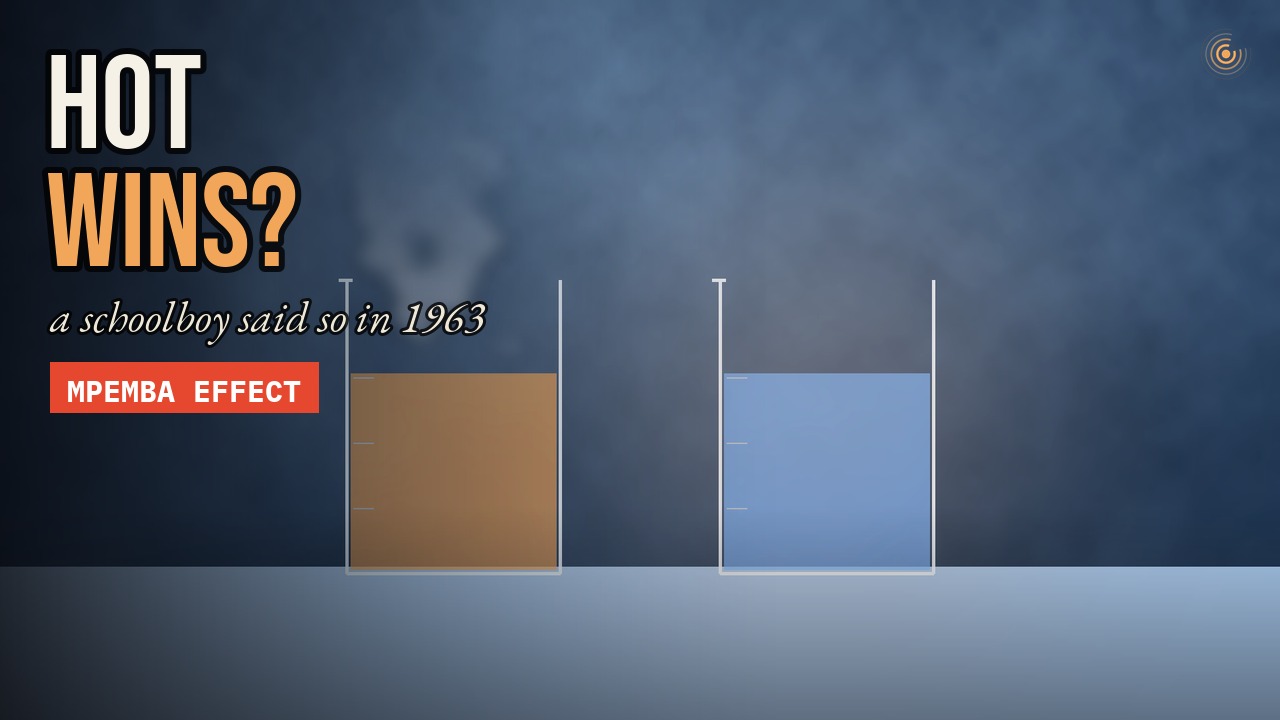
A common misconception is that the law says hot water can never overtake cold water. It only describes the same water under the same conditions: if hot water evaporates, changes its contact with a frosty shelf or supercools differently, the conditions are no longer the same, and that is where the Mpemba effect argument begins.