Radioactive decay
Unstable atomic nuclei break down by themselves, giving off radiation as alpha particles, beta particles or gamma rays.
The nucleus at the heart of most atoms is stable and stays the same indefinitely. Some, though, have an unbalanced mix of protons and neutrons, and sooner or later they change spontaneously, releasing energy as radiation. This is radioactive decay, or radioactivity. It needs no outside trigger or energy source, and heating or chemically combining the atoms does not change its rate.
Its discovery involved some luck with the weather. In 1896 Henri Becquerel was testing whether uranium salts, after exposure to sunlight, gave off rays that could pass through black paper and fog a photographic plate. When the sun refused to shine, he kept his wrapped plates and uranium in the dark, developed the plates anyway and found strong images: the uranium was giving out radiation all by itself. He announced it on 2 March 1896. Marie and Pierre Curie went on to discover polonium and radium in 1898, and the three shared the 1903 Nobel Prize in Physics.
Ernest Rutherford sorted the radiation into types by how easily it was stopped. He measured that about 0.0005 centimetres of aluminium was needed to block alpha rays, 0.05 centimetres for beta rays and 8 centimetres for the far more penetrating gamma rays.
A common misconception is that anything exposed to radiation becomes radioactive. Usually it does not. The greater danger comes from contamination: radioactive material itself, as dust or powder, getting onto skin or inside the body.
See it in action
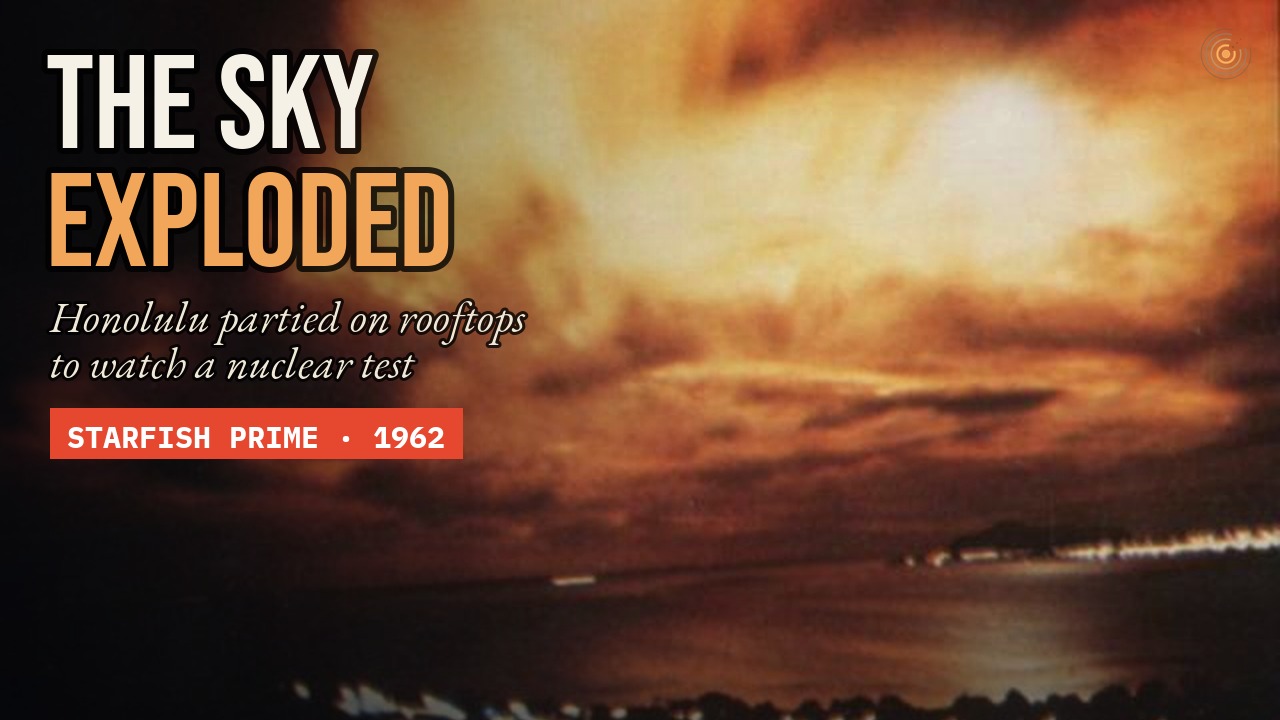 Watch nowThe Night America Nuked the Sky8 Jul 1962, 11 pm Honolulu time · 400 km above Johnston Island
 Premieres 19 NovHow the Solar System Was Born4,567 million years ago · Allende, Mexico, 1969
Coming up in future stories
- A Cosmic Ray May Have Voted in Belgium and Moved Mario 2003 · Schaerbeek, Brussels / 2013 · a Super Mario 64 speedrun
- Our Species Is 100,000 Years Older Than We Thought 300,000 years ago · Jebel Irhoud, Morocco
- Radioactivity Was Found Because It Was Cloudy 1896 · Paris, France
- The Black Fungus Growing Toward Chernobyl's Radiation 1990s–2019 · Chernobyl, Ukraine, and the International Space Station
- The Glowing Blue Powder That Poisoned a City 1987 · Goiânia, Goiás, Brazil
- The Wine Vintages That Could Not Exist 2008–2013 · New York, USA and Burgundy, France