The Day the Sun Blew Up a Minefield
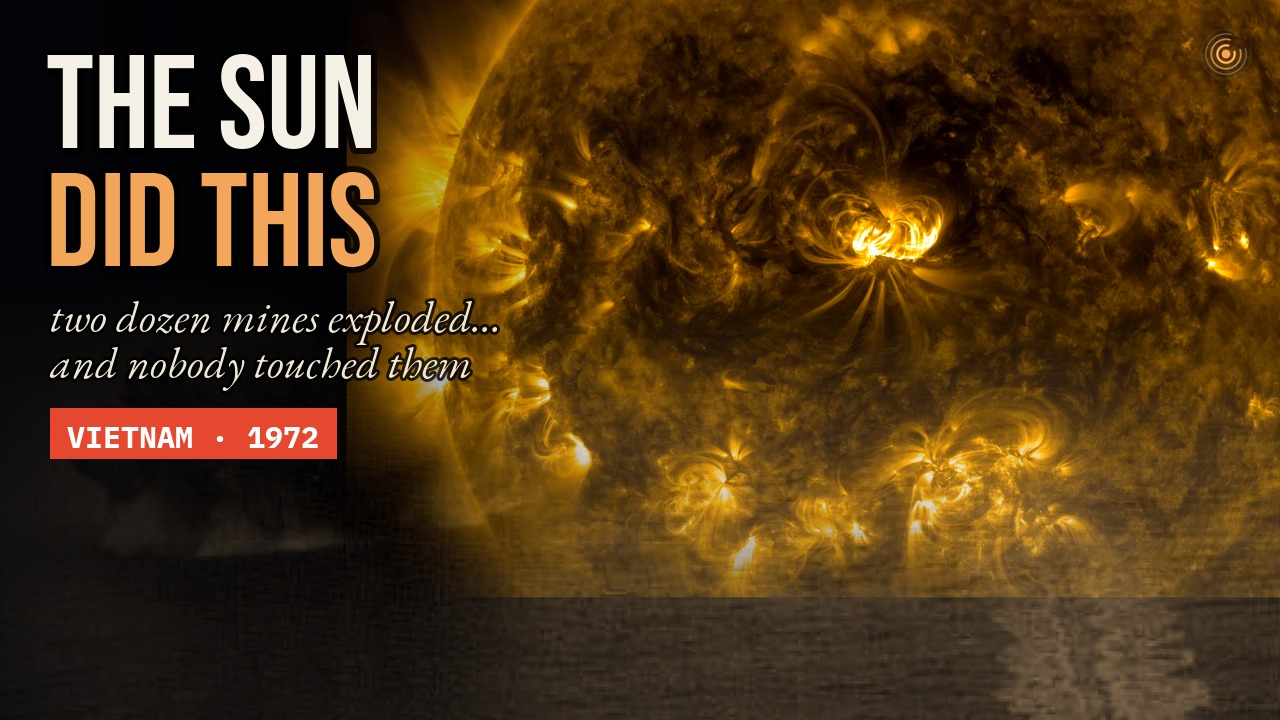
American aircraft saw some two dozen mines explode off the coast of North Vietnam in about 30 seconds, with no ship anywhere near them. The trigger was 150 million km away.
 Premieres on YouTube Friday 06 November, 17:00 UTC · subscribe to get it
On 4 August 1972, American aircraft flying off the coast of North Vietnam saw something nobody had ordered. In a minefield near Hon La, the sea began to erupt. Some two dozen explosions, in about 30 seconds.
There were no ships in the minefield. Nobody had touched it. The trigger was 150 million km away.
Three months earlier, on 9 May, US Navy jets from the carrier Coral Sea had dropped mines into the channels leading to Haiphong, North Vietnam's main port. In Washington, it was still the evening of the 8th, and President Nixon went on television while the planes were in the air:
I have ordered the following measures, which are being implemented as I am speaking to you.
By the end of the year, more than 8,000 mines had been dropped along the coast of North Vietnam, and about 3,000 more in its rivers. Many of them were magnetic.
The Trigger
A magnetic mine sits on the seabed and does nothing. It waits for a steel hull to pass overhead and bend the Earth's magnetic field around it. One type, the Mark 36 Destructor, carried a 500-pound charge. When the field shifted, it fired.
Meanwhile, on the Sun, a tangled group of sunspots was turning to face the Earth. Between the end of July and 11 August, that one region produced 67 solar flares.
On 4 August, it produced one of the biggest ever recorded. It was so bright in X-rays that it overloaded the satellite sensor that was measuring it. And it threw a vast cloud of magnetised gas, a coronal mass ejection, straight at the Earth.
Fourteen Hours
A cloud like that usually takes 2 or 3 days to reach us. This one took 14.6 hours. It is still the fastest arrival ever recorded. On average, close to 3,000 km every second. Fast enough to cross from London to New York in about 2 seconds.
When it hit, it squeezed the Earth's magnetic shield, pushing its edge in from about 10 Earth radii to about 5. On the ground, the magnetic field jumped. Instruments in Boulder, Colorado, and in Honolulu were driven off the scale.
The Verdict
Now think about a magnetic mine again. It does not know what a ship is. It only feels a change in the magnetic field. A steel hull makes the field shift. And so, that August, did the Sun.
Navy investigators concluded that the explosions had been caused by the magnetic disturbance of the solar storm. One report called it
the first example of what happens to a major mining campaign in the face of the vagaries of nature.
Afterwards, the Navy sped up its switch to mines that need two signals, not one: a magnetic change, and the sound or vibration of a real ship.
Around the World
The mines were not the storm's only victims. Auroras were seen as far south as Bilbao, in Spain. In British Columbia, a 230,000-volt transformer exploded. In the American Midwest, a long-distance telephone cable went dead.
And it struck in the gap between the last two Moon missions. Apollo 16 had come home in April. Apollo 17 would not launch until December. Estimates of what the storm would have done to astronauts vary widely. Some suggest the dose could have been severe.
For decades, the mine story stayed buried in Navy files. Then, in 2018, a team led by the space physicist Delores Knipp brought it to light. They argued that, in some ways, 1972 belongs with the most extreme space storms on record. Not every scientist agrees.
You may read online that 4,000 mines went off. That number comes from one sailor's memoir. The Navy's records say some two dozen.
By the usual measure of a storm's strength, 1972 does not even look that big. The great storm of May 2024 was around three times stronger. What made '72 different was speed. The field changed so fast that, on the seabed, it felt like a ship.
Epilogue
One August day, in the middle of a war, a minefield exploded with nobody near it. The Sun had reached across 150 million km, and nobody on Earth had pressed a button.
Key facts
- On 4 August 1972, US Task Force 77 aircraft reported some two dozen explosions in a minefield near Hon La in about 30 seconds; the Navy concluded a solar storm's magnetic disturbance was the cause. source ↗
- The coronal mass ejection reached Earth in about 14.6 hours, still the fastest arrival on record (normally 2 to 3 days). source ↗
- It struck between Apollo 16 (back on 27 April) and Apollo 17 (launched 7 December); estimates of the dose astronauts could have received vary widely. source ↗
- Knipp et al. (2018) argued the storm deserves a place among the most extreme on record; other researchers dispute the 'Carrington-class' label. source ↗
Sources
- Knipp, Fraser, Shea & Smart (2018), Space Weather, AGU
- U.S. Navy History & Heritage Command: mining and mine clearance in North Vietnam
- Wikipedia: August 1972 solar storms; Operation Pocket Money
- National Academies (2008): Severe Space Weather Events
- Scientific American; spaceweatherarchive.com; AGU GeoSpace blog