The Summer Nights You Could Read By
At midnight, Europeans read newspapers outdoors without a lamp, lit by a sky glowing from a space rock that exploded over Siberia.
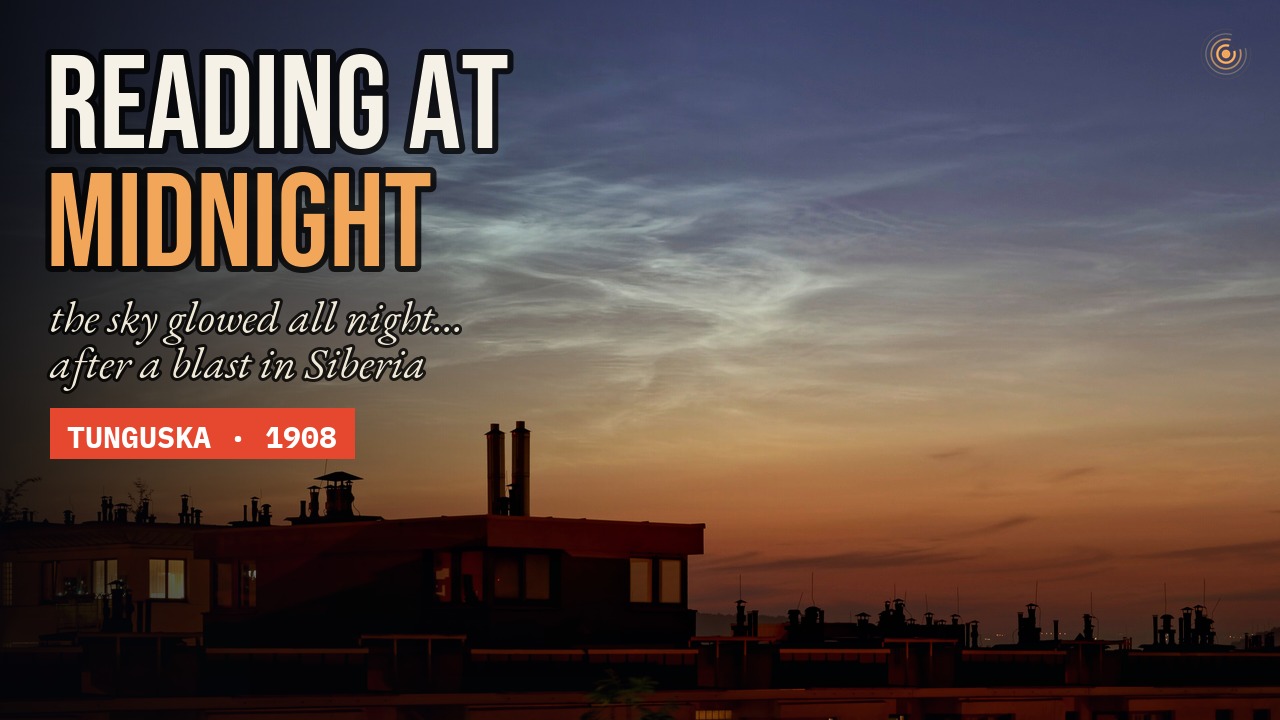 Premieres on YouTube Wednesday 11 November, 17:00 UTC · subscribe to get it
At a quarter past one in the morning, on 1 July 1908, a man on the Norfolk coast in England sat by his window and read a book. Without a lamp.
Outside, the sky was glowing salmon pink. Across Europe, from Scotland to the south of France, people looked up at a night that refused to get dark. And nobody knew why.
The Bright Nights
The glow peaked on the night of 30 June. It was reported from more than 140 places, across some 10 million km²: north to Aberdeen and Stockholm, south to Bordeaux and Tashkent.
In Bristol, an astronomer gave up observing because the sky was too bright. Readers wrote to The Times about a brilliant aurora, and the paper compared the glow to the sunsets after Krakatoa, twenty-five years earlier. But this time, no volcano had erupted.
The answer lay more than 5,000 km to the east. At 7:14 that morning, local time, something exploded in the sky above the forests of central Siberia, near the Podkamennaya Tunguska river.
At the trading post of Vanavara, about 65 km away, a man named Semenov was sitting on his porch. Years later, he described the moment:
The sky split in two. Fire appeared high and wide over the forest.
The blast threw him several metres, and for a moment he lost consciousness. Windows broke 200 km away.
The Blast
A rock from space, probably 50 or 60 metres across, had burst between 5 and 10 km above the ground. Estimates of its energy range from 3 to 30 megatons. That is hundreds of times the bomb that destroyed Hiroshima.
It never hit the ground. But the blast flattened about 2,000 km² of forest. Millions of trees, laid out in a shape like a giant butterfly, 70 km across. An area bigger than Greater London.
The Wave
And then, just like Krakatoa, the air itself carried the news. Seismographs as far away as Tashkent and Jena registered the shock. About five hours later, a pressure wave reached Britain, and the pens of barographs in London, Cambridge and Hampshire twitched.
In 1908, nobody could explain those squiggles. It took until 1930 for a British meteorologist, Francis Whipple, to match them to Siberia.
So why could Europe read at midnight? The leading idea is that the explosion sent dust and water vapour high into the atmosphere. Up at around 80 km, ice crystals form thin, shining clouds.
At midsummer in northern Europe, the sun only just dips below the horizon. The ground goes dark, but a cloud that high is still in sunlight. It glows all night. It's a good explanation, but not a complete one: scientists still argue about how that material spread so far, so fast.
For 19 years, no scientist went to look. The site was remote, and Russia went through war, revolution and civil war. Then, in 1927, a meteorite hunter named Leonid Kulik finally reached it, by sledge and by reindeer.
He found trees lying like the spokes of a wheel, all pointing away from one place. At the centre, trees were still standing, stripped of their branches, like telegraph poles. And there was no crater at all.
Today, most scientists think it was a stony asteroid that shattered completely in the air. We have seen a smaller one since. In 2013, a rock about 20 metres wide burst above Chelyabinsk in Russia. Around 1,500 people needed medical help, most of them hit by flying glass.
Tunguska was many times more powerful. It happened to fall on one of the emptiest places on Earth.
Epilogue
One morning in Siberia, a flash nobody could explain. And for a few nights afterwards, half of Europe could read by the light of the sky.
Key facts
- On the nights after 30 June 1908 the sky glowed over Europe, from Scotland to the south of France; people read outdoors at midnight. source ↗
- At 7:14 local time an airburst 5 to 10 km above central Siberia flattened about 2,000 km² of forest, with an energy estimated at 3 to 30 megatons. source ↗
- Barographs in Britain recorded the pressure wave about five hours later; Francis Whipple matched the traces to Siberia only in 1930. source ↗
Sources
- Wikipedia: Tunguska event
- C. Pillinger, Gresham College lecture on Tunguska (1999)
- Scientific American, “The Tunguska Mystery—100 Years Later” (2008)
- Linda Hall Library: Leonid Kulik
- Kelley et al. 2009 (Cornell): noctilucent clouds
- The Planetary Society: the Chelyabinsk meteor