Easter Island's Statues Walked
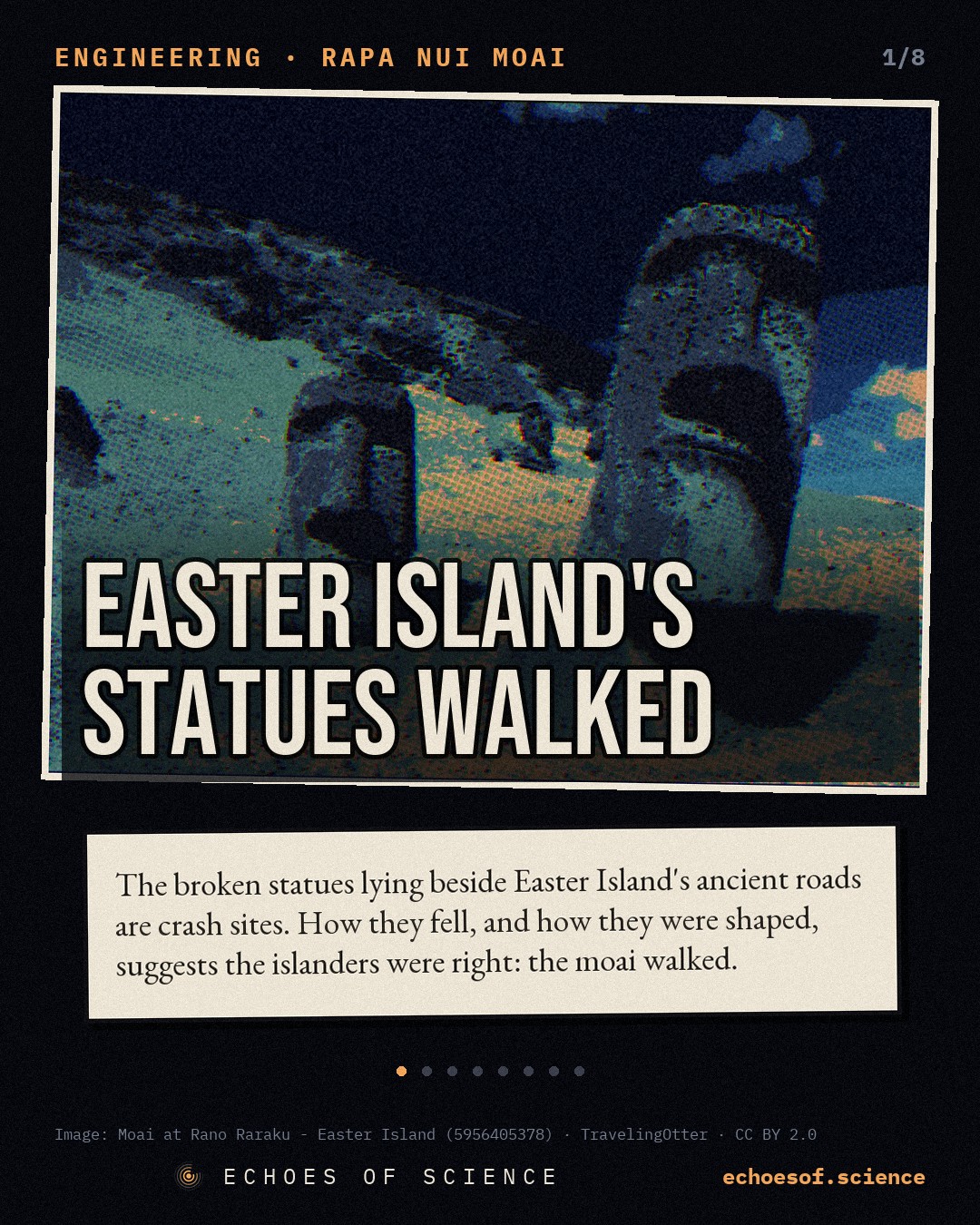
The broken statues lying beside Easter Island's ancient roads are crash sites. How they fell, and how they were shaped, suggests the islanders were right: the moai walked.
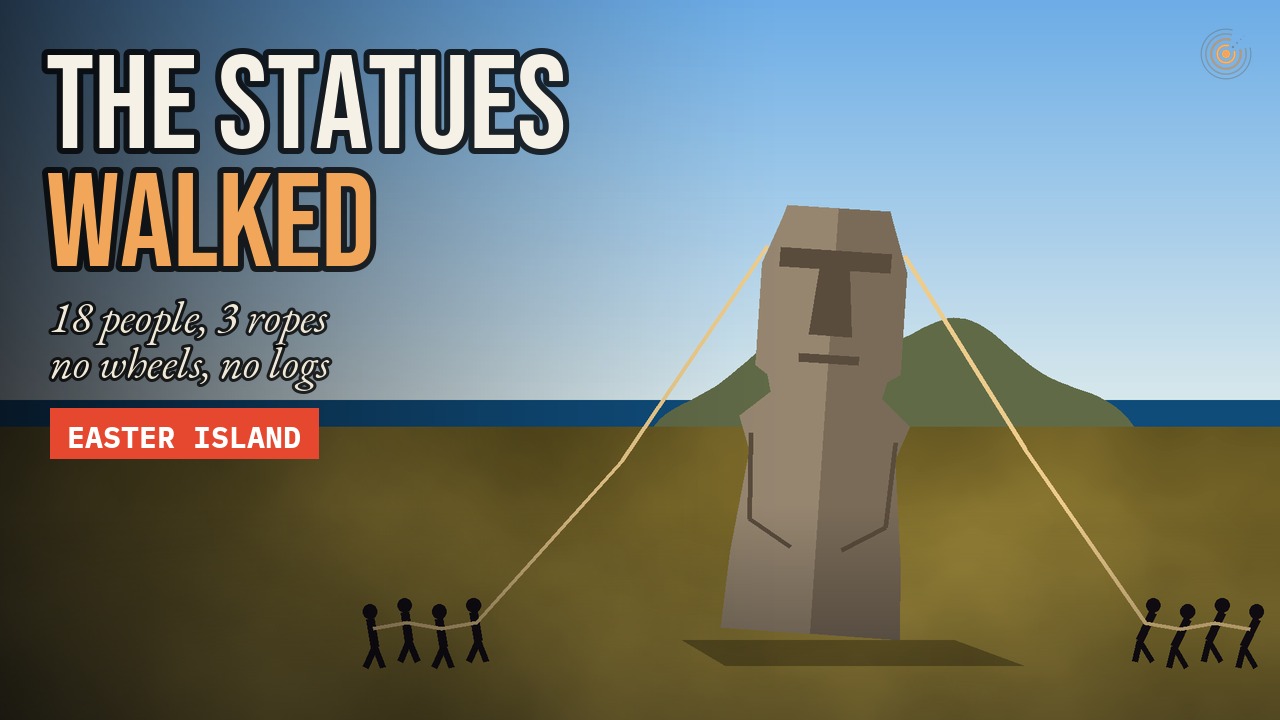
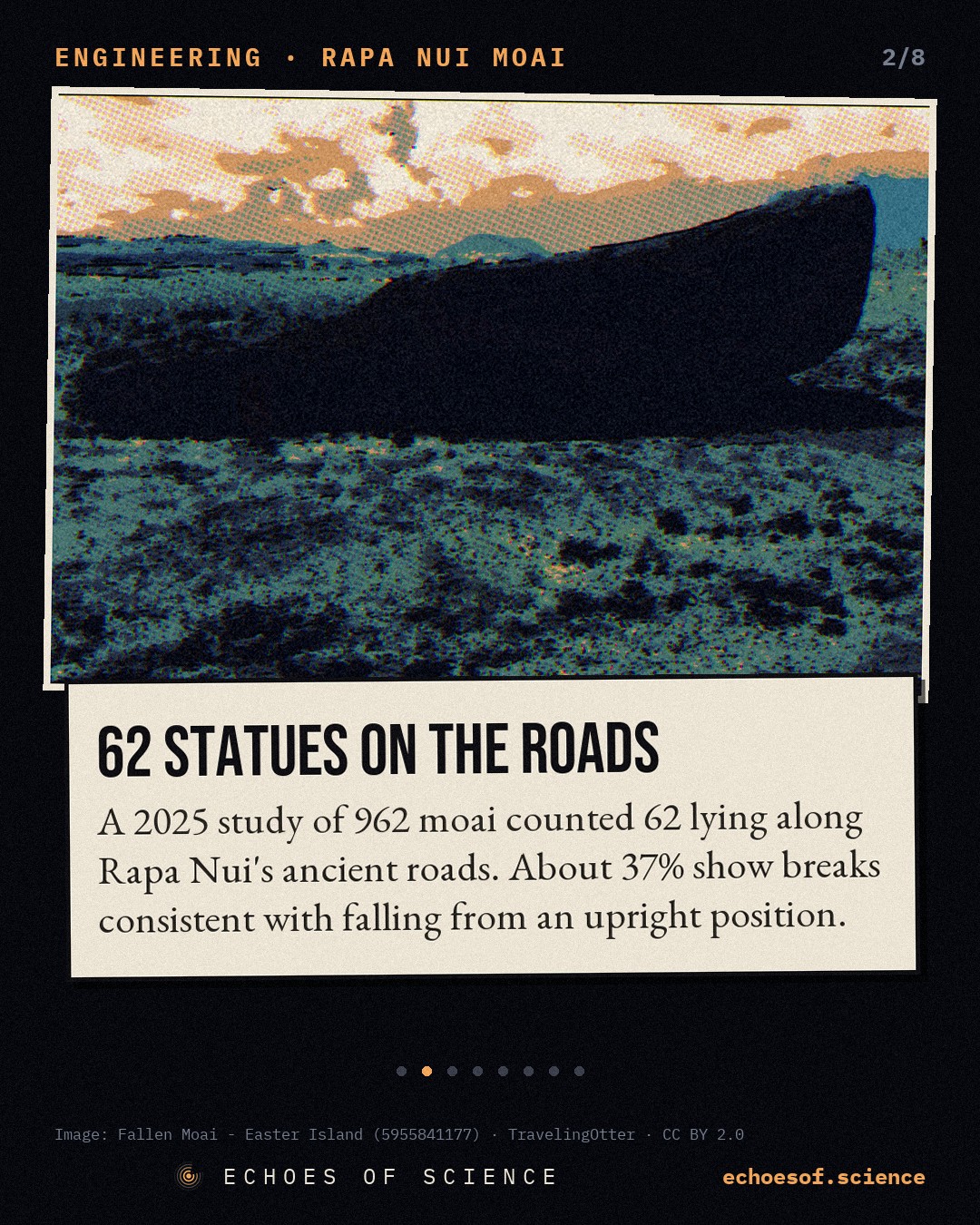
Walk the old roads of Rapa Nui and you meet giants lying in the grass. Some are face down, some on their backs, some snapped in two. It is easy to see them as leftovers: statues dropped on the way to their platforms and never collected. A 2025 study reads them differently. They are, in effect, crash sites, and the way each one fell is a clue to how it was moving.
A story the islanders always told
The Rapanui have long said that their ancestors made the moai walk from the quarry at Rano Raraku, the volcanic crater where most of the statues were carved. For much of the twentieth century outsiders preferred other answers: sledges, log rollers, wooden frames. In 1986 the Czech engineer Pavel Pavel, working with Thor Heyerdahl and sixteen local residents, roped a 15-ton statue and made it shuffle upright. In 2012 Carl Lipo and Terry Hunt went further: 18 people with three ropes walked a 4.35-tonne concrete replica 100 metres in 40 minutes.
Those experiments showed that walking a moai was possible. The new question was whether the statues themselves carry the evidence that it actually happened.
Reading the fallen giants
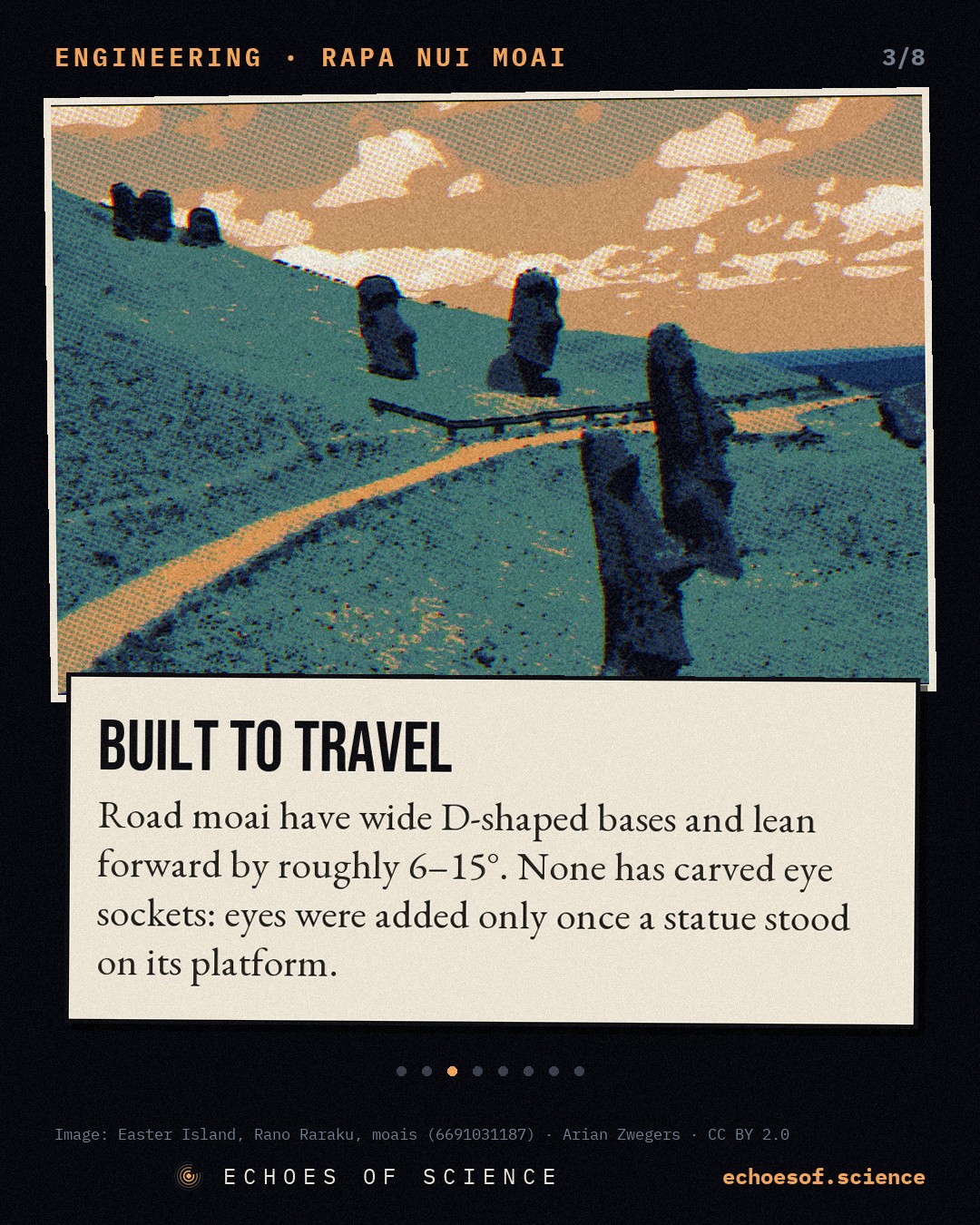
In their paper in the Journal of Archaeological Science (November 2025), Lipo and Hunt analysed 962 moai and built 3-D models of the 62 that lie along the ancient roads. These road moai are not like the statues standing on the platforms (ahu). They have wide, D-shaped bases and lean forward by roughly 6 to 15 degrees. And none has carved eye sockets. On the platforms, the eyes appear to have been the final step, carved only once a statue was raised. The road moai never got that far.
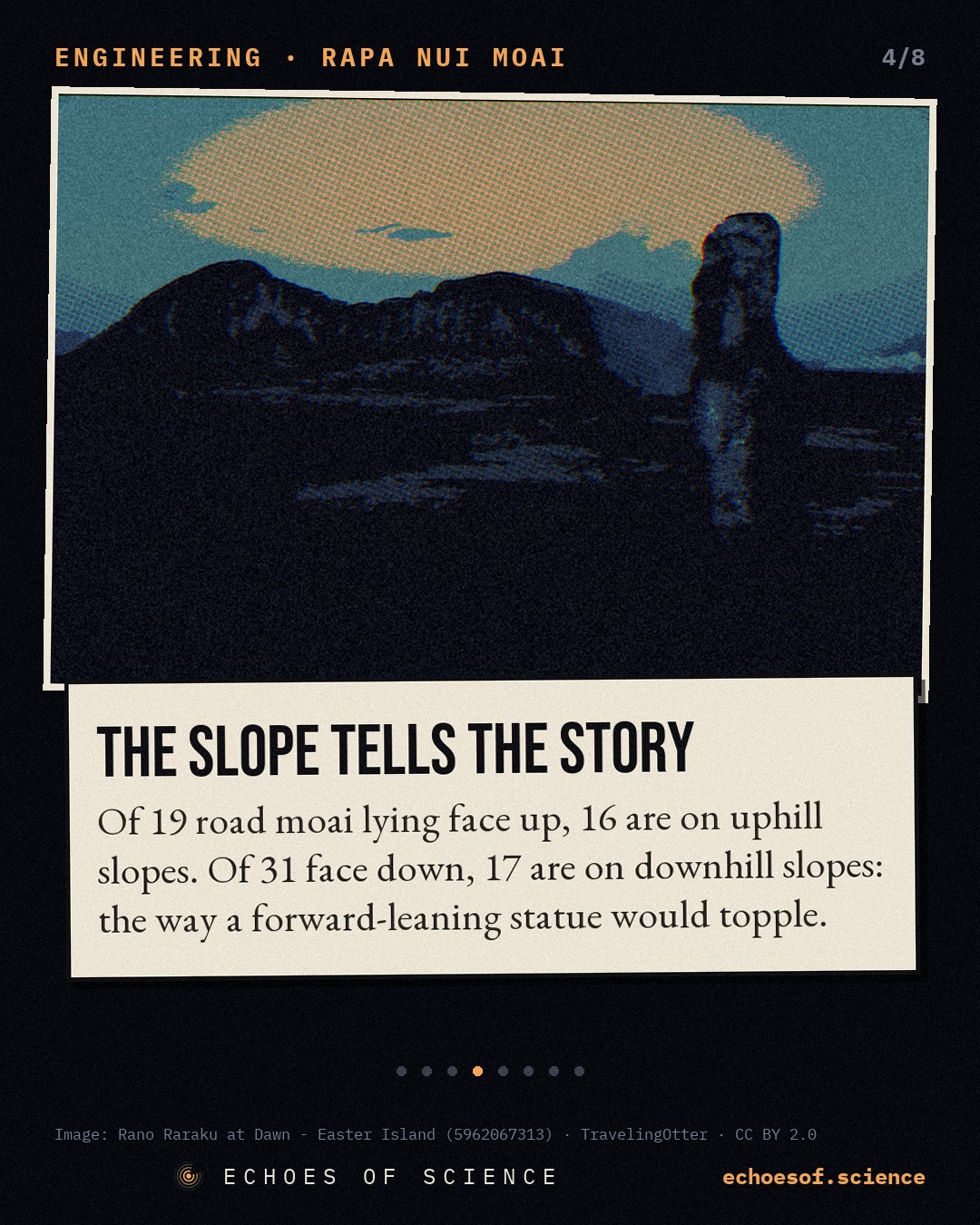
Then there is the way they fell. About 37% show breaks consistent with toppling from an upright position. The direction matters too. Of 19 road moai lying face up, 16 are on uphill slopes; of 31 lying face down, 17 are on downhill slopes. That is what you would expect from a forward-leaning statue that is walked uphill and tips backwards, or walked downhill and pitches onto its face when the crew loses control.
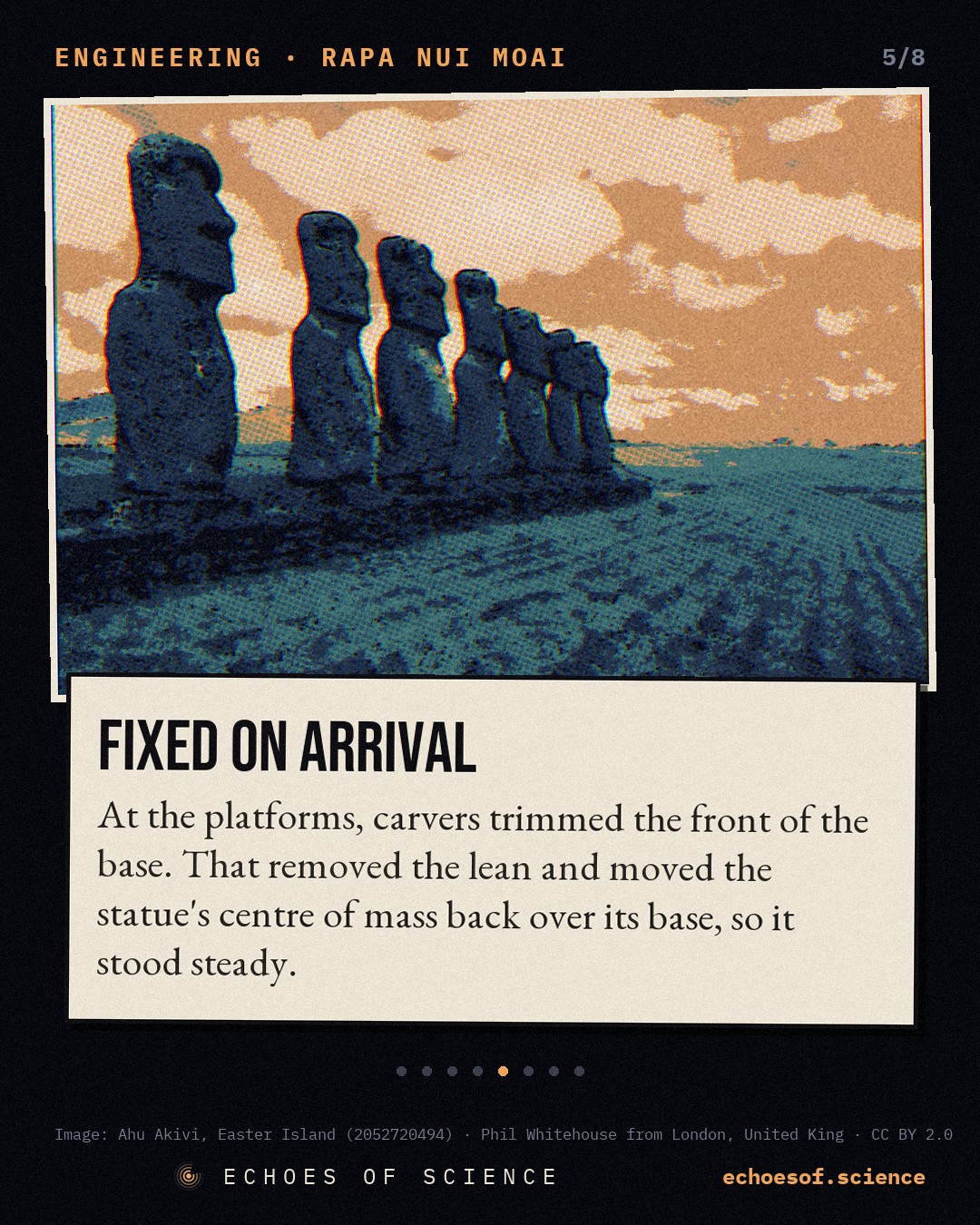
Even the roads fit the idea. They average about 4.5 metres wide and are dished in the middle. "The road is part of moving the statue," Lipo told his university. At the platforms, the story ends with a repair: carvers trimmed the front of each base, removed the lean and moved the centre of mass back over the base, so the statue could stand still for centuries.
How do we know?
The evidence is a pattern, not a photograph. It combines the measured shapes of hundreds of statues, statistics on where and how the road moai lie, a physics model and a full-size experiment. The model suggests that 15 to 60 people could start a statue rocking and 5 to 25 could keep it going, at roughly 310 metres an hour in steps of about 89 centimetres (Live Science).
Not everyone is convinced. Sue Hamilton, an archaeologist at University College London, called the research ingenious but said it shows that upright transport was technically possible, not that it happened; the road moai may look different for other reasons, such as a different purpose, different carvers or a fashion of one period. Nobody has walked one of the largest statues, which weigh many tens of tonnes. Lipo and Hunt reply that no rival idea explains all the clues at once. For now, walking is the explanation that fits the most evidence, and it is the one the islanders gave from the start.
The science: why a leaning statue walks
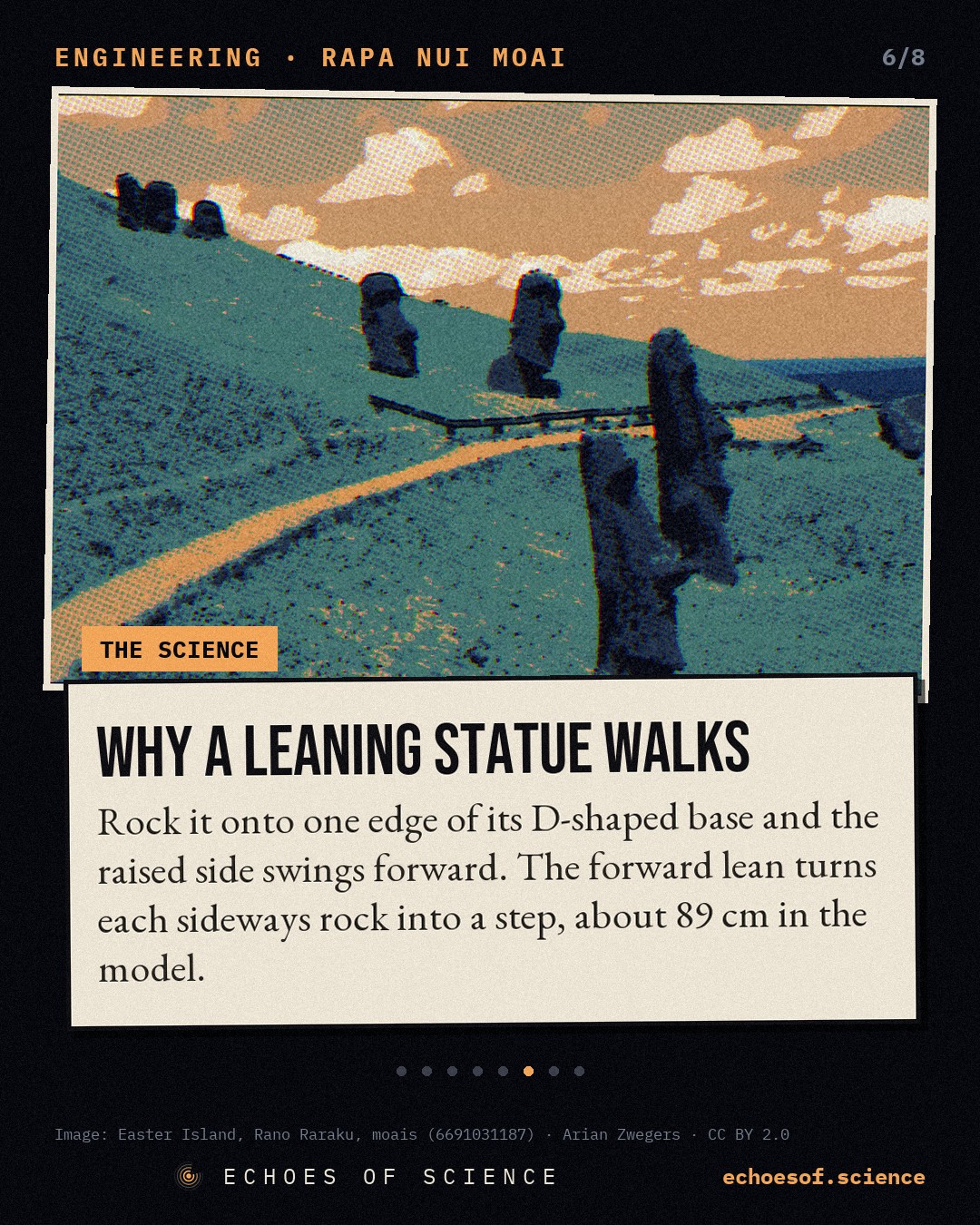
Think of moving a heavy fridge. You do not lift it: you tip it onto one corner, swing the other corner forward and set it down. The floor carries the weight; you only steer the fall. A moai with a curved D-shaped base works the same way. Pull a rope on one side and the statue rocks onto one edge of its base. The other side lifts and, like a pendulum, swings forward. Rock it back the other way and the second side steps ahead.
The forward lean is the clever part. It places the statue's centre of mass near the front edge of the base, so every rock carries it slightly forward instead of back and forth on the spot. Too much lean and it falls on its face, which is why a third rope behind the statue acts as a brake. Downhill, that brake is hardest to hold, and that is just where the face-down statues lie.
Why it matters today
For a long time the moai were used as a parable of a people who could not have done it alone, or who ruined their island doing it. The walking statues tell a different story: the islanders found an efficient method, using ropes, rhythm and a deep feel for balance, and remembered it in its own words. Experimental archaeology at its best does not overrule local tradition. Sometimes it catches up with it.
The science in this story
Key facts
- Carl Lipo and Terry Hunt's study 'The walking moai hypothesis' (Journal of Archaeological Science, November 2025) analysed 962 moai, including 62 'road moai' found along Rapa Nui's ancient roads. source ↗
- Road moai have wide D-shaped bases and lean forward by roughly 6–15° from vertical; their centre of mass sits about 0.39 of the way up from the base. source ↗
- Road moai lack carved eye sockets; the authors argue eyes were carved only after a statue had been raised on its platform, where the base was reshaped to remove the lean. source ↗
- 37% of road moai show breaks consistent with falling from a vertical position. Of fallen road moai, 16 of 19 lying face up are on uphill slopes and 17 of 31 lying face down are on downhill slopes. source ↗
- The ancient roads average about 4.5 m wide and have concave cross-sections; Lipo: 'The road is part of moving the statue.' source ↗
- In 2012, 18 people with three ropes 'walked' a 4.35-tonne concrete replica 100 m in 40 minutes. source ↗
- The model suggests 15–60 people to start a statue rocking and 5–25 to keep it moving, at about 310 m an hour with steps of about 89 cm. source ↗
- UCL archaeologist Sue Hamilton called the work an ingenious contribution but said it shows upright transport was technically possible, not that it happened; the road moai's shape could have other explanations. source ↗
- In 1986 Czech engineer Pavel Pavel, with Thor Heyerdahl and sixteen local residents, made a 15-ton statue 'walk' upright with ropes. source ↗
- Rapa Nui National Park, a UNESCO World Heritage Site, holds an estimated 900 or so statues, mostly carved from volcanic tuff at the Rano Raraku quarry. source ↗
In pictures

Loading the quiz…
Where every picture, clip and sound in this story comes from
Keep scrolling: more true stories ↓
New mini-documentaries every week and a true story every day. Pick where you like to watch:
▶ Subscribe on YouTube Telegram TikTok Instagram Bluesky Threads ✉ Weekly email
Everything here is free and stays free. If you would like to help us make more: 🪐 Shop: calendars, posters, mugs & books