"I Have Seen My Death": The First X-Ray of a Person
In January 1896 a photograph of the bones inside a living hand went round the world in days. It began in November 1895, with a glow that should not have been there.
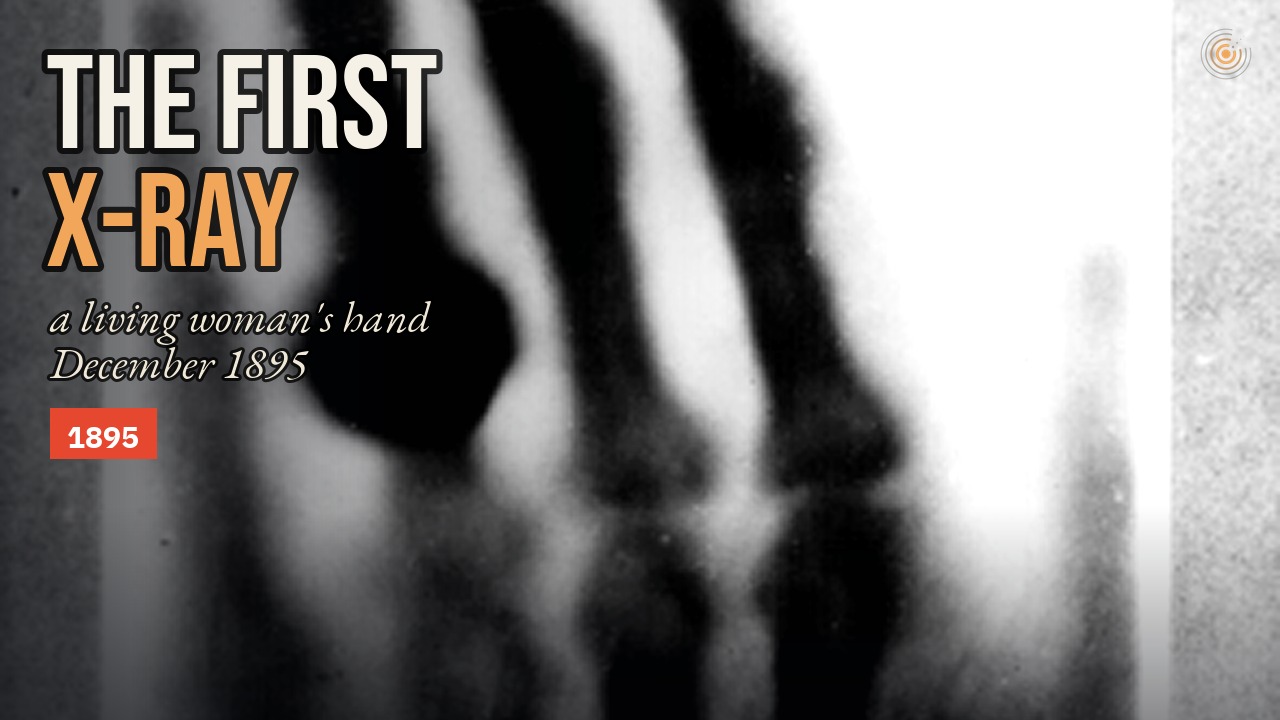
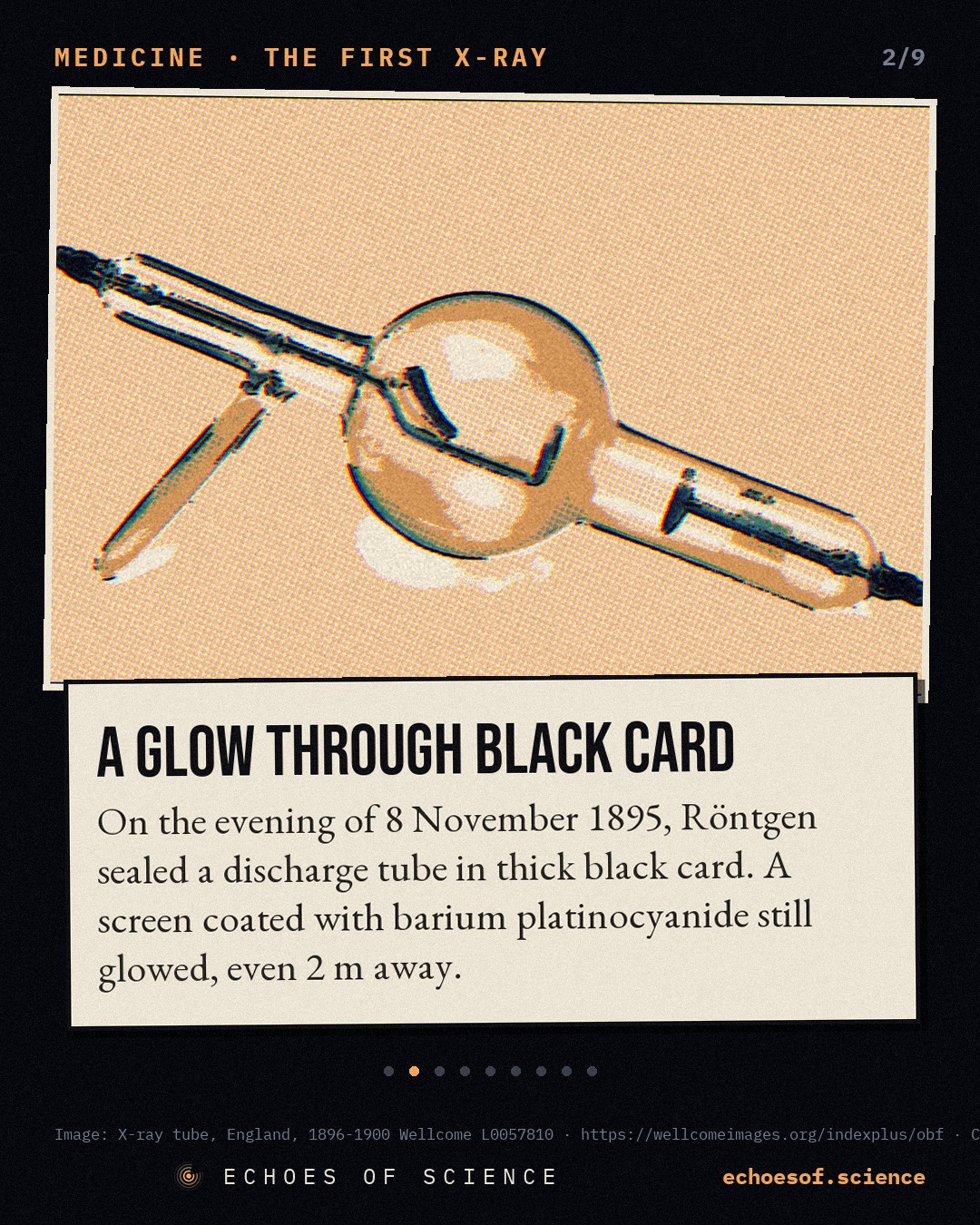
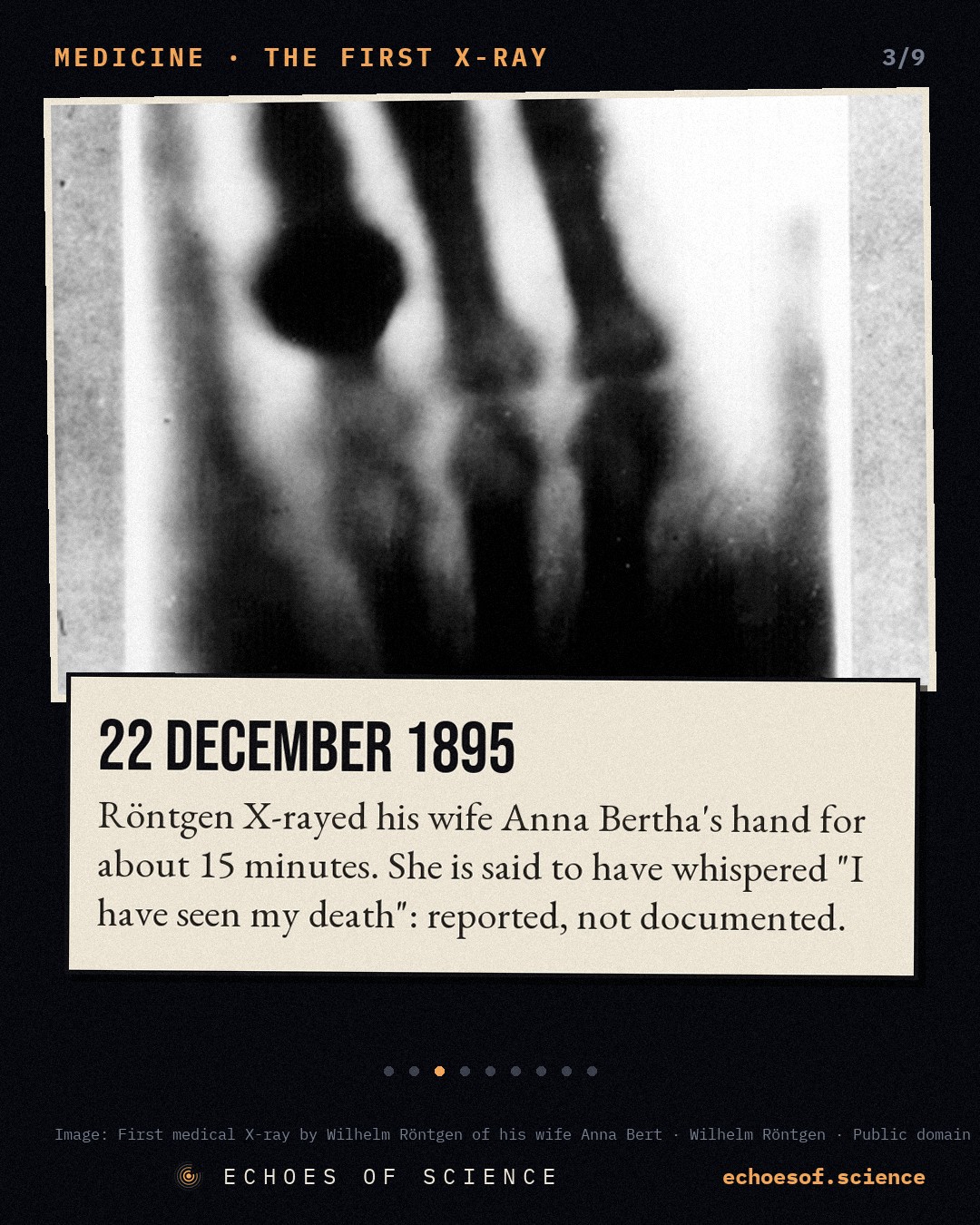
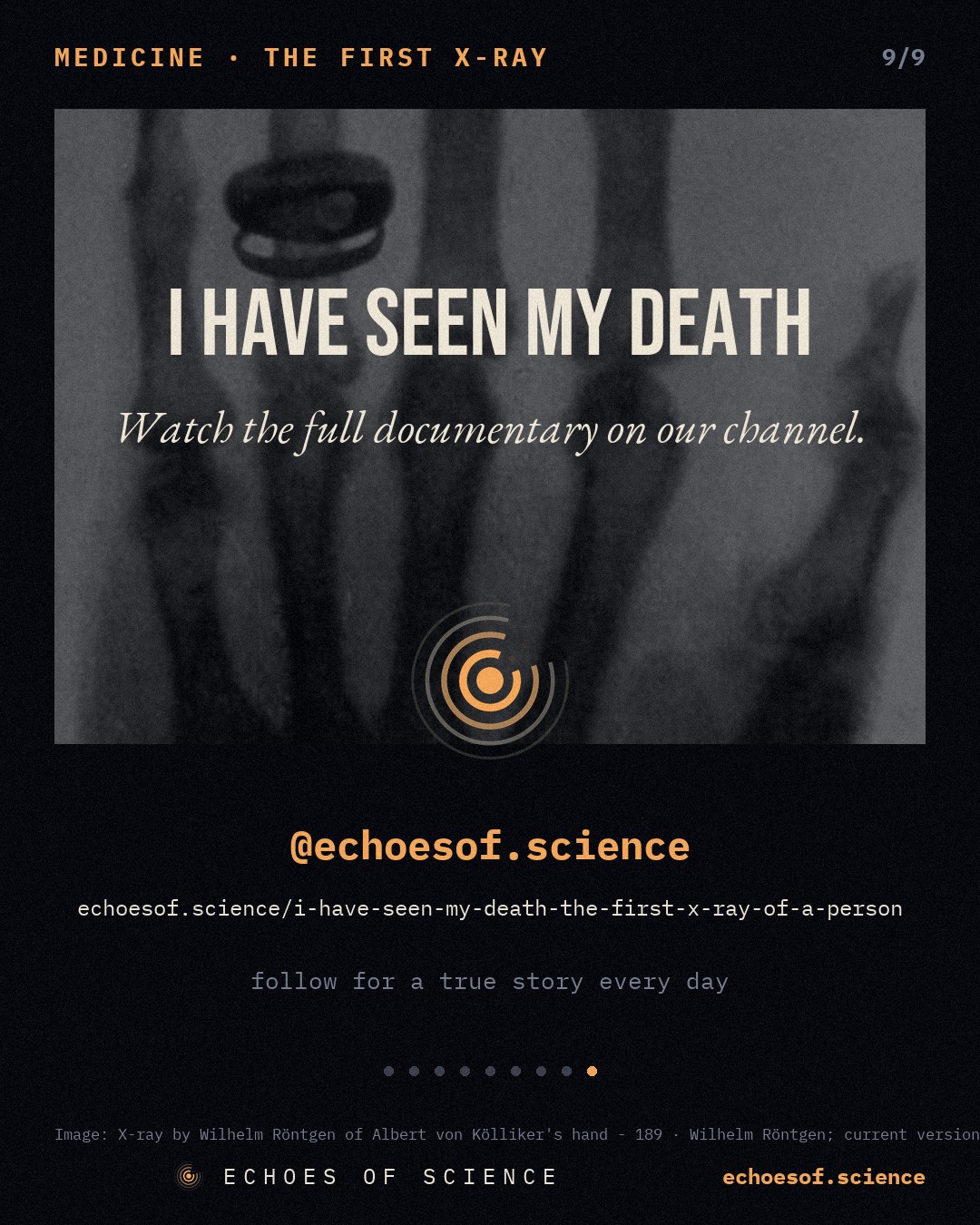
On 22 December 1895, in a physics institute in Würzburg, a woman held her left hand still for about a quarter of an hour. When the photographic plate was developed, it showed something no one had ever seen in a living person: the bones of her fingers, with her wedding ring hanging around one of them like a hoop in the air. According to a story told ever since, Anna Bertha Röntgen looked at it and said: "I have seen my death." Within a month the picture had been printed across Europe. Within two months doctors on another continent were using the same invisible rays to look at a broken wrist.
A glow that should not have been there
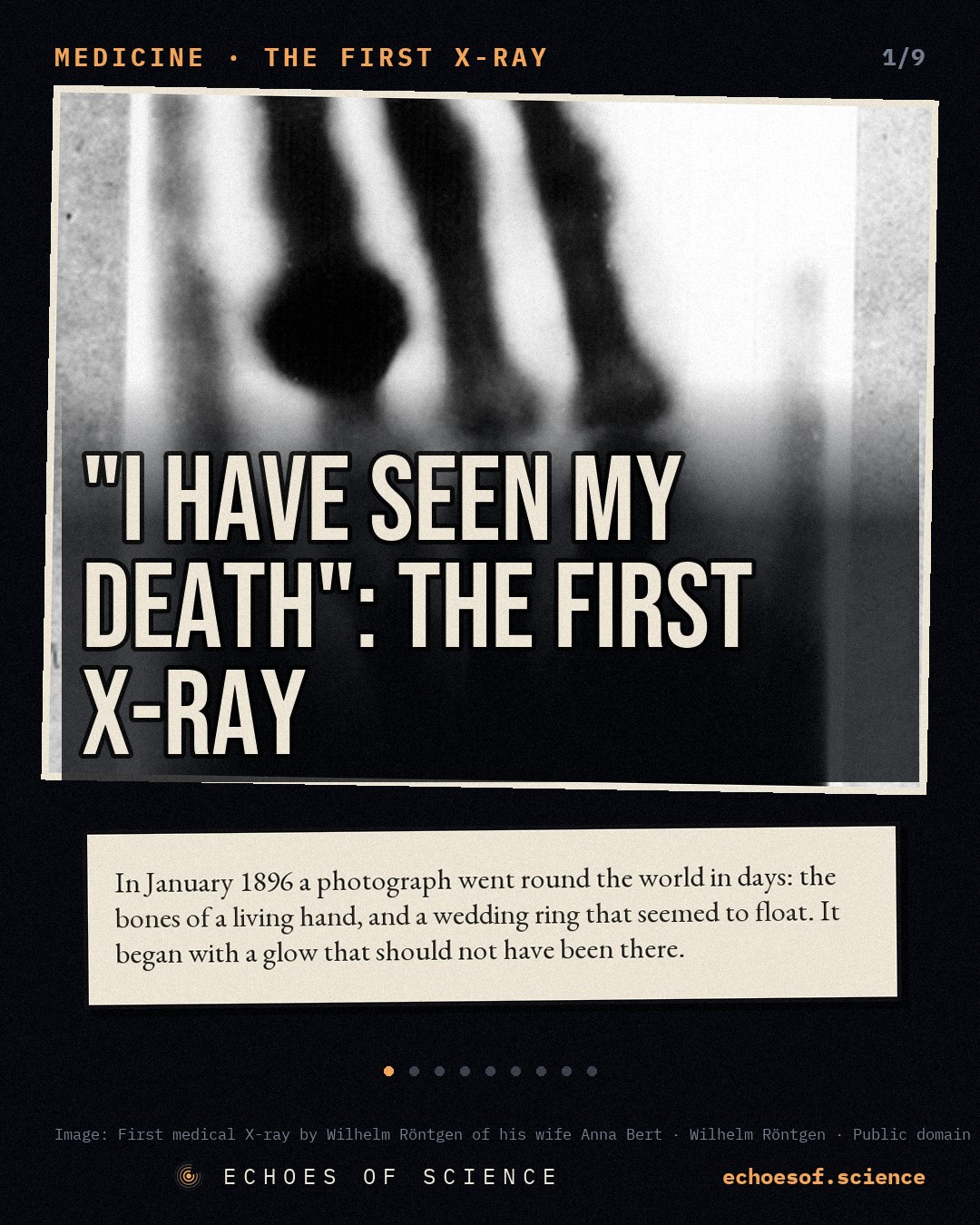
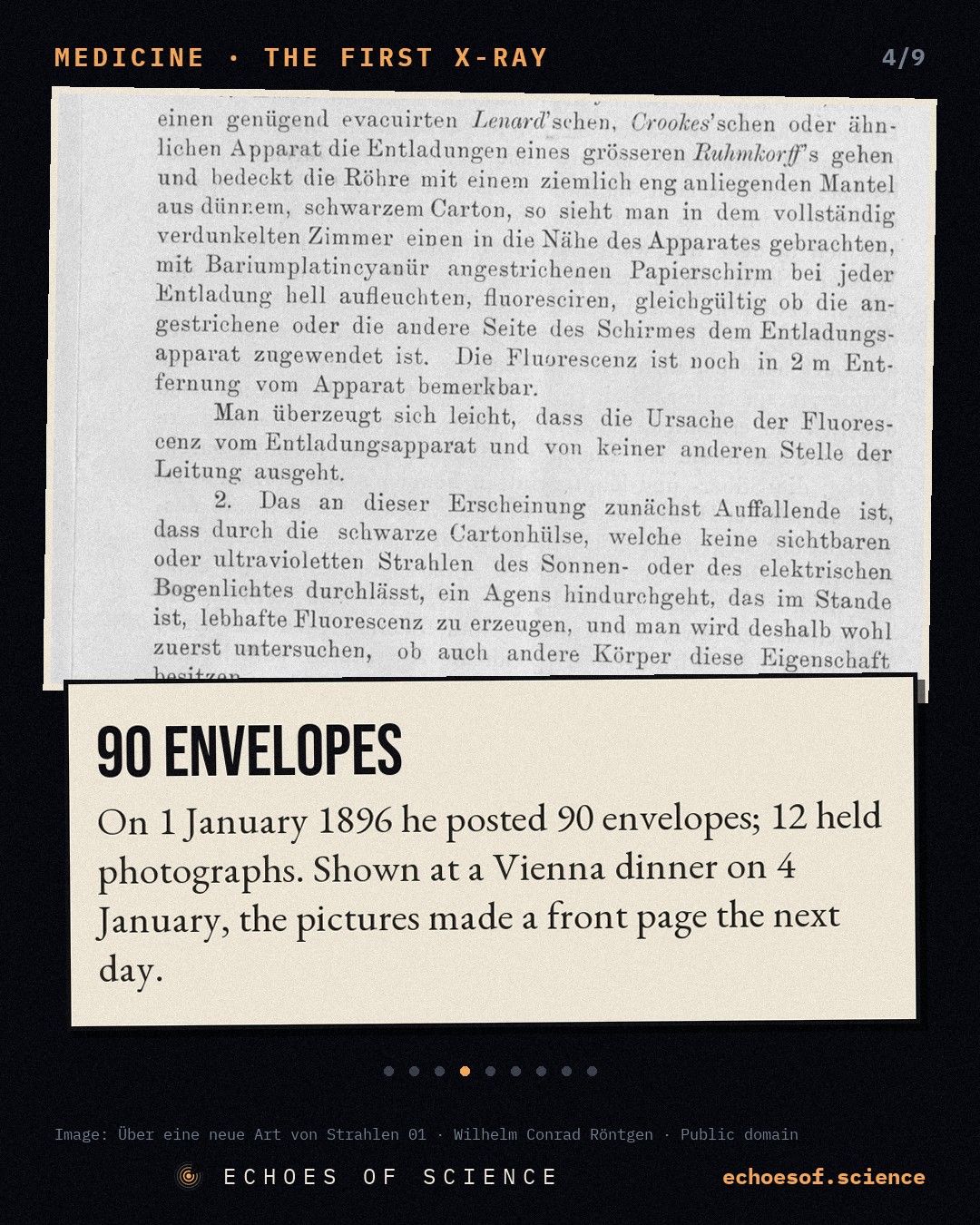
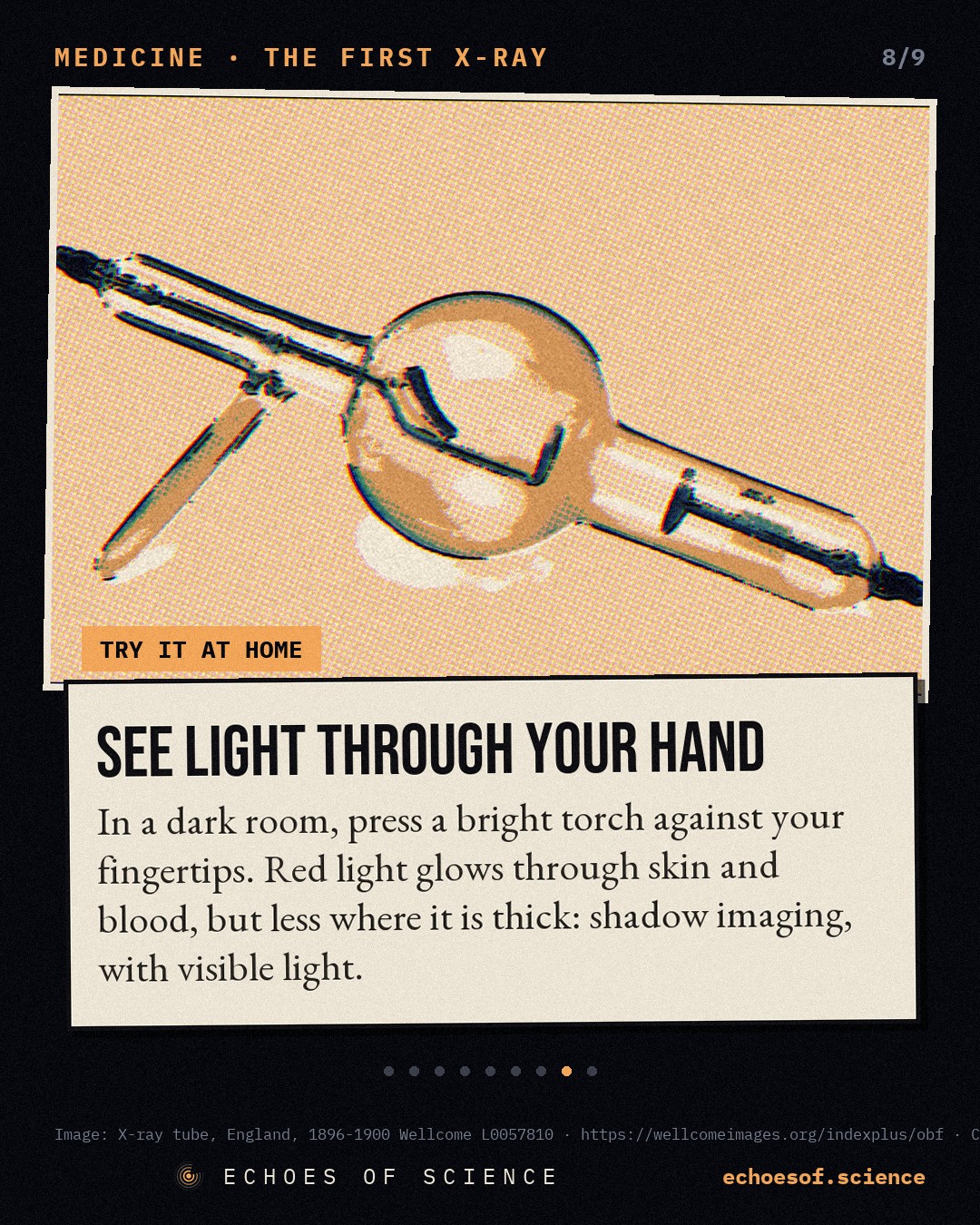
Her husband, Wilhelm Conrad Röntgen, was a 50-year-old professor of physics studying cathode rays, the streams of electrons that flow through a glass tube when most of the air is pumped out and a high voltage is applied. According to the Nobel Prize biography, on the evening of 8 November 1895 he had sealed his tube inside a thick black carton so that no light could escape. Yet a paper screen painted with barium platinocyanide, a chemical that glows when energy strikes it, lit up nearby. It kept glowing even when he moved it two metres away, far beyond the reach of cathode rays in air.
Something invisible was leaving the tube, passing through the card and making the screen shine. Röntgen did not know what it was, so he used the mathematician's symbol for an unknown: he called it X. The Siemens Healthineers MedMuseum describes the next seven weeks as a period of tireless, almost hidden work, in which he tested what the rays would and would not pass through. Paper, wood and flesh barely stopped them. Metals did.
The hand, and the words
The picture of his wife's hand, taken on 22 December with an exposure of about 15 minutes, became the most famous of his early images. On 28 December his first report, "Ueber eine neue Art von Strahlen" ("On a New Kind of Rays"), was handed to the Physical-Medical Society of Würzburg, as the Linda Hall Library records.
Bertha's sentence is the part to handle with care. It is quoted in many accounts, including PBS NewsHour, but it comes to us as a reported remark, not from a letter or diary of the time. It may be exactly what she said. We simply cannot check it.
Viral, in 1896
What happened next is unusually well documented, and it is the real surprise of the story. The Nobel Prize's account of the media coverage says that on 1 January 1896 Röntgen posted 90 envelopes with copies of his paper to fellow scientists; 12 of them also held photographs. One reached the physicist Franz Exner in Vienna, who showed the pictures at a dinner on Saturday 4 January. A guest's father edited the newspaper Die Presse, and the next day's front page carried the story. On Monday 6 January leading German papers had it too, and medical journals followed within weeks.
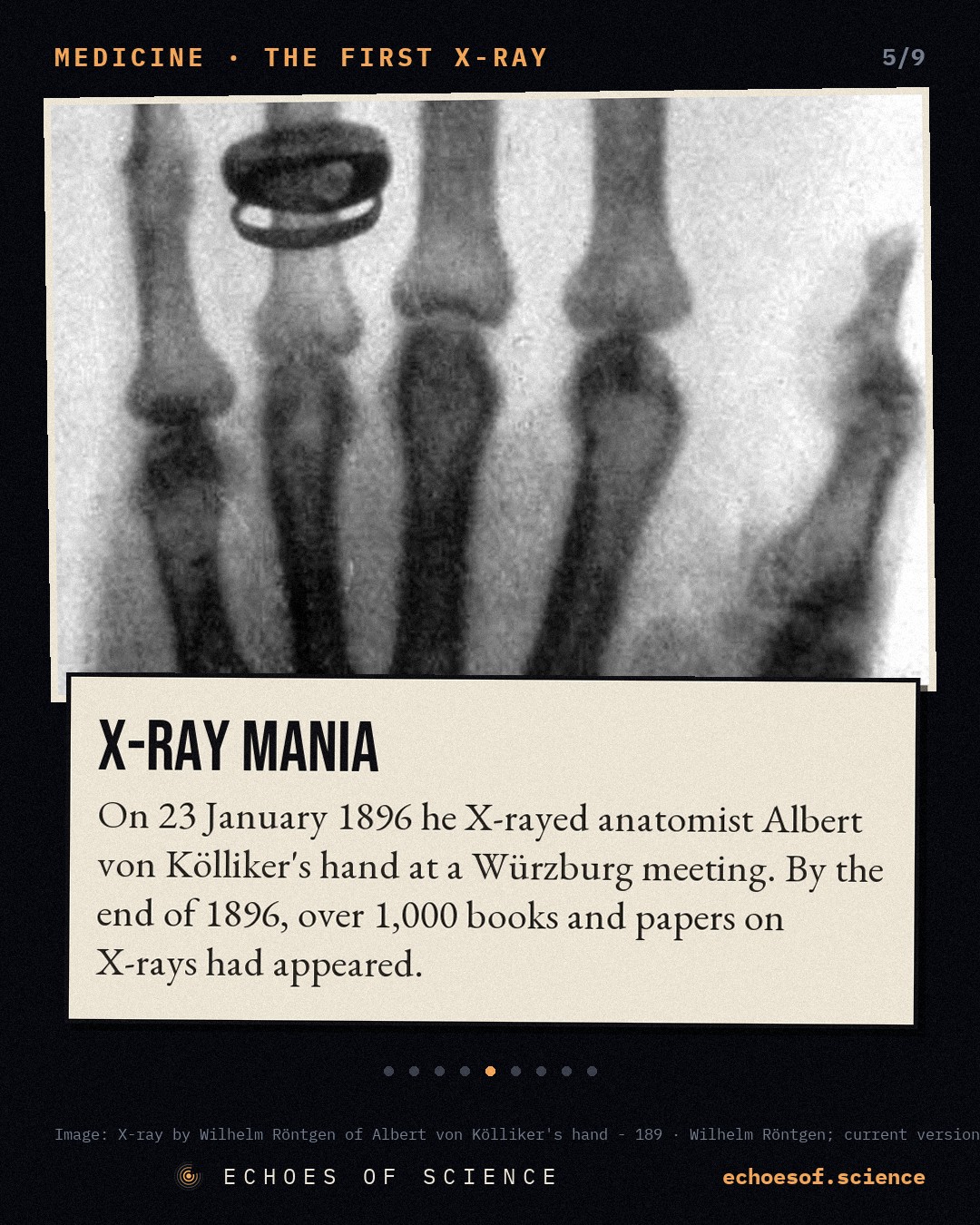
On 23 January Röntgen spoke at a meeting of the Würzburg society and X-rayed the hand of the elderly anatomist Albert von Kölliker in front of the audience. Kölliker suggested that the rays should be called Röntgen rays, a name still used in German today. On 3 February, as Dartmouth College recounts, the physician Gilman Frost and his brother Edwin, a physics professor, X-rayed the broken wrist of a local schoolboy, Eddie McCarthy: the first clinical X-ray in America. By the end of 1896, more than 1,000 books and papers had been published on X-rays and their uses.
How do we know?
The dates come from Röntgen's published paper, surviving letters and the newspapers and journals themselves, which can still be read. The original radiographs of Bertha's and Kölliker's hands survive and are in the public domain. The weakest link is the most quoted line, Bertha's "I have seen my death", which rests on later retelling. The exact details of the November evening also come from later accounts, which differ in small ways, for example in how far away the screen was and whether he worked for six or seven weeks before publishing.
The science: why bones cast shadows
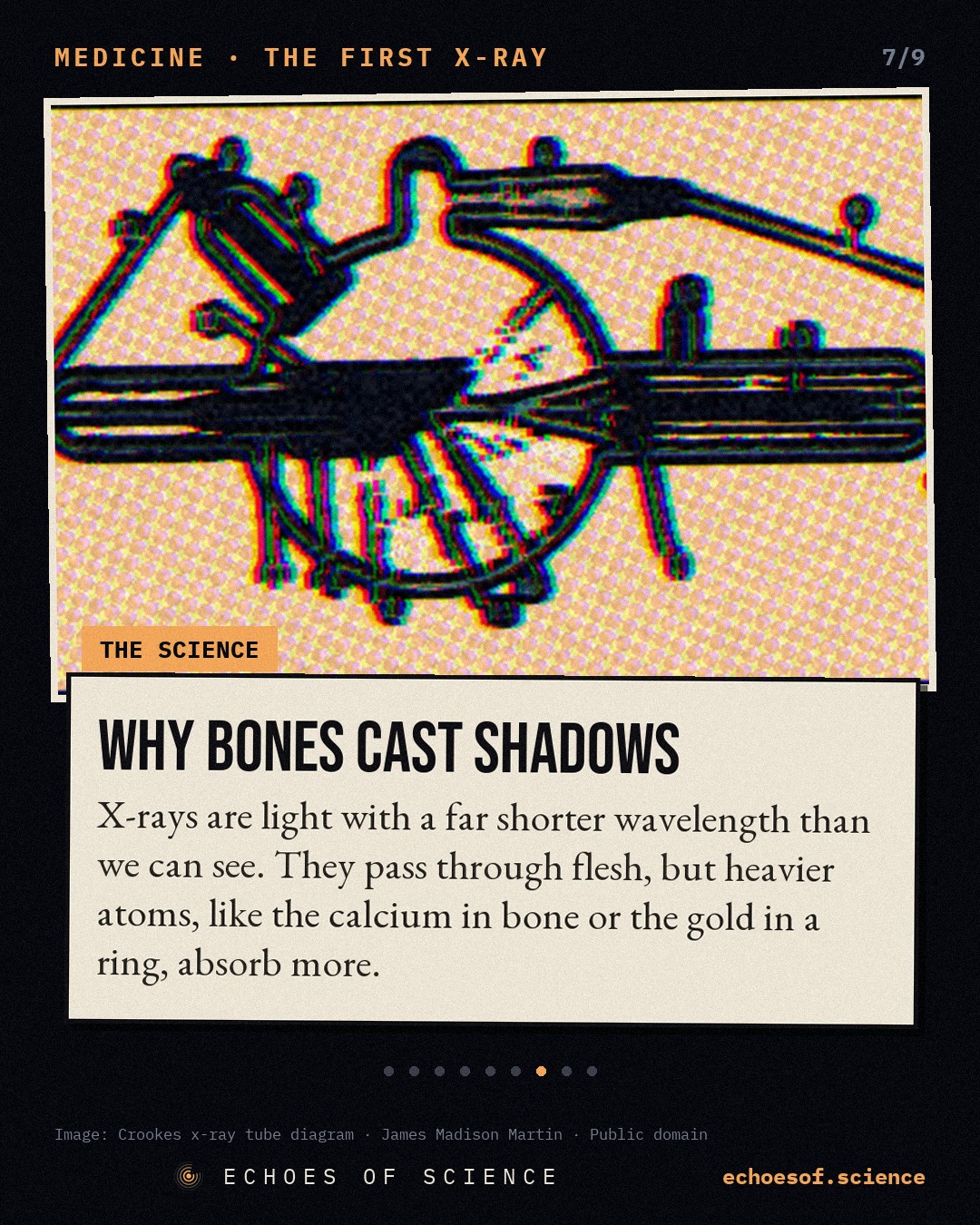
X-rays are electromagnetic waves, like visible light, but with a wavelength typically thousands of times shorter, so each photon carries far more energy. Most of them pass straight through the light atoms that make up soft tissue: hydrogen, carbon, oxygen. Heavier atoms, such as the calcium in bone or the gold in a ring, are much better at absorbing them. Behind the hand, the plate is darkened wherever X-rays get through and stays pale where bone and metal have soaked them up. The thicker and denser the material, the stronger the effect, a fall-off physicists call attenuation. Every hospital radiograph and every airport baggage scanner still works on that principle.
You can see a gentle version with visible light. Press a bright torch against your fingertips in a dark room and red light glows through the skin, dimmer where the finger is thicker.
Why it matters today
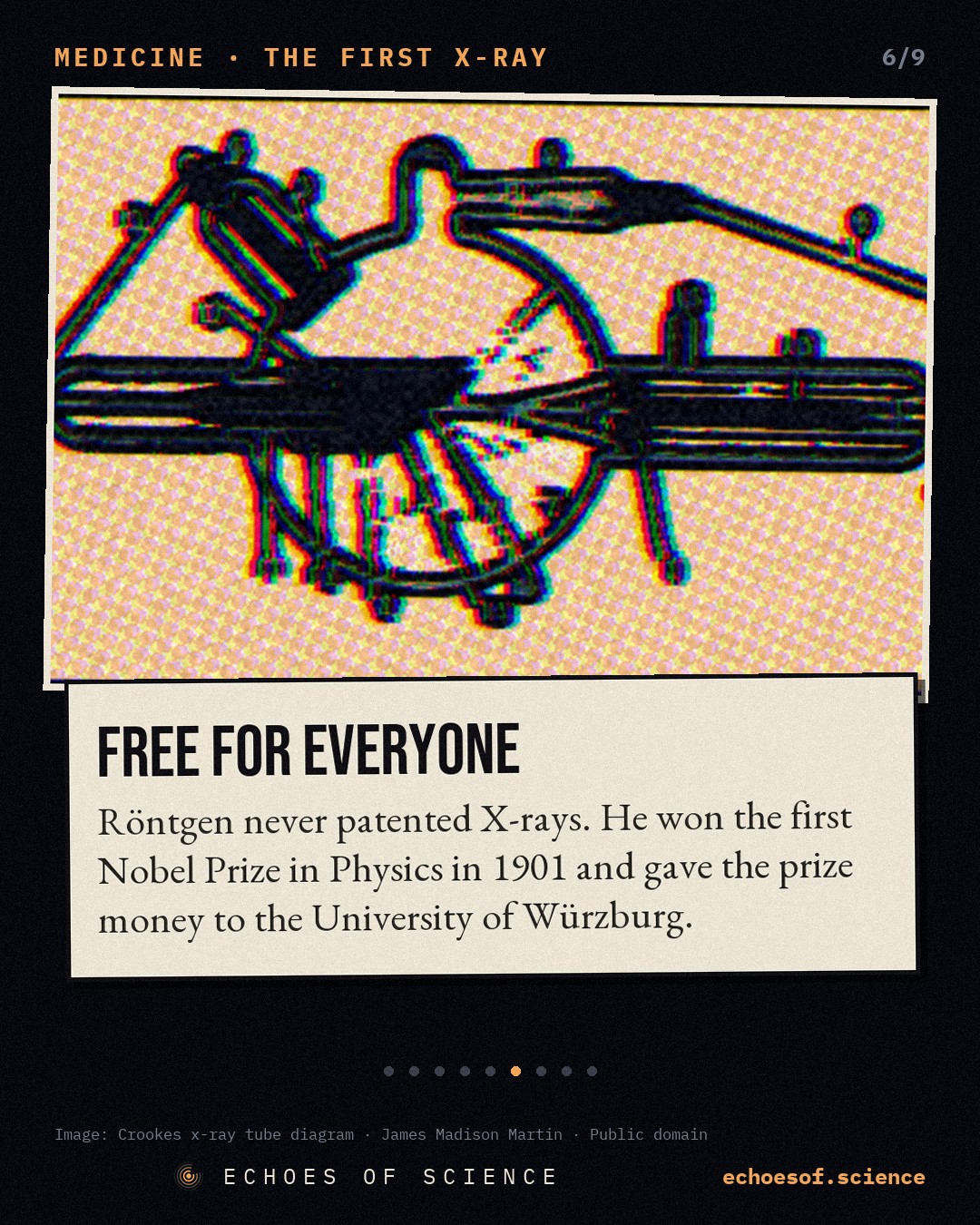
Röntgen never took out a patent. The University of Würzburg records that he did so to make the discovery available to everyone, and that he gave the 50,000 crowns of his 1901 Nobel Prize, the first ever awarded for physics, to the university. Because anyone could build an X-ray tube, the technique spread through medicine within months rather than decades. The speed came at a price: the early users did not yet know that the same rays could burn and damage living tissue, a lesson that led to the radiation safety rules used today. A single photograph of a hand, sent by post, had changed how medicine looks inside the body.
The science in this story
Key facts
- On the evening of 8 November 1895, Wilhelm Röntgen found that a paper screen coated with barium platinocyanide glowed beside a discharge tube sealed in thick black card, even 2 m away. source ↗
- On 22 December 1895 he X-rayed his wife Anna Bertha's hand, exposing it for about 15 minutes; the image shows her bones and wedding ring. source ↗
- She is widely reported to have said "I have seen my death"; the words are reported, not documented in a primary record. source ↗
- His paper 'Ueber eine neue Art von Strahlen' (On a New Kind of Rays) was presented on 28 December 1895. source ↗
- On 1 January 1896 he posted 90 envelopes, 12 of them with photographs; shown at a Vienna dinner on 4 January, they made the next day's front page of Die Presse, and leading German papers covered the story on 6 January. source ↗
- On 23 January 1896, at a Würzburg society meeting, he X-rayed the hand of anatomist Albert von Kölliker, who suggested calling them Röntgen rays. source ↗
- On 3 February 1896, Gilman and Edwin Frost at Dartmouth X-rayed schoolboy Eddie McCarthy's broken wrist, the first clinical X-ray in America. source ↗
- By the end of 1896, more than 1,000 books and papers had been published on X-rays and their applications. source ↗
- Röntgen did not patent the discovery, won the first Nobel Prize in Physics in 1901 and donated the prize of 50,000 crowns to the University of Würzburg. source ↗
In pictures
Loading the quiz…
Where every picture, clip and sound in this story comes from
Keep scrolling: more true stories ↓
New mini-documentaries every week and a true story every day. Pick where you like to watch:
▶ Subscribe on YouTube Telegram TikTok Instagram Bluesky Threads ✉ Weekly email
Everything here is free and stays free. If you would like to help us make more: 🪐 Shop: calendars, posters, mugs & books