The Telegraph That Ran on Aurora
Two telegraph operators unplugged their batteries and kept chatting for two hours, powered by the sky.
 The documentary is coming soon to YouTube · subscribe to get it
At 11:18 on the morning of 1 September 1859, an English astronomer named Richard Carrington was sketching sunspots. Suddenly, two patches of brilliant white light broke out on the face of the Sun.
I hastily ran to call some one to witness the exhibition with me.
When he came back, less than a minute later, the light was already fading. Across London, another astronomer, Richard Hodgson, had seen it too. Together, they had witnessed the first solar flare ever recorded.
The Flare
At almost the same moment, the magnetic needles at the Kew Observatory, near London, jumped. And on a telegraph line in Kent, a strong current suddenly appeared, out of nowhere.
About 17½ hours later, a cloud of magnetised gas from the Sun hit the Earth. It is one of the fastest arrivals ever recorded. Only the storm of 1972, which you can watch on this channel, is known to have been faster.
The Sky
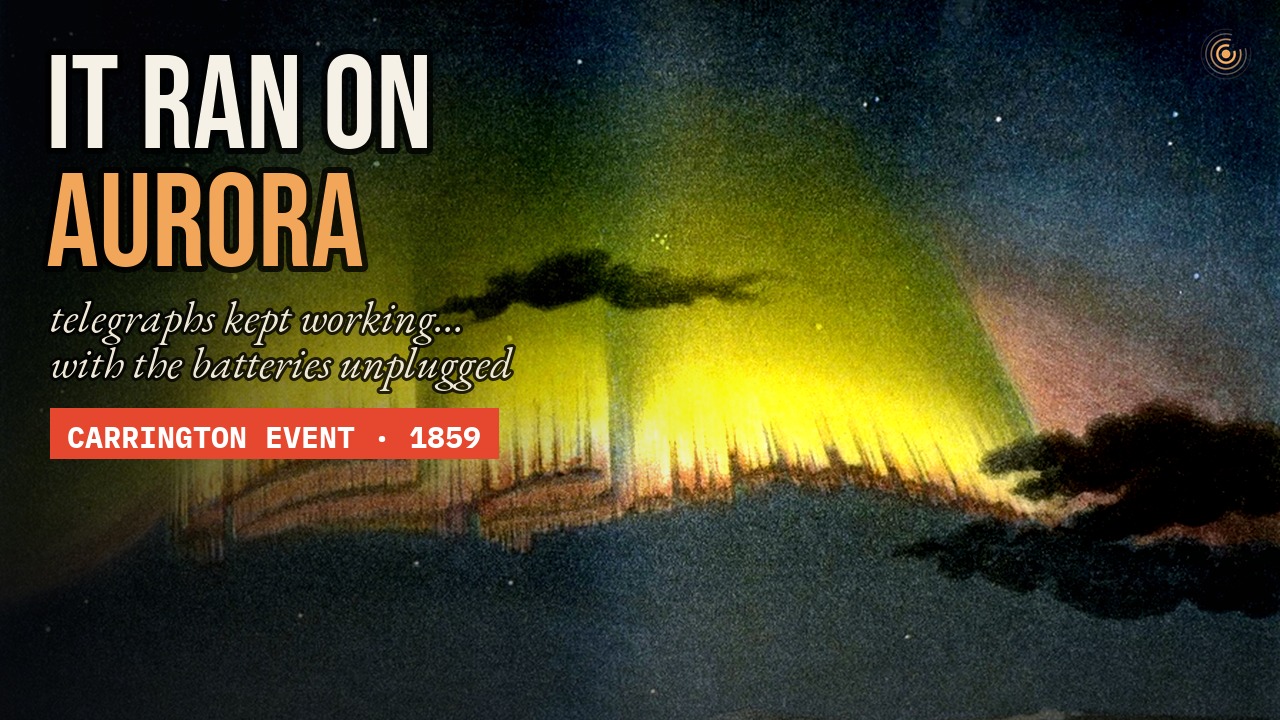
That night, auroras lit up the sky as far south as Cuba, Jamaica and Puerto Rico, and in the southern hemisphere, Chile. In the Rocky Mountains, it was bright enough to read print. One party camped outdoors woke up, and some of them started making breakfast, convinced it was morning.
The Wires
For the world's telegraphs, it was chaos. A smaller storm had already hit a few days earlier. In Washington, an operator named Frederick Royce took a shock that stunned him, and a witness saw a spark jump from his forehead to the instrument. During both storms, in some telegraph offices, paper and even wood caught fire.
But on the morning of 2 September, operators in Boston tried something remarkable. Boston called Portland, Maine:
Please cut off your battery, and let us see if we cannot work with the auroral current alone.
Portland disconnected its batteries. And the reply came back:
Better than with our batteries on. Current comes and goes gradually.
For about two hours, the line between Boston and Portland carried messages powered by nothing but the storm.
How?
How can the sky power a telegraph? When a storm shakes the Earth's magnetic field, the changing field drives electric currents through the ground. A long wire, earthed at both ends, like the telegraph lines of 1859, collects that current along its whole length. The longer the wire, the bigger the push.
Today we call these geomagnetically induced currents. And our wires are much, much longer.
Today
In 1989, a storm about two thirds as strong as Carrington's took down the whole power grid of Quebec in about 90 seconds. Six million people lost power for nine hours.
In 2013, the insurer Lloyd's estimated that a Carrington-sized storm today could leave 20 to 40 million people in the United States without power, for weeks or even longer, at a cost of up to $2.6 trillion. They put the odds at roughly once every 150 years.
Epilogue
In eighteen fifty-nine, two telegraph operators switched off their batteries, and let the Sun do the work. For two hours, a storm from space carried their messages.
Key facts
- Boston to Portland: "Please cut off your battery entirely for fifteen minutes", then they sent messages on auroral current alone. source ↗
- Gold miners in the Rockies woke and started breakfast, thinking it was morning. source ↗
- The aurora reached Cuba and Colombia, close to the equator. source ↗
Make your own induced current: move a magnet through a coil of wire connected to a cheap LED or a phone-app magnetometer.
Sources
- Carrington (1859), Monthly Notices of the RAS 20: 13
- Loomis (1860–61), American Journal of Science: the great auroral exhibition
- Prescott (1860), History, Theory and Practice of the Electric Telegraph
- Cliver & Svalgaard (2004), Solar Physics: the 1859 storm in context
- Boteler (2006), Advances in Space Research: the 1989 Québec blackout
- Lloyd's & AER (2013): Solar storm risk to the North American grid