Exponential growth
Growth by a fixed percentage each period, so a population keeps doubling in the same time and soon becomes enormous.
In exponential growth a quantity increases by the same proportion in each period, rather than by the same amount. A population growing by 10 per cent a year adds 10 animals when there are 100, and 1,000 when there are 10,000. The result is a steady doubling time: however big the number already is, it doubles again in the same interval.
A handy rule of thumb gives the doubling time: divide 70 by the percentage growth rate. Growth of 1 per cent a year doubles in about 70 years; 7 per cent, in about 10. The rule is accurate to within about 10 per cent for growth rates below 25 per cent.
Doubling is deceptive. Ten doublings multiply a number by about a thousand, and twenty by about a million. That is how 60 European starlings released in New York's Central Park in 1890 could become more than 200 million across North America, and how a handful of infections can become an epidemic. For a long time little seems to happen; then the numbers explode.
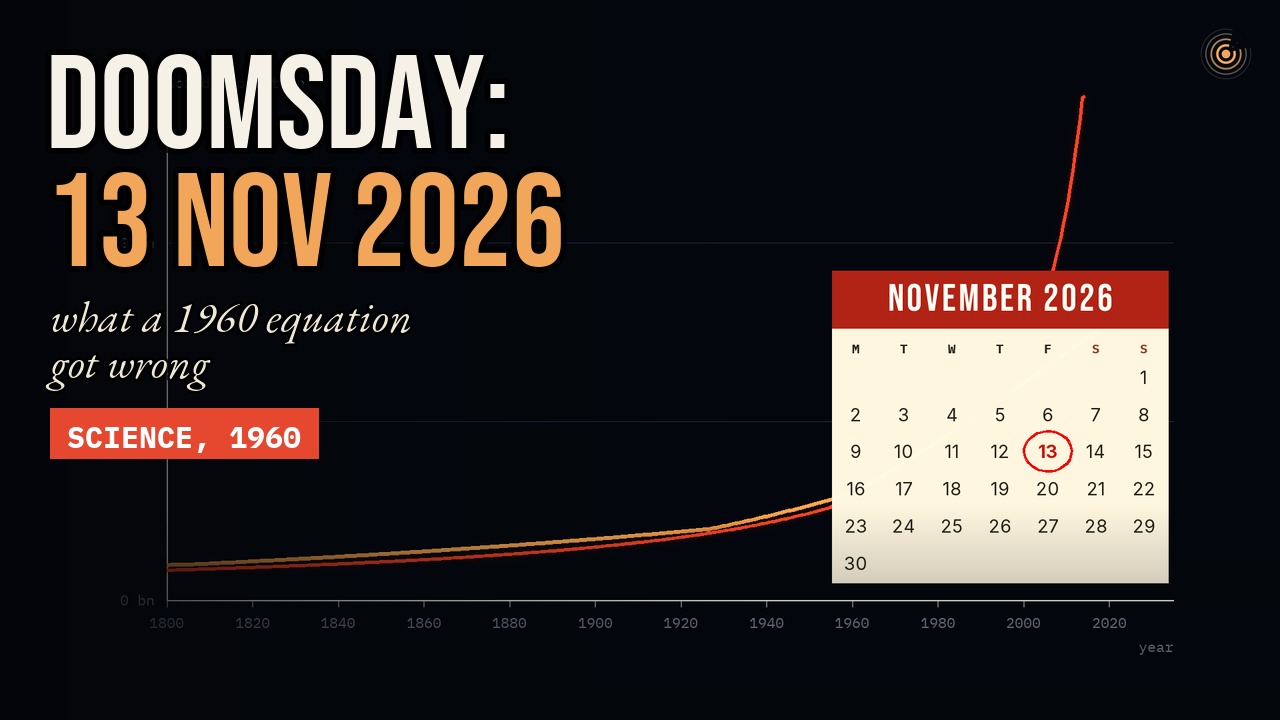
Nothing grows exponentially forever. Limits on food and space, predators, disease or immunity eventually slow the growth, and many populations then level off or crash.
A common misconception is that "exponential" simply means "very fast". It describes a pattern: growth in proportion to the current size. A slow percentage rate is still exponential, and still doubles, just over a longer time.
See it in action
Coming up in future stories
- 60 Birds in Central Park, 200 Million Starlings 1890 · New York City, USA
- The 376-Byte Worm That Lapped the Internet in Minutes 25 Jan 2003 · worldwide
- The Parade That Killed Philadelphia 1918 · Philadelphia and St. Louis, USA