Gravity assist
Steering a spacecraft close past a planet so the planet's gravity changes its speed and direction for free, instead of burning fuel.
A gravity assist (also called a swing-by or slingshot) uses a close pass of a planet to change a spacecraft's path around the Sun. Relative to the planet, the craft leaves as fast as it arrived; but because the planet itself is moving, the craft can come away faster or slower relative to the Sun, and pointed in a new direction. No fuel is needed for the change, only careful navigation.
Everyday picture: a ball thrown at a moving train bounces off faster if the train is coming towards it, slower if the train is moving away.
Going inwards, to Mercury, flybys are used to slow down: falling towards the Sun speeds a spacecraft up. BepiColombo used nine flybys (Earth once, Venus twice, Mercury six times) plus electric thrusters. The idea of using Venus to reach Mercury came from Giuseppe Colombo, for Mariner 10 in the 1970s.
A common misconception is that a gravity assist steals nothing from the planet. It does, but the planet is so heavy that the change is far too small to measure.
See it in action
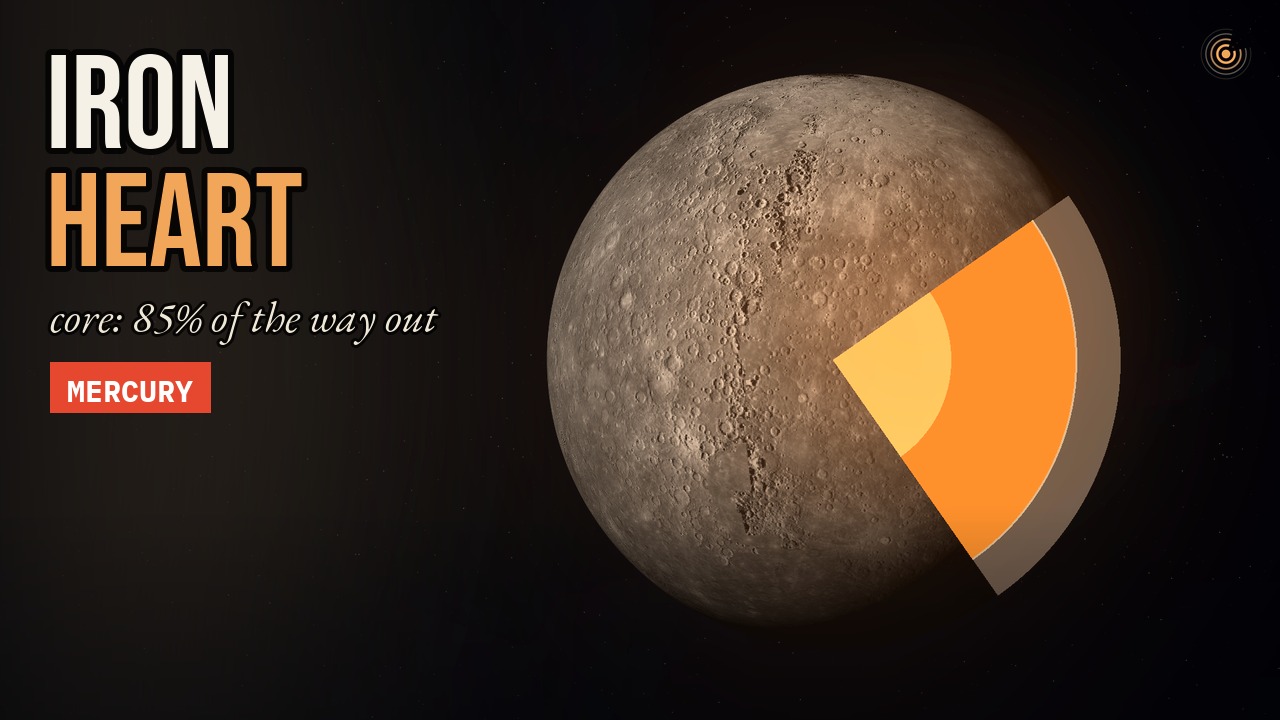 Watch nowMercury Is Mostly Metal. Nobody Knows Why4.6 billion years ago · 1965-2026 (Arecibo, Mariner 10, MESSENGER, BepiColombo)
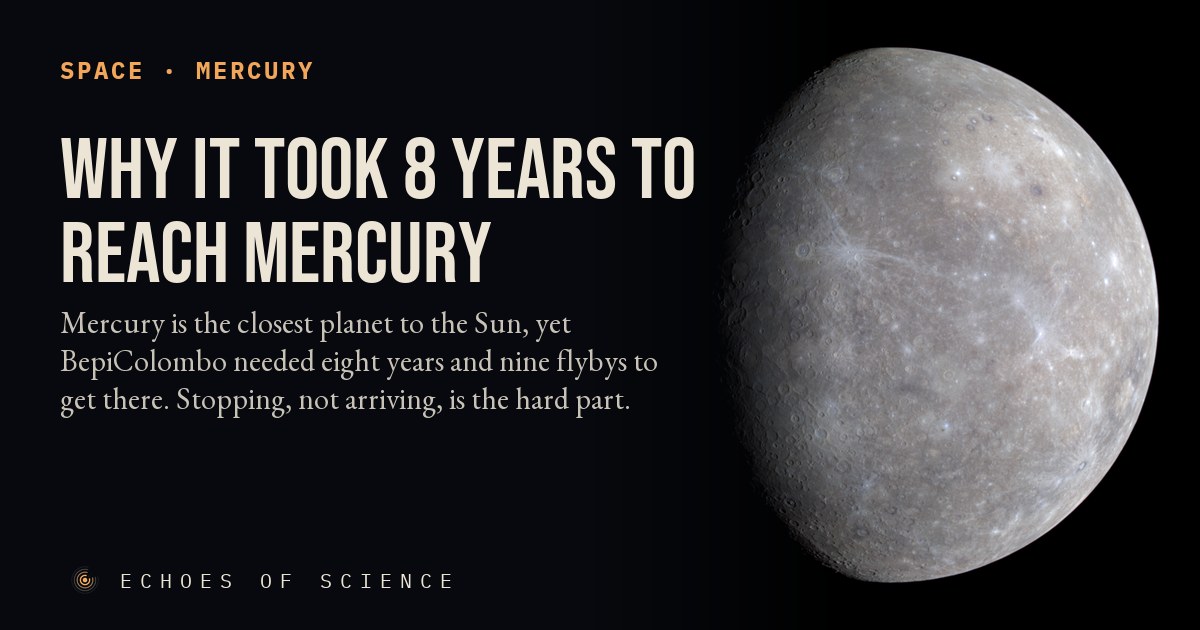 Coming soonWhy It Took 8 Years to Reach Mercury2018–2026 · BepiColombo (ESA/JAXA), launched 20 Oct 2018; capture at Mercury scheduled 21 Nov 2026
Coming up in future stories
- A Student's Side Project Flung Voyager to Neptune Summer 1961 · Jet Propulsion Laboratory, Pasadena