Why It Took 8 Years to Reach Mercury
Mercury is the closest planet to the Sun, yet BepiColombo needed eight years and nine flybys to get there. Stopping, not arriving, is the hard part.
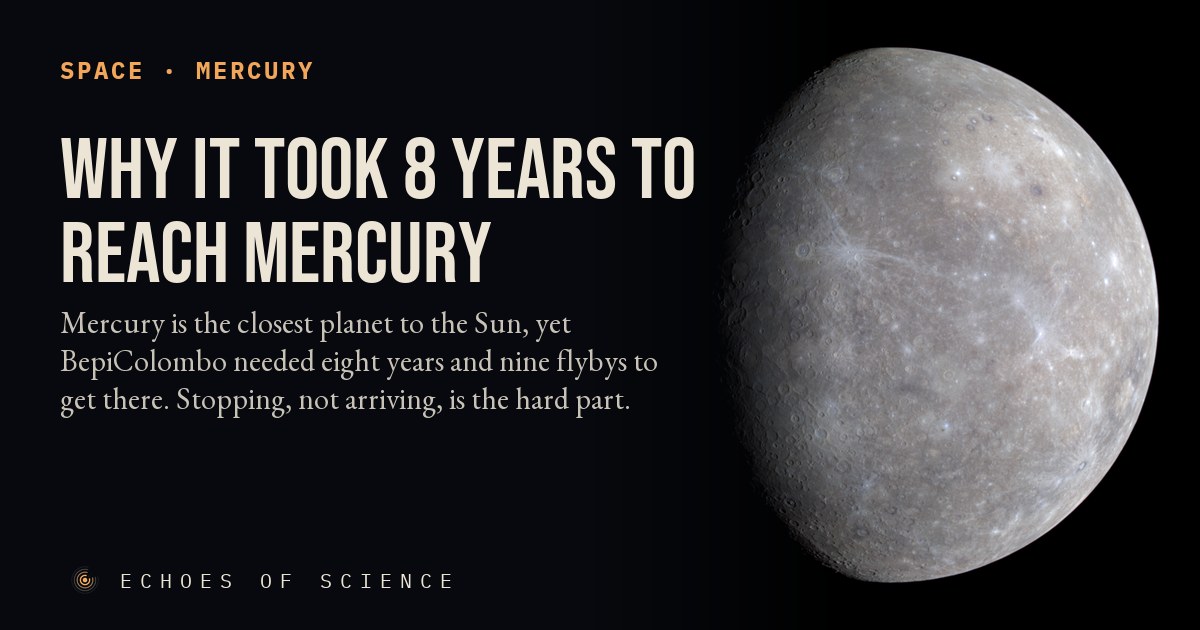
Of all the planets, Mercury is the one closest to the Sun, and on a map of the Solar System it looks like the easiest one to visit after Venus. Yet the European–Japanese spacecraft BepiColombo needed eight years to get there. It launched from Kourou in French Guiana in October 2018, swung past three planets nine times, covered roughly 9.9 billion kilometres, and was scheduled to be captured by Mercury's gravity on 21 November 2026. Why should the nearest planet to the Sun be one of the hardest places to reach?
Getting there is easy; stopping is not
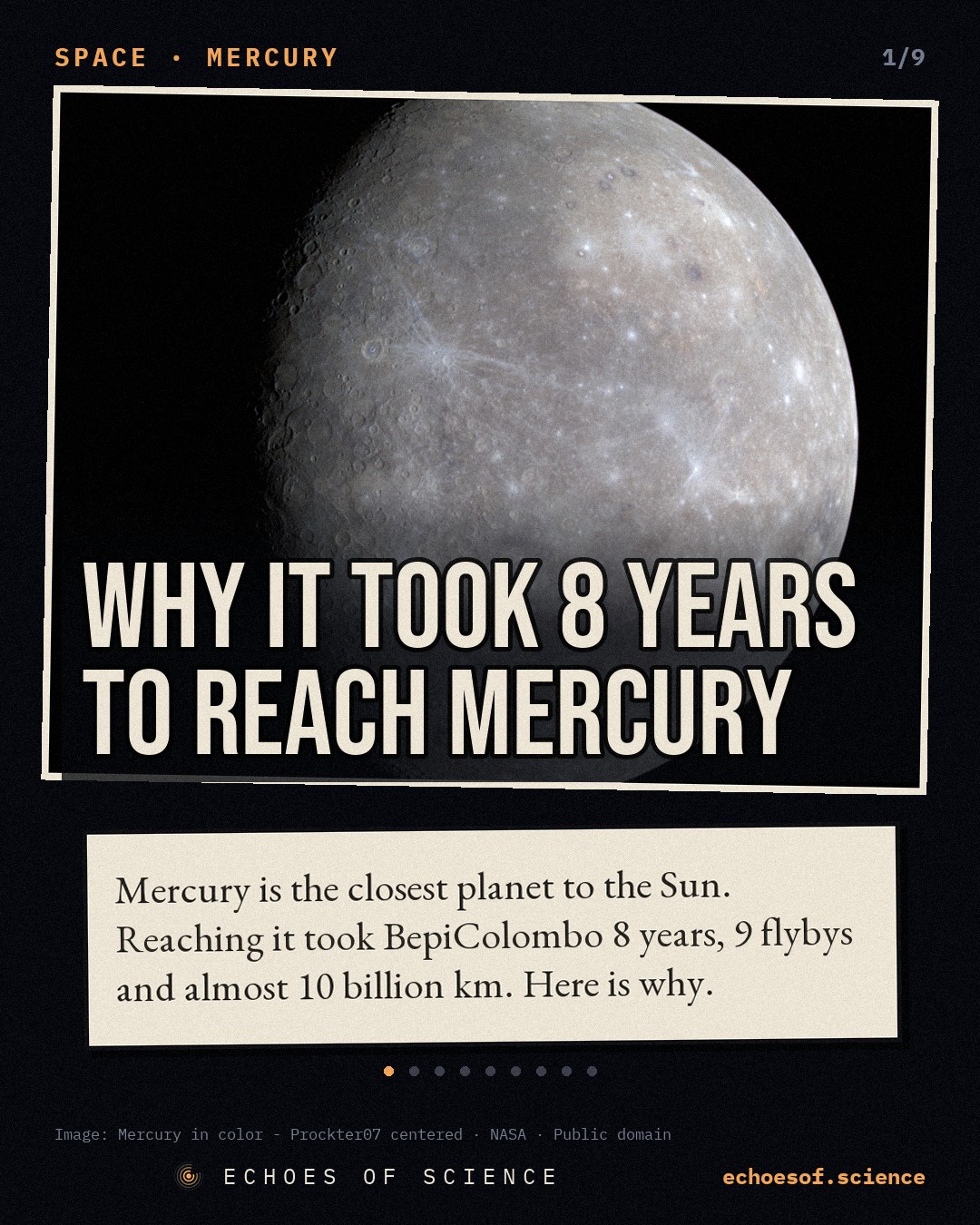
Reaching Mercury quickly has been done. NASA's Mariner 10, launched in November 1973, arrived in about 147 days and made three flybys of the planet in 1974 and 1975. But Mariner 10 never stopped: it simply shot past. Going into orbit is a different problem, because the spacecraft has to arrive at almost exactly the planet's own speed.
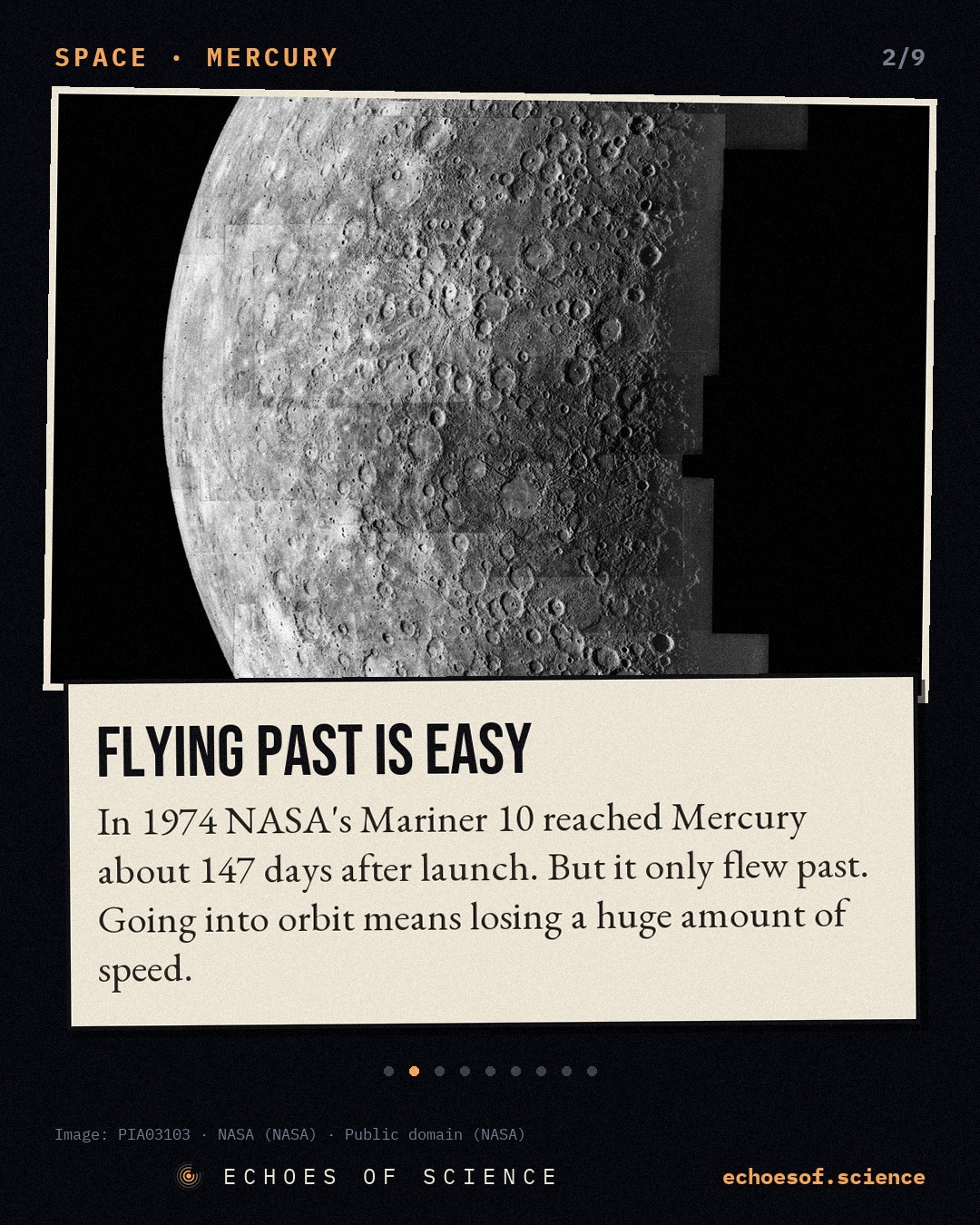
And Mercury is fast. According to NASA's planetary fact sheet, it moves around the Sun at an average of 47.36 kilometres per second, compared with 29.78 for Earth. A probe that leaves Earth and falls inwards does gain speed on the way, but it arrives on a stretched orbit, moving in a different direction and at a different speed from the planet. ESA likens the trip to a car driving downhill: the closer you get to the Sun, the faster you go, and the more you must brake to stay put.
Brakes borrowed from the planets
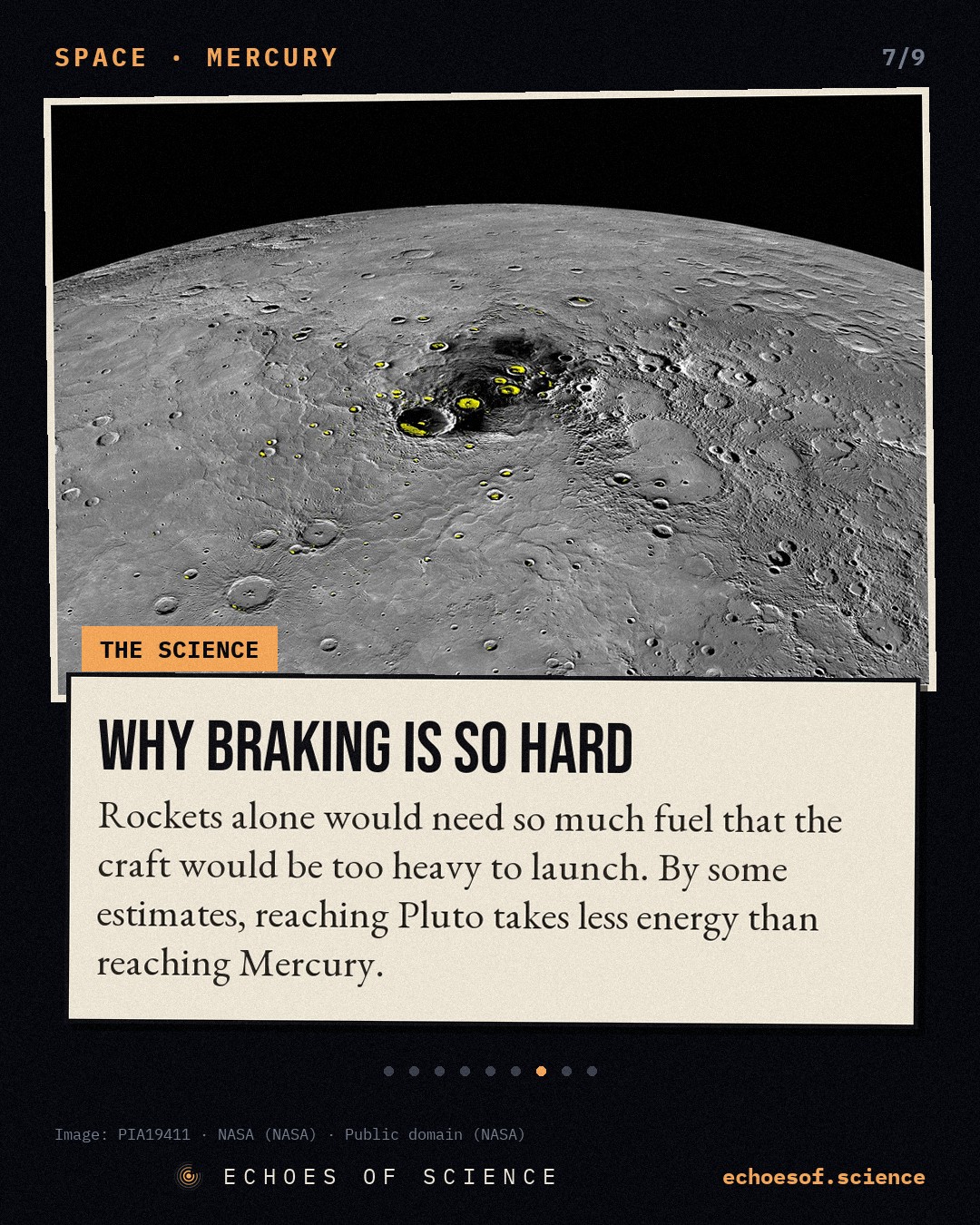
Braking with rocket engines alone is not an option. ESA says the fuel needed would make the spacecraft far too heavy to launch, even on the most powerful rocket. In fact, by some estimates it would take less energy to reach the dwarf planet Pluto than to reach Mercury.
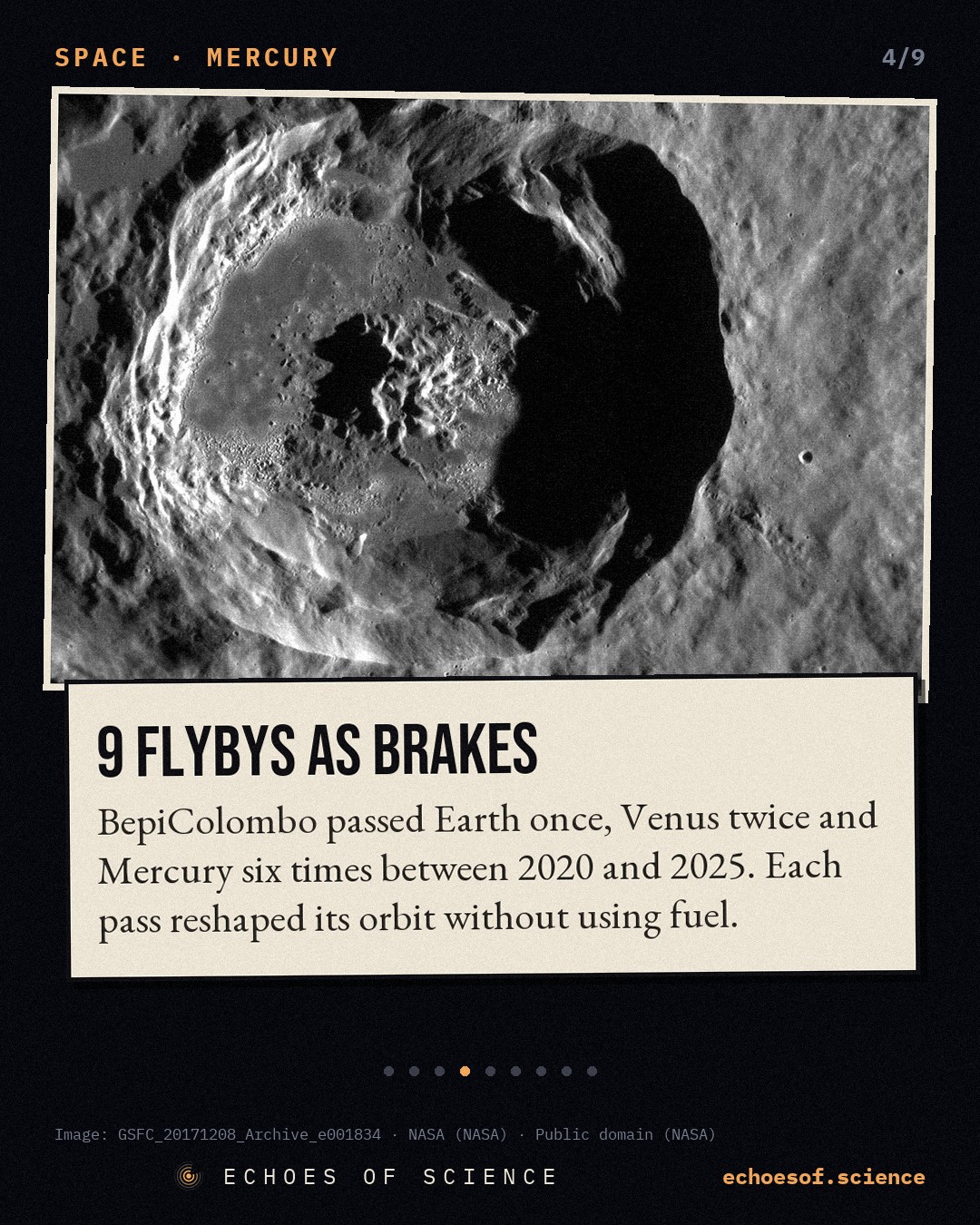
The solution is the gravity assist. As a spacecraft swings past a planet, it trades orbital energy with it: the planet's path is changed by an unmeasurably small amount, while the spacecraft's path around the Sun changes a lot. Pass a planet from the right direction and you lose speed relative to the Sun, without burning any fuel. BepiColombo did this nine times: once at Earth in April 2020, twice at Venus in 2020 and 2021, and six times at Mercury between October 2021 and January 2025. Each pass reshaped its orbit a little closer to Mercury's.
Between the flybys, four British-built T6 ion thrusters on the mission's transfer module did the fine work. They accelerate charged xenon atoms to very high speed and give a very gentle but continuous push: at full power, ESA engineers compared it to the weight of three 1-euro coins. A push that small, kept up for weeks and months, adds up to a large change in speed.
An eleven-month detour
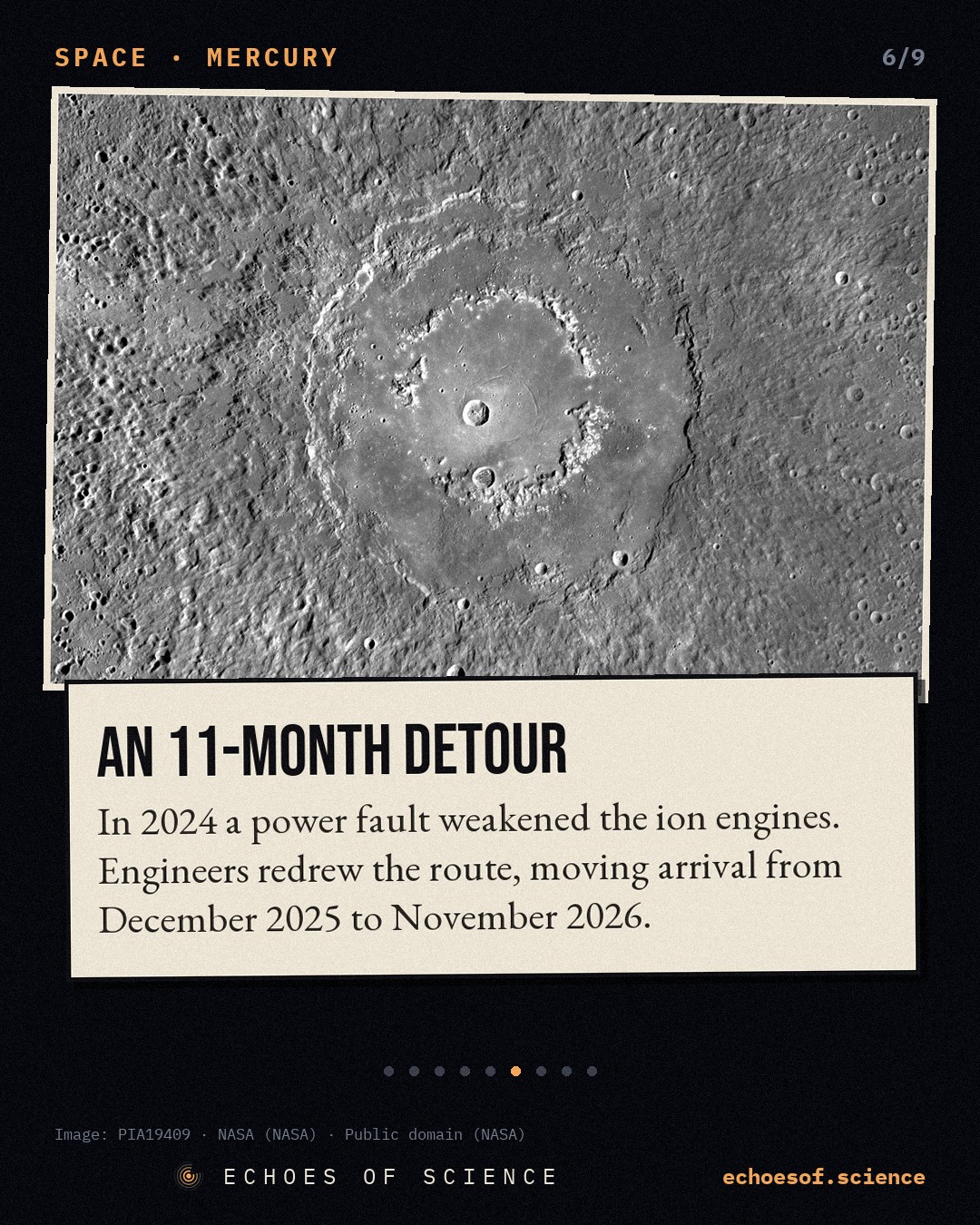
The plan did not survive untouched. In 2024, a problem reduced the power reaching the electric thrusters, so they could no longer push at full strength. Engineers designed a gentler route, and, as Space.com reported, the arrival moved from December 2025 to November 2026. The ion engines were switched off for the last time in June 2026, and on 3 September the transfer module separated, leaving the two science orbiters, ESA's Mercury Planetary Orbiter and JAXA's Mio, stacked together with a sunshield.
The final step is subtle. Rather than one huge braking burn, the stack arrives so slowly relative to Mercury that the planet's gravity can take hold, a technique ESA calls weak stability boundary capture, helped by burns of the orbiter's own chemical thrusters. ESA planned for the two spacecraft to separate on 9 December 2026, and for both to begin their science in April 2027.
How do we know?
The speeds come from orbital measurements gathered over centuries and summarised by NASA; the route and timings come from ESA's own mission updates. Some figures are estimates rather than measurements: the Pluto comparison depends on the trajectory chosen, and ESA presents it only as "some estimates". At the time of writing, the capture on 21 November had been scheduled but not yet confirmed by ESA, so this article describes it as planned.
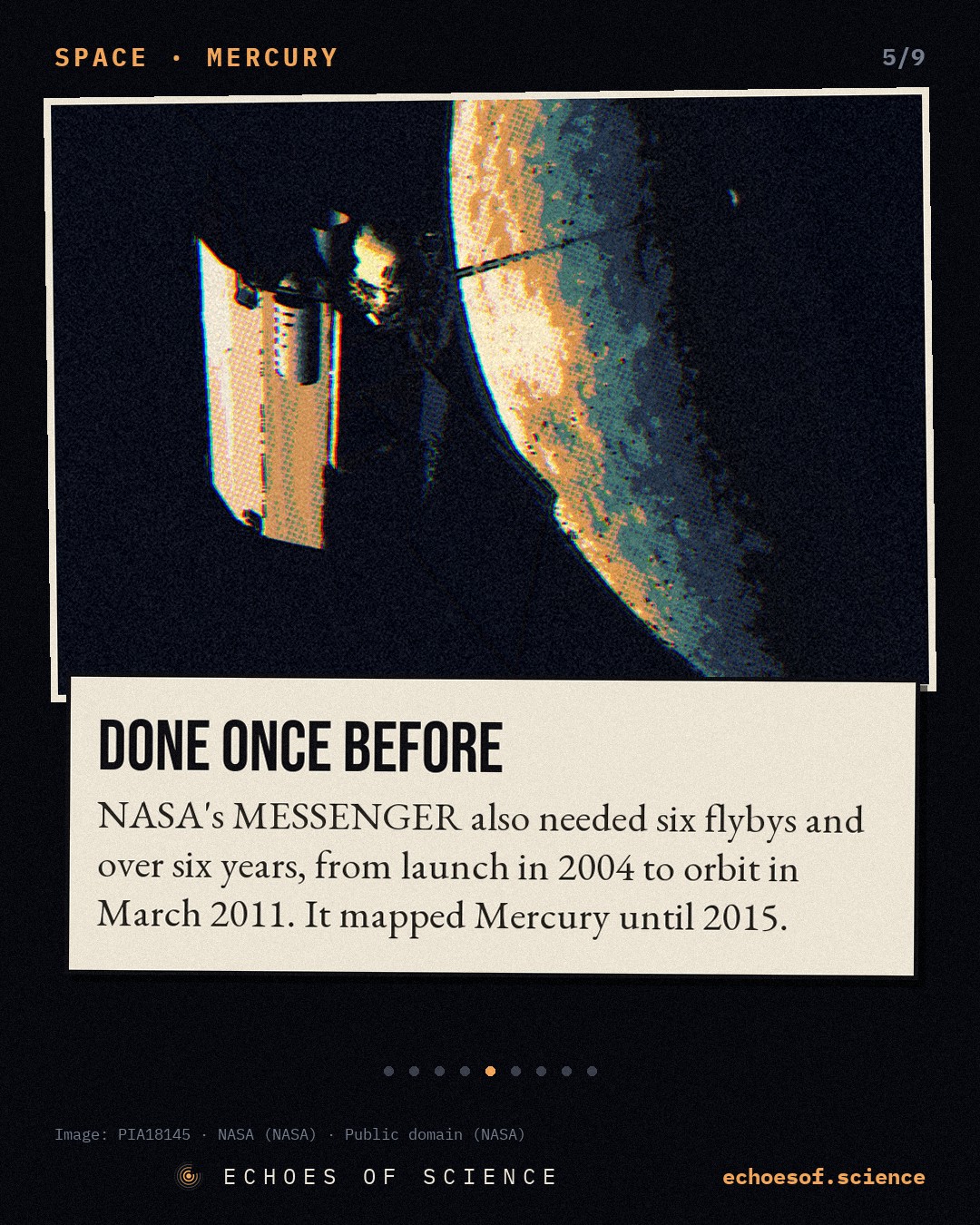
There is also a precedent. NASA's MESSENGER spacecraft, launched in August 2004, needed six flybys of Earth, Venus and Mercury before it entered orbit in March 2011. It studied the planet until it was steered into the surface in 2015.
Why it matters today
Mercury holds puzzles that only an orbiter can solve: an oversized iron core, a weak but lopsided magnetic field, ice in permanently shadowed polar craters, and strange bright hollows where something seems to be escaping from the rock. BepiColombo carries two spacecraft so it can study the planet and its magnetic surroundings at the same time. And its journey is a lesson in how spaceflight really works: in the Solar System, distance matters less than speed, and the shortest route is rarely the cheapest.
The science in this story
Key facts
- BepiColombo, a joint ESA–JAXA mission, launched on an Ariane 5 from Kourou, French Guiana, on 20 October 2018 (01:45 UTC). source ↗
- On the way it made nine planetary flybys: one of Earth, two of Venus and six of Mercury. source ↗
- By the time its transfer module separated on 3 September 2026, the spacecraft had travelled about 9.9 billion kilometres. source ↗
- ESA scheduled the capture of its two orbiters, MPO and Mio, by Mercury's gravity for 21 November 2026; science operations are planned from April 2027. source ↗
- Mercury's mean orbital speed is 47.36 km/s, against 29.78 km/s for Earth. source ↗
- ESA explains that a probe heading towards the Sun speeds up like a car driving downhill, and that braking with thrusters alone would make it too heavy to launch. source ↗
- According to some estimates quoted by ESA, it would take less energy to reach Pluto than to reach Mercury. source ↗
- At full power, BepiColombo's ion engines gave a push that ESA compared to the weight of three 1-euro coins. source ↗
- A 2024 problem that reduced the power available to the electric thrusters forced a lower-thrust route, delaying arrival from December 2025 to November 2026. source ↗
- Mariner 10 reached Mercury about 147 days after launch in 1974, but only flew past it. source ↗
In pictures
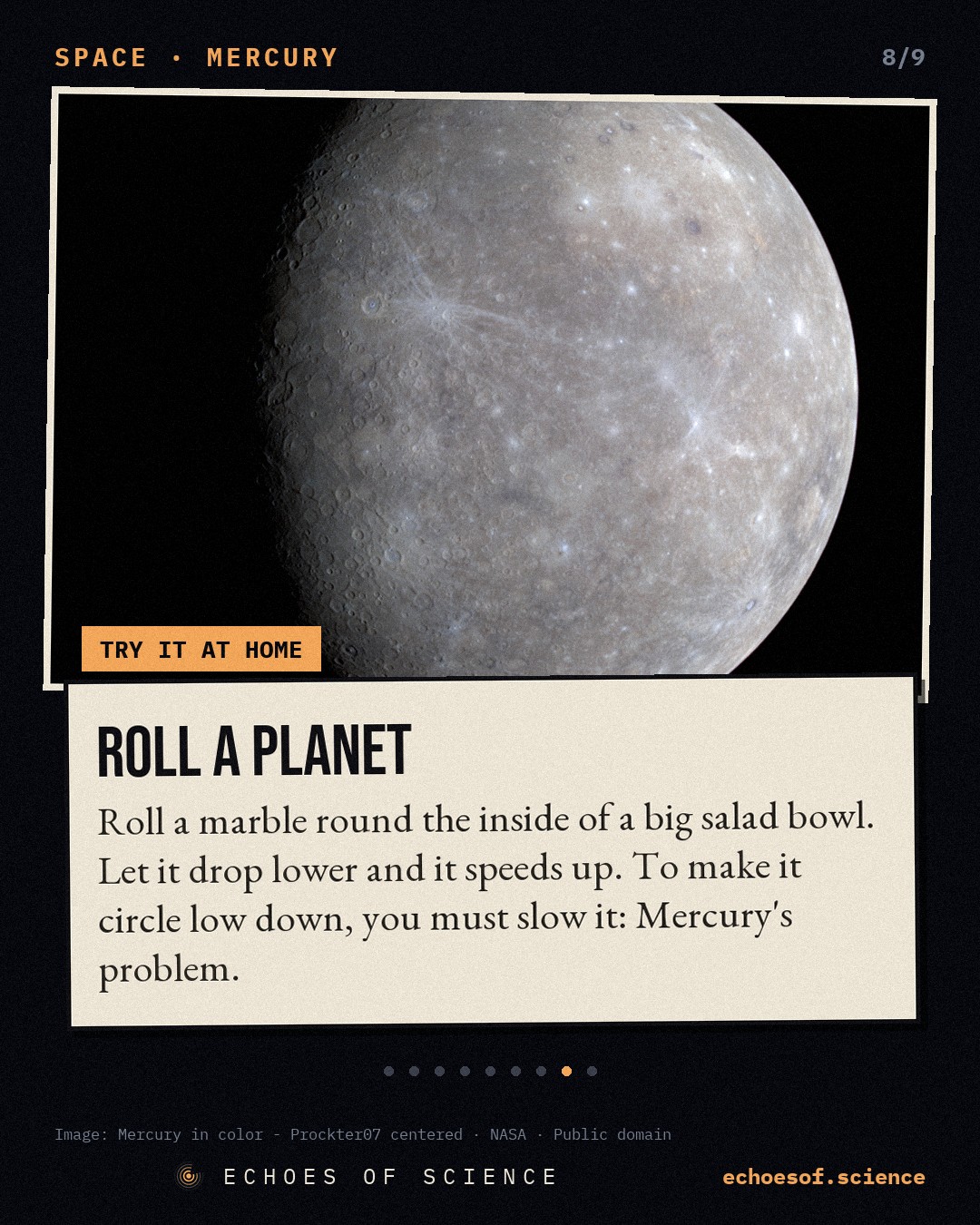

Roll a marble around the inside of a large salad bowl. Push it fast and it circles high up; let it lose speed and it drops lower and moves faster. To make it circle low down near the bottom, you have to take speed away, which is exactly BepiColombo's problem.
Loading the quiz…
Where every picture, clip and sound in this story comes from
Keep scrolling: more true stories ↓
New mini-documentaries every week and a true story every day. Pick where you like to watch:
▶ Subscribe on YouTube Telegram TikTok Instagram Bluesky Threads ✉ Weekly email
Everything here is free and stays free. If you would like to help us make more: 🪐 Shop: calendars, posters, mugs & books