Lightning and lightning conductors
A giant spark that discharges electric charge built up in storm clouds; a grounded metal rod gives it a safe path to earth.
Lightning is an enormous electric spark, static electricity on a grand scale. Inside a thundercloud, collisions between ice particles separate electric charge, so different parts of the cloud, and the ground below, end up oppositely charged. When the difference becomes large enough the air breaks down, and a channel of hot, glowing gas carries a huge current in a fraction of a second. The sudden heating makes the air expand explosively, and that is thunder.
In 1750 Benjamin Franklin proposed testing whether storm clouds are electrified by raising a tall metal conductor towards them. The first to do it was Thomas-François Dalibard, who had translated Franklin's work into French: on 10 May 1752 at Marly-la-Ville, his 40-foot metal rod drew sparks from a passing storm. A lightning conductor uses the idea for protection. A metal rod on top of a building, connected to the ground by a thick wire, gives a strike an easy path to earth instead of through the roof.
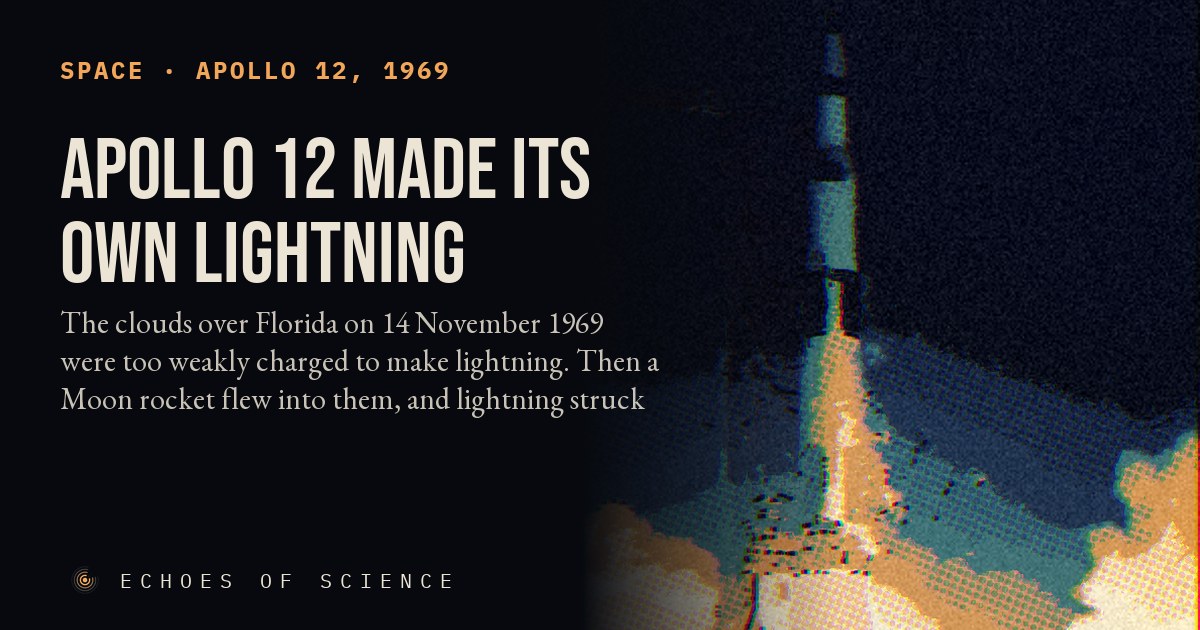
A tall conductor can also start lightning. On 14 November 1969 Apollo 12 was struck twice, 36.5 and 52 seconds after launch. The clouds were not charged enough to make natural lightning, but the rocket and its long, electrically conductive exhaust plume concentrated the electric field and set off triggered lightning.
Despite the saying, lightning can and often does strike the same place twice, especially tall buildings.
See it in action
Coming up in future stories
- The Frenchman Who Beat Franklin's Kite 1752–53 · Marly, France and St Petersburg, Russia