Apollo 12 Made Its Own Lightning
The clouds over Florida on 14 November 1969 were too weakly charged to make lightning. Then a Moon rocket flew into them, and lightning struck it twice.
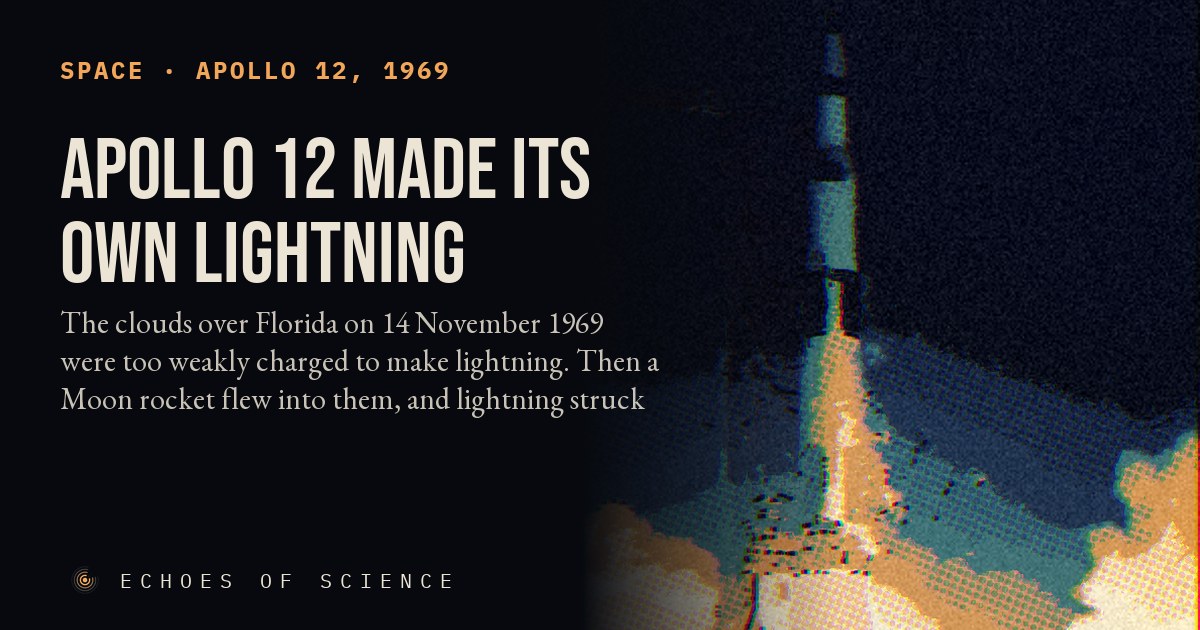
The clouds over Cape Kennedy on the morning of 14 November 1969 were grey and drizzly, but nobody had seen lightning in them. A cold front was drifting across central Florida, rain was falling at a few thousand feet, and President Richard Nixon had come to watch, the first sitting American president to see a crewed launch. At 11.22 am Apollo 12, the second mission to land people on the Moon, rose from Pad 39A into the overcast.
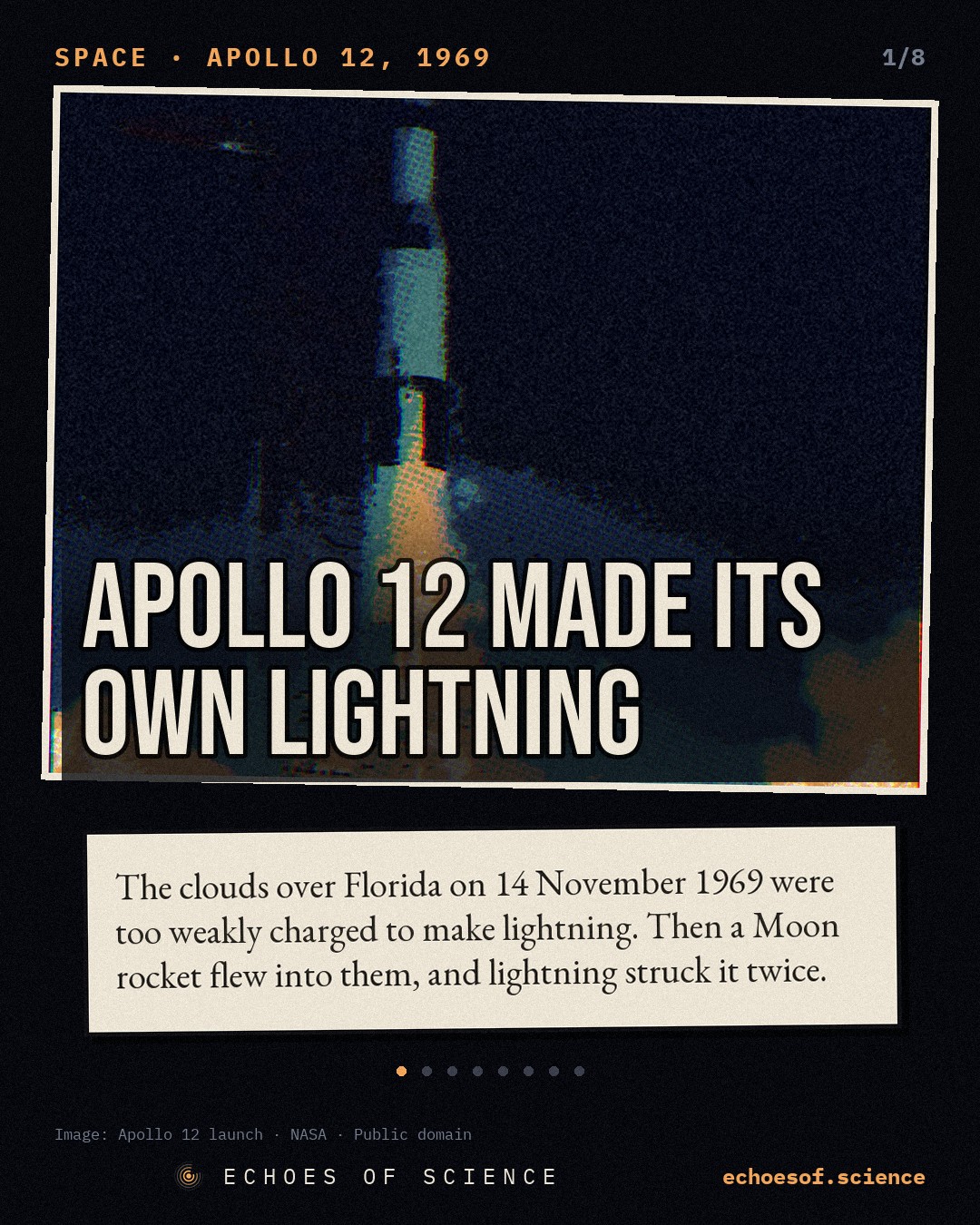
Thirty-six and a half seconds later the clouds produced the lightning they had seemed unable to make. A bolt ran through the 110-metre Saturn V and down its exhaust trail to the launch pad below. Sixteen seconds after that a second discharge flickered inside the cloud. Neither would have happened if the rocket had not been there.
"We had everything in the world drop out"
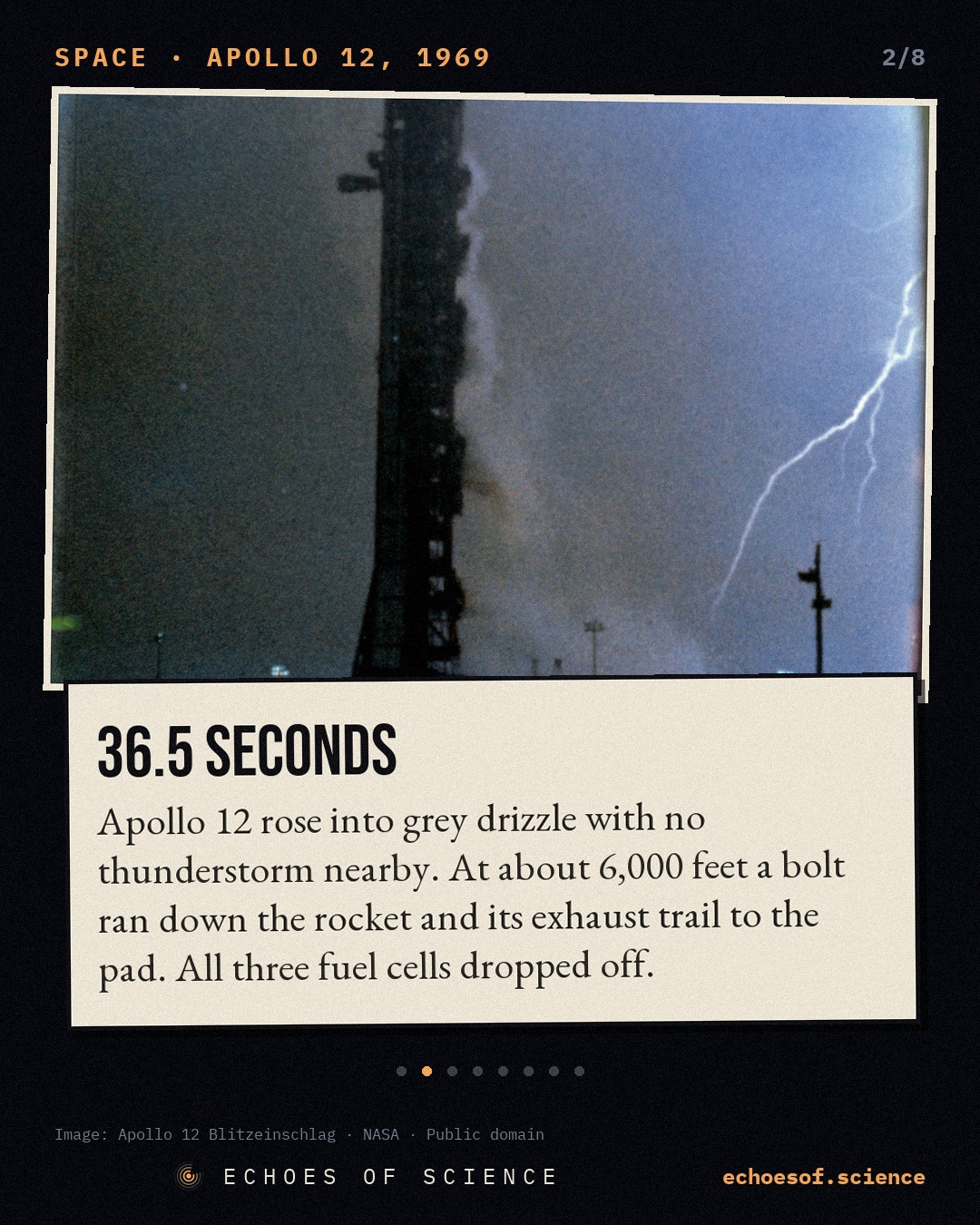
In the command module, the caution and warning panel lit up. All three fuel cells, the spacecraft's main source of electricity, had disconnected, and the capsule was running on its re-entry batteries. The second strike threw the navigation platform, the gyroscope-steadied reference the spacecraft uses to know which way it is pointing, into gimbal lock. "Okay, we just lost the platform, gang," commander Pete Conrad said, in words preserved in NASA's Apollo 12 Flight Journal. "I don't know what happened here; we had everything in the world drop out."
In Houston the telemetry, the stream of numbers describing the spacecraft's health, had turned to nonsense, and the flight director, Gerry Griffin, was weighing whether to abort. The rocket itself, though, was fine. The Saturn V was steered by its own instrument unit, separate from the spacecraft, and its computer simply rejected the spurious signals as unreasonable and kept flying.
Three words from the back room
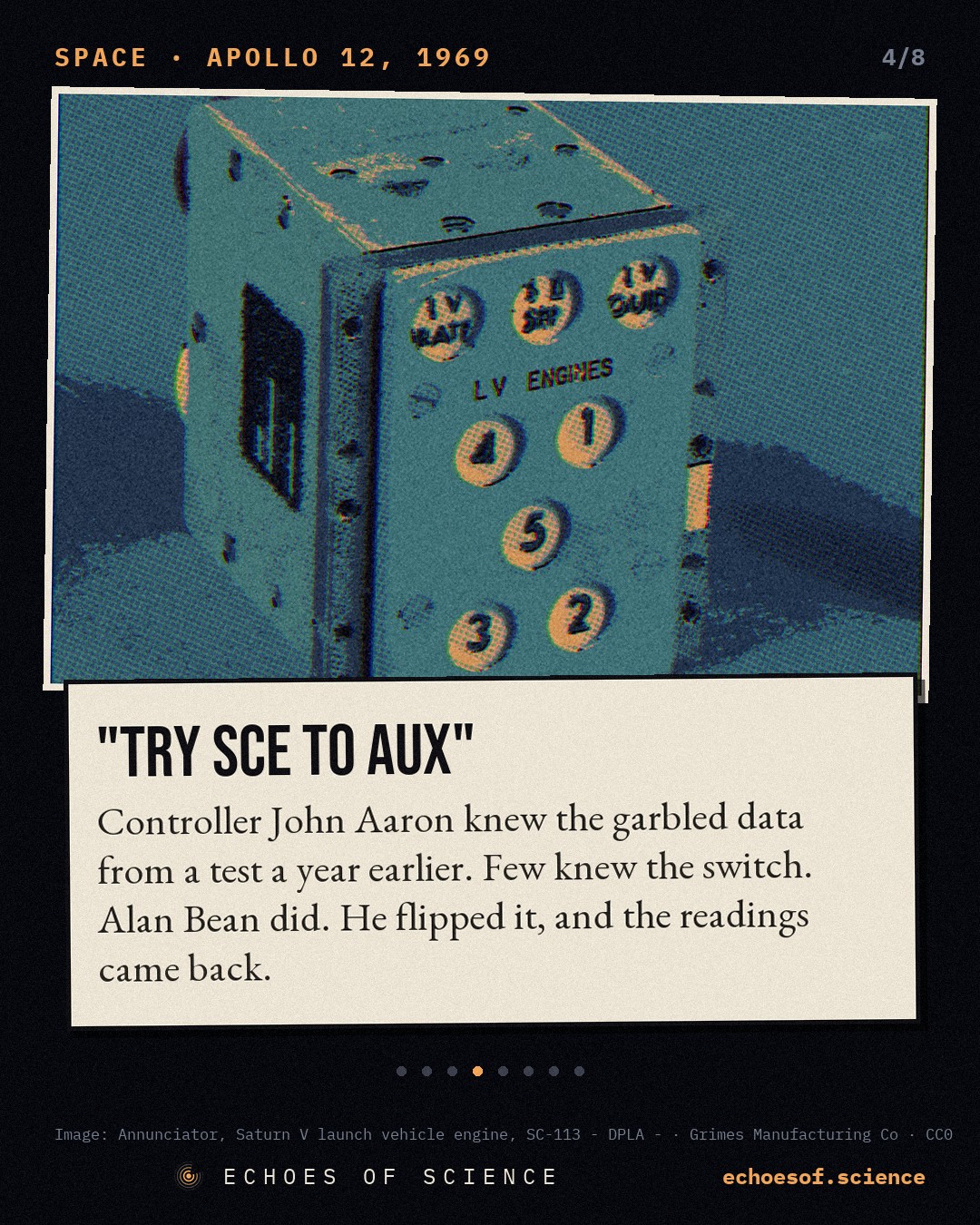
The man who untangled the electrical mess was John Aaron, the EECOM, the controller responsible for the spacecraft's electrical, environmental and communications systems. About a year earlier, watching a test at Kennedy Space Center, he had noticed a strange telemetry pattern and traced it, on his own initiative, to a little-known unit called the Signal Conditioning Equipment, which turns raw sensor readings into data that can be sent to the ground. A power dip could knock it into producing garbage. The pattern on his screen looked the same.
"Flight, EECOM. Try SCE to AUX," he said, asking for the unit to be switched to its auxiliary power supply. Hardly anyone knew the switch. The capsule communicator Gerald Carr passed it up; Conrad did not recognise it. The lunar module pilot, Alan Bean, did, and flipped it. The data snapped back. Bean then brought the fuel cells back on line, and once in orbit the crew realigned the navigation platform by sighting stars. Apollo 12 was cleared for the Moon, and Conrad and Bean landed on the Ocean of Storms on 19 November. Aaron's colleagues called him a "steely-eyed missile man", a phrase later borrowed by the film Apollo 13.
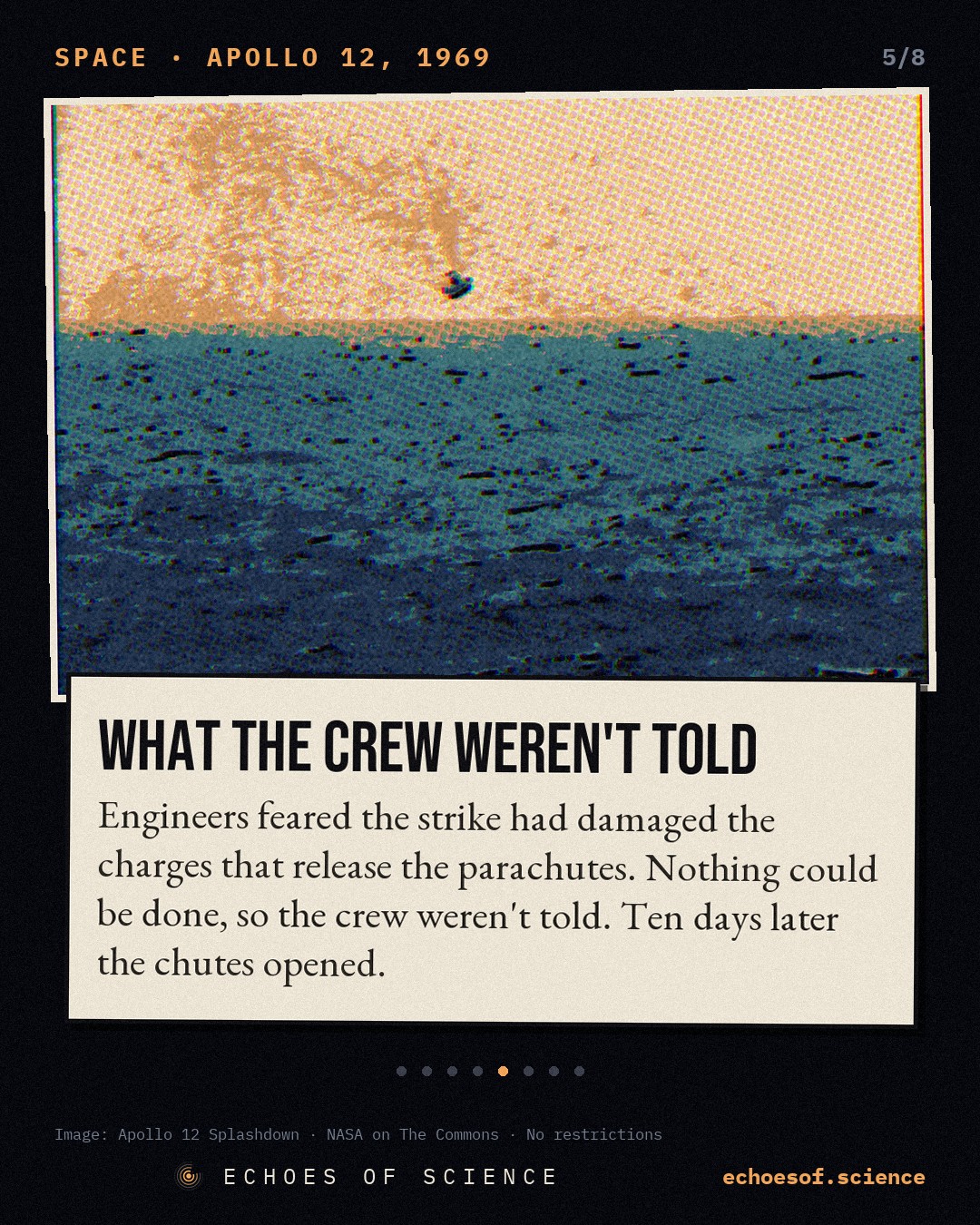
One worry was kept quiet. Engineers feared the strike might have damaged the explosive devices that open the command module's parachute compartment. Without parachutes the capsule would have hit the sea far too fast to survive. Because there was nothing the crew could do about it, and an early return would need the same parachutes, mission officials decided not to tell them. Ten days later the parachutes opened normally.
How do we know what happened?
The evidence comes from the onboard recordings and telemetry, a NASA photograph (S69-60068) of a bolt striking near the pad, electric-field meters around the Cape that had shown disturbed conditions, and an investigation that reported early in 1970. Experts at a December 1969 meeting of the American Geophysical Union broadly agreed that the vehicle had triggered the discharges, according to NASA's history of the launch centre, Moonport. Some details are less certain: accounts differ on exactly where the first bolt attached, and estimates of its energy span several orders of magnitude. Fifty years on, the physicists Philip Krider and James Dye revisited the case and described the launch as flying into "a weakly electrified environment", as Live Science reported.
The science: a flying lightning rod
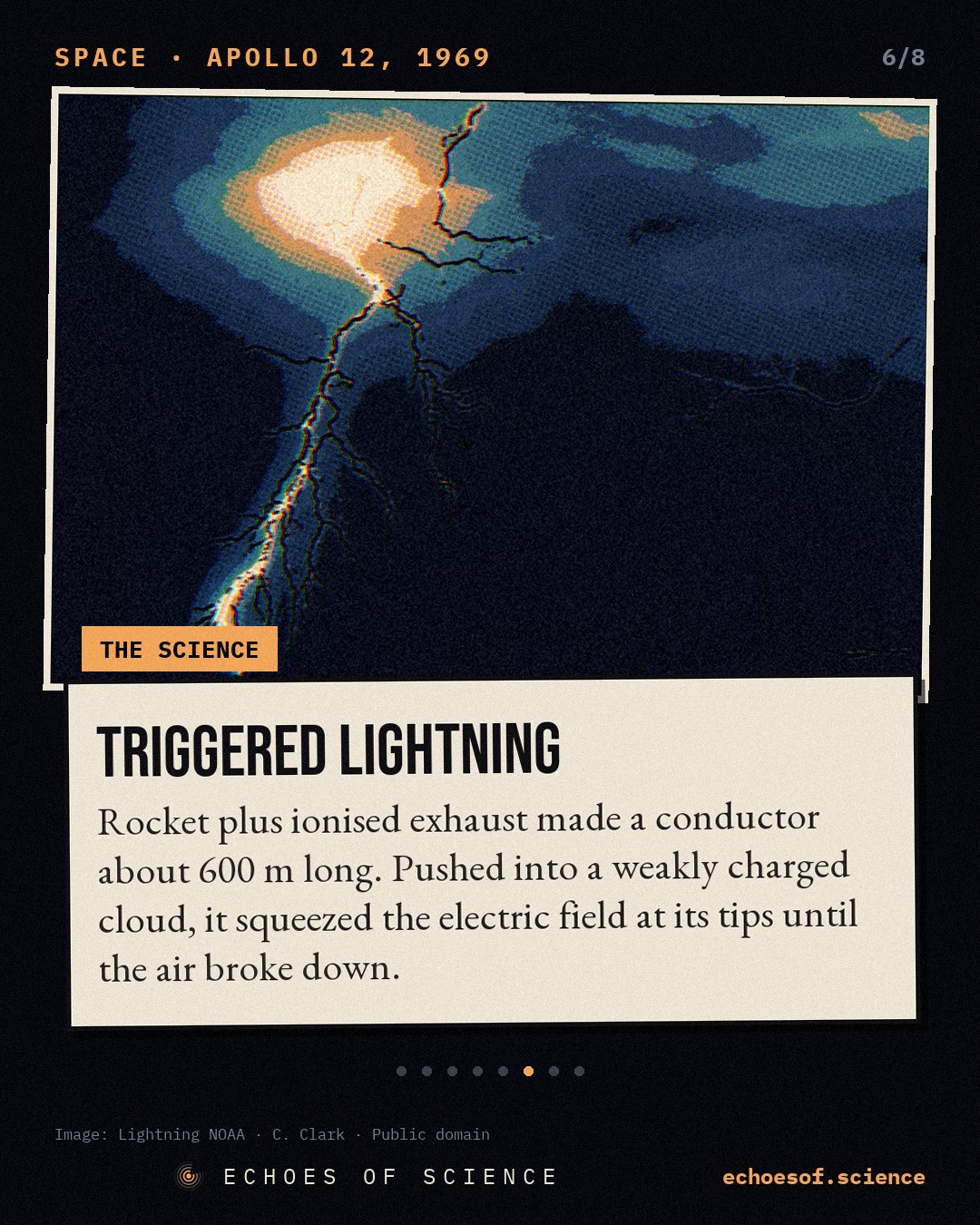
Lightning needs the air to break down, and air is a good insulator: it takes an electric field of about three million volts per metre to make dry air spark at sea level. A storm cloud separates charge and builds a strong field, but the Apollo 12 clouds were only weakly charged, not enough to spark by themselves.
A long conductor changes that. Metal, and a hot, ionised exhaust plume, let charge move freely, so the charge gathers at the conductor's tips, and the field there is squeezed far above its value in the open air. The Saturn V and its exhaust trail, together about 600 metres long, made such a conductor. Pushed up into the charged cloud, it concentrated the field at its ends until the air broke down. This is triggered lightning, the same effect researchers use when they fire small rockets trailing thin wires into thunderclouds to start strikes on purpose.
Why it matters today
Before Apollo 12, NASA's rules treated lightning as a danger only before launch, at the pad. Afterwards the agency added restrictions: Apollo 13 would not fly within 8 kilometres of a thunderstorm, through cold-front or squall-line clouds, or through cumulus clouds with tops above about 3,000 metres. Those rules grew into today's lightning launch commit criteria, which every launch from Florida must meet. The danger is real: on 26 March 1987 the Atlas-Centaur 67 rocket triggered lightning 49 seconds after launch and was lost with its Navy communications satellite, a NASA safety review records.
Apollo 12 is also a lesson in preparation: a controller who had chased a strange reading in a ground test, and an astronaut who knew where an obscure switch sat, turned a possible abort into a Moon landing. "Try SCE to AUX" still turns up on engineers' mugs and T-shirts.
The science in this story
Key facts
- Apollo 12 lifted off from Pad 39A at 11.22 am EST on 14 November 1969 into overcast, rainy weather, with no thunderstorms reported; President Nixon watched. source ↗
- Lightning struck the vehicle about 36.5 and 52 seconds after lift-off; the clouds were too weakly electrified to make natural lightning, and the ionised exhaust plume helped trigger the strikes. source ↗
- The first strike knocked all three fuel cells off line, leaving the spacecraft on batteries; the second tumbled the inertial platform into gimbal lock. The Saturn V's instrument unit rejected the spurious signals and flew normally. source ↗
- EECOM John Aaron recognised the garbled telemetry from a test about a year earlier and called 'Flight, EECOM. Try SCE to AUX'; Alan Bean knew the switch and flipped it, restoring the data. source ↗
- Engineers feared the strike had damaged the pyrotechnics that open the parachute compartment; the crew were not told, and the parachutes worked at splashdown. source ↗
- The 110 m vehicle and its 500 m ionised plume formed a good conductor; afterwards Apollo 13's rules barred launching within 8 km of a thunderstorm, through cold-front or squall-line clouds, or through cumulus with tops above 3,050 m. source ↗
- On 26 March 1987 Atlas-Centaur 67 triggered lightning about 49 seconds after launch and was lost with its Navy communications satellite. source ↗
In pictures
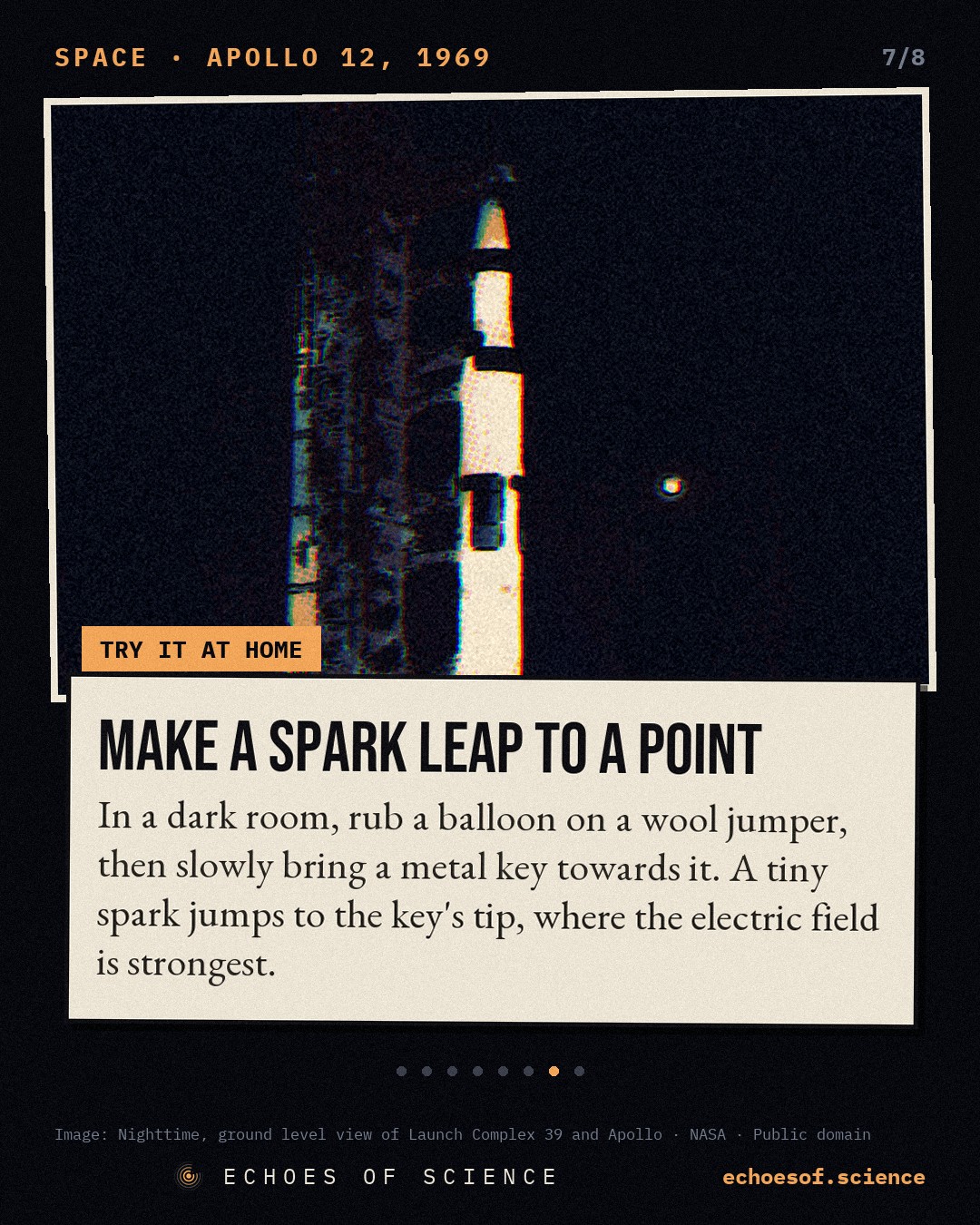
In a dark room, rub a balloon on a wool jumper and slowly bring a metal key towards it: a tiny spark jumps to the key's tip, where the electric field is strongest.
Loading the quiz…
Where every picture, clip and sound in this story comes from
Keep scrolling: more true stories ↓
New mini-documentaries every week and a true story every day. Pick where you like to watch:
▶ Subscribe on YouTube Telegram TikTok Instagram Bluesky Threads ✉ Weekly email