Salt dome
A huge plug of rock salt that has slowly flowed upwards through heavier rock, sometimes reaching close to the surface; many hold oil, gas or mines.
A salt dome starts as a layer of salt left behind when a shallow sea evaporates again and again. Buried under thousands of feet of mud and sand, the salt behaves strangely: over millions of years it creeps and flows like very slow putty, and it is lighter than the rock above it (rock salt is about 2.17 g/cm³, buried sediments are heavier). Where the weight on top is uneven, the salt is squeezed upwards in great columns that can be a mile or more across.
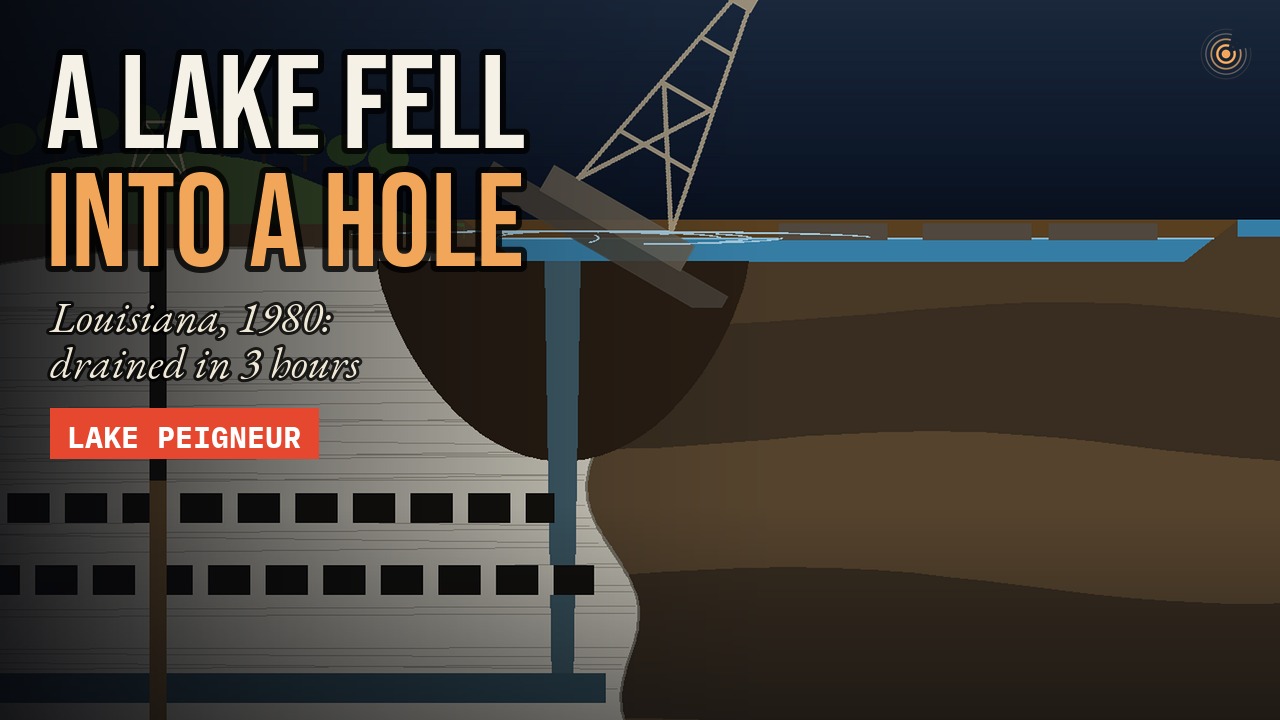
The Gulf Coast of the United States has more than 500 of them, most grown from the Jurassic Louann Salt. As the salt pushes up, it bends the rock layers around it and traps oil and gas along its flanks: the famous Spindletop gusher of 1901 came from the edge of a dome. In southern Louisiana, five domes even make low hills in the marsh, the so-called Five Islands, including Jefferson Island above Lake Peigneur.
Rock salt is almost watertight, which is why domes are mined for salt and hollowed out to store oil, gas and hydrogen. A common misconception is that it is as strong as any rock: in contact with fresh water it simply dissolves, about 360 grams per litre.