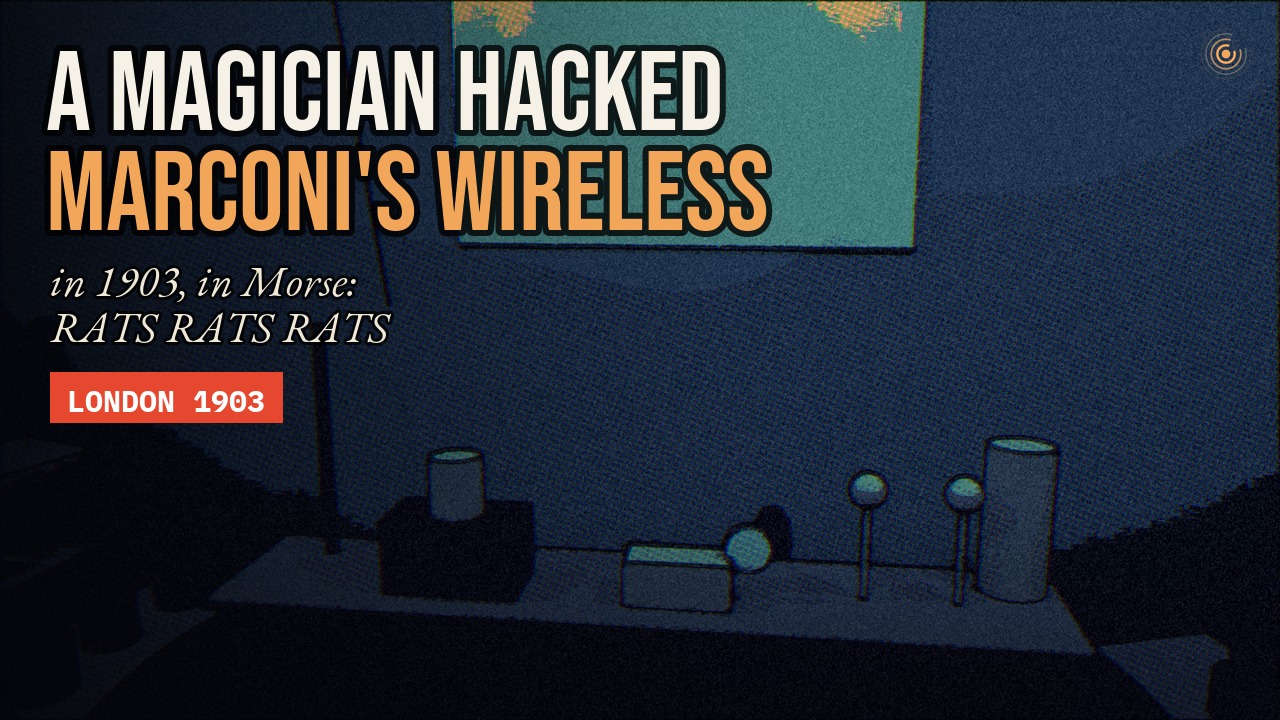
Spark-gap transmitter
The first kind of radio transmitter: a spark across a gap sets a circuit ringing, sending out bursts of radio waves that spread over a wide band of frequencies.
A spark-gap transmitter charges a capacitor until the voltage is high enough to jump a small gap as a spark. The spark lets the circuit ring like a struck bell, hundreds of thousands to millions of times a second, and the aerial radiates that ringing as radio waves. Pressing a Morse key starts and stops the sparks, making dots and dashes.
Because each spark rings for only a moment and dies away, its waves are not one pure frequency. A sound that stops quickly is never a clean tone, and a radio burst that decays quickly spreads its energy over a wide band. Measurements of early ship transmitters showed broad humps instead of sharp peaks.
That made sparks noisy neighbours: several stations working at once smeared into each other. From the 1910s they were gradually replaced by transmitters that send continuous waves on a narrow channel.
A common misconception is that early radio sent speech. Spark sets could only send on and off bursts, so they carried Morse code, not voices.