The Magician Who Hacked Marconi's Wireless
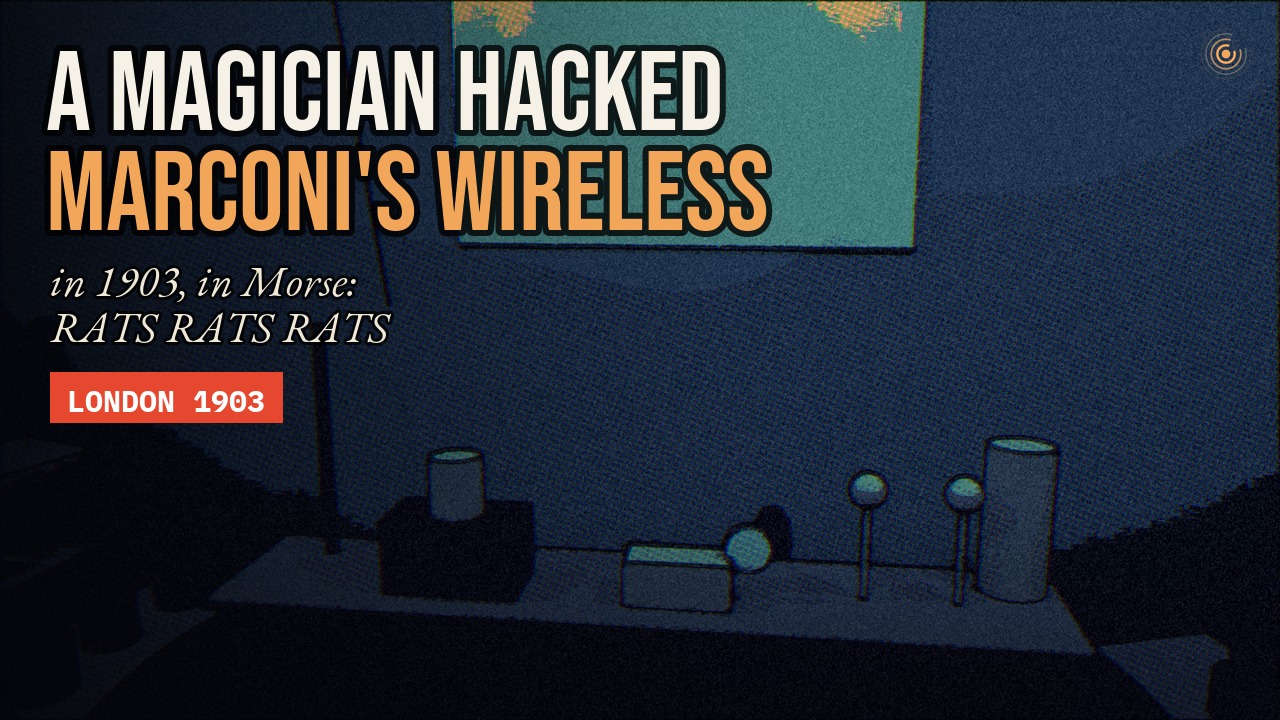
In June 1903, as Marconi's company set out to prove wireless was private, the receiver at London's Royal Institution began tapping one word in Morse: 'Rats'. The hacker was a stage magician, and his trick was the inverse-square law.
 Premieres on YouTube Sunday 22 November, 17:00 UTC · subscribe to get it
London, June 1903. The lecture theatre of the Royal Institution is full. On the table at the front stands one of the newest machines in the world: a wireless receiver. Nearly 400 km away, on a cliff in Cornwall, Guglielmo Marconi's station is getting ready to send a message through thin air.
The lecturer is John Ambrose Fleming, a professor who advises Marconi's company. Today he will show that a message can fly across the country with no wire at all. And Marconi has promised something else: that nobody else can listen in.
Then, before Cornwall has sent a single word, something strange happens. Fleming's assistant, Arthur Blok, notices the theatre's projection lantern flickering in a rhythm. Short, long, short. Short, long. It is Morse code. Someone is spelling a word.
R. A. T. S. Rats. And again. Rats. Rats. Rats.
Then a rhyme, mocking the great inventor by name. Someone had broken into Marconi's wireless, in front of an audience, and was laughing at it. Who was it? And how do you hack a message made of nothing but air?
The Invisible Wire
Seven years earlier, in February 1896, a 21-year-old arrived in Britain with a case of strange apparatus. Guglielmo Marconi was born in Bologna to an Italian father and an Irish mother, and that June he filed what has been called the world's first patent for wireless telegraphy.
His transmitter was a spark. When a powerful spark leaps across a gap, the electricity around it rings back and forth, hundreds of thousands of times a second. That ringing sends ripples out into space: radio waves. The German physicist Heinrich Hertz had first made and detected them less than 10 years before.
At the receiving end sat a coherer: a small glass tube of metal filings. When radio waves arrive, the filings cling together and let a current through. A tap shakes them loose again. A long burst makes a dash; a short one, a dot. Morse code, through the air.
By 1901, Marconi had built a huge station at Poldhu, on the Lizard peninsula in Cornwall. Fleming designed its heavy power plant. Then, in September, a storm flattened the station's ring of 20 masts. Marconi strung up a simpler aerial instead, and sailed for Newfoundland.
On 12 December 1901, at Signal Hill above St John's, with a wire held up by a kite, he listened through a telephone earpiece and heard faint clicks. Three dots: the letter S, sent from Cornwall, about 3,400 km away.
For one industry, this was alarming. The world's news and money moved through undersea telegraph cables, and many of them came ashore at Porthcurno, a small cove less than 30 km from Poldhu. The cable companies had spent decades laying copper across the ocean floor. Now a young man with a kite was talking across the Atlantic without one.
The Eastern Telegraph Company wanted to know exactly what Marconi's system could do, and what it could not. So it hired a magician.
The Magician's Son
Nevil Maskelyne was born in 1863 into the most famous family of magicians in Britain. From 1873, his father, John Nevil Maskelyne, ran the show at the Egyptian Hall on Piccadilly. It was known as England's Home of Mystery.
The Maskelynes were engineers as much as entertainers. The father had trained as a watchmaker. He built automata, patented a typewriter, and in 1892 invented a coin-operated lock for public toilets. It is often said to be why the British still talk about spending a penny. His son Nevil turned to the newest magic of all: electricity.
In 1899, newspapers as far away as New Zealand reported his experiments. By wireless signals alone, he set off a string of gun-cotton charges hanging beneath a balloon, and exploded a small powder magazine 400 yards away.
But wireless was quickly becoming Marconi's territory. His company held broad patents, and rival inventors found the doors closing. By several accounts, Maskelyne grew bitter.
Then came the cable company's offer. On the cliffs west of Porthcurno, Maskelyne put up a mast around 50 metres tall, and listened to the sea, where Marconi's stations were talking to ships. In November 1902, he wrote in the trade journal The Electrician:
I received Marconi messages with a 25-foot collecting circuit, raised on a scaffold pole.
A pole and a wire, and the messages were his to read. Marconi had said that should not be possible. He believed he had a lock on his messages. He called it tuning.
The Promise of Tuning
Think of a child on a swing. Push at random, and not much happens. Push in time with the swing's own rhythm, and every small push adds up. That is resonance. And an electrical circuit can do it too.
A coil and a capacitor, joined together, have a natural frequency: a rhythm at which electricity sloshes back and forth between them. Build a receiver that way, and it responds strongly to waves of its own frequency, and only weakly to others. The British physicist Oliver Lodge patented the idea in 1897. He called it syntony.
In April 1900, Marconi patented tuned circuits at both ends, in the transmitter and in the receiver. The British patent became famous for its number: 7777.
Tuning answered a real problem. When several spark stations worked at once, their signals tangled. By the naval manoeuvres of 1899, as one historian puts it, the interference was becoming intolerable. With tuning, many stations could share the air, each on its own wavelength, like voices singing different notes.
And in February 1903, Marconi told a London newspaper exactly what that meant for privacy:
I can tune my instruments so that no other instrument that is not similarly tuned can tap my messages.
It was a bold claim, and a commercial one. Privacy was exactly what governments, navies and businesses wanted to buy. But tuning has a limit. A tuned receiver does not block other frequencies completely. It only turns them down.
And a spark does not sing one clean note. It rings for a moment and dies away, and a sound that dies quickly is never a pure tone. It is more like a clap of thunder, spraying energy across a wide band of frequencies. A few years later, engineers measured it: the waves from many ship transmitters were broad, smeared across the dial.
So what happens if somebody with a powerful spark sets up very close to your receiver? The answer arrived at the Royal Institution.
Rats
Back at the Royal Institution, on Albemarle Street, the stakes were high. Michael Faraday had lectured in this theatre, one of the most respected stages in British science. Fleming, a professor at University College London, wanted to show how far wireless had come.
The plan was simple. At a set time, Poldhu would send a message. Fleming's receiver would pick it up, and the words would be read out to the audience. But first, the lantern started to misbehave.
According to the best-known account, its lamp began to flicker and sputter, disturbed by powerful wireless pulses in the air. Blok listened, and realised the rhythm was Morse, tapped out by a human hand.
He wrote the letters down. R, A, T, S. Rats, over and over. Then the message changed, to a limerick:
There was a young fellow of Italy, who diddled the public quite prettily.
More rude lines followed, reportedly borrowed from Shakespeare. Then, shortly before the real signal from Cornwall was due, the mystery transmitter fell silent. Poldhu's message came through, and the demonstration went on. To most of the audience, it had all been just a tapping sound.
But Fleming knew. Someone had just shown, in the most public way possible, that Marconi's private wireless could be listened to, and talked over.
How? Not with some clever trick of tuning. With distance. Radio waves spread out as they travel, so their strength falls with the square of the distance. That is the inverse-square law. Poldhu was nearly 400 km away. A transmitter a few hundred metres from the theatre would arrive more than a million times stronger, if both had the same power.
A tuned receiver turns an unwanted signal down, but not by a million times. It was like trying to hear a whisper from the other side of the country while someone shouts in your ear. Except the shouting was in Morse, and it was rude.
Scientific Hooliganism
Fleming was furious. He wrote to The Times and asked its readers to help him find the culprit. He called the stunt scientific hooliganism: an outrage against the traditions of the Royal Institution.
Four days later, The Times printed a reply. It was signed Nevil Maskelyne. He did not apologise. He argued that the public had a right to know the truth: wireless messages were not secret, whatever the advertisements said.
The row ran on in the papers for weeks. When Fleming kept up the attack, Maskelyne answered with a line any internet argument would recognise:
I would remind Professor Fleming that abuse is no argument.
So was it vandalism, or a public service? Both sides had a point. Maskelyne worked for Marconi's commercial rivals, and he clearly enjoyed the humiliation. But what he revealed was true. A wireless telegram could be read by anyone with a receiver, and drowned out by anyone close enough with a strong transmitter.
The timing was awkward for Marconi. That August, delegates from 9 countries met in Berlin to talk about rules for wireless. The big question: could a company refuse to handle messages from ships using a rival's equipment, as Marconi's stations had done? Most countries said no. Britain and Italy held back.
How Do We Know?
How much of this can we trust? The firmest evidence is in print from the time: Fleming's complaint and Maskelyne's confession in The Times, and Maskelyne's own articles in The Electrician.
Other details come from later retellings, above all a 2011 article in New Scientist, and they do not always agree. Most accounts date the lecture to 4 June 1903. The Royal Institution's own history page gives the 12th. Many say Poldhu was 300 miles away. On a map, it is closer to 250.
Where did the messages come from? One account says a transmitter at the family's theatre on Piccadilly, only a few minutes' walk from the Royal Institution. We could not confirm that. And the exact Shakespeare lines were not recorded in any source we found.
Even Marconi's great triumph has question marks. At Signal Hill, the only other person listening was his assistant, George Kemp. The clicks were too faint to drive a recorder. Some historians now suspect Marconi heard a harmonic, a higher frequency that his untuned receiver happened to catch. Two months later, signals from Poldhu were strong enough to work a Morse printer, in front of witnesses.
And was Maskelyne's stunt really the first hack? Probably not. Nearly 70 years earlier, two brothers in Bordeaux had secretly slipped their own signals into France's government telegraph. That is a story for another day.
Why It Matters Today
Three years after the hack, on 3 November 1906, delegates of 27 countries met in Berlin and agreed the first International Radiotelegraph Convention. Ship stations were to exchange messages with each other, whatever make of radio they carried. Britain, Italy and 4 others opted out of that rule. The treaty also brought in a new distress call: three dots, three dashes, three dots. SOS.
Spark transmitters, the thunderclaps of the airwaves, were slowly replaced by clean, continuous waves that each sit on a narrow channel. And Fleming himself, in November 1904, had applied for a patent on an oscillation valve: a glass bulb that let current flow only one way, to detect radio signals. It was the first thermionic valve, the ancestor of every vacuum tube.
Marconi himself shared the 1909 Nobel Prize in Physics with the German physicist Karl Ferdinand Braun, whose coupled circuits had made tuning sharper.
But Maskelyne's lesson never went away. Tuning picks a channel. It does not lock it. Today your phone, your Wi-Fi and your car key all share the air, and what keeps them private is encryption: scrambling the message so that anyone can hear it, but only the right receiver can understand it.
What keeps them working is that nobody shouts over them. Yet in 2025, the Council of the UN's aviation agency, ICAO, condemned interference with satellite navigation signals. It attributed the interference to Russia, affecting flights in 6 countries around the Baltic Sea. A weak signal from far away, drowned out by a strong one nearby. The physics is the same as in 1903.
There is a quieter echo, too. When security researchers find a flaw today, they still argue about how to reveal it: quietly to the company first, or loudly, to force a fix. Maskelyne chose loudly. More than a century later, that argument is still going.
Epilogue
In 1904 the Maskelyne show left the Egyptian Hall, and the old building was soon pulled down. Nevil Maskelyne died in 1924. Fleming lived to 95, honoured as a founder of electronics. And the first word used to hack a public wireless demonstration was not a password, or a threat. It was a schoolboy insult, tapped out in Morse. Rats.
Next time: the first hack of all, when two brothers in Bordeaux broke into France's telegraph, in 1834. And on our website, you can try to tune a receiver through a magician's interference.
The science in this story
Key facts
- In June 1903, during a wireless demonstration at London's Royal Institution, the receiver tapped out 'Rats' in Morse, then a limerick mocking Marconi, before the real signal from Poldhu arrived. source ↗
- In February 1903 Marconi told the St James's Gazette: 'I can tune my instruments so that no other instrument that is not similarly tuned can tap my messages.' source ↗
- Fleming's assistant Arthur Blok noticed the projection lantern flickering in human-keyed Morse. source ↗
- Fleming called it 'scientific hooliganism' in The Times; four days later the magician Nevil Maskelyne confessed, saying the public needed to know. source ↗
- Maskelyne had been hired by the Eastern Telegraph Company and built a 50 m mast west of Porthcurno to intercept Marconi messages to ships. source ↗
- In 1899 newspapers reported Maskelyne exploding gun-cotton charges under a balloon and a powder magazine 400 yards away by wireless. source ↗
- Lodge patented tuning ('syntony') in 1897; Marconi's patent 7777 (April 1900) tuned both transmitter and receiver. source ↗
- On 12 Dec 1901 Marconi reported hearing the Morse letter S at Signal Hill, St John's, sent from Poldhu; historians still debate what he heard. source ↗
- The 1906 Berlin Radiotelegraph Convention (3 Nov 1906) obliged ship stations to intercommunicate whatever their system. source ↗
- Fleming applied for his oscillation-valve patent on 16 November 1904, the first thermionic valve. source ↗
Loading the quiz…
Sources
- P. Marks, New Scientist (Dec 2011) · C. New, Royal Institution (2025)
- IEEE Milestones: Poldhu and Signal Hill (1901), Fleming valve (1904)
- J. I. Waterbury, North American Review (1903) · Manawatu Herald (1899)
- Nobel Prize 1909 · Radiotelegraph Convention, Berlin, 1906 · ICAO (2025)
Where every picture, clip and sound in this story comes from
Keep scrolling: more true stories ↓
New mini-documentaries every week and a true story every day. Pick where you like to watch:
▶ Subscribe on YouTube Telegram TikTok Instagram Bluesky Threads ✉ Weekly email