Midnight at Noon
By 1 pm roosters thought it was night, and Connecticut's lawmakers thought it was Judgment Day.
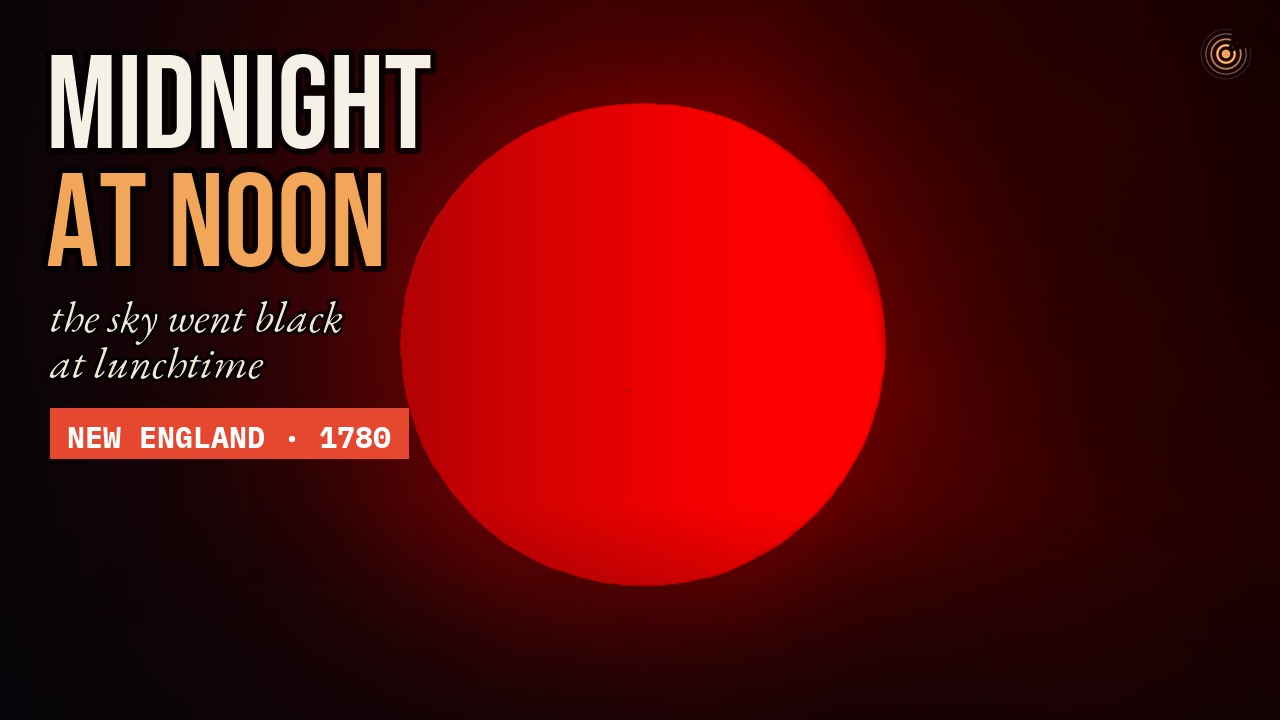 Premieres on YouTube Wednesday 04 November, 17:00 UTC · subscribe to get it
On 19 May 1780, in the middle of a spring morning, the sky over New England began to turn yellow. By noon, people could not read inside their own houses.
Candles were lit at lunchtime. Roosters crowed as if it were dawn. Birds fell silent, and frogs began to sing. Observers in one Massachusetts town summed it up:
In short, there was the appearance of midnight at noonday.
It came on between 10 and 11 in the morning. In Westborough, Massachusetts, the pastor Ebenezer Parkman wrote that by 12 o'clock he could not read anywhere in his house, and his family ate their dinner by candlelight.
In Braintree, Abigail Adams called it the most solemn sight she had ever seen. And the night that followed was worse. The moon was full, she wrote, yet you could not make out the objects nearest to you.
Judgment Day
It was the middle of the American Revolution, and many people believed the end of the world had come. Churches filled. In Hartford, the Connecticut legislature was in session. The lower house adjourned in alarm. In the upper chamber, a motion to adjourn was raised, and a councillor named Abraham Davenport stood up. As the story was later told:
The Day of Judgment is either approaching, or it is not. If it is not, there is no cause for an adjournment. If it is, I choose to be found doing my duty. I wish therefore that candles may be brought.
That account was written about forty years later, so the words may not be exactly his. But they became some of the most quoted lines in New England.
Scientists of the time went looking for clues. The Harvard professor Samuel Williams collected reports. The sun had risen red that morning. Everything looked tinged with yellow. Rainwater smelled of soot, and a black scum floated on the Merrimack River.
People noticed a smell, like a chimney, or a swamp on fire. And one letter mentioned that the woods near Ticonderoga, in New York, had been burning for some time.
More than two centuries later, in 2007, researchers from the University of Missouri found a likely answer in tree rings. Trees in southern Ontario carry scars from a huge fire, in the year 1780.
Smoke from wildfires, most likely in Ontario and New York, drifted hundreds of kilometres over New England. Many researchers think low cloud and fog made it worse, trapping the smoke and blocking what light was left.
But why yellow first, and then black? Clean air scatters blue light, which is why the sky is blue. Smoke particles are bigger. They scatter all colours, and they absorb blue and green. A thin layer turns the light yellow and the sun red. A thick enough layer swallows almost everything.
It Happens Again
We have seen smaller versions since. On 9 September 2020, smoke from wildfires turned San Francisco's sky orange all day, and workers needed lights to see.
In June 2023, smoke from Canada's fires drifted over New York, and the sky darkened by the afternoon. Hundreds of km from the flames. The same kind of event as 1780, only less dark.
Epilogue
One spring day, smoke from distant forests turned noon into midnight. And in Hartford, a councillor asked for candles.
Key facts
- Roosters crowed, frogs peeped and birds went to roost in the middle of the day. source ↗
- Legislator Abraham Davenport refused to adjourn: "I wish therefore that candles may be brought." source ↗
- Fire scars in Ontario's Algonquin Park trees point to the wildfire smoke that caused it. source ↗
Turn a torch into a smoky sun with a glass of water, a few drops of milk and a drop of tea, and watch the light go yellow, orange, then dark.
Sources
- McMurry et al. (2007), Int. J. Wildland Fire: fire scars and the Dark Day
- Samuel Williams, Memoirs of the American Academy of Arts and Sciences, vol. 1
- Founders Online: Abigail Adams; Cotton Tufts
- Ebenezer Parkman's diary, 19 May 1780
- Stamford Historical Society: Abraham Davenport (after Timothy Dwight)
- Boston Globe (2023); RMetS (2023); KTVU and SF Chronicle (2020)