The Fog That Starved Egypt
A crack in Iceland's ground poisoned the air over Europe, filled the Mississippi with ice, and likely helped the Nile flood fail in Egypt.
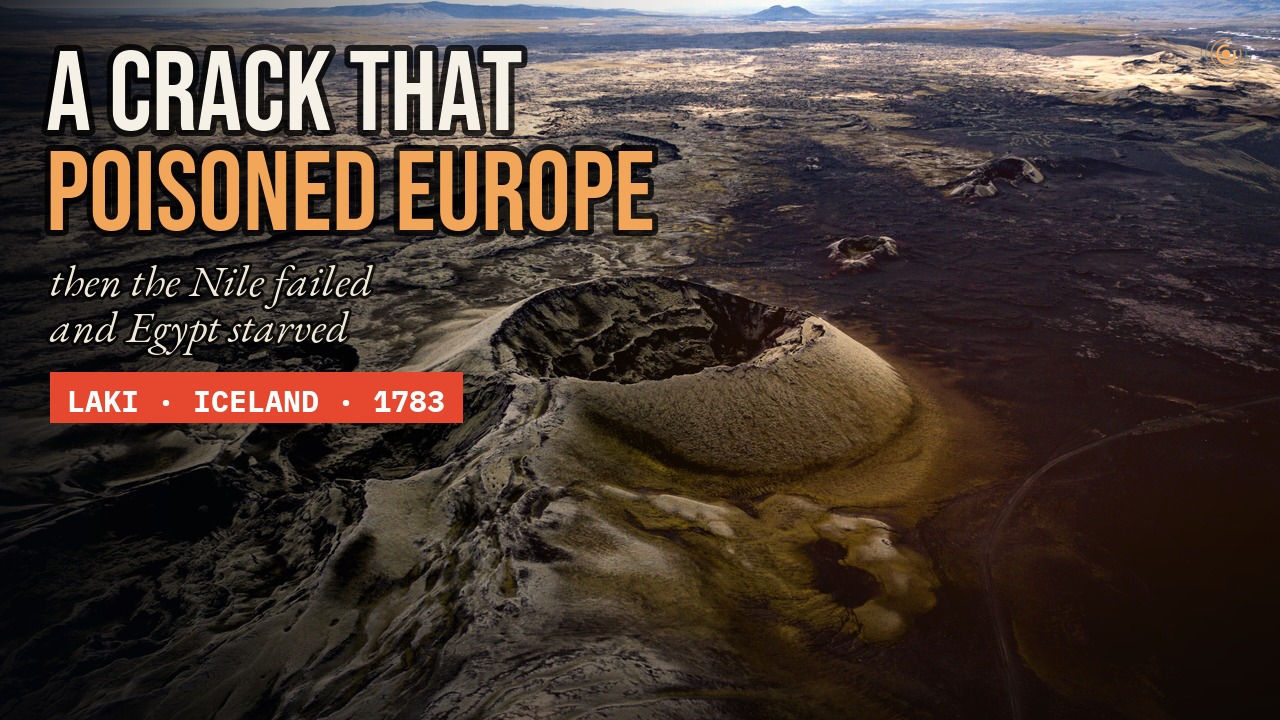 Premieres on YouTube Sunday 08 November, 17:00 UTC · subscribe to get it
On 20 July 1783, a pastor in the south of Iceland led his people into church. Outside, a river of lava was moving towards them.
His name was Jón Steingrímsson, and the service he held that day became known as the Fire Mass. When they came out, the lava had stopped, just short of the church. But the real danger was not the lava. It was in the air.
Six weeks earlier, on 8 June, the ground had split open. A crack about 27 km long, with around 140 vents, all fountaining lava. Over 8 months it poured out nearly 15 km³ of it. Enough to bury Greater London 9 metres deep.
And it breathed out gas. About 120 million tonnes of sulfur dioxide, and millions of tonnes of fluorine. The pastor wrote:
More poison fell from the sky than words can describe.
The Haze Famine
The fluorine settled on the grass. Animals that grazed on it sickened and died. Well over half of Iceland's grazing livestock was lost, and in the famine that followed, about 1 Icelander in 5 died.
The Dry Fog
But the gas did not stay in Iceland. Within days, a strange haze reached Norway and Scotland. By the middle of June it lay over western Europe, and by the end of the month it had reached Lisbon, Saint Petersburg and Moscow.
In a village in Hampshire, the naturalist Gilbert White watched the sun:
The sun, at noon, looked as blank as a clouded moon, and shed a rust-coloured, ferruginous light on the ground.
In Paris, Benjamin Franklin, then America's minister to France, found that a magnifying glass could barely set paper alight. He described a constant fog over all of Europe, and a great part of North America.
The Deaths
That summer was one of the hottest in memory, and the haze hung low. Burial records from 400 English parishes show about 11,500 extra deaths in August and September alone. Heat explains only part of that. The poisoned air may have contributed.
Then came a brutal winter, about 3 °C colder than normal across Europe and the eastern United States. In February 1784, the Mississippi filled with ice at New Orleans. England alone counted around 20,000 extra deaths that year.
And far to the south, something else went wrong. In Egypt, the yearly flood of the Nile failed. A French traveller, Volney, wrote:
The inundation of 1783 was not sufficient. Great part of the lands therefore could not be sown.
The next year, the river failed again, and famine followed. In Cairo, he wrote, hunger killed nearly as many people as the plague.
How could a volcano in Iceland starve Egypt? The haze cooled the northern lands. That weakened the contrast between hot land and cooler sea that drives the summer monsoon. Less rain fell on the highlands of Ethiopia, where the Nile's flood begins.
A climate model in 2006 linked Laki to the failed flood. And Nile records going back more than 1,000 years show lower floods in years after big eruptions. But one bad year can have many causes. Laki likely helped starve Egypt. We can't say it acted alone.
Could It Happen Again?
Laki was an unusual kind of disaster. Most of its gas stayed low in the sky and sank over Europe. It was less a global cooling event, and more a giant episode of air pollution.
In 2011, scientists modelled what an eruption like Laki would do to Europe today. Their estimate: around 140,000 extra deaths from heart and lung disease, in the first year alone.
Epilogue
A crack in the ground in Iceland. A fog over Europe, ice on the Mississippi, and a river that would not rise in Egypt. One eruption, felt across half the world.
Key facts
- From 8 June 1783 a 27 km fissure with about 140 vents erupted for 8 months, pouring out about 15 km³ of lava and about 120 million tonnes of sulfur dioxide. source ↗
- Fluorine poisoning killed well over half of Iceland's grazing livestock, and about one Icelander in five died in the famine that followed. source ↗
- Burial records point to about 20,000 extra deaths in England in 1783–84; Gilbert White saw the noon sun 'as blank as a clouded moon'. source ↗
- The Nile flood failed in 1783; a 2006 climate model linked it to Laki's haze weakening the monsoon, though one year's low Nile can have many causes. source ↗
Sources
- Thordarson & Self (2003), J. Geophys. Res.: Laki review
- Witham & Oppenheimer (2004), Bull. Volcanol.: mortality in England
- Oman et al. (2006), GRL: Laki and the Nile
- Manning et al. (2017): eruptions and Nile floods
- Schmidt et al. (2011), PNAS: a Laki-type eruption today
- Gilbert White; Benjamin Franklin; C.-F. Volney