The Volcano That Invented the Bicycle?
Soldiers on Java marched out to a battle that wasn't there. They were hearing a volcano 1,260 km away.
 The documentary is coming soon to YouTube · subscribe to get it
On the evening of 10 April 1815, British troops on the island of Java heard what sounded like cannon fire. Thinking a nearby post was under attack, they marched out to help. Boats set off to search for a ship in distress.
There was no battle, and no ship. What they had heard was a volcano, more than 1,000 km away. The memoir of the island's governor, Stamford Raffles, recalls:
The noise was, in the first instance, almost universally attributed to distant cannon.
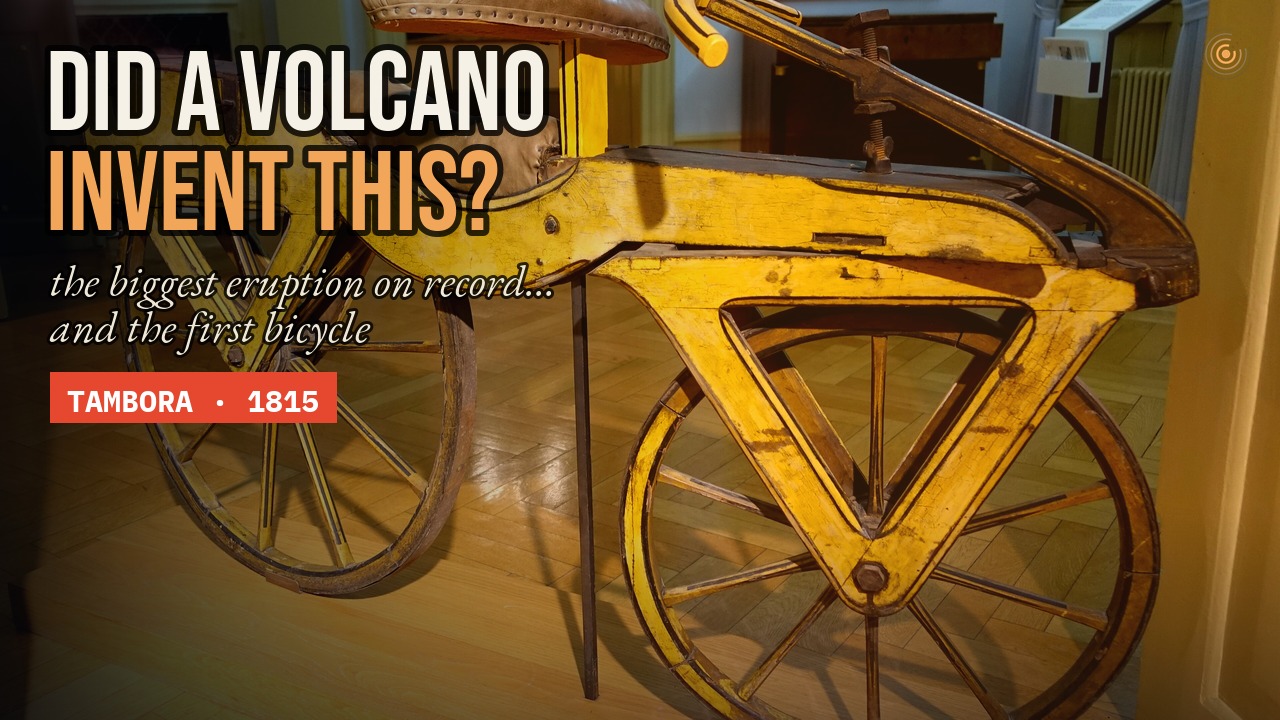
Two years later, in Mannheim, in Germany, a man pushed off on a strange wooden machine with two wheels and no pedals. Some historians think these two moments are connected. Others think that's a stretch. This is the story of both.
Mount Tambora, on the island of Sumbawa in today's Indonesia, had been rumbling for days. On the evening of the tenth of April, it exploded, in the largest eruption in recorded history.
It threw out about 40 km³ of rock, and the mountain lost well over a kilometre of its height. Avalanches of hot gas and ash, and a tsunami, swept the coasts. In the eruption, and the famine and disease that followed, at least 70,000 people died, perhaps more than 100,000.
Even the daylight went. A ship's commander at Makassar, nearly 400 km away, wrote:
It was impossible to see your hand when held up close to the eye.
The Veil
Tambora blasted around 55 million tonnes of sulfur dioxide high into the stratosphere. There it turned into a fine haze of droplets that spread around the world, and reflected sunlight back into space for the next few years.
The planet cooled by about half a degree. That doesn't sound like much. But in parts of Europe, the summer of 1816 ran up to 3 °C colder than normal.
In New England, snow fell in June. Frosts in July and August killed the crops. In Europe, harvests failed, grain prices doubled or more, and hungry crowds protested in the markets. In eastern Switzerland, people were reduced to eating grass.
On the shore of Lake Geneva, a group of young writers was kept indoors by the endless rain. Mary Shelley later remembered a wet, ungenial summer. It was there that she began Frankenstein.
In southern Germany, the famine dragged on into 1817. Food prices peaked that spring, and working horses were slaughtered and eaten.
And on 12 June 1817, Karl Drais rode his running machine out of Mannheim. Sitting on a wooden frame and pushing along the ground with his feet, he rode to a coaching inn outside the city and back, in about an hour. Faster than walking. Faster, it was said, than the mail coach.
So did a volcano invent the bicycle? Drais's biographer, Hans-Erhard Lessing, argued that with horses scarce and expensive, a machine that needed no oats suddenly made sense.
Other historians disagree. Drais had already designed a horseless carriage in 1813, before Tambora erupted. He said himself that the idea came from ice skating. And even Lessing admitted that you just cannot quite prove it.
What we can say is this. The first ride on two wheels came in the middle of a famine, two years after the biggest eruption on record. Coincidence, or cause? You decide.
Epilogue
A mountain in Indonesia exploded. Soldiers marched to a battle that wasn't there, a summer never came, and maybe, just maybe, a man in Germany got off his horse, and onto two wheels.
Key facts
- Troops left Yogyakarta and boats searched for a ship in distress, mistaking the blasts for gunfire; it was heard on Sumatra, 2,600 km off. source ↗
- June frosts and snow hit New England in 1816, the 'Year Without a Summer'. source ↗
- Theory, not settled fact: with horses dying or eaten, Karl Drais built the first push-bike, first ridden 12 June 1817. source ↗
Find out why a bike balances: roll a coin and a bottle cap, then race Karl Drais to the coaching inn.
Sources
- Self et al. (2004), GRL: Tambora's magma and aerosols
- Brönnimann & Krämer (2016): Tambora and the Year Without a Summer
- Pietsch, ICHC proceedings: the Drais–Tambora link questioned
- German Patent Office (DPMA): 200 years of the running machine
- Mary Shelley, Frankenstein, 1831 introduction
- Sophia Raffles (1830), Memoir of Sir T. S. Raffles