The Tea Shop That Built the First Office Computer
In 1951 J. Lyons & Co., the London teashop and cake company, built LEO I behind its own bakery and ran the world's first routine office job on it: the weekly bakery valuations. Its memory was sound, clicks racing through tubes of warm mercury.
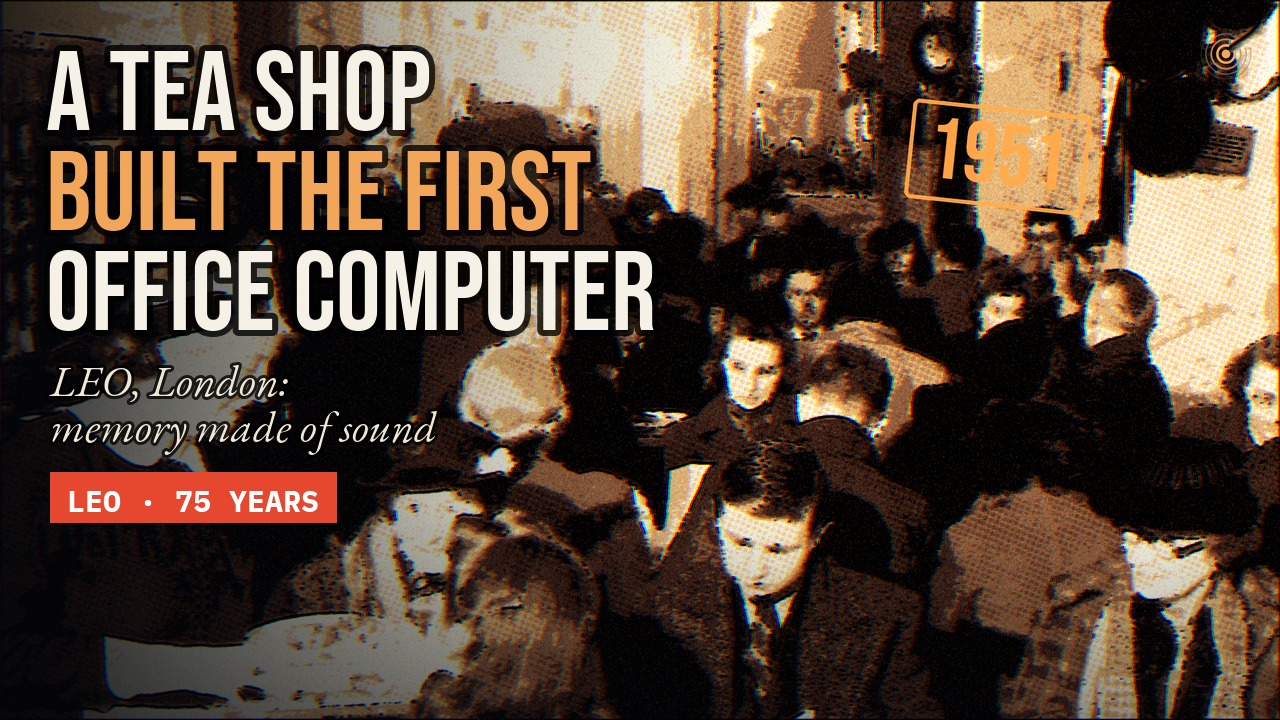 The documentary is coming soon to YouTube · subscribe to get it
The first computer ever to run a business was not built by IBM, or by a government. It was built by a company that sold tea and cakes.
London, 1951. Behind a bakery in Hammersmith, thousands of glowing valves fill a room. Under the floor, tubes of warm mercury hold the machine's memory. As sound.
Its first job is to work out what a week of bread, cakes and pies is worth. Until now, that took a small army of clerks.
75 years later, almost every payslip, invoice and online order on Earth runs on the idea it proved: let the machine do the office's sums.
So why did a tea shop company build the world's first office computer? And how do you store numbers in sound?
An Empire of Tea and Cake
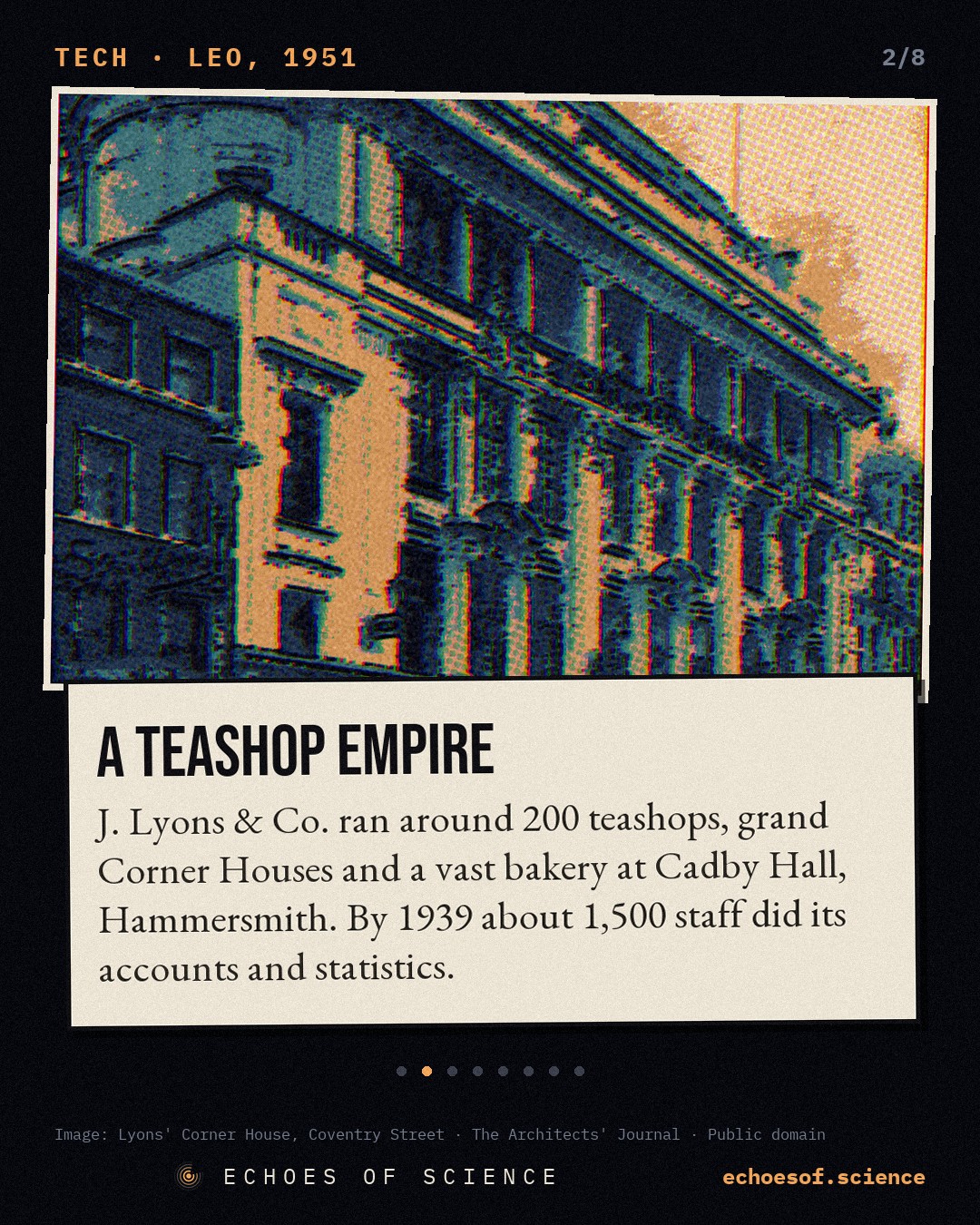
To understand LEO, start with a cup of tea. J. Lyons and Company was founded in 1884. By the 1930s it ran more than 200 teashops. There seemed to be a Lyons on every high street in London.
Its Corner Houses were vast: several floors of restaurants, with around 400 staff in each. The uniformed waitresses were known as Nippies.
And behind it all stood a factory. At Cadby Hall in Hammersmith, Lyons baked bread, cakes and pies, blended tea and made ice cream. In the 1920s, it made and sold 36 miles of Swiss roll every week.
This was a business of tiny margins. The profit on each cup and each bun was a fraction of a penny. Lose track of a few farthings per meal, and the whole empire was in trouble.
And every morning, hundreds of shops needed fresh bread and cakes, in the right amounts. Too few, and customers walked out. Too many, and the cakes went stale. Every order, every delivery and every wage had to be written down, checked and added up, by hand.
So Lyons counted everything. By 1939 it employed about 30,000 people. About 1,500 of them did nothing but accounts and statistics. Clerks with ledgers. Rows of calculating machines.
In 1932, a Cambridge mathematician called John Simmons set up an office inside Lyons with an unusual job: to study how the company's paperwork flowed, and make it faster. He would soon have a much bigger idea.
The Voyage to America
In May 1947, Simmons sent two managers, Raymond Thompson and Oliver Standingford, across the Atlantic. Their brief was simple: find out what had changed in office machinery since before the war.
In America they found something far stranger than a new adding machine. They met Herman Goldstine, one of the people behind ENIAC. It was a giant electronic calculator, built for the United States Army.
The newspapers called ENIAC an electronic brain. Thompson and Standingford thought that was nonsense. It could not think. But it could do sums at electronic speed, thousands of times faster than any clerk.
They visited Harvard, IBM, and the Prudential insurance company. And then someone told them that the most interesting work was happening back at home, in Cambridge.
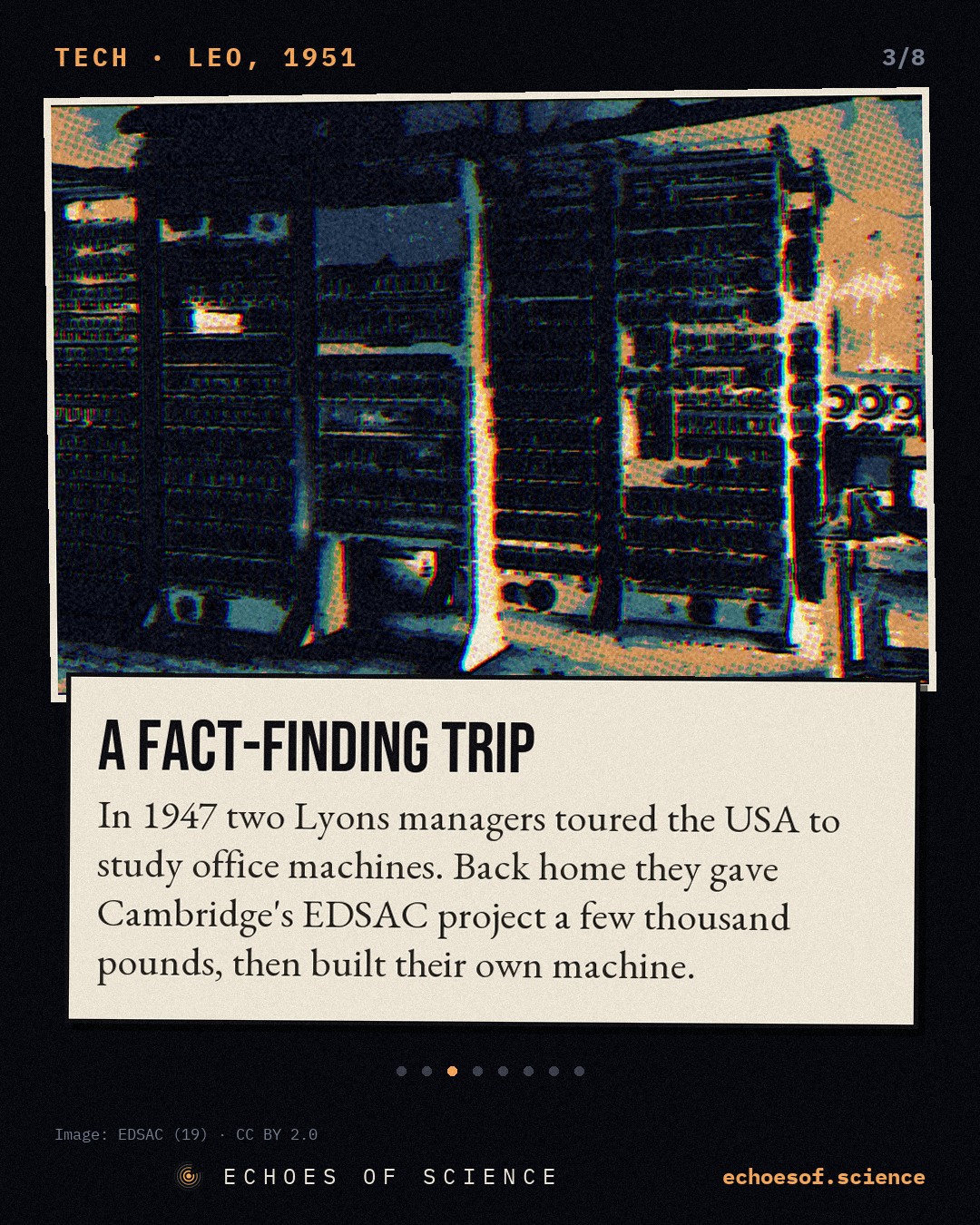
There, Maurice Wilkes was building a machine called EDSAC. It was short of money. The two men came home and wrote a report of about 200 typed pages. Its message was blunt. Lyons occupies a key position. Nobody else in Britain sees what these machines could do for an office.
In November 1947, the Lyons board agreed. They would give Cambridge a few thousand pounds, and lend them an engineer. In return, Lyons would learn how to build a computer of its own. A cake company was going into electronics. To build it, they would need a way to remember.
A Memory Made of Sound
Every computer needs a memory: a place to keep numbers while it works on them. In the 1940s, there were no memory chips. So Wilkes borrowed an idea from wartime radar, and stored numbers as sound.
Why sound? Because electricity is too fast to hold on to. A pulse of electricity crosses a room in a few billionths of a second. Sound in a liquid is slower, about 100,000 times slower. Slow enough to keep a whole queue of pulses in flight.
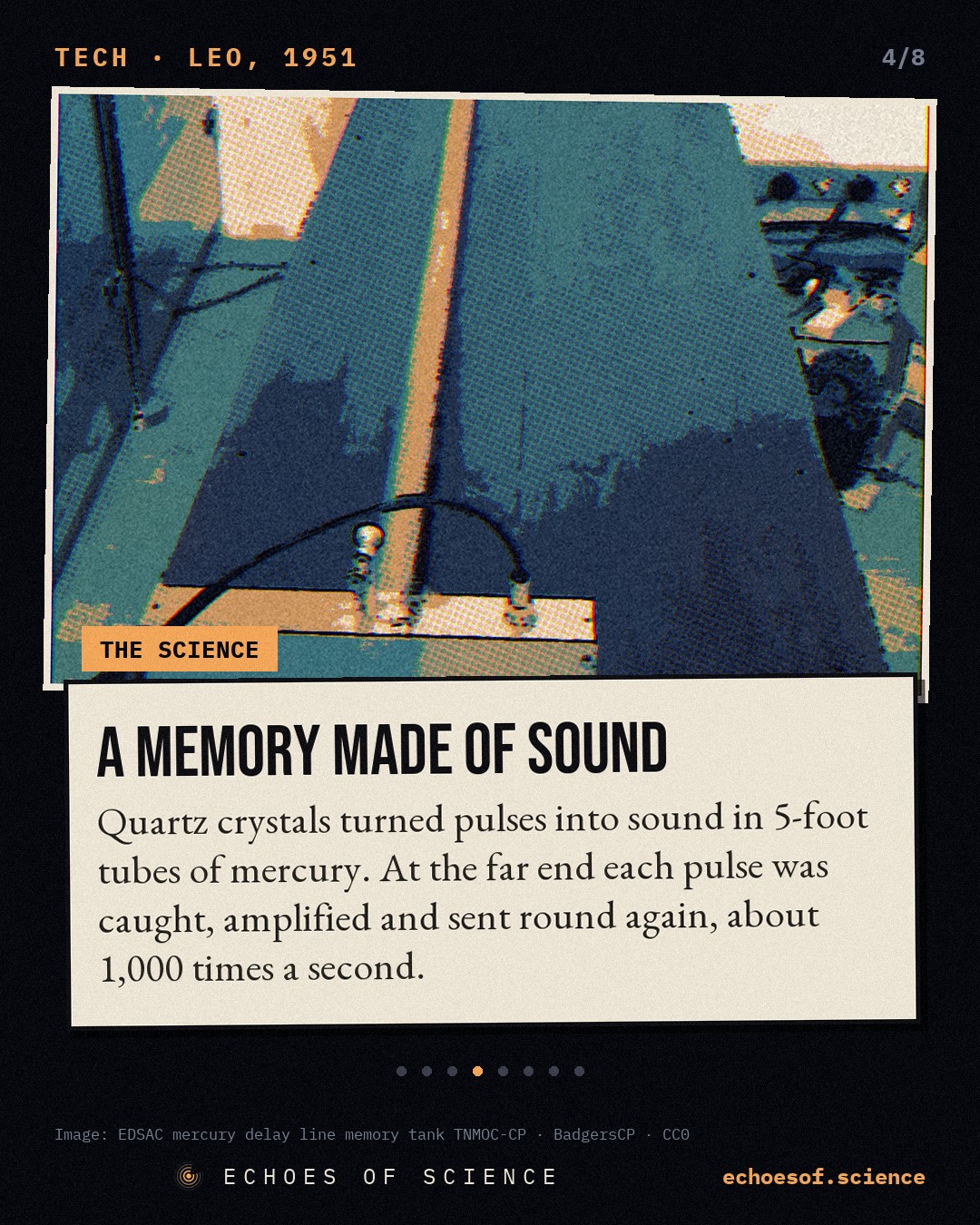
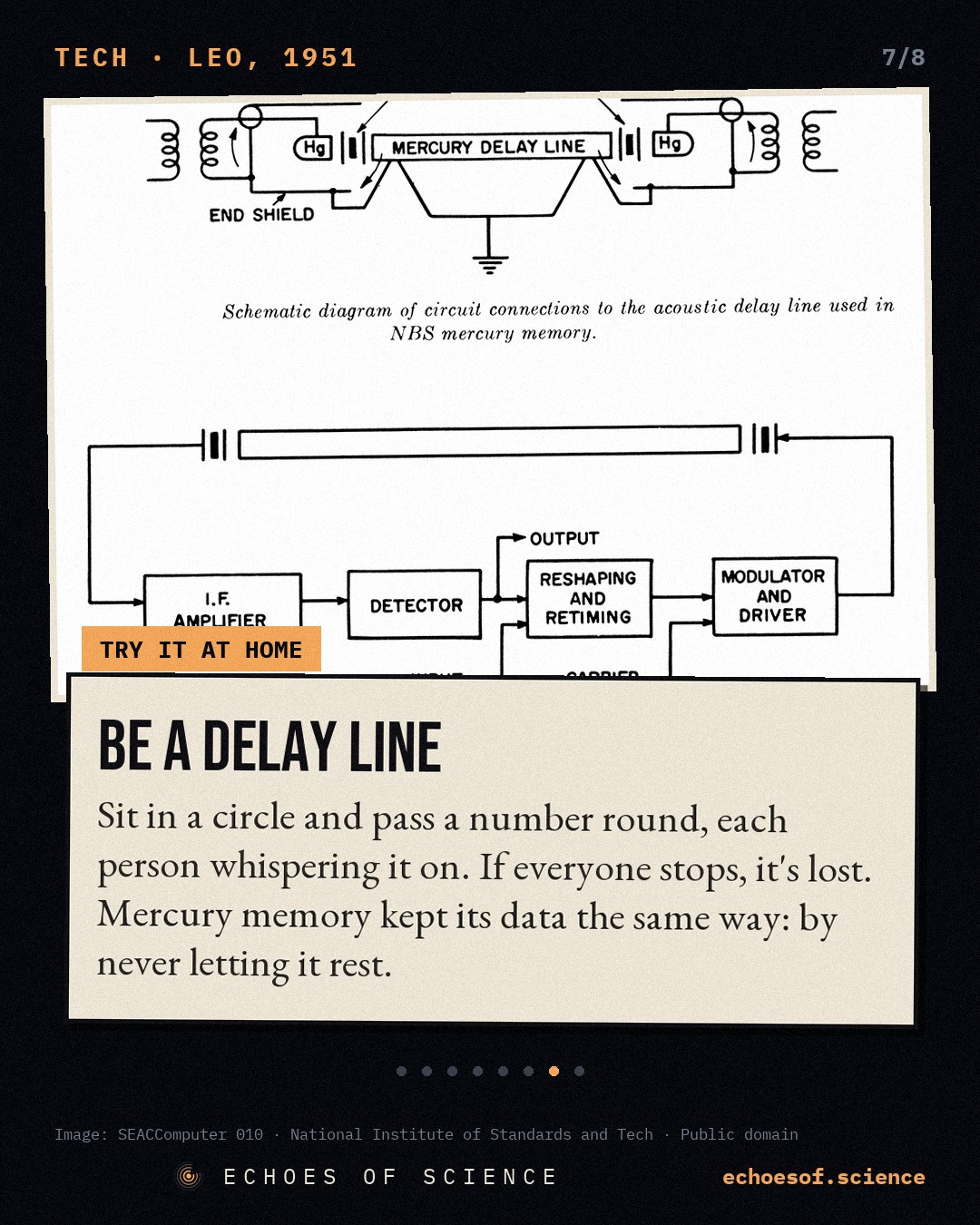
Picture a steel tube about 5 feet long, filled with mercury. At one end sits a thin slice of quartz crystal. Give it an electrical pulse, and it twitches, sending a tiny click of sound into the mercury.
Sound travels through mercury at about 1,450 metres a second. So each click takes about a thousandth of a second to reach the far end, where a second crystal turns it back into electricity.
A click is a one. A gap is a zero. Hundreds of them travel down the tube at once, in a line, like carriages on a train.
But sound fades. So at the far end, every pulse is caught, cleaned up, amplified, and sent straight back to the start. Round and round, 1,000 times a second. As long as the power stays on, the numbers never stop moving.
That means you cannot read a number whenever you like. You have to wait for it to come round, like waiting on a station platform for your train. Good programmers learned to place their numbers so they arrived just as they were needed.
And EDSAC kept something else in those tubes: its instructions. The program sat in the same memory as its numbers. So the machine could switch jobs in an instant, just by loading new instructions. That idea, the stored program, is how every computer has worked ever since.
There was a catch. The speed of sound in mercury changes with temperature. A tube a little too warm, and the train of pulses arrives late. So the tubes lived in boxes kept at about 40 °C, warm as a bath.
At Cambridge, Alan Turing is said to have suggested that gin would work just as well as mercury. Wilkes stuck with mercury. In May 1949, EDSAC ran its first program. Lyons had its proof. But could a scientist's machine survive the daily grind of a bakery?
The Bakery Valuations
Lyons needed someone to build it. They hired a young physicist, John Pinkerton, who had answered an advertisement in the journal Nature. His interview lasted a whole day.
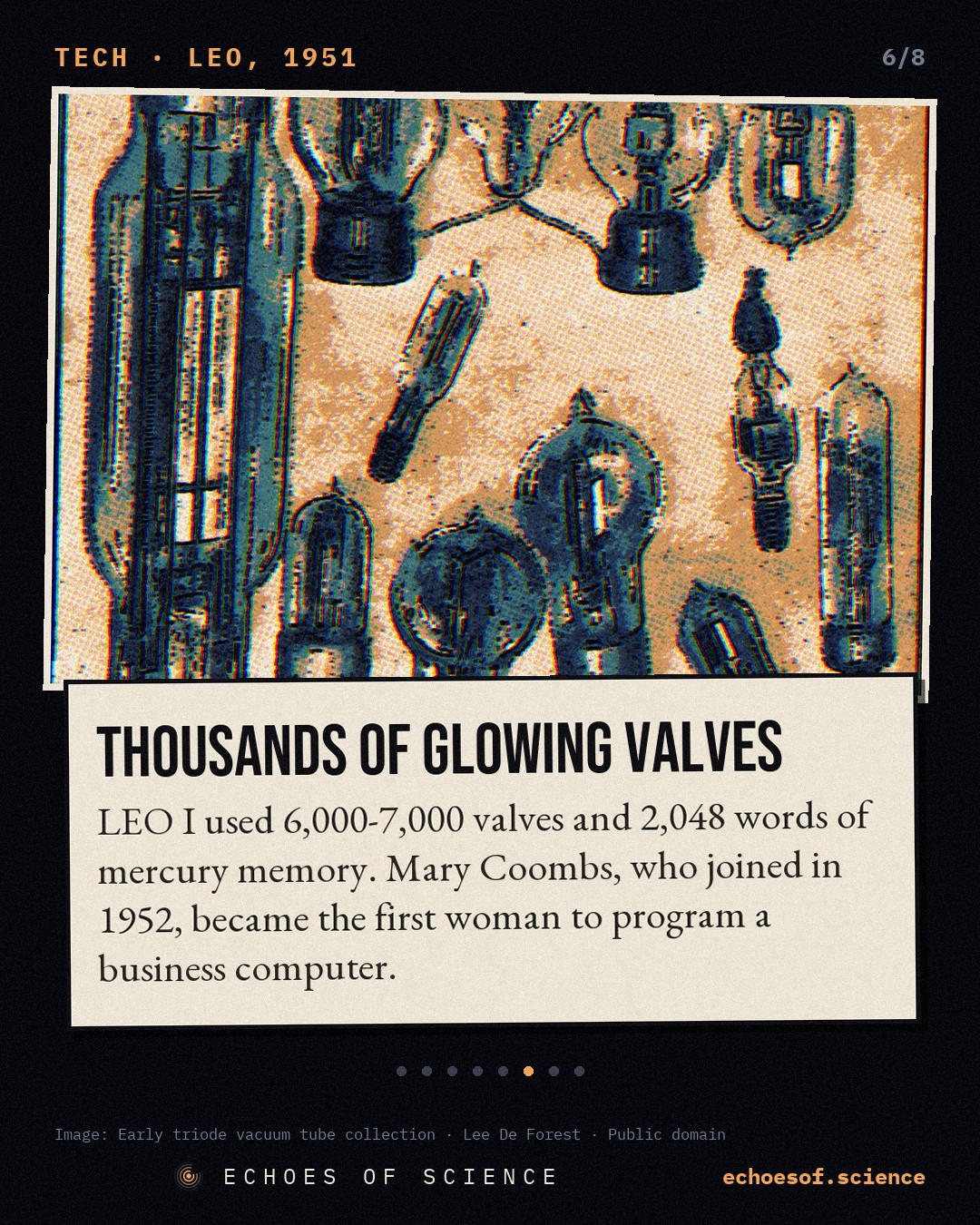
In a workshop at Cadby Hall, his team built LEO: the Lyons Electronic Office. It was EDSAC made bigger and tougher. 6,000 to 7,000 valves, in 19 tall racks. 64 mercury tubes. About 30 kilowatts of power, and a great deal of heat.
Its memory held 2,048 numbers. Today a cheap phone holds many millions of times more. But LEO did not need much. It needed to be fast, and above all, reliable.
Numbers went in on punched cards and paper tape. Answers came out on a printer that rattled off 100 lines a minute. And every valve was a small glowing light bulb, which could burn out at any moment. Keeping thousands of them alive was a constant job for the engineers.
In February 1951, LEO ran its first test program. That same month, the future Queen, Princess Elizabeth, came to see it.
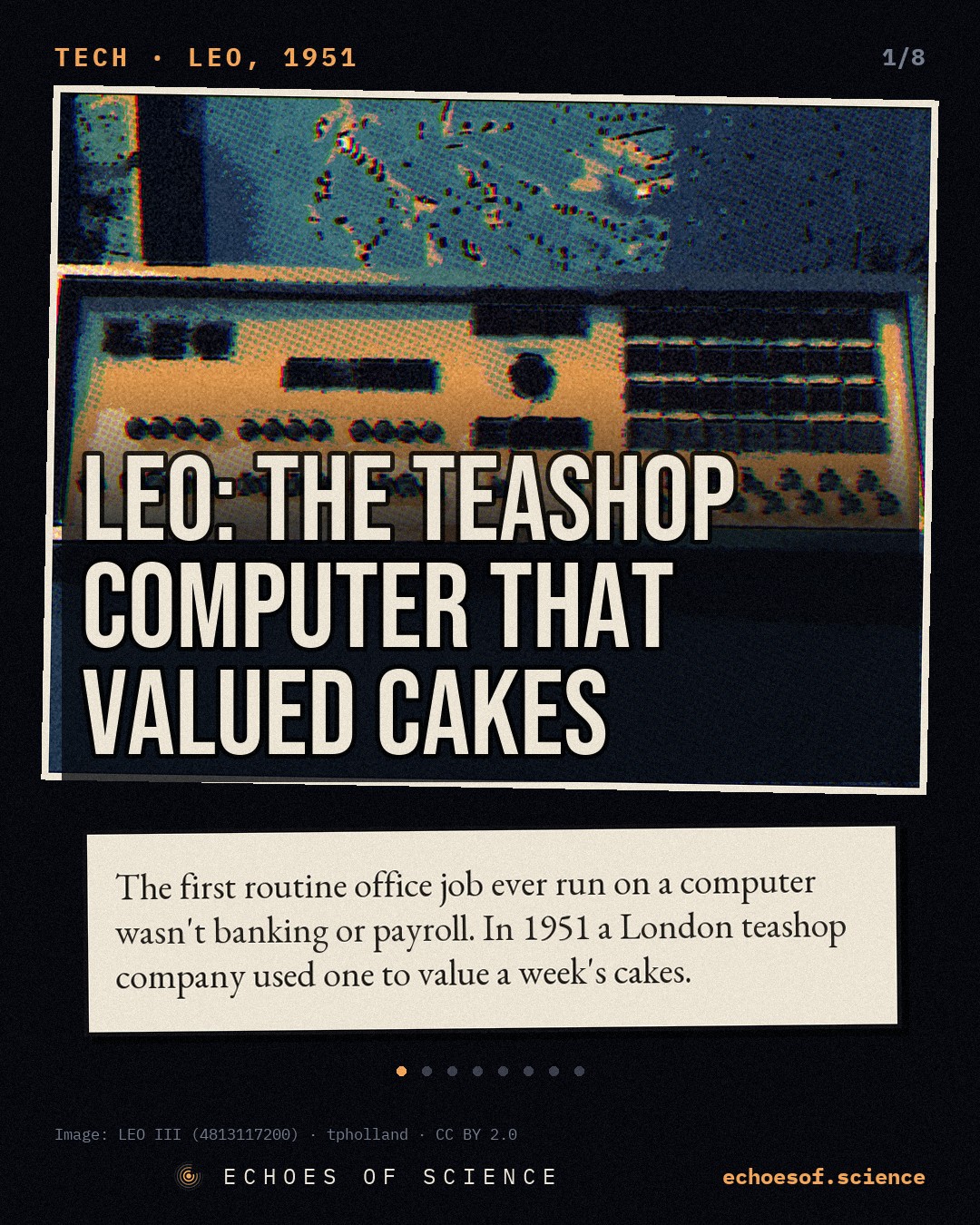
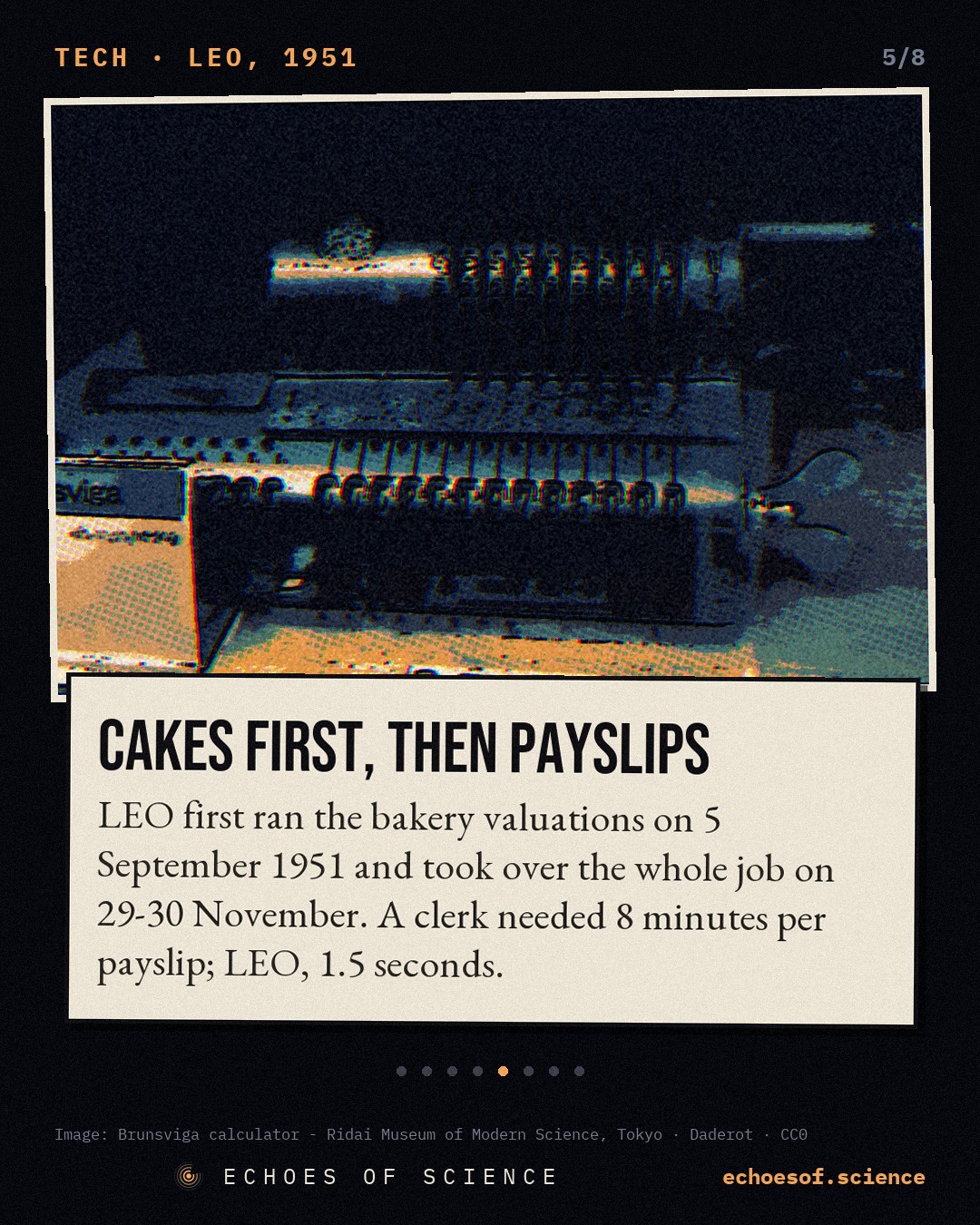
And on 5 September, it ran its first real business job: the bakery valuations. Every week, Lyons had to know what its bakeries had produced, and what it was all worth. The flour, the sugar, the labour, the cakes sent out to every shop.
For the clerks, it had been a slow weekly grind. LEO did it in a couple of hours. By the end of November 1951, it had taken over the job completely. No computer had ever run a company's routine business before. But bakery sums were the easy part.
Payday
The real test was payroll. Get the bakery sums wrong, and an accountant frowns. Get the wages wrong, and thousands of people go home short on a Friday.
Pay in 1950s Britain was a maze. Hourly rates, overtime, bonuses, tax codes, national insurance, all in pounds, shillings and pence. An experienced clerk needed about 8 minutes to work out one person's pay.
LEO did it in about 1.5 seconds. By Christmas Eve, 1953, it was running the Lyons payroll for good.
The programmers who wrote those jobs were inventing a profession. One of them, Mary Coombs, joined in 1952. She became the first woman to program a business computer. Years later she remembered it simply.
We were all engaged in a big adventure.
Then LEO took on the teashops themselves. Every afternoon, the shops telephoned in their orders for the next day. LEO turned them into baking plans, delivery lists, invoices and reports for the managers.
One of the LEO team, Frank Land, later put it plainly.
This was as near a real-time system as you could get.
It was, in effect, the first management information system. Soon other firms wanted time on the machine. The Met Office ran weather calculations on it. Ford sent its payroll. In 1954, Lyons set up a new company just to build and sell computers. It is an astonishing story. But how much of it can we actually check?
How Do We Know?
Much of the paper trail survives. The 1947 report is now in the Science Museum's collection in London. Other copies, flowcharts and job plans are kept by the Centre for Computing History in Cambridge.
And the people who built and ran LEO wrote it down. The LEO Computers Society has collected their memories, in an online archive called LEOPEDIA.
But the sources do not agree on everything. Some say Lyons gave Cambridge £2,500. Others say £3,000. Some count about 6,000 valves in LEO. Others, nearly 7,000.
Even LEO's birthday is slippery. The first bakery job ran on 5 September 1951. Others pick 17 November, or the 29th, when LEO took over for good. All three are true. They mark different steps.
And was it really the first? In America, a computer called UNIVAC was delivered to the Census Bureau in March 1951. But that was a government, counting people. The first UNIVAC sold to a business did not arrive until 1954.
So the careful claim is this: LEO was the first computer to run the routine, everyday work of a business. And it was built by the business itself. So what became of it?
Today
LEO's children went into offices across Britain and beyond. 11 LEO IIs were built, and 94 LEO IIIs. They worked out wages, tax tables and telephone bills. The Post Office was still sending out bills from a LEO III in 1981.
But Lyons was a cake company, not a computer giant. In 1963 its computer business merged into English Electric, which later became part of ICL. LEO I itself was switched off on 4 January 1965. It had worked for 14 years. The last teashops closed in 1981.
What survives is the idea. Enter the data once, and let the machine turn it into everything else: the orders, the stock, the wages, the reports. Every supermarket that restocks its shelves overnight works that way. So does every online shop, and every payroll in the world.
And the memory? Mercury tubes vanished within a few years. But the trick at their heart did not. Inside the chips in your phone, some memory still has to be refreshed, over and over, before the charge leaks away. Keep it moving, or lose it.
This November, the LEO Computers Society marks the machine's 75th birthday. The machine is long gone. Its story is being told again.
Epilogue
In November 1951, while Londoners queued for tea and buns, a room behind the bakery quietly did the sums.
75 years later, the clerks with their ledgers are gone. But every time a computer pays a wage or prints a bill, it is doing the job that a tea shop taught it to do.
Next time: the first hack in history. In 1834, two bankers broke into the French state telegraph. And on our website, try to keep LEO's mercury memory alive. Can you run a whole day of teashop orders without losing a single bit?
The science in this story
Key facts
- LEO I ran its first business job, Bakery Valuations, on 5 September 1951 and took it over completely on 29–30 November 1951 (some histories give 17 November). source ↗
- In May–June 1947 Lyons sent T. R. Thompson and O. W. Standingford to the USA 'to find out what developments had taken place, since before the war, in accounting and office machinery'. source ↗
- LEO I used nearly 7,000 valves (other sources: over 6,000), about 30 kW, and 2,048 words of mercury delay-line memory. source ↗
- An experienced clerk took about eight minutes to work out one employee's pay; LEO took one and a half seconds. source ↗
- Mary Coombs joined Lyons in 1952 and became the first woman to program a business computer. source ↗
- Sound travels at about 1,450 m/s in mercury; delay-line tubes were kept at about 40 °C because the speed of sound changes with temperature. source ↗
- UNIVAC I was accepted by the US Census Bureau on 31 March 1951; the first UNIVAC sold to a business went to GE in 1954. source ↗
- 11 LEO II and 94 LEO III computers were built; the GPO used LEO III for telephone bills until 1981. source ↗
In pictures

Loading the quiz…
Sources
- Thompson & Standingford, Report on American Tour (1947): Science Museum Group; Centre for Computing History (LEO archive)
- Computer Conservation Society: LEO I · BCS: 'From baking to business computing'; Mary Coombs obituary (2022)
- LEO Computers Society / LEOPEDIA · The Register (2013) · Wikipedia as index only: LEO, J. Lyons, Delay-line memory, UNIVAC I
Where every picture, clip and sound in this story comes from
Keep scrolling: more true stories ↓
New mini-documentaries every week and a true story every day. Pick where you like to watch:
▶ Subscribe on YouTube Telegram TikTok Instagram Bluesky Threads ✉ Weekly email