Speed of sound
How fast sound travels: about 343 metres per second in air, and more than four times faster in water.
Sound is a pressure wave: molecules nudge their neighbours, which nudge theirs. How fast that nudge travels, the speed of sound, depends on the material it passes through, not on how loud the sound is or what made it.
In dry air at 20 °C sound travels about 343 metres per second, roughly a kilometre every three seconds, which is why you can estimate how far away a thunderstorm is by counting the seconds between flash and thunder. Warmer air carries sound slightly faster, by about 0.6 metres per second for each degree. In fresh water at 20 °C the speed is about 1,481 metres per second, and in steel around 6,000.
The first measurement in water was made on Lake Geneva in 1826. Jean-Daniel Colladon and Charles Sturm worked from two boats 10 km apart. Colladon set off gunpowder above the water at the same moment as he rang a bell under it, and Sturm, listening through an underwater tube, timed the gap between flash and sound. They got 1,437.8 metres per second at 8 °C, within a metre per second of the modern value.
A common misconception is that sound is faster in water because water is denser. Density on its own actually slows sound down. Water wins because it is far harder to compress than air, and that stiffness more than makes up for its extra weight.
See it in action
 Coming soonA Tea-Shop Chain Built the First Office Computer1951 · J. Lyons & Co., London
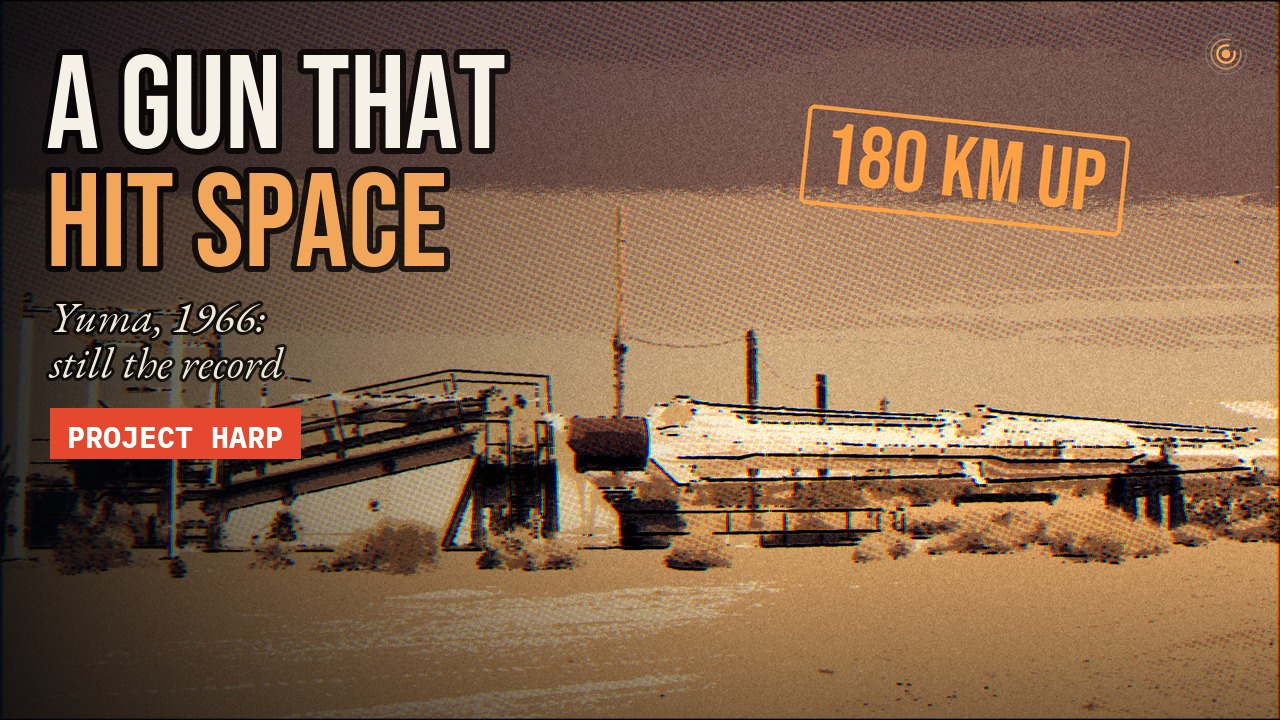 Premieres 18 NovThe Cannon That Tried to Shoot Into Space18 November 1966 · Yuma, Arizona (Project HARP, 1962–1967)
Coming up in future stories
- The Man Who Stepped Off a Balloon at 31 Kilometres 16 Aug 1960 · Excelsior III gondola, above New Mexico
- The Volcano Boom That Lapped the Planet 2022 · Hunga Tonga–Hunga Ha'apai, Tonga
- They Rang a Bell Under a Lake 1826 · Lake Geneva, Switzerland