This Knowledge Was Free All Along
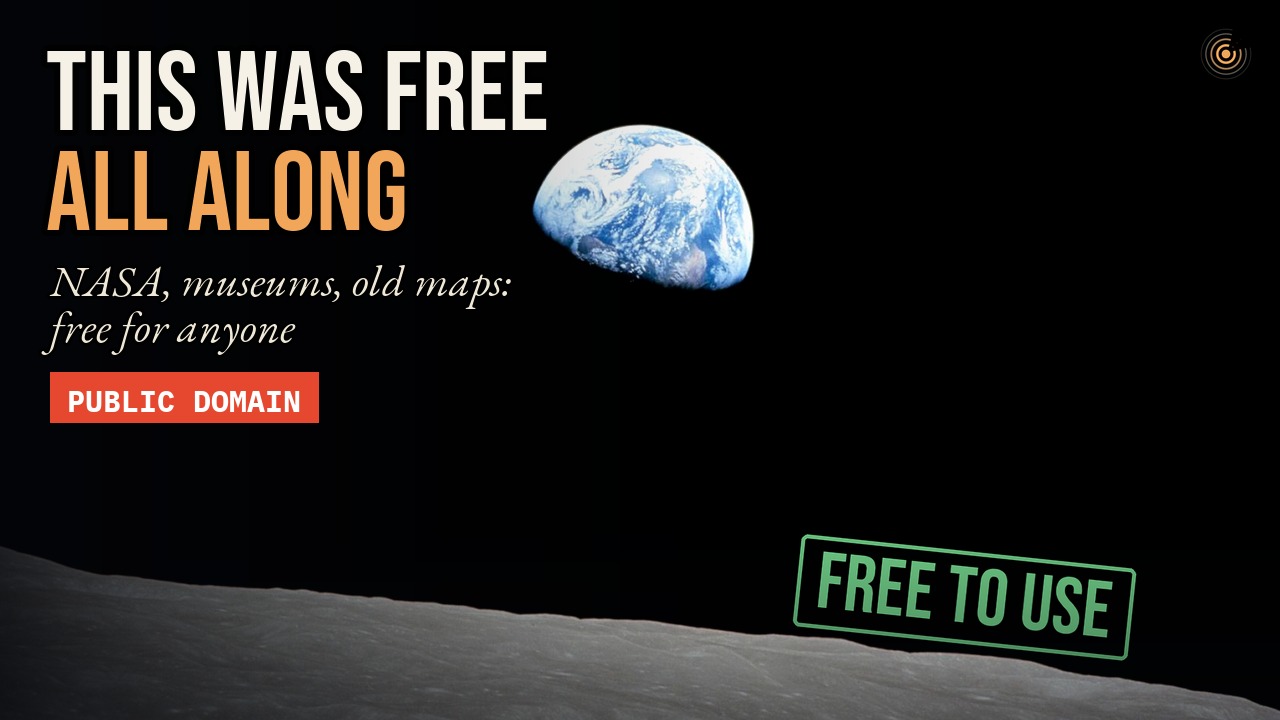
Earthrise, the Apollo 8 photo of 1968, is free for anyone to use, and so are millions of NASA images, museum collections and centuries-old maps and engravings. Most people never knew. How AI and open tools turn that public knowledge into films, quizzes and labs, with every fact and picture traceable.
 The documentary is coming soon to YouTube · subscribe to get it
This is one of the most famous photographs ever taken. And you are allowed to use it.
In a film, on a school worksheet, in a book you sell. You don't need to ask anyone, and you don't need to pay.
Engravings of the Moon nearly four hundred years old. Maps drawn before the French Revolution. The Sun, filmed from space every few seconds. Millions of pictures, free for anyone, for decades.
So why has so much of it sat unused? And if machines can now help turn it into films, quizzes and lessons for almost nothing, how would you know whether to trust what they make?
The Open Door
It is called Earthrise. On Christmas Eve, 1968, three men were circling the Moon on Apollo 8, and one of them, Bill Anders, grabbed a camera. NASA still files it under a plain number: AS08-14-2383.
Why is it free? Because of one sentence in American copyright law. Section 105: copyright protection is not available for any work of the United States Government.
So a NASA astronaut's photograph, taken on the job, belongs to everyone. NASA says its pictures, video and sound are generally not subject to copyright in the United States. With a few limits: don't use the NASA logo to sell things, or suggest that NASA endorses you, and take care with pictures of identifiable people.
And NASA never stopped filming. Since 2010, the Solar Dynamics Observatory has photographed the Sun every 12 seconds: around 1.5 terabytes a day. Flares, loops, storms of plasma bigger than the Earth. All of it public.
Other archives opened their doors on purpose. In February 2017, New York's Metropolitan Museum of Art released more than 375,000 images of public-domain art, for free and unrestricted use.
Three years later the Smithsonian followed: 2.8 million images, under a licence called CC0. No rights reserved. Any purpose, commercial or not.
Then there is Wikimedia Commons, the picture library behind Wikipedia. Started in 2004, it now holds more than 140 million free files.
The door has been open for years. The question is who walks through it, and what they bring back.
Old Enough to Be Free
Some of it is free because a government made it, some because a museum gave its rights away. But a great deal is simply old enough. Copyright does not last forever. In the European Union it runs out 70 years after the creator dies. Then the work enters the public domain, and belongs to all of us.
This map of New England was engraved by the French mapmaker Rigobert Bonne, in 1780. We used it in a film about the day the sky went dark at noon.
This aurora was drawn in 1839, for a French expedition to the far north. In our film on the great solar storm of 1859, it showed the sky as people saw it, before anyone could photograph it.
And this Moon was engraved by Claude Mellan in the 1630s, from what he saw through a telescope, for two scholars who wanted a map of the Moon. The Met lets anyone use it.
Some licences ask for one small thing. This crater in Iceland was photographed recently, under CC BY: use it however you like, as long as you say who made it. So we always do.
We use only these three: public domain, CC0, and CC BY. Licences with extra conditions, like no changes or no commercial use, we leave alone. And we never lift clips from other people's videos and call it fair use.
Every item gets its licence on screen, in the credits, and in a public list. But a list is only worth something if you can check it. Hold on to that.
What the Machine Does
So where does artificial intelligence come in? Not where you might think. It does not make the pictures of the past. Every photograph, map and engraving here is real, and you can look each one up.
What the AI does is the slow, invisible work. It searches archives and reads sources. It drafts scripts and web pages. It writes the code behind the maps and diagrams.
The voice you are hearing is synthetic, too: an open-source speech model, on a home computer in Belgium. The same computer translates titles and subtitles into 14 languages.
And all of it can be wrong. A language model can state a false fact as calmly as a true one. Those translations have not yet been checked by native speakers, and the website says so.
So there are rules. Every fact links to a source that anyone can open. Wikipedia helps us find sources, but is never one. AI illustrations are always stylised, and labelled. And there is no AI-generated footage of real events. Not one frame.
Then every film waits. It is uploaded privately and held for at least 24 hours, so that a person can watch it, and stop it, before anyone else sees it.
How Do We Know?
Here is the list we promised: a page on our website called Transparency. It shows every picture, film clip, sound and piece of music in our films.
For each one: the title, the maker, the licence, and the source page. Then two kinds of proof. A digital fingerprint of the exact file, so anyone can tell if it was swapped. And a snapshot of the source page in the Internet Archive's Wayback Machine, showing what the licence said the day we took it.
Right now it holds around 400 items, from about 20 films, most of them public domain. Unclear licences are marked as under review, in public.
The same page shows what it all costs. Every render on our computer is measured. One finished documentary takes, on average, well under half a kilowatt-hour: at our Belgian tariff, roughly 10 euro cents.
Add the AI subscription: €90 a month. Over about 30 films a month, that is around €3 a film, at most. All paid by echoesof.science. No sponsor, no grant.
And what we cannot measure, we say. The company behind the AI model does not publish the energy its servers use for us. So our table simply reads: not published.
Fair Worries
None of this means the worries about AI are wrong. In late 2023, the Pew Research Center asked more than 2,500 American teachers. A quarter said AI tools do more harm than good in schools. Only 6% said more good than harm. The rest were in between, or unsure.
Those are fair answers. Take accuracy. A machine that writes fluently can also mislead fluently. The only defence we know is the old one: show your sources, and let people check them.
Energy is a real question, too. The International Energy Agency estimates that data centres used about 415 terawatt-hours in 2024: around 1.5% of the world's electricity. That could more than double by 2030. So we publish our own share.
And jobs. This channel did not replace a film crew; without these tools, it would not exist. What AI will do to work in general, nobody can honestly say yet.
What we can say is this. Teachers stay the ones who decide what is good enough for a classroom. Our job is to make that decision easier to check.
Where It Goes
Where does it all go? Every story becomes a documentary, a short film, and a web page with its sources. Then a scroll of short stories for your phone: a feed you can doomscroll that teaches you something.
A daily quiz: five questions, with the story and the source behind every answer. And science labs: small games where the physics is real, like firing Newton's cannonball so fast it never comes down.
The plan is a school library, sorted by age, from 2-year-olds to university, so a teacher can find a story and check every fact behind it before it reaches a class.
Back to that photograph. It has been free for almost 58 years. So have the maps, the engravings, and the Sun, filmed every 12 seconds. All of it was waiting for someone with the time to use it.
Machines can now give us some of that time. They won't decide what is true. That is still our job, and yours. Which is why everything we use is on one page.
Check everything we use: echoesof.science/transparency
Next time: the cannon that tried to shoot into space, and the gun that fired a projectile 180 kilometres up. And on our website, a game: which archive pictures are you allowed to use?
The science in this story
Key facts
- Copyright protection is not available for any work of the United States Government (17 U.S.C. § 105), so NASA photos like Earthrise (AS08-14-2383, Bill Anders, 24 Dec 1968) are public domain in the US. source ↗
- NASA: its images, video and audio 'generally are not subject to copyright in the United States' (limits: logo, endorsement, identifiable people). source ↗
- The Met released 375,000+ images of public-domain artworks under CC0 on 7 Feb 2017. source ↗
- Smithsonian Open Access (Feb 2020) released about 2.8 million images under CC0, for any purpose. source ↗
- In the EU, copyright lasts for the author's life plus 70 years. source ↗
- Pew (2023 survey of 2,531 US K-12 teachers): about a quarter say AI tools do more harm than good, 6% more good than harm, 32% an equal mix, 35% not sure. source ↗
- IEA: data centres used about 415 TWh in 2024 (~1.5% of world electricity), possibly ~945 TWh by 2030. source ↗
- Our ledger lists every item with licence, source, SHA-256 fingerprint and a Wayback snapshot; a film averages well under 0.5 kWh of rendering. source ↗
Loading the quiz…
Sources
- 17 U.S.C. § 105 (govinfo.gov) · NASA images and media guidelines
- The Met Open Access (7 Feb 2017) · Smithsonian Open Access (25 Feb 2020)
- Wikimedia Commons · NASA SDO · IEA, Energy and AI (2025)
- Pew Research Center (15 May 2024) · echoesof.science/transparency
Where every picture, clip and sound in this story comes from
Keep scrolling: more true stories ↓
New mini-documentaries every week and a true story every day. Pick where you like to watch:
▶ Subscribe on YouTube Telegram TikTok Instagram Bluesky Threads ✉ Weekly email