Black hole
A region where gravity is so strong that nothing, not even light, can escape once inside its boundary, the event horizon.
A black hole is what you get when enough mass is squeezed into a small enough space that gravity wins completely: inside a boundary called the event horizon, nothing, not even light, can get out. Small black holes form when the cores of very massive stars collapse. Supermassive black holes, millions to billions of times the mass of the Sun, sit at the centres of most large galaxies; the one at the heart of the Milky Way, Sagittarius A*, has about 4 million solar masses.
A black hole itself gives off no light, but gas falling towards it can shine brilliantly. As the gas spirals in, it is squeezed and heated to millions of degrees, so a feeding black hole can outshine all the stars of its galaxy.
A common misconception is that black holes suck in everything around them like a vacuum cleaner. From far away, a black hole pulls like any other object of the same mass: if the Sun were replaced by a black hole of equal mass, the planets would keep their orbits.
See it in action
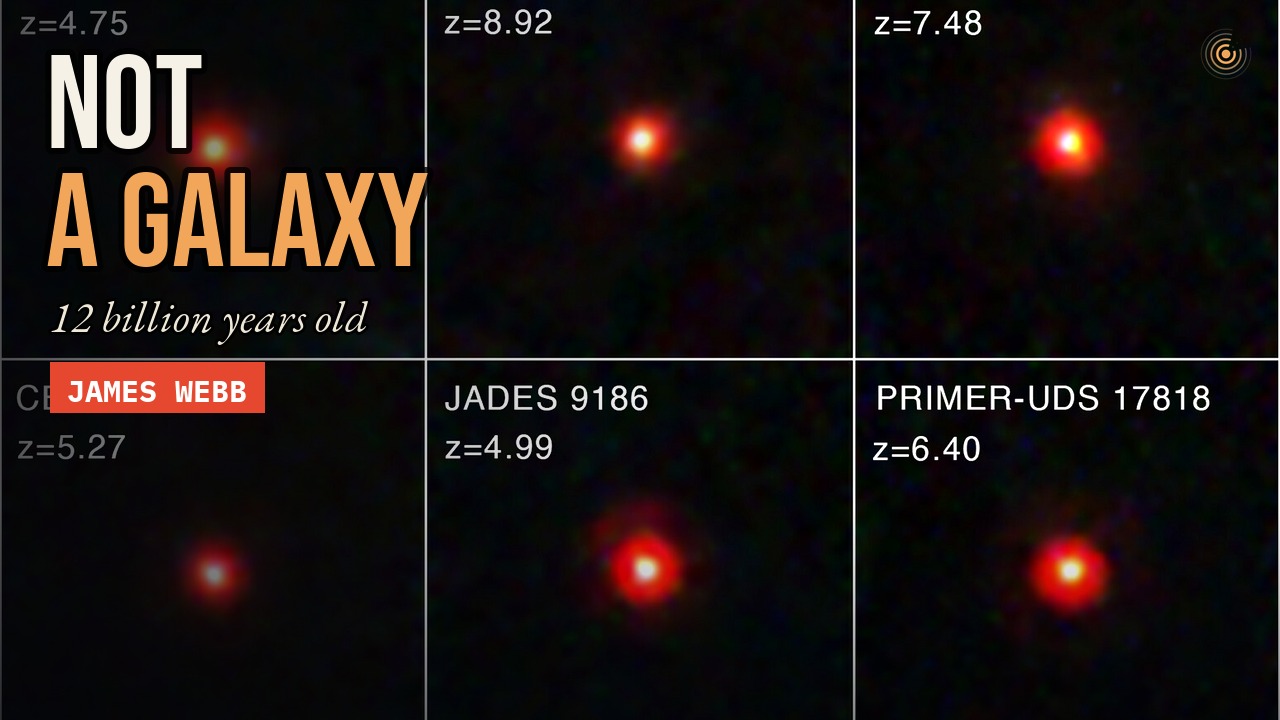 Premieres 04 DecWebb Found Red Dots That Shouldn't Exist2022-2026 · James Webb Space Telescope (light from 600 million-1.8 billion years after the Big Bang)
Coming up in future stories
- South Africa's Telescope Found Bubbles Around Our Black Hole 11 September 2019 · MeerKAT, Northern Cape, South Africa
- Two Black Holes Collided and LIGO Heard a Chirp 14 Sep 2015 · LIGO Hanford and Livingston, USA