Webb Found Red Dots That Shouldn't Exist
In its first deep images, Webb found tiny red dots with 12-billion-year-old light that looked like galaxies almost as heavy as the Milky Way, far too early. 'Universe breakers'. Four years later the best explanation is stranger: young black holes hidden in glowing cocoons of gas.
 Premieres on YouTube Friday 04 December, 17:00 UTC · subscribe to get it
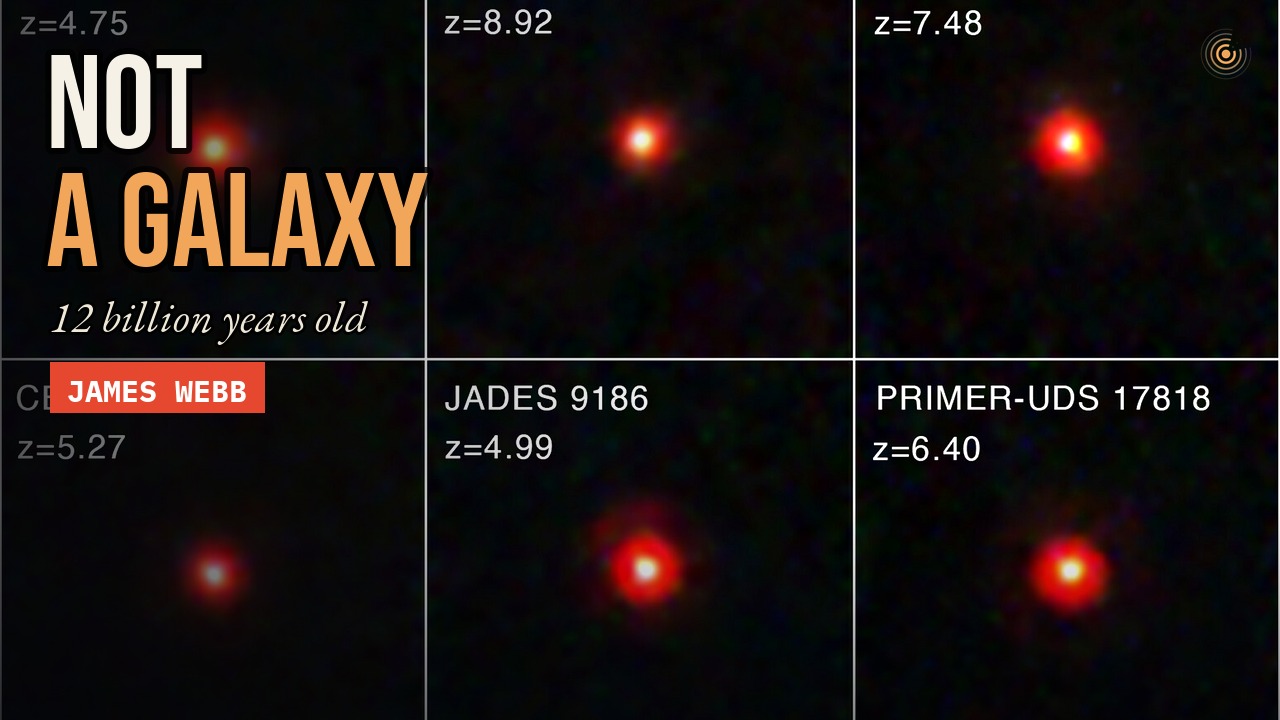
These six red dots should not exist.
Each one is light that left its source more than 12 billion years ago.
When Webb first spotted dots like these, they looked like galaxies packed with stars. One seemed to rival our own Milky Way. Yet the universe had barely had time to build anything that big.
Astronomers nicknamed them universe breakers.
Four years later, nobody has fully explained them. The best answer so far is stranger than the problem, and it may reveal how the biggest black holes began.
A Telescope That Sees the Past
Every telescope is a time machine. Light takes time to travel, so the further away you look, the further back in time you see.
Sunlight is about eight minutes old when it reaches you. The light from these dots set off before the Earth existed.
To catch light that old, the James Webb Space Telescope was launched on Christmas Day, 2021. It now works about 1.5 million km from Earth.
Its gold-coated mirror is 6.5 metres across. Behind a sunshield the size of a tennis court, it cools to about −233 °C.
It has to be that cold, because Webb sees in infrared, the heat light our eyes cannot see. And the oldest light in the universe arrives as infrared.
As light crosses expanding space, its waves are stretched. Blue is stretched towards red, and red into infrared. Astronomers call this redshift. The bigger the stretch, the further back in time.
So the most distant things Webb sees all look red. The surprise was not that these dots were red. It was how bright they were, how small, and how many.
The Universe Breakers
In the summer of 2022, Webb's first deep images reached astronomers around the world. Within weeks, teams were combing through them.
One team, led by Ivo Labbé in Melbourne, picked out a handful of compact red objects in one small patch of sky. Their colours put them only 500 to 700 million years after the Big Bang.
Their brightness suggested enormous numbers of stars. Six looked like galaxies holding more than 10 billion suns' worth of stars each. One perhaps 100 billion, a rival for the Milky Way.
That was the problem. Our galaxy built its stars over billions of years. These seemed to have done it in a few hundred million.
If they were real, the early universe held far more stars in big galaxies than astronomers had expected. Our best models did not seem to leave enough time, or enough gas, to build them.
The paper appeared in Nature in February 2023. Even one of its own authors later said the story did not add up.
But a picture can only tell you so much. To find out what something really is, you have to split its light apart. And when astronomers did, the dots changed character.
A Clue in the Light
Pass light through a prism, and it spreads into a rainbow. Every element leaves its own fingerprint there: bright lines, or dark gaps, at exact colours.
Hydrogen, the most common element in the universe, glows at a few exact colours. One of them, a deep red line called hydrogen alpha, became the key.
In many of the dots, that line was not thin. It was smeared out across a wide band of colours.
A smeared line means the glowing gas is moving, some towards us and some away, at thousands of kilometres a second. Gas in a quiet galaxy does not move that fast. Gas whirling around a giant black hole does.
In 2023, several teams, one led by Jorryt Matthee, found these broad lines again and again. One paper put the name that stuck into its title: little red dots.
So perhaps they were not giant galaxies at all, but feeding black holes, hidden behind dust that made them look red. Problem solved?
Not quite. They were far too common. Matthee's team counted roughly 10 times more of them than quasars, the familiar bright black holes, would lead you to expect.
And they were too quiet. A feeding black hole should blaze in X-rays. Almost none of the dots do.
Feeding black holes also flicker, as clumps of gas fall in. Matthee put it simply: little red dots basically don't change.
So they were not ordinary galaxies, and not ordinary black holes. Whatever they were, something was hiding them.
A Star That Isn't
The next clue was a cliff.
In a Webb survey called RUBIES, a team led by Anna de Graaff found a dot from about 1.8 billion years after the Big Bang. At one particular colour, its light jumped suddenly in brightness. They nicknamed it the Cliff.
A jump like that, called a Balmer break, comes from dense hydrogen gas, like the gas in the outer layers of a star. Galaxies full of older stars show a gentler version. This one was far too sharp for any galaxy of stars to make.
The explanation the team proposed was, in de Graaff's words, a pretty crazy conclusion.
A black hole, feeding hard, wrapped in a cocoon of gas so thick and dense that the cocoon itself glows, like the surface of a star. A black hole star.
It is not really a star. Nothing inside it fuses atoms. The energy comes from gas heating up as it spirals in. But from outside, through all that gas, it shines like one. In the team's models, the glowing ball is at least 100,000 times larger than the Sun.
That single idea answers two of the puzzles at once. The thick gas swallows the X-rays. And it is the gas, not dust, that makes the light so red.
In August 2026, a team led by Rohan Naidu and Jorryt Matthee published the cleanest example yet, from a Webb survey called Mirage or Miracle. Its light left less than 660 million years after the Big Bang.
Its jump was even stronger than the Cliff's, and there was almost no galaxy around it. Nearly all of its light came from the black hole in its cocoon.
Matthee's verdict: far from a mirage, this might well be a cosmic miracle.
So the universe breakers may not have been giant galaxies after all. If most of the light comes from a black hole, the galaxies around them can be small. The galaxy problem shrinks. A black hole problem grows.
Weighing the Invisible
How heavy are these black holes? It sounds like a simple question. It has split the field.
The usual method reads the speed of the gas from the width of that smeared hydrogen line. Faster gas means a heavier black hole. By that method, many dots held black holes of tens of millions of suns, or more.
In January 2026, a team at the University of Copenhagen made the front page of Nature with a different reading. In a dense cocoon, light bounces off countless free electrons on its way out, and every bounce smears the line a little more.
Allow for that, they argued, and the gas is moving more slowly than it looks. The black holes come out about 100 times lighter: from 100,000 to 10 million suns.
They called them messy eaters. Feeding close to the fastest rate physics allows, and blowing much of their food back out into space.
That speed limit has a name: the Eddington limit. Feed a black hole too quickly, and the light from the hot, infalling gas pushes the rest of the gas away. A black hole cannot simply eat as fast as it likes.
Then, in May 2026, a team led from Cambridge weighed one directly. A dot called QSO1, magnified by a huge cluster of galaxies in front of it, and seen three times over.
With Webb, they mapped the speed of hydrogen gas circling its centre, the way you can weigh the Sun from the speed of its planets. The answer: about 50 million suns.
That black hole makes up about two-thirds of the whole object's mass. In galaxies near us, the central black hole is a tiny fraction of the total. Here, the black hole outweighs its galaxy.
And the gas around it is almost pure hydrogen and helium, with less than 0.5% of the Sun's share of heavier elements. Stars make those elements. Here, there seem to have been hardly any stars yet.
So this black hole seems to have come first, and its galaxy later. One of the astronomers involved, Roberto Maiolino, called it a paradigm shift.
50 million suns in QSO1. 10 million at most in the Copenhagen sample. Both may be right for different dots, or one method may need fixing. For now, the masses are an open question.
The Deepest Look
More clues come from the faint light around the dots. In August 2026, a team at Wuhan University combined images of 217 dots from one patch of sky.
By modelling Webb's optics and removing the bright point at each centre, they found the galaxies around them. Tiny ones: about 4% the size of the Milky Way, with roughly a billion stars.
At red colours, those galaxies give only about a tenth of the light. The rest comes from the dot at the heart. The team concluded that the black holes grow most of their mass before their galaxies grow most of their stars.
In June 2026, a team led by Vasily Kokorev in Texas took the deepest look yet at a single dot, called GLIMPSE-17775. 30 hours of Webb's time, boosted by a cluster's lens to the equivalent of about 80 hours.
Its light held more than 40 spectral lines. Among them, 16 lines of iron that need a powerful, hungry engine, and lines of hydrogen and helium that carry the marks of a dense, layered cocoon.
Kokorev's summary was short: everything fits, nothing is broken.
But he adds a warning: other ideas are still being proposed. Some astronomers think a few dots may be bursts of extreme star formation, and that they may not all be one kind of object.
And not every dot is quiet. One, seen several times through a cosmic lens, looks about twice as bright in one image as in another. Each image shows it at a different moment, about 130 years apart.
So the cocoon is the best explanation we have. It is not yet the final one. But if it holds, it may solve a puzzle far older than Webb.
Where Giants Come from
That puzzle begins with quasars.
Long before Webb, astronomers had found quasars in the early universe. One, called J0313-1806, already weighed about 1.6 billion suns, just 670 million years after the Big Bang.
Black holes cannot grow faster than the Eddington limit for long. Run the clock backwards, and that one must have started from a seed of at least 10,000 suns, 100 million years after the Big Bang.
A dying star leaves a black hole of tens of suns, perhaps a hundred. Far too small. So where did the heavy seeds come from?
Two ideas stand out. A huge cloud of pristine gas might collapse straight into a black hole, skipping the star stage. Or black holes might have formed in the first moments after the Big Bang itself. Neither has been confirmed.
The little red dots may be the missing chapter: young black holes, wrapped in gas, growing fast inside tiny galaxies. QSO1, born heavy in nearly pristine gas, fits that story.
They also seem to have had a season. They appear in large numbers about 600 million years after the Big Bang, and become rare after about 1.5 billion. Something about the young universe made them, then mostly stopped.
Mostly. In 2025, astronomers searching an older survey of the sky found three that look just like them, only a billion or two light-years away. One, nicknamed the Egg, wraps its black hole in cool gas.
At the centre of our own galaxy sits a black hole of about 4 million suns. Whether it ever spent its youth inside a cocoon, nobody knows. But the dots are showing how giants like it may have begun.
Epilogue
Four years ago, a few red dots in Webb's first pictures seemed to break the universe.
They did not break it. They may have shown us a stage nobody had seen: black holes, born early and heavy, hiding inside their own glowing gas.
Kokorev thinks the final answer may come in a year or two. Until then, these are some of the oldest, strangest lights we have ever seen.
On our website, try it yourself: feed a baby black hole, and see whether it can become a giant before the universe runs out of time.
The science in this story
Key facts
- Labbé et al. (Nature, Feb 2023): six red candidates 500-700 Myr after the Big Bang with >10^10 solar masses of stars, one perhaps ~10^11. source ↗
- Rusakov, Watson et al. (Nature, 14 Jan 2026): electron scattering in dense cocoons; black holes of ~10^5-10^7 suns, ~100x lighter than earlier estimates. source ↗
- QSO1 (Nature/MNRAS, 27 May 2026): black hole of ~50 million suns from orbiting gas, ~two-thirds of the object's mass, metallicity <0.5% solar. source ↗
- GLIMPSE-17775 (ApJ, June 2026): 30 h of Webb time (~80 h with lensing), >40 lines incl. 16 of iron; strongest evidence yet for a black hole star. source ↗
Loading the quiz…
Sources
- Labbé et al., Nature 2023 · Matthee et al., ApJ 2024 · Kocevski et al., ApJL 2023 · de Graaff et al., A&A 2025 · Naidu et al., Nature 2026
- Rusakov et al., Nature 2026 (Univ. of Copenhagen) · Juodžbalis / Marconcini / Maiolino et al., Nature & MNRAS 2026 (ESA/Webb weic2609)
- Kokorev et al., ApJ 2026 (ESA/Webb weic2610) · Zhang et al., Nature Astronomy 2026 (UWA / The Conversation) · Lin et al. 2025 (arXiv 2507.10659)
- Wang et al. 2021 (Univ. of Arizona) · ESA Webb factsheet · NASA JWST mirrors · National Geographic (2026)
Where every picture, clip and sound in this story comes from
Keep scrolling: more true stories ↓
New mini-documentaries every week and a true story every day. Pick where you like to watch:
▶ Subscribe on YouTube Telegram TikTok Instagram Bluesky Threads ✉ Weekly email
Everything here is free and stays free. If you would like to help us make more: 🪐 Shop: calendars, posters, mugs & books