Giant-impact hypothesis
The leading idea that the Moon formed from debris thrown out when a Mars-sized body called Theia struck the young Earth.
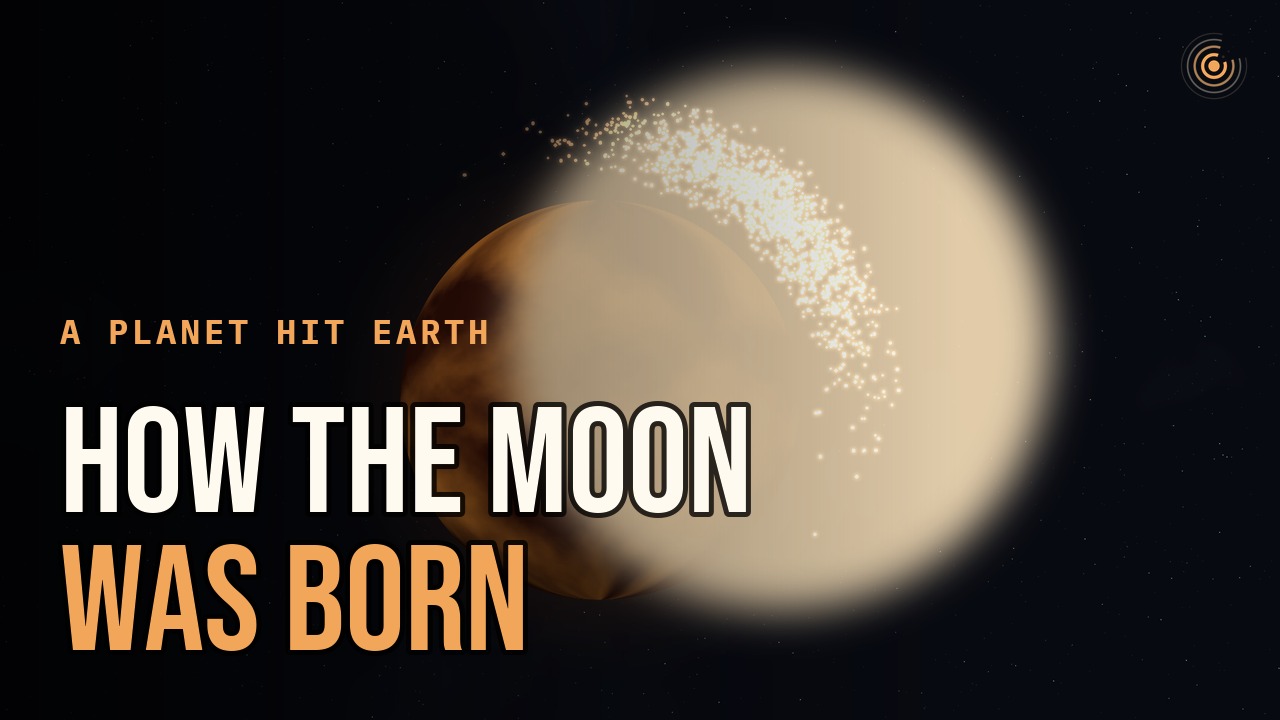
The giant-impact hypothesis is the leading explanation of where the Moon came from. About 4.5 billion years ago, some 20 to 100 million years after the Solar System formed, a body about the size of Mars, now called Theia, collided with the young Earth. The impact threw a huge amount of molten and vaporised rock into orbit, and some of it gathered together to form the Moon.
The idea, set out in its modern form by William Hartmann and Donald Davis in 1975, explains several puzzles. The Moon has only a small iron core, less than about a quarter of its radius, compared with about half for most rocky bodies, because the debris came mostly from rocky outer layers. Apollo samples suggest the Moon was once molten to a great depth, covered in a magma ocean, and a giant impact could supply the energy for that. And Moon rocks have oxygen isotope ratios nearly identical to Earth's.
That last point is also a puzzle. Bodies that formed in different parts of the Solar System usually carry different isotope fingerprints, so if much of the Moon came from Theia it might be expected to look a little different. Scientists are still testing versions of the collision, more violent or with more mixing, that could explain why Earth and Moon are so alike.
The hypothesis is widely favoured, but not every detail is settled, and no single model yet reproduces everything we know about the Moon.