How the Moon Was Born: The Planet That Hit Earth
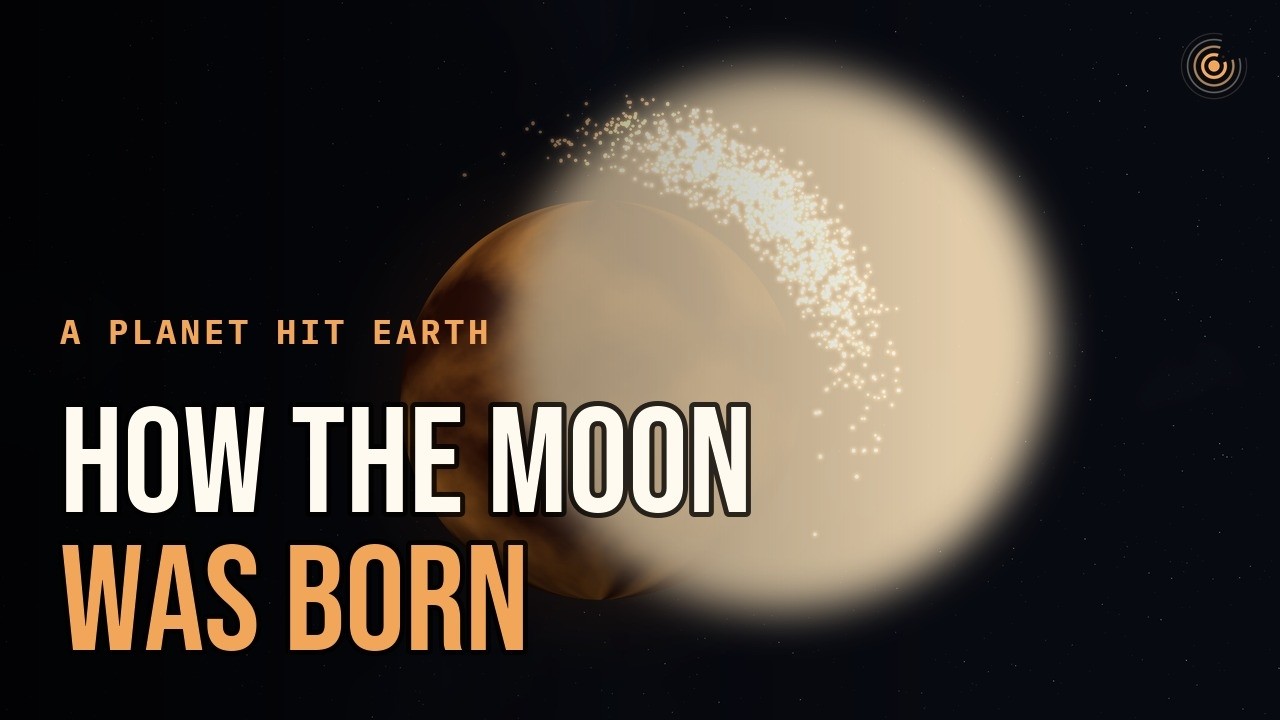
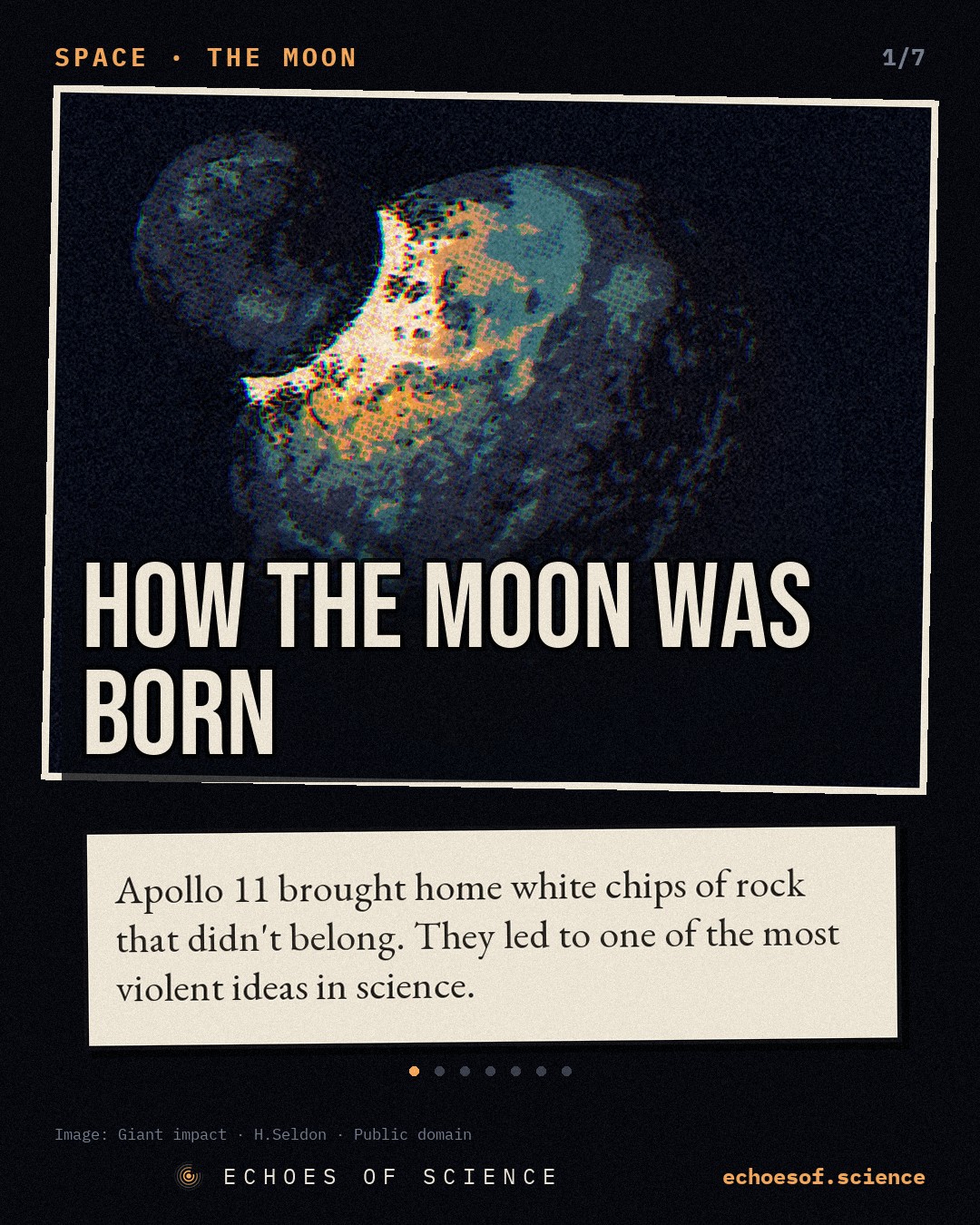
Apollo 11 brought home a few white chips of rock that didn't belong. They led to one of the most violent ideas in science: a planet hit the Earth.
In July 1969, two astronauts scooped up some grey dust from the Sea of Tranquility, sealed it in a metal box, and flew it home.
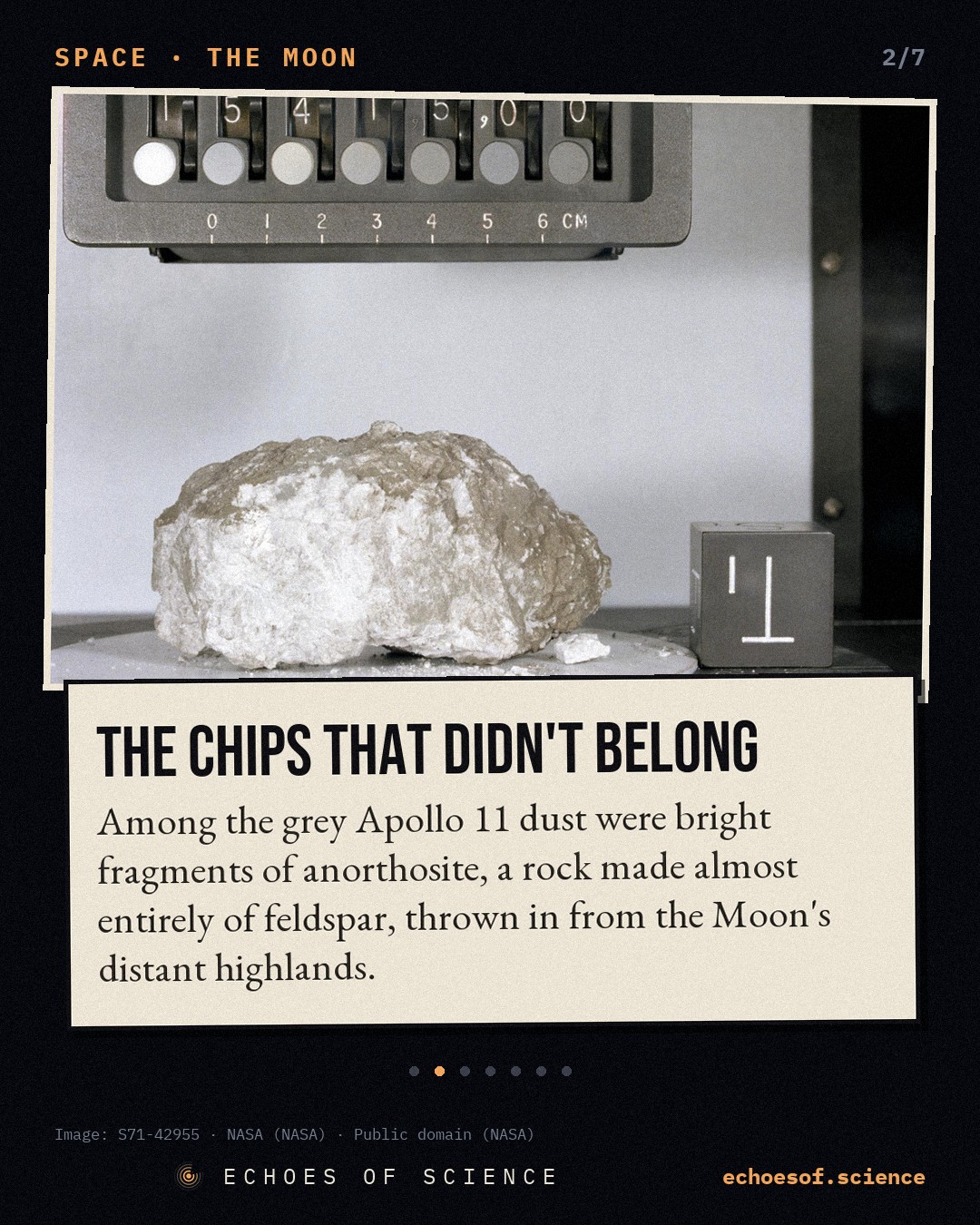
Back on Earth, scientists poured it out and looked closer. Among the dark grains were a few small white chips. They didn't belong there. They had come from mountains far away, and they were the first clue to one of the most violent events in the history of our planet.
Because the Moon was not always there. Something made it. And for most of history, nobody could say what.
Three Old Ideas
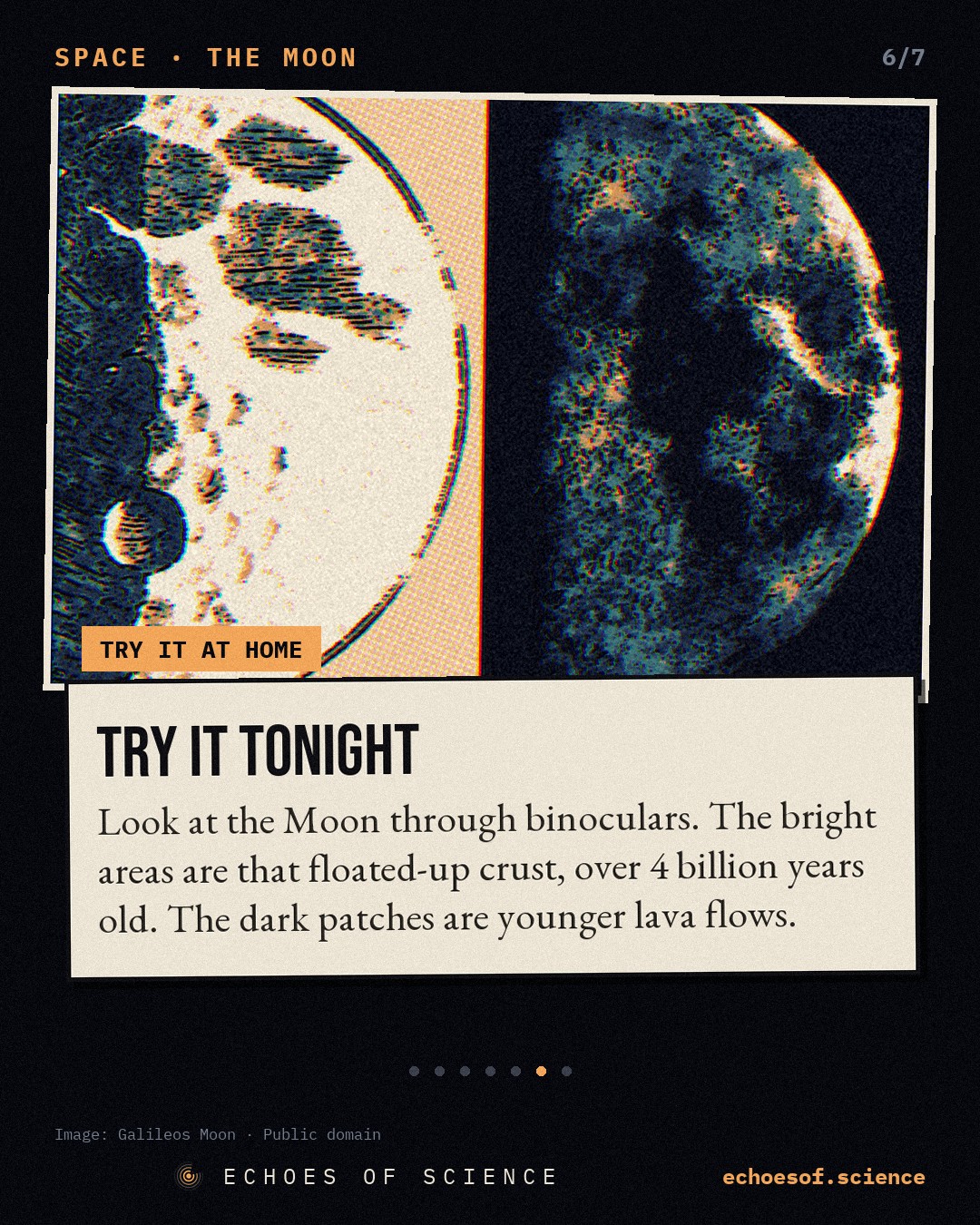
In 1610, Galileo pointed a telescope at the Moon and drew what he saw. Mountains, valleys, craters. Not a perfect heavenly sphere, but a world.
In the 1870s, George Darwin, the son of Charles Darwin, worked out that the tides are slowly pushing the Moon away from us. Run the clock backwards, he reasoned, and the Moon and the Earth were once almost touching.
So perhaps a young, fast-spinning Earth had flung the Moon off, like mud from a spinning wheel. Some even pointed at the Pacific Ocean, and suggested that was the scar.
Others thought the Moon had formed somewhere else and been captured by Earth's gravity as it wandered past. A third camp said the two were sisters, built side by side from the same cloud of rock.
For a century, all three ideas survived, because nobody had a single piece of the Moon to test them with.
382 Kilograms
Then came Apollo. Between 1969 and 1972, six crews brought back 382 kg of the Moon: 2,196 rocks, pebbles and scoops of soil.
Those white chips from Apollo 11 were anorthosite, a rock made almost entirely of a light mineral called feldspar. John Wood, at the Smithsonian, asked how a whole mountain range of it could form.
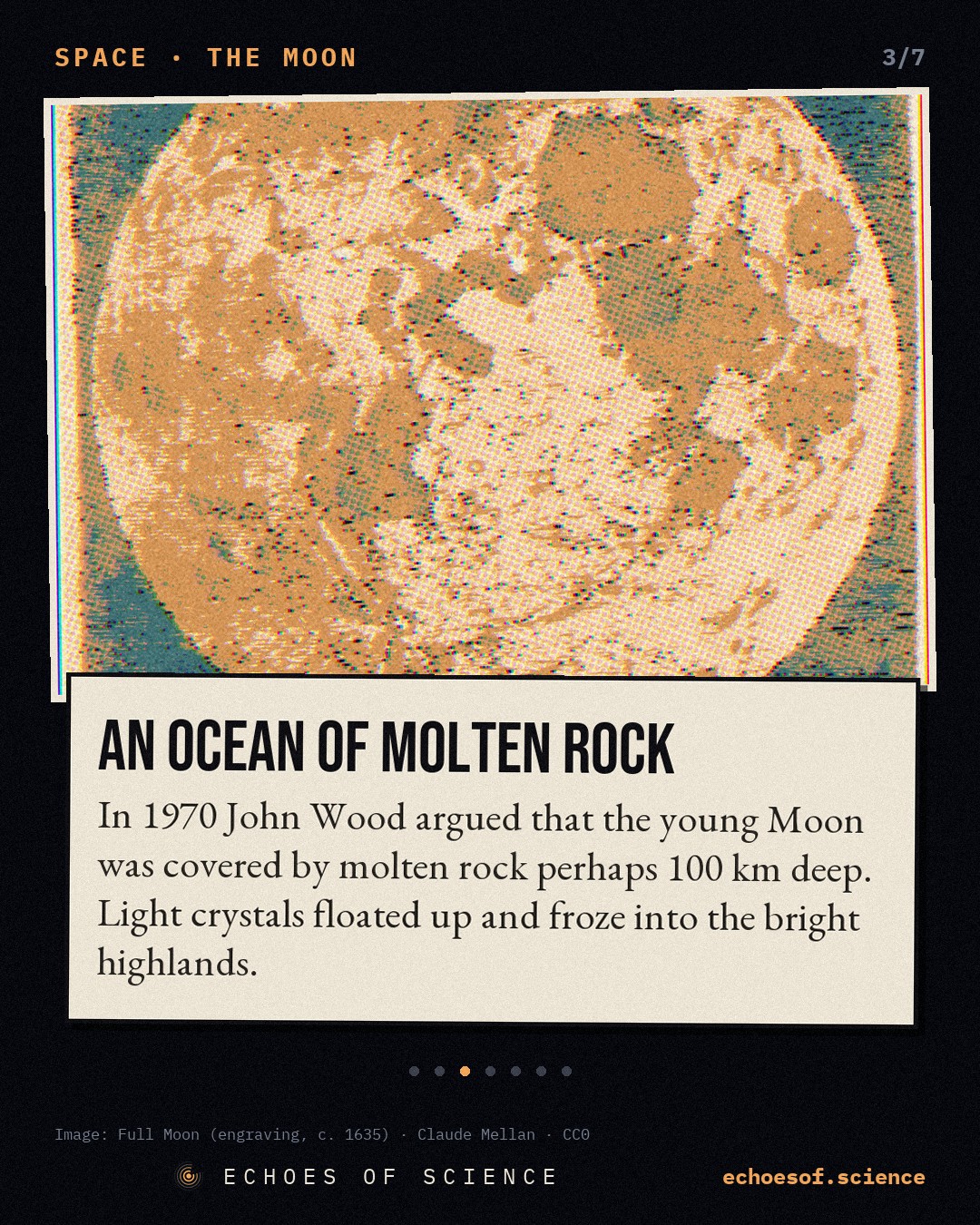
His answer was startling. The young Moon must have been covered by an ocean of molten rock, perhaps 100 km deep. Light crystals floated to the top like ice on a pond, and froze into the crust we see today as the bright highlands.
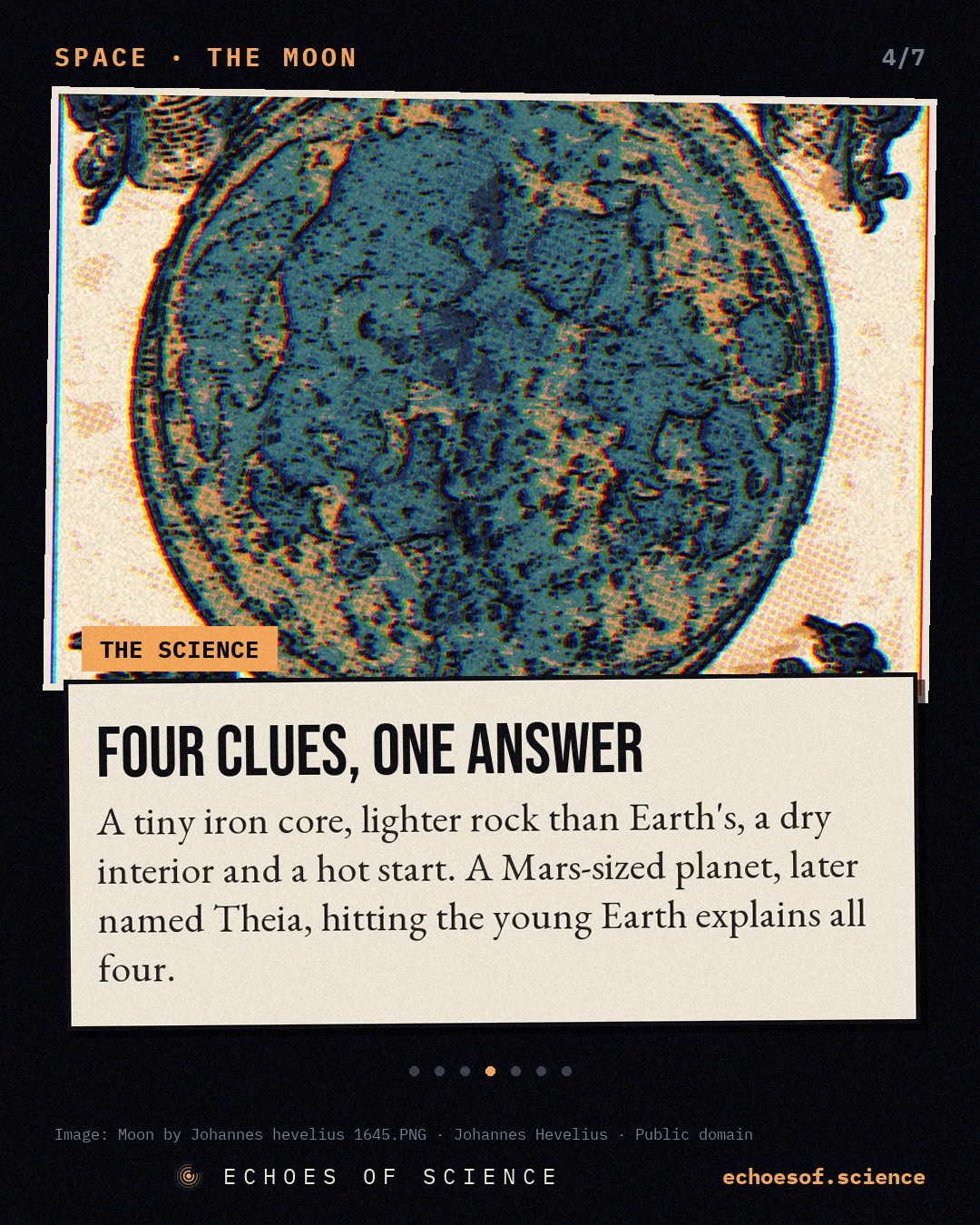
So something had made the newborn Moon incredibly hot. And the rocks had more surprises. The Moon has only a tiny iron core. Its rock is lighter than Earth's. And it is drier, missing many of the substances that boil away easily.
None of the three old ideas could explain all of that at once.
The Collision
In 1974, at a conference on planetary moons, William Hartmann and Donald Davis proposed something outrageous. Early in Earth's history, they said, another planet hit us.
In the same room, Alastair Cameron revealed that he and William Ward had reached the same idea on their own, by a completely different route. They thought the other planet had been about the size of Mars.
For ten years, the idea sat on the shelf. Then, in 1984, scientists met in Kona, Hawaii, to compare every theory against the Apollo evidence. They left with a new favourite. The impactor was later given a name: Theia, after the mother of the Moon goddess in Greek myth.
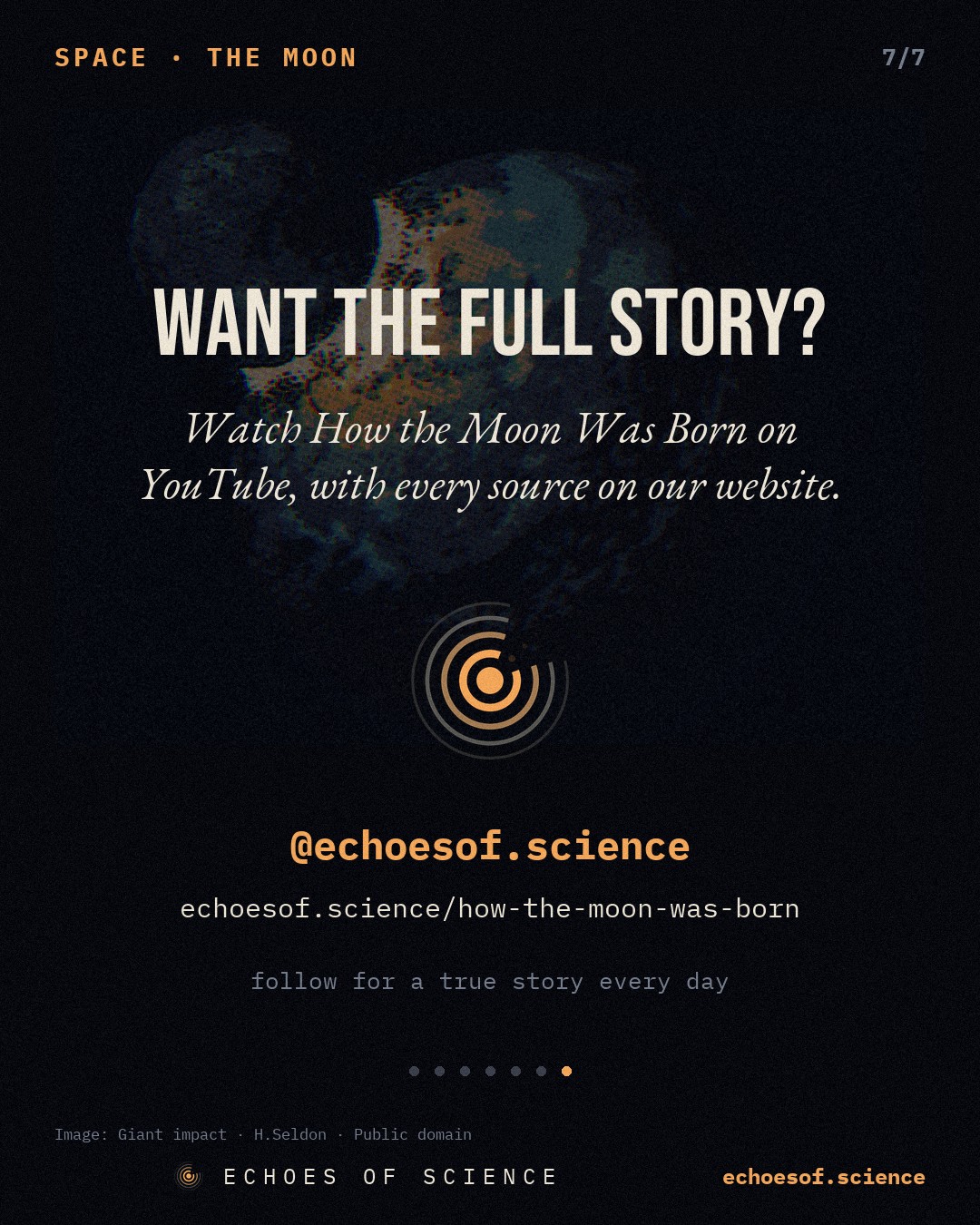
Here is what they think happened, about 4.5 billion years ago. Earth was young, and its iron had already sunk to its centre. Theia struck at an angle.
The blow melted much of both worlds. A spray of glowing rock was thrown into orbit, made mostly from their outer layers, which contain very little iron. Out there, the debris gathered together into a new Moon, so hot that it was molten all over, and lost its most easily boiled ingredients to space.
One idea explained the hot start, the small core, the light rock and the dry Moon. In 2022, the most detailed simulations so far, run by Jacob Kegerreis and colleagues, suggested the Moon might even have formed within a few hours.
This opens up a whole new range of possible starting places for the Moon's evolution.
The Fingerprint
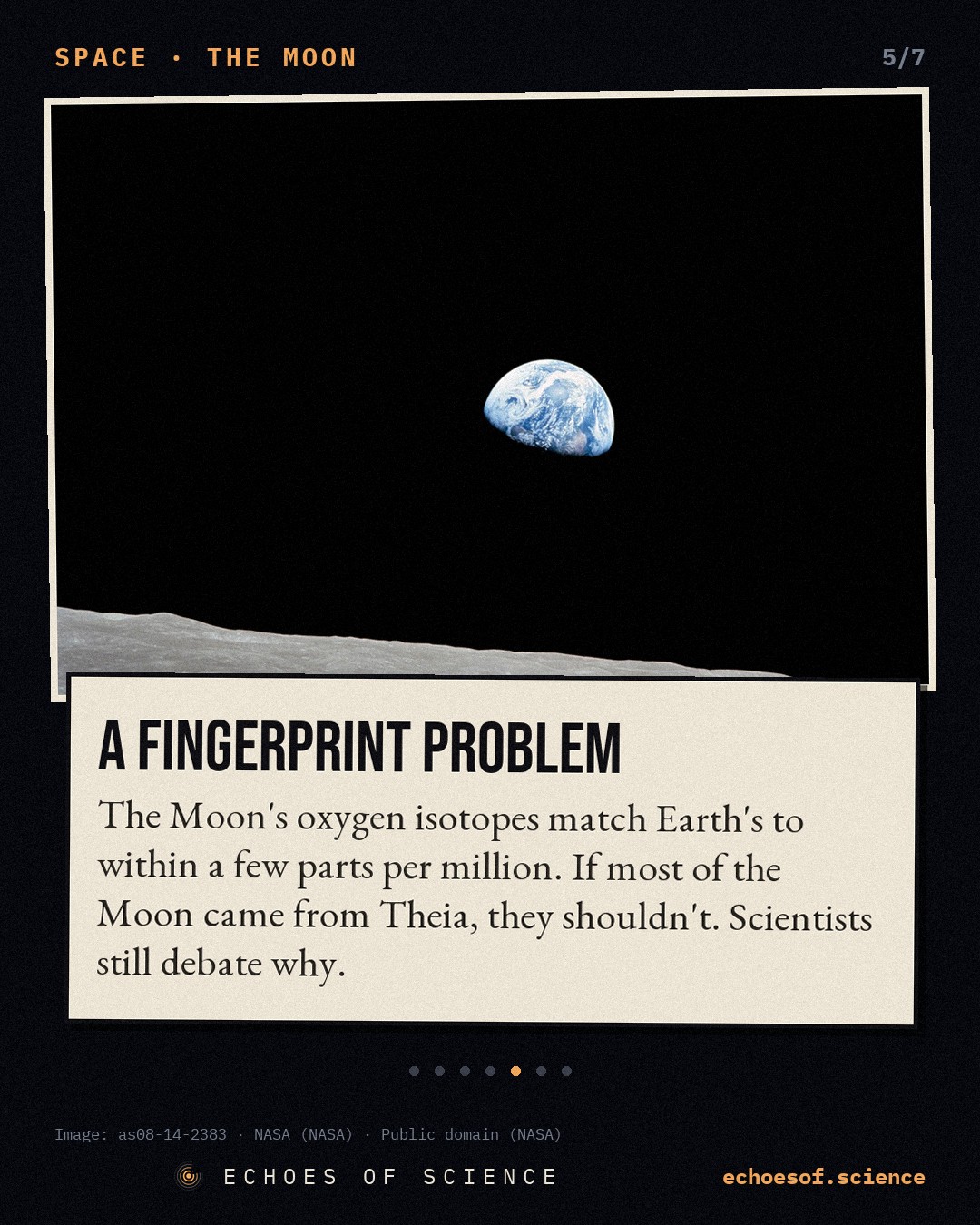
But there was a problem, hidden inside the atoms. Oxygen comes in slightly different weights, called isotopes, and every body in the solar system has its own mix, like a fingerprint. Mars has one. Meteorites from the asteroid belt have others.
The Moon's fingerprint is identical to Earth's. In 2016, Edward Young's team at UCLA compared Apollo rocks with rocks from Earth's mantle and found them the same, to within a few parts per million.
That should not happen. In the classic simulations, most of the Moon is made of Theia, not Earth. If Theia formed somewhere else, the Moon should carry Theia's fingerprint.
Young's team proposed a head-on collision, violent enough to blend the two worlds together.
Theia was thoroughly mixed into both the Earth and the Moon, and evenly dispersed between them.
Others suggest the impact turned everything into a spinning, doughnut-shaped cloud of vapour, which they call a synestia, with the Moon condensing inside it. Or that Theia simply formed close to Earth, from the same material. This is still argued about today.
Is Theia Still Here?
And there may be another witness, much closer than the Moon. Deep inside the Earth, almost 3,000 km down, seismologists have found two enormous blobs of unusual rock, one beneath Africa and one beneath the Pacific. Each is bigger than the Moon.
In 2023, Qian Yuan and colleagues suggested they could be pieces of Theia itself, which sank through the molten Earth and never mixed in. It is a bold idea, based on simulations, and it has not been tested yet.
The Moon Today
Meanwhile, the Moon keeps giving up its age. In 2023, scientists examined tiny zircon crystals from Apollo 17, atom by atom. They formed at least 4.46 billion years ago, after the magma ocean cooled. So the Moon is at least that old.
And it is still leaving us. Apollo 11 left a panel of mirrors on the Moon. Observatories still fire lasers at it, and time the echo. The Moon drifts about 3.8 cm further away every year, just as George Darwin's tides predicted.
The next clues will come from the Artemis missions, with new rocks from places Apollo never reached.
So next time you see the Moon, remember what you are looking at. Not a stranger, captured from space. A piece of the young Earth, and of a lost planet, thrown into the sky by the biggest collision our world has ever known.
The science in this story
Key facts
- Six Apollo missions (1969–72) brought back 382 kg of lunar material in 2,196 samples. source ↗
- In 1970 John Wood proposed that the young Moon was covered by a magma ocean, from light anorthosite chips in the Apollo 11 soil. source ↗
- Hartmann and Davis (1975) and Cameron and Ward (1976) proposed independently that a Mars-sized body hit the early Earth. source ↗
- Apollo rocks match Earth's mantle in oxygen isotopes to within a few parts per million, which classic impact models struggle to explain. source ↗
- Zircons from Apollo 17 are at least 4.46 billion years old. source ↗
- Laser ranging to the Apollo 11 mirrors shows the Moon moving away by about 3.8 cm a year. source ↗
In pictures
Loading the quiz…
Sources
- Hartmann & Davis (1975), Icarus 24; Cameron & Ward (1976), Lunar Science VII
- Wood et al. (1970), Apollo 11 Lunar Science Conference: the magma ocean
- Young et al. (2016), Science 351: oxygen isotopes of Earth and Moon
- Kegerreis et al. (2022), ApJ Letters 937: a Moon in hours
- Lock & Stewart et al. (2018), JGR Planets: synestias
- Yuan et al. (2023), Nature 623: Theia in Earth's mantle?
- Greer et al. (2023), Geochem. Persp. Letters: Apollo 17 zircons
- NASA JPL: Apollo 11 laser ranging retroreflector; Planetary Science Institute: Origin of the Moon
Where every picture, clip and sound in this story comes from
Keep scrolling: more true stories ↓
New mini-documentaries every week and a true story every day. Pick where you like to watch:
▶ Subscribe on YouTube Telegram TikTok Instagram Bluesky Threads ✉ Weekly email