Nebular hypothesis
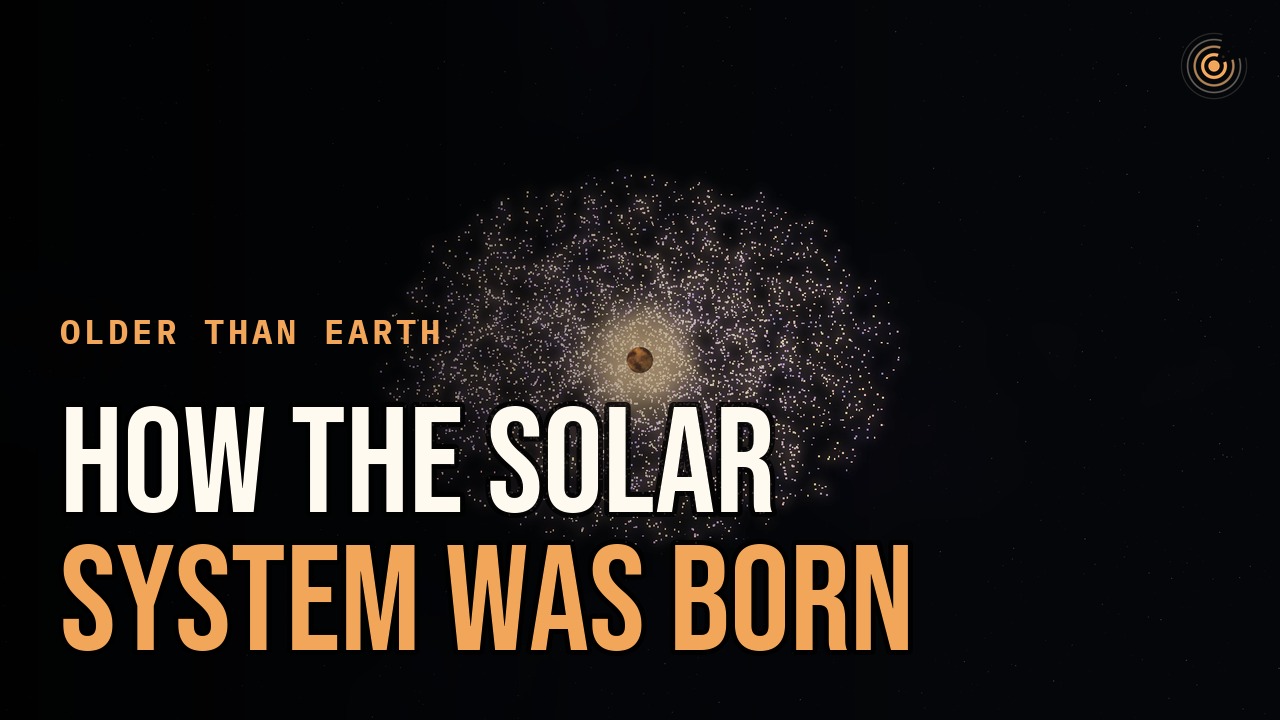
The Sun and planets formed from a collapsing, spinning cloud of gas and dust that flattened into a disc in which the planets grew.
The nebular hypothesis says the Solar System formed from a cloud of gas and dust. Early versions were put forward by Immanuel Kant in 1755 and Pierre-Simon Laplace in 1796. The modern form is supported by telescopes that can now see discs of dust, and planets forming in them, around other young stars.
The story begins when a dense pocket of a cold interstellar cloud collapses under its own gravity. As it shrinks it spins faster, like a skater pulling in her arms, and flattens into a disc, the protoplanetary disc, around the newborn star at the centre. A Sun-like star takes about a million years to form, and its disc lasts roughly 10 million years.
In the disc, dust grains stick together into pebbles, and these somehow gather into planetesimals about a kilometre across; exactly how is one of the biggest open questions. Planetesimals then collide and merge into embryos the size of the Moon or Mars, which combine into planets over 10 to 100 million years. Close to the young Sun it was too hot for ice, so the inner planets are rocky. Beyond the frost line, a few times Earth's distance from the Sun, ice was plentiful, cores grew larger and some swept up gas to become giant planets.
The model explains why the planets orbit in nearly the same plane, and in the same direction as the Sun spins.