Hyperbolic growth
Growth that speeds up as the quantity gets bigger, so fast that the curve reaches infinity at a definite moment, unlike exponential growth.
Hyperbolic growth happens when the growth rate of a quantity rises with the quantity itself. Exponential growth has a fixed doubling time; in hyperbolic growth the doubling time keeps shrinking, so the curve shoots up to infinity at a definite date, called a finite-time singularity.
An everyday picture: a savings account that raises your interest rate every time your balance grows. The bigger the balance, the faster it grows, and the faster it grows, the bigger it gets.
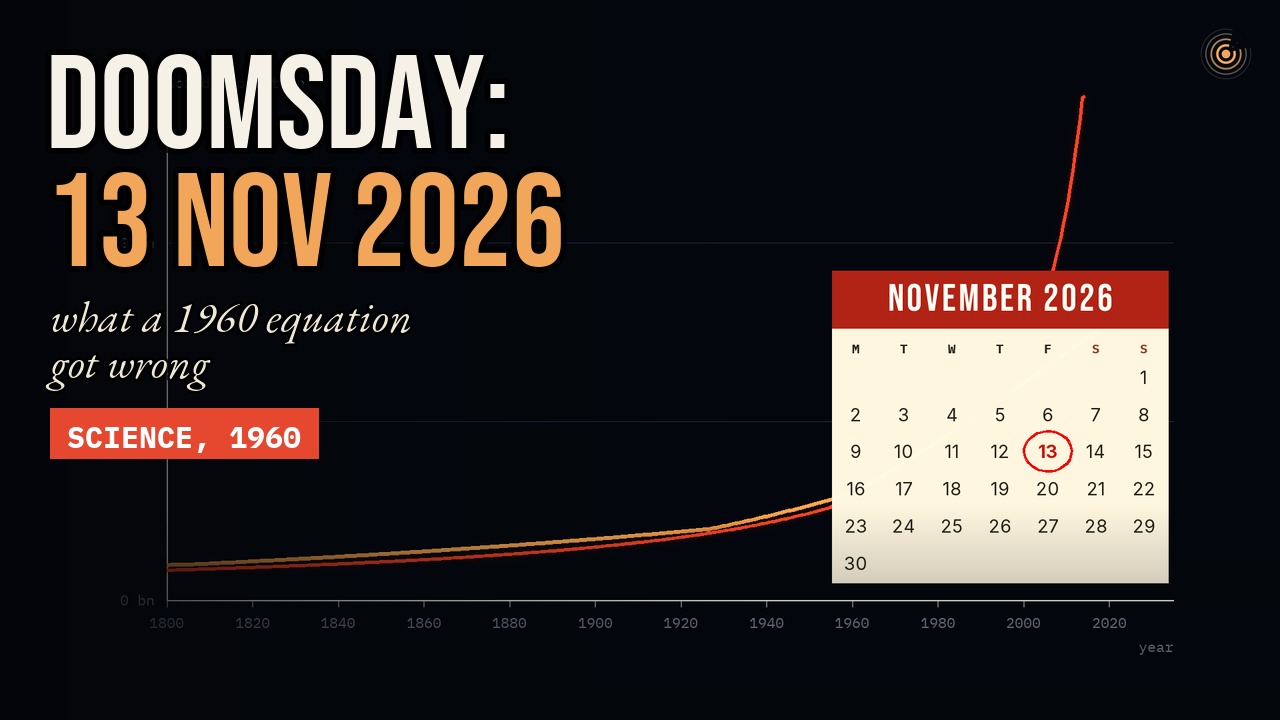
In 1960, Heinz von Foerster and two students fitted the curve N = 1.79×10¹¹ / (2026.87 − t)^0.99 to 24 estimates of world population. Its doubling time was about 0.445 times the years left, roughly 30 years in 1960, and it reached infinity in November 2026.
A common misconception is that a curve like this predicts a catastrophe. A real quantity can never reach infinity: the singularity shows where the model's assumptions must break down. World population left the curve around 1993 as families got smaller.