The Cannon That Tried to Shoot Into Space
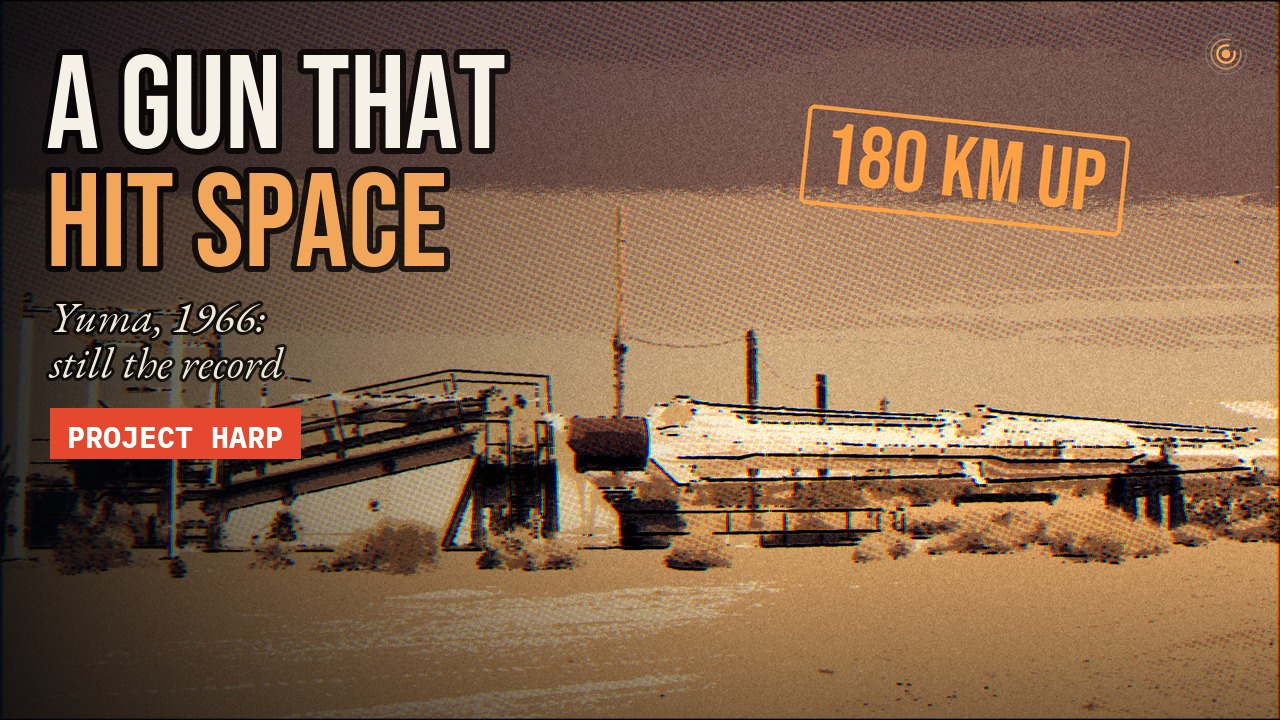
Near midnight on 18 November 1966, a 36-metre gun built from two battleship barrels fired an 84 kg Martlet about 180 km up, into space. Sixty years later no gun has fired anything higher. So why has no cannon ever put a satellite into orbit, as Newton imagined?
 Premieres on YouTube Wednesday 18 November, 17:00 UTC · subscribe to get it
A gun longer than a blue whale, aimed straight at the stars. It is about to fire something into space.
Arizona, near midnight. A sheet of flame 70 feet high, and something as long as a person leaves the barrel at more than 2 kilometres a second.
About 3 minutes later, it is 180 kilometres up. Above the air.
18 November 1966. 60 years later, no gun on Earth has fired anything higher.
So could a cannon put a satellite into orbit? 300 years ago, Isaac Newton thought it could. Then why has nobody ever managed it?
Newton's Cannon
The idea is older than the rocket. It appears in a little book printed in 1728: A Treatise of the System of the World. In it, Isaac Newton asks us to imagine a stone thrown from the top of a high mountain.
Throw it gently, and it falls nearby. Throw it harder, and it lands further away. Throw it hard enough, and something strange happens.
The Earth is round. As the stone falls, the ground curves away beneath it. Throw it fast enough, and it falls all the way round the planet without ever touching the ground. It is in orbit.
Today we know how fast that is. Just above the Earth, about 7.9 kilometres per second. 28,000 kilometres an hour. Fast enough to cross the Atlantic in a quarter of an hour.
But Newton added one quiet condition. His mountain stood above the air. No air, no drag. On the real Earth, the air would turn out to be the hardest part.
In 1865, Jules Verne took the idea further, in fiction. In From the Earth to the Moon, a club of American gunmakers builds a giant cannon called the Columbiad. Then they fire three men at the Moon.
Verne got a lot right: a launch site in Florida, a splashdown at sea. But any real passenger in that shell would have been crushed flat in the first instant. Keep that in mind. It comes back. And the first real gun to aim that high would not be built for science at all.
The Paris Gun
It was built for war. On 23 March 1918, at a quarter past seven in the morning, a shell exploded in Paris. There was no aircraft overhead. The gun that fired it stood more than 100 kilometres away.
The German army had built a gun with a barrel tens of metres long. Its shells left the muzzle at about 1,600 metres a second. They climbed around 42 kilometres high, into the stratosphere.
Each flight lasted about three minutes. That was so long, and so far, that the gunners had to allow for something no artillery had worried about before. While the shell was in the air, the Earth turned underneath it.
The gun wore itself out. Each shot scraped steel from the inside of the barrel, so each shell had to be slightly larger than the last. After about 65 shots, the barrel went back to the factory to be bored out again.
The shelling of Paris killed about 250 people. It changed nothing in the war. But it proved something to engineers: a gun could throw a shell to the edge of the stratosphere. Decades later, a Canadian engineer would study that gun very closely.
A Cannon for Science
His name was Gerald Bull. He was born in North Bay, Ontario, in 1928, and became a gifted aeronautical engineer. By the late 1950s he had a simple, stubborn idea. Rockets were expensive, and thrown away after one flight. A gun could fire again and again.
In 1961 he joined McGill University in Montreal. In March 1962, McGill and the United States Army announced the High Altitude Research Project: HARP. The Army gave him old battleship guns, 16 inches across, and a radar tracking system.
Now he needed somewhere to fire them. He chose Barbados, the most easterly island of the Caribbean. From there, a shell could fly out over open Atlantic Ocean.
That same year, a 16-inch naval barrel came ashore at Foul Bay. It was hauled to a site called Paragon, beside the island's airport. Bull's team joined two barrels end to end, and smoothed out the rifling inside. The gun was now about 36 metres long, and weighed some 200 tonnes.
What came out of it was not a shell. It was a slim dart called a Martlet, about 20 centimetres wide, with fins at the back. It sat in a wooden sleeve, called a sabot, that filled the barrel. The sabot fell away as the dart left the muzzle.
Inside, a Martlet carried science. Chemicals that left trails of smoke high in the air, so cameras on the ground could watch the winds twist them. Clouds of metal foil for radar to follow. Small instruments, and balloons.
In 1963, a Martlet reached 92 kilometres, a record for a gun. By the end of 1965, more than 100 had gone above 80 kilometres. Each shot cost a few thousand dollars, and took about half an hour to load. A rocket to the same height cost far more.
And the acceleration was savage. In the barrel, a Martlet felt up to 15,000 times the pull of gravity. No human body could survive that. A steel dart did not mind at all. But the record that still stands today would not be set in Barbados.
The Record
In 1966, HARP built a second big gun, almost identical, at Yuma Proving Ground in Arizona. Here, shells landed on Army land, where the crew could go and pick them up.
On the night of 18 November, the crew loaded a Martlet 2 weighing about 84 kilograms. Behind it went a stack of powder bags 4.5 metres long. More than 550 kilograms of propellant, lit at 5 points at once.
At 4 minutes to midnight, the gun fired. The Martlet left the barrel at about 2,100 metres a second. Radar stations across Arizona and California tracked it as it rose.
It passed 50 kilometres. Then 100, which is where space is usually said to begin. It kept climbing, slowing all the time. At about 180 kilometres, it stopped, and began to fall.
It came down on the range about 50 kilometres away. It was the highest altitude ever reached by a gun-fired projectile. Guinness World Records still lists it today.
But 180 kilometres up is not orbit. The Martlet went up, and came straight back down. Why it could never stay up is a matter of physics. But first: how do we know any of this?
How Do We Know?
The Army tracked each shot with radar. HARP's results were written up in technical reports. Those reports are now public, in the archive of the US Defense Technical Information Center.
The sources do not agree on every detail. Some give the height as 179 kilometres, some 180, some 181. The Army gives the date as 18 November. Guinness says the 19th. But at 4 minutes to midnight in Arizona, it was already the morning of the 19th in universal time. Both can be right.
What nobody disputes is the physics. To see why HARP never reached orbit, we need Newton again. There are three walls. The first is speed. The record shot left the barrel at about 2.1 kilometres a second. Orbit needs 7.9.
That sounds like 4 times faster. But energy grows with the square of the speed. To reach orbital speed, the Martlet would have needed about 14 times more energy. The Paris Gun's engineers already knew the trick: a longer barrel, more powder. But every gun hits a limit, where the powder gases cannot push any faster.
The second wall is the air. A gun fires at the bottom of the atmosphere, where the air is thickest. A shell travelling several times the speed of sound ploughs through it, and loses speed every metre of the way. Newton's mountain was above the air. Barbados was at sea level.
The third wall is geometry, and it is the one most people miss. Anything fired from the ground, with no engine, follows a path that brings it back to the height it started from. Newton's stone could orbit because it was thrown sideways from the top of a mountain. A shell fired upward from the ground will always come back.
To stay up, it needs a second push, high above the ground, sideways along the orbit. That push needs a rocket. Bull knew this. His design for a Martlet 4 was a rocket in its own right. It was about 8.5 metres long, built to survive the gun, and then fire its own motors at the top.
It would have carried a small satellite, of a few tens of kilograms. It was never built. In the very month of the record, the trouble began.
The End of the Gun
That November, 1966, Canada announced it would stop paying for HARP. The money ran out in June 1967. By then Canada had spent about $4.3 million, and the US Army about $3.7 million. HARP was over.
Bull kept going on his own, with a company that designed artillery. Here his story turns dark. In 1980 he spent about six months in an American prison. His crime was shipping shells and gun technology to South Africa, in breach of a United Nations arms embargo.
Later he worked for Iraq, on long-range guns, and on a giant gun project the press called the supergun. On 22 March 1990, Gerald Bull was shot dead outside his apartment in Brussels. Nobody has ever been charged with his murder.
Soon afterwards, customs officers in Britain seized steel tubes that turned out to be parts of the Iraqi gun. After the Gulf War, United Nations inspectors destroyed what was left. But Bull's first guns, the ones built for science, are still there.
Today
The one in Barbados still lies on its concrete base at Paragon, rusting in the salt air beside the airport. The Yuma gun still sits in the Arizona desert. It was fired for the last time in 1992, horizontally.
And the upper air that HARP studied is still hard to reach. Too high for aircraft and balloons. Too low for satellites, which would quickly be dragged down. Scientists still send sounding rockets up for a few minutes at a time, much as Bull sent his Martlets.
The dream of launching from the ground without a big rocket has not gone away either. Engineers keep returning to it, because a gun can be fired again and again. But every new design still meets the same three walls: the speed, the air, and the push you need at the top.
Epilogue
Newton's cannon was a thought experiment. It needed a mountain above the air, and a perfect throw. Gerald Bull got closer to building it than anyone before or since.
For about three minutes, on a night in November 1966, a shell from a gun touched space. Then it fell back to Earth, exactly as Newton said it would.
Next time: the first hack in history, in 1834, when two bankers broke into the French state telegraph. And on our website, fire the HARP gun yourself, and try to beat the record.
The science in this story
Key facts
- 18 Nov 1966, 11:56 p.m., Yuma Proving Ground: the HARP gun fired a Martlet 111 miles (~180 km) high; flame 70 ft; it landed ~30 miles away; last fired 1992, horizontally. source ↗
- Guinness: highest altitude reached by a gun-fired projectile, 180 km, 84 kg projectile, Yuma (dated 19 Nov 1966). source ↗
- The Yuma gun: 15-ft stack of powder bags lit at five points; Martlet with a wooden sabot; payloads of chemical smoke, chaff and balloons. source ↗
- HARP's Barbados gun came ashore at Foul Bay in 1962 and stood at Paragon beside the airport; it is still there, rusting. source ↗
- The Paris Gun (1918) fired from ~120 km; its shells climbed ~42 km and flew ~3 minutes; the barrel was rebored after ~65 shots. source ↗
- Newton's cannonball appears in A Treatise of the System of the World (1728). source ↗
Loading the quiz…
Sources
- US Army: 'Space cannon blasts into 1960's space race' (2013); '…50th anniversary of world record setting shot' (2016)
- Guinness World Records: highest altitude reached by a gun-fired projectile
- Newton, A Treatise of the System of the World (1728) · Verne, From the Earth to the Moon (1865)
- Wikipedia as index only: Project HARP, Paris Gun, Gerald Bull
Where every picture, clip and sound in this story comes from
Keep scrolling: more true stories ↓
New mini-documentaries every week and a true story every day. Pick where you like to watch:
▶ Subscribe on YouTube Telegram TikTok Instagram Bluesky Threads ✉ Weekly email