Tsunami
A series of long, powerful waves made when a huge volume of water is suddenly displaced by an earthquake, landslide or eruption.
A tsunami is a series of waves made when a huge volume of water is suddenly pushed out of place. Most are caused by undersea earthquakes that jolt the sea floor up or down, but landslides, volcanic eruptions and asteroid impacts can cause them too.
Tsunamis are not like wind waves. A wind wave stirs only the top few metres of the sea; a tsunami moves the whole depth of the water, and its wavelength can be hundreds of kilometres. In the open ocean it may pass a ship almost unnoticed, yet it travels as fast as a jet airliner. Reaching shallow water it slows, its energy piles up, and it rises into a wall of water or a fast, relentless surge that can run far inland. Often the first sign is the sea drawing back unusually far.
When a landslide or rockfall plunges into a narrow bay it can create a local impulse wave of extraordinary height. On 9 July 1958 an earthquake in Alaska shook about 30 million cubic metres of rock into Gilbert Inlet, at the head of Lituya Bay. The water surged up the opposite slope to a height of 524 metres, stripping away the forest, the highest wave run-up ever recorded. Five people died.
A common misconception is that a tsunami is a "tidal wave". It has nothing to do with the tides.
See it in action
 Watch nowThe Sound That Circled the Earth27 August 1883 · Sunda Strait, Dutch East Indies
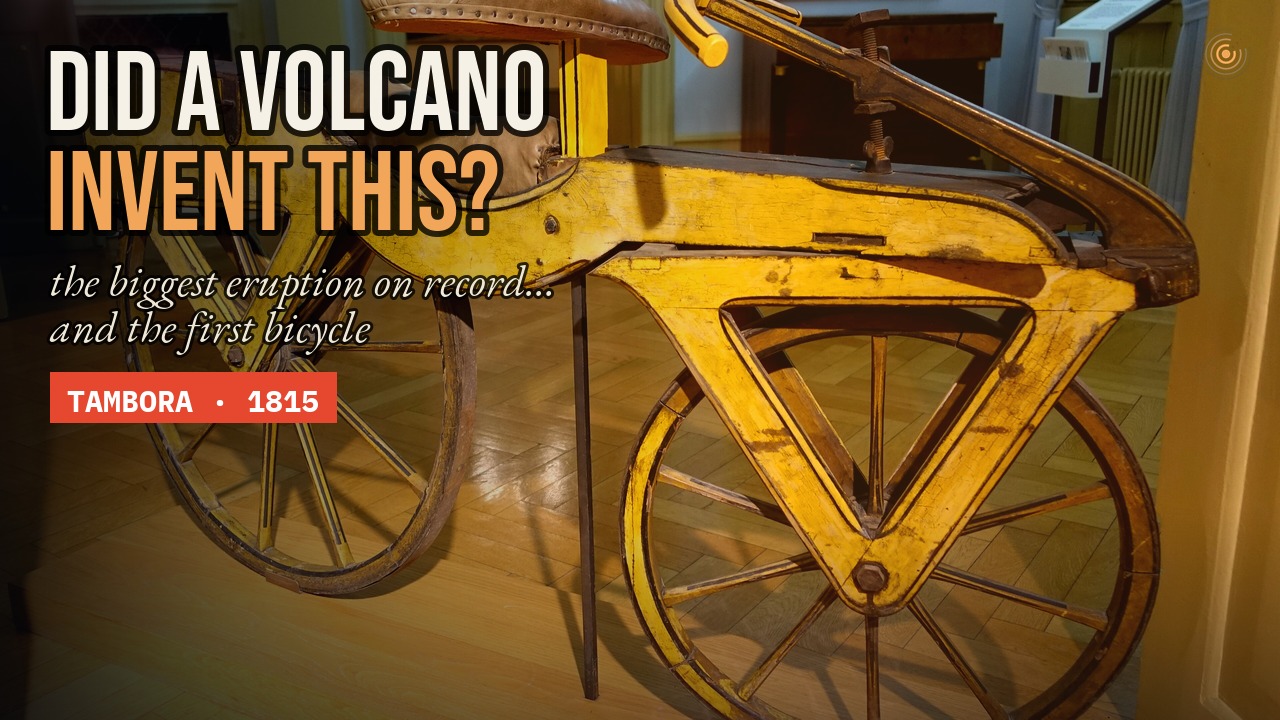 Premieres 21 NovThe Volcano That Invented the Bicycle1815–1817 · Tambora to Mannheim
 Premieres 15 NovThe Oil Prospectors Who Found the Dinosaur Killer1978–1991 · Yucatán Peninsula, Mexico
Coming up in future stories
- The Stone That Said 'Do Not Build Below This Point' 1896, 1933, 11 March 2011 · Aneyoshi, Iwate, Japan
- The Wave Taller Than the Empire State Building 1958 · Lituya Bay, Alaska