Ultraviolet vision
The ability of many birds, insects and other animals to see light just beyond violet, which human eyes block and cannot detect.
Humans have three kinds of colour-sensing cone cell. Most birds have four, and the fourth is tuned to violet or ultraviolet light, roughly 300 to 400 nanometres. Bees, many fish and some reptiles can also see near-ultraviolet.
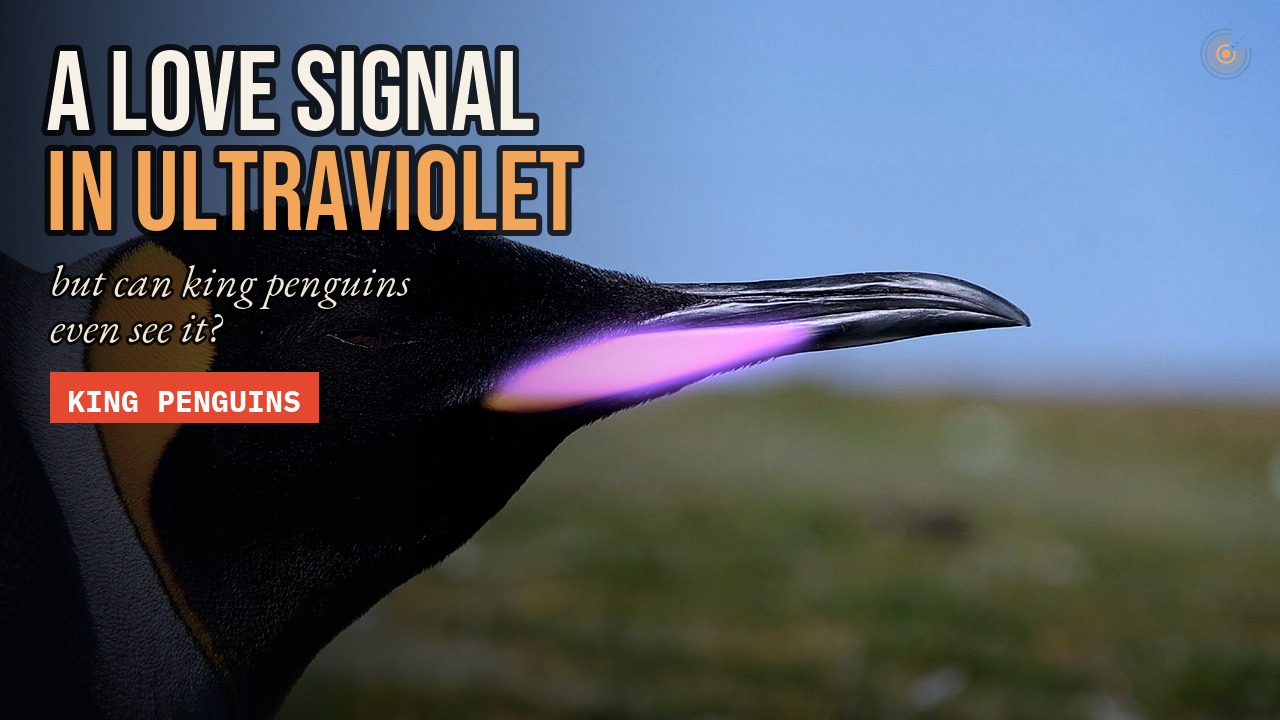
Two things decide whether an animal sees ultraviolet: its cone pigments, and the clear parts of the eye in front of them. Our own lens soaks up most ultraviolet before it reaches the retina, which helps protect it. In 2023, measurements in Auckland found that the lens of a king penguin lets through half the light only at 406 nanometres, while little penguins let half through at 329 nanometres.
Experiments showed that homing pigeons detect ultraviolet (1978) and that zebra finches use it in choosing mates (1996). Feathers that look plain to us can carry ultraviolet patterns that birds see clearly.
A common misconception is that all birds see the same colours. In fact ultraviolet sensitivity has switched on and off many times in bird evolution, and some species, perhaps including king penguins, see very little of it.