The Ultraviolet Love Signal Penguins Might Not See
King penguins seem to choose partners partly by their colourful beak spots, which reflect ultraviolet light. But a 2023 study of their eyes found the king penguin's lens blocks almost all UV, so the signal may not work the way scientists thought.
 Premieres on YouTube Monday 23 November, 17:00 UTC · subscribe to get it
Possession Island, in the Crozet archipelago, roughly halfway between Madagascar and Antarctica. On a black beach, tens of thousands of king penguins stand shoulder to shoulder, and the air is thick with their trumpeting.
At the edge of the crowd, two birds face each other, stretch tall, and turn their heads to show off a bright orange stripe on their long black beaks. To us, it is simply orange.
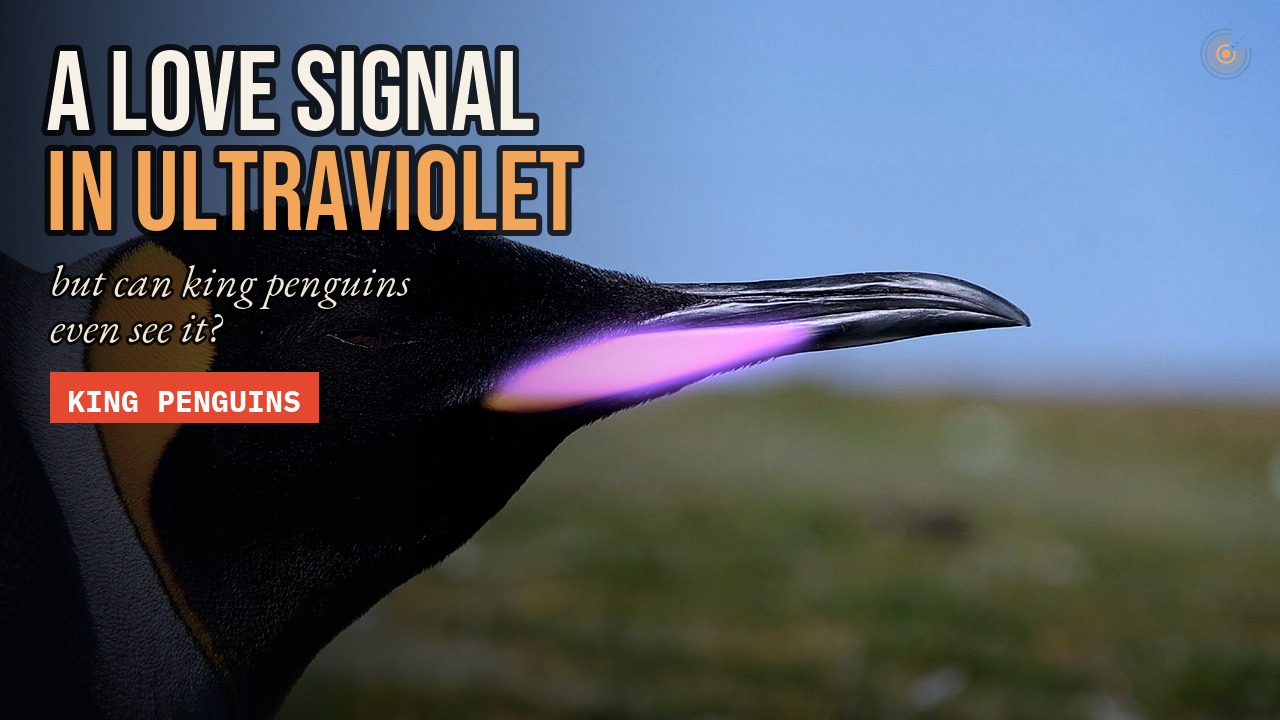
But that stripe also shines in a colour our eyes cannot see: ultraviolet. Scientists found that a penguin whose ultraviolet glow was dulled had a harder time finding a partner. A secret love signal, it seemed, in a light only birds could see.
Then, in 2023, an eye surgeon in Auckland, New Zealand, published what happened when he shone light through a king penguin's eye. Almost none of the ultraviolet got through.
So who is that glow really for? And how could a signal the birds may barely see help them choose who to love?
A City Without Addresses
King penguins are the second-largest penguins on Earth: almost a metre tall, and up to 15 kg. They breed on the windswept islands of the far Southern Ocean, from South Georgia to Crozet, Kerguelen, Macquarie and a handful of others. More than 2 million pairs in all.
And they live by a strange calendar. An egg takes about 54 days to hatch. Then the chick stays at the colony for nearly a year, huddled with thousands of others through the southern winter, while its parents shuttle to and from the sea. It is the longest breeding cycle of any penguin.
That is why a pair can raise, at most, 2 chicks every 3 years. Each partnership is a huge investment, for both birds. Choosing the right partner matters.
But there is a problem. King penguins build no nest. There is no tree, no burrow, no address. Partners must find each other again in a crowd with few landmarks, in colonies that can hold 300,000 birds. So how do you find your one bird in all of that?
In the 1990s, the French bioacoustician Thierry Aubin and the ecologist Pierre Jouventin answered part of that question with loudspeakers. They played recordings of parents' calls to chicks in the colony. The chicks ignored strangers, and ran towards their own parent's voice, even when the scientists mixed in the din of other birds.
The secret is in the throat. A bird's voice box, the syrinx, has two branches, and a king penguin sounds both at once. The two voices beat against each other, and the beating pattern is as personal as a face. When the scientists played back emperor penguin calls with one voice removed, the birds did not answer.
So penguins can recognise each other by sound. But before a pair is a pair, there is courtship. And courtship is about looking. For that, the same French team turned to the most striking thing about a king penguin's face.
Beyond Violet
Light is a wave, and the colour we see depends on its wavelength. Our eyes catch waves from about 700 nanometres, which we see as red, down to about 400, violet. Beyond violet, the waves get shorter still. That is ultraviolet.
In 1801, the German physicist Johann Ritter shone sunlight through a prism and put light-sensitive paper just past the violet end of the rainbow. Where he could see nothing at all, the paper turned dark. There was light there, invisible light.
Why can't we see it? Partly because of the lens in our eyes, which soaks up most ultraviolet before it reaches the retina. Some people who have had a lens removed have reported seeing it, and one described a world that looked brighter, and bluer.
Many birds have no such barrier. We have 3 kinds of colour-sensing cone in the retina. Most birds have 4, and the fourth is tuned to violet or ultraviolet. In 1978, experiments showed that homing pigeons could detect ultraviolet light.
Then, in 1996, a team in Bristol showed that zebra finches use ultraviolet when they choose a mate. Their warning was pointed: when we judge a bird's colours with our own eyes, we may be missing part of the message.
So biologists began to carry spectrometers into the field, instruments that measure exactly how much light a surface reflects at every wavelength, including the ones we cannot see. Feathers and skin that looked plain to people could carry patterns in ultraviolet.
And when the French team pointed a spectrometer at a king penguin's beak, they found that the orange stripe was hiding something.
A Mirror Made of Layers
In 2005, Pierre Jouventin and his colleagues reported that the beak spots of king and emperor penguins reflect ultraviolet light, strongly. Among seabirds, nothing like it was known.
Unlike humans, most birds perceive UV light.
But what makes the glow? Birds have no known ultraviolet pigment. So that same year, the vision scientist Birgitta Dresp, with Jouventin and Keith Langley, took beak horns that penguins had shed during their moult on Possession Island, and looked inside.
Under the electron microscope, the top of the horn turned out to be built in layers, like the pages of a closed book, each thinner than a wavelength of light. That is a photonic structure: colour made from shape, not from pigment.
Here is how it works. Each boundary between layers reflects a little light. For most wavelengths, those small reflections arrive out of step and cancel. But for one wavelength, set by the spacing of the layers, they arrive in step, and add up. That wavelength is reflected strongly. The same trick paints soap bubbles, and the blue of a morpho butterfly.
In the king penguin's beak, the peak sat at 367 nanometres, well into the ultraviolet. When Dresp's team removed about a sixth of the horn's thickness, the peak shifted slightly. When they removed more than a third, it vanished. The glow lived in the top layers.
A precise, built structure, on the one part of the face that a courting partner stares at. It looked like a signal. The obvious next question was: does anyone read it?
The Dating Game
Watch a king penguin colony in the southern spring, and you see the dating game. Birds ready to breed gather at the edge of the colony and display: heads up, beaks raised, ear patches flashing gold. Some pairs move into the colony and lay an egg. Others split up, and try again with someone else.
With the American ecologist Stephen Dobson, the French team began to experiment. On some birds, they dulled the ultraviolet of the beak spots. On others, they made the golden ear patches smaller. Both kinds of bird were slower, or less likely, to find a partner.
In 2015, the team published the colours of 75 courting pairs on the Kerguelen Islands, measured with a spectrometer and modelled for penguin eyes. The partners who stayed together had beak spots more alike in colour than chance would predict. The ear patches and the chest showed no such pattern. Only the beak.
And the females in lasting pairs had beak spots richer in ultraviolet, and more yellow, than the females whose pairs broke up.
There is a reason a partner might care. Later studies found that the colour of the beak spots shifts with a bird's condition. It changes during the long fasts on land, and with parasite loads. Stress during the moult changed the yellow and the ultraviolet too.
In other words, the beak may be an honest advertisement: a report on how well its owner is doing, written in colour. And because mother and father share every task, from incubation to months of feeding, it pays for both of them to be choosy. That may be why both sexes wear the same bright beak.
It was a satisfying story, and science magazines loved it. A love signal, written in a colour only birds could see. But one person was not satisfied. He was not an ornithologist. He was an eye surgeon.
The Eye Surgeon's Question
Peter Hadden operates on human eyes in Auckland. Some years ago, John Darby, formerly of the Otago Museum in Dunedin, asked him to look at how penguins see. Hadden and Jie Zhang of the University of Auckland have since scanned, dissected and measured the eyes of captive and rescued penguins.
We need to understand how they see, as they depend on sight for foraging and to avoid predation.
Their question about the beak was simple. Before ultraviolet light can tell a penguin anything, it has to get into the eye. It must pass the cornea, then the lens, then the clear jelly behind it, and only then reach the retina.
So the team took eyes from penguins that had died, kings and gentoos from Kelly Tarlton's aquarium in Auckland, and a little penguin from the wild, the smallest species of all. Then they measured how much light, at each wavelength, passed through each part.
The cornea stopped the harshest ultraviolet in all three. But the lens made the difference. In the little penguin, half the light got through even at 329 nanometres, deep in the ultraviolet. The gentoo's eye let ultraviolet in, too.
In the king penguin, the lens let half the light through only at 406 nanometres. That is violet, not ultraviolet. Below about 370, almost everything was absorbed.
Remember where the beak spot shines brightest: 367 nanometres. Right where the king penguin's own lens closes the door.
UV reflectance should be of much lesser importance in the behaviour of the King Penguin.
Published in the journal Polar Biology in August 2023, the paper concluded that ultraviolet vision in king penguins is very limited, and unlikely to play a significant role in their lives. The idea of an ultraviolet love signal, the authors argued, should be reconsidered, or at least tested again.
How Do We Know?
So is the love signal a myth? Maybe not. The new study had real limits. It measured just 2 king penguins, captive birds descended from South Georgia, and from one of them only the jelly of the eye could be used.
And a lens is not the whole story. What a bird sees depends on its cone cells, and on its brain. Penguins have a cone tuned to violet, at around 403 nanometres, and it may still catch some of the longest ultraviolet that slips through. Very limited is not the same as none.
Then there is the beak itself. The spot is not only ultraviolet. Its orange and yellow also change with a bird's condition, and those colours pass through a king penguin's lens with no trouble at all.
One possibility, and it is only a possibility, is that the ultraviolet glow is a side effect: a by-product of a well-built, well-maintained beak whose visible colour is the real message. If so, an experiment that dulled the ultraviolet might also have changed what the birds could see.
The honest answer today is that nobody knows for sure. The way to find out is an experiment that changes the ultraviolet and nothing else, run in a colony, with partners watching. Until then, the king penguin's love signal is an open question, and a good one.
Seeing Through Other Eyes
Why does any of this matter, beyond the private lives of penguins? Because it is a lesson about measuring the world with the wrong instrument. For centuries, we described animal colours as we saw them. Then we learned that birds see more. Now we are learning that not every bird sees the same.
And what animals see is becoming a conservation question. In March 2026, the same Auckland group published the eye filters of 8 New Zealand seabirds. Most petrels and shearwaters let ultraviolet in. Gannets and shags did not.
Light pollution is one of the great threats to petrels and shearwaters. On their first flight to sea, young birds are drawn to bright lights and come down on land. On Phillip Island, in Australia, rescuers found almost 9,000 grounded shearwater chicks in 15 years, and 39% were dead or dying.
Knowing which wavelengths each species sees could help us design lighting that birds can ignore.
King penguins have their own troubles. On Île aux Cochons, in the Crozet islands, the world's largest king penguin colony held about half a million pairs in the 1980s. Satellite images taken in 2017 showed around 60,000. When the decline was reported, nobody could say why.
And as the oceans warm, the rich feeding waters of the Antarctic Polar Front are drifting south, away from the islands. One modelling study warned that if emissions stay high, up to 70% of king penguins might have to move by the end of this century, or could disappear.
Epilogue
Back on the black beach, two birds still face each other, beak to beak. Each sees something in the other that we cannot. Maybe it is a glow of ultraviolet. Maybe it is a shade of orange, or a voice. We have measured the light, the lens and the layers. What the penguins see in each other is still theirs to know.
Next time: the wild bird that answers when people call, and leads them to honey, in Mozambique. And on our website, you can look at a penguin colony through three different eyes, and play penguin matchmaker.
The science in this story
Key facts
- Keddar and colleagues (Ethology, 2015) measured 75 courting pairs on the Kerguelen Islands; pairs that went on to breed had similar beak colours, while chest patches did not predict success source ↗
- Females in lasting pairs had more UV and more colourful beak spots than females in temporary pairs source ↗
- A 2023 Polar Biology study found the king penguin lens blocks nearly all light below 370 nm (50% transmission at 406 nm), concluding UV perception is 'very limited' and the mate-choice idea should be re-tested source ↗
Loading the quiz…
Sources
- Hadden et al., Polar Biology 2023 · Hadden & Zhang, Vision 2023
- Dresp et al., Biol. Lett. 2005 · Jouventin et al., Condor 2005
- Keddar et al., Ethology 2015 · Schull et al., Ecol. Evol. 2017 · Viblanc et al. 2016
- Aubin & Jouventin 1998 · Aubin et al. 2000 (Proc. R. Soc. B)
- Weimerskirch et al. 2018 · Cristofari et al. 2018 · Heswall et al. 2026 · Rodríguez et al. 2014
Where every picture, clip and sound in this story comes from
Keep scrolling: more true stories ↓
New mini-documentaries every week and a true story every day. Pick where you like to watch:
▶ Subscribe on YouTube Telegram TikTok Instagram Bluesky Threads ✉ Weekly email