Agatha Christie Vanished for 11 Days. She Was Found Dancing
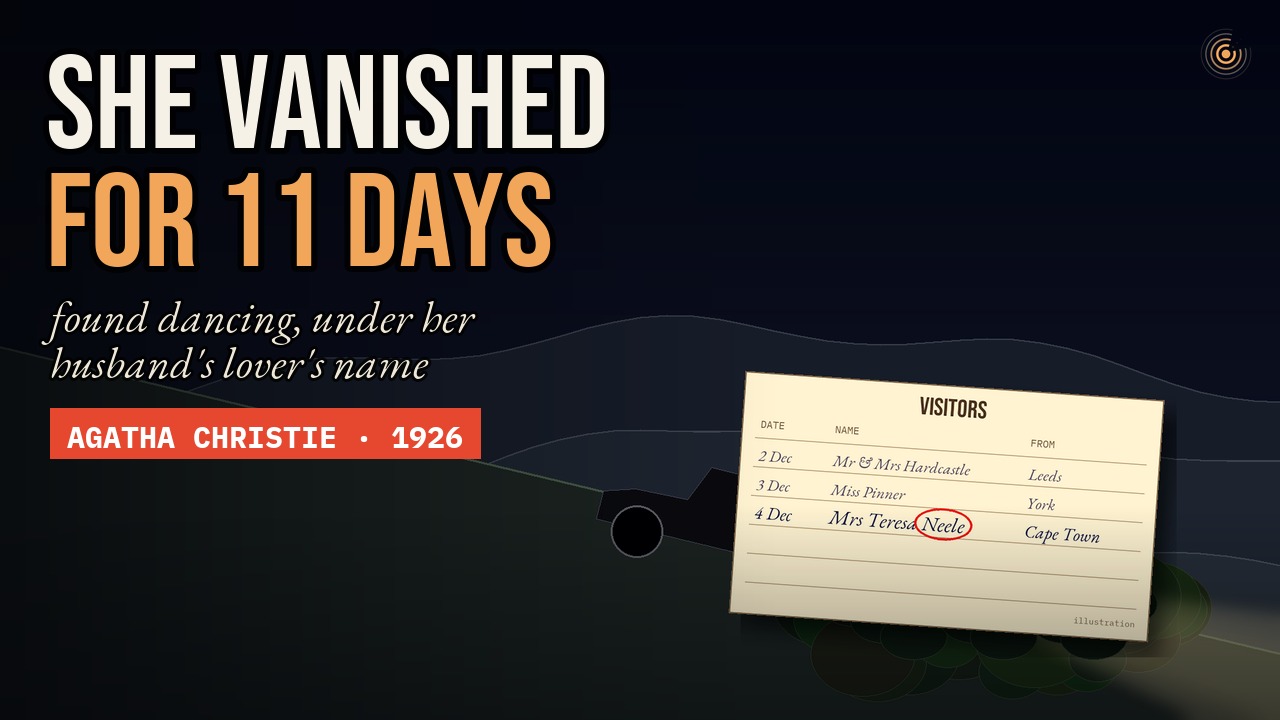
In December 1926 the world's most famous mystery writer vanished. Eleven days later she was found dancing in a Harrogate spa hotel, signed in under the surname of her husband's lover. A hundred years on, the clues still fit more than one story.
 The documentary is coming soon to YouTube · subscribe to get it
In December 1926, the most famous mystery writer in Britain vanished. 11 days later, she was found dancing in a spa hotel, more than 200 miles away. She had signed the register with the surname of her husband's lover.
Her name was Agatha Christie. For 11 days, the police, the newspapers and thousands of strangers had hunted for her across the hills of Surrey.
100 years later, nobody knows for certain what happened. But we can do what her detectives do. Lay out the clues, and test every theory against them.
The Empty Car
Friday, 3 December 1926. Her home in Sunningdale, Berkshire. Late in the evening, Agatha Christie goes upstairs and kisses her sleeping daughter, Rosalind. She is 7.
Then she gets into her car, a Morris Cowley, and drives off into the dark.
It had been a terrible year. Her mother had died. And in August, her husband Archie had told her he loved another woman, Nancy Neele, and wanted a divorce. That day, after a quarrel, he had left to spend the weekend with friends.
The next morning, the car is found at Newlands Corner, a beauty spot on the chalk hills near Guildford. It is half-way down a grassy slope, its bonnet buried in bushes. The headlights are still on.
Inside: a fur coat, a case of clothes, and her driving licence. Of Agatha Christie herself, there is no sign at all.
Two months later, the police wrote to the Home Office about the car. They said it was found in a position that suggested, quote, some unusual proceeding had taken place. So where was the driver?
The Hunt
The Surrey police search the downs that weekend, with constables and volunteers. They drag a dark little lake nearby, the Silent Pool. They find nothing.
By then the story is on every front page. A missing novelist, an abandoned car, a husband with a secret. The Daily News offers a reward of £100.
On Sunday 12 December, the great hunt reaches its peak. Thousands of people walk the hills in lines, with dogs. Some accounts say 15,000. An aeroplane flies over the downs.
Even other writers join in. Arthur Conan Doyle, the creator of Sherlock Holmes, gives one of her gloves to a medium. Dorothy L. Sayers goes to look at the scene herself.
And there was a real clue, hiding in plain sight. Archie's brother, Campbell, had received a letter from her, postmarked London, the day after she vanished. It said she was going to a spa in Yorkshire, to rest.
Almost nobody followed it up. Everyone was looking at the hills. Nobody was looking at the spas. Yet in Yorkshire, a woman had already signed a hotel register under another name.
Mrs Neele of Cape Town
More than 200 miles to the north, in the spa town of Harrogate, a new guest had checked into the Swan Hydropathic Hotel on the Saturday. She arrived with almost no luggage.
She signed in as Mrs Teresa Neele, visiting from Cape Town in South Africa.
For more than a week, Mrs Neele lived the quiet life of a hotel guest. She shopped for clothes. She borrowed books from the library. She did crosswords, played billiards, and joined the dances in the evening.
She read the newspapers, which were full of the missing Mrs Christie. Her face was on the front pages. And still, for days, nobody connected the two.
Then two musicians from the hotel's dance band became suspicious, and told the police. On the evening of Tuesday 14 December, Archie Christie came to Harrogate, and found his wife in the hotel dining room.
The hunt was over. The mystery was not. Because the story the family gave the press was almost stranger than anything the papers had guessed.
How Do We Know?
Archie told reporters that his wife was ill. She had, he said, suffered from the most complete loss of memory. Two doctors backed him up. She did not know who she was.
Many people did not believe it. A publicity stunt, they said, to sell books. Or revenge, to embarrass her husband and his lover. And the hunt had cost a fortune. Or had it?
The best evidence we have is a letter in the National Archives. Surrey's Deputy Chief Constable wrote it to the Home Office in February 1927, after a question in Parliament about what the search had really cost.
Under no circumstances could the police of this district have justified any inaction in the matter.
He wrote that the numbers of police had been greatly exaggerated, and that the aeroplanes had nothing to do with them. The expenses came to about £25. One newspaper had guessed £25,000.
So even the hunt became a story that grew in the telling. And Christie herself spoke about it in detail only once.
In 1928, she told the Daily Mail she had left home that night in a state of high nervous strain. She described letting the car run towards the quarry, a jolt, a blow to her head, and then a gap.
She said that up to that moment she was Mrs Christie. After it, she believed she was someone else. In her autobiography, published after her death, the 11 days are not mentioned at all. But could anyone truly forget who they are?
Forgetting Who You Are
Could a person really forget who they are, and still shop, dance and play billiards? Doctors today recognise something close to it. It is called dissociative amnesia, and its rare, dramatic form is a dissociative fugue.
In a fugue, a person under severe stress travels away from home, and loses their sense of who they are, sometimes taking on a new identity. It can last hours, or months. What they lose is personal memory: their name, their life story.
Skills are a different kind of memory: how to dance, how to drive, how to hold a billiard cue. Those live in other systems of the brain, and in a fugue they usually stay. That makes the story plausible.
But there are reasons for doubt. She planned enough to write that letter. Her biographer Laura Thompson thinks the amnesia was a cover story, for a woman in deep despair. The historian Lucy Worsley thinks a fugue is the likeliest answer.
And there is a twist in the science of memory itself. Our memories are not recordings. We rebuild them every time we remember. One famous experiment shows how easily.
In 1974, psychologists Elizabeth Loftus and John Palmer showed students a film of a car crash. Then they asked how fast the cars were going when they smashed into each other. Another group heard the word contacted instead.
One word changed the memory. Smashed gave estimates of almost 41 mph. Contacted, under 32. A week later, students who had heard smashed were more than twice as likely to remember broken glass. There was no broken glass in the film.
In 1926, the whole country was asked leading questions every morning, on the front page. One newspaper even printed pictures of how she might have disguised herself. Memory, it turns out, is a witness you cannot fully trust. Hers, and ours.
Why It Matters Today
This December is the 100th anniversary of those 11 days. And the way we tell the story has changed.
In 1926, a woman in crisis became a puzzle for the whole nation to solve, with prizes, maps, and theories over breakfast. Today we would see a person who was ill, or in deep distress, and needed help, not headlines.
And her case is a lesson in evidence. The same clues fit more than one story: the letter, the false name, the dancing, the doctors. A good detective does not pick the most exciting theory. She asks which theory explains every clue, and admits what is still missing.
Agatha Christie divorced Archie in 1928. She travelled, remarried, and wrote more than 60 more novels. Her books have sold more than a billion copies in English alone.
She solved thousands of mysteries on paper. The one about herself, she never explained. 100 years on, it is still the only Christie mystery without a final chapter.
Next time: the first hack, in 1834. And on our website, play The Witness: test your own memory against a leading question, and see if you can spot what was never there.
The science in this story
Key facts
- She left her Sunningdale home late on 3 December 1926; her Morris Cowley was found next morning at Newlands Corner, half-way down a grassy slope, headlights on, a fur coat and her driving licence inside source ↗
- She was recognised on 14 December at the Swan Hydro hotel in Harrogate, registered under the surname of her husband's lover, Nancy Neele source ↗
- Surrey's Deputy Chief Constable told the Home Office in February 1927 that police numbers had been 'greatly exaggerated' and the expenses came to about £25 source ↗
- Popular accounts put the volunteer searchers at about 15,000; the 'Great Sunday Hunt' of 12 December drew over 2,000 source ↗
- A dissociative fugue is a rare form of dissociative amnesia, with travel and loss of identity, lasting hours to months source ↗
- In Loftus & Palmer (1974), 'smashed' gave mean speed estimates of 40.8 mph against 31.8 for 'contacted'; a week later 32% vs 14% ('hit') recalled broken glass that was not there source ↗
Loading the quiz…
Sources
- The National Archives: police report on the search, HO 45/25904 (1927), and its blog (2016)
- National Geographic (2024) · History Hit · Countryfile · Shedunnit (2018)
- MSD Manual: dissociative amnesia and fugue
- Loftus & Palmer (1974), J. Verbal Learning and Verbal Behavior 13: 585–589
Where every picture, clip and sound in this story comes from
Keep scrolling: more true stories ↓
New mini-documentaries every week and a true story every day. Pick where you like to watch:
▶ Subscribe on YouTube Telegram TikTok Instagram Bluesky Threads ✉ Weekly email