The Woman Who 'Gave Birth' to Rabbits
In 1726 Mary Toft, a poor farm worker from Godalming, appeared to give birth to rabbits, and King George I's own anatomist watched, believed it and published a pamphlet to prove it. Days later a bath-house porter was caught smuggling a rabbit into her room, and on 7 December 1726 she confessed.
 Premieres on YouTube Thursday 03 December, 17:00 UTC · subscribe to get it
London, 4 December 1726. In a bath-house in Leicester Fields, a porter named Thomas Howard is caught trying to slip something into a lodger's room. It is a rabbit. A small one.
Upstairs lies a young woman from Surrey named Mary Toft. For days, some of the most famous medical men in England have been watching her, day and night. Because Mary Toft, they had been told, was giving birth to rabbits.
The king's own anatomist had seen it with his own eyes. He had just published a pamphlet to prove it. Three days later, Mary Toft confessed. That was 300 years ago this December.
So how did a poor farm worker from a small country town fool the king's surgeon? Why did educated men believe something so impossible? And what really happened to the woman at the centre of it all?
Godalming
Godalming, in Surrey, south-west of London, on the road to Portsmouth. In 1726 it was a cloth town, and its woollen trade was in decline. The men who owned property ran the town, and the rules they enforced were hard on the poor. Even taking fish or game, rabbits included, could land you in court.
Mary Toft was born Mary Denyer, and baptised here in February 1703. In 1720 she married Joshua Toft, a journeyman clothier. They had three children. Mary worked in the fields, for about a penny a day. The Tofts were among the town's poor, and they stayed poor.
In the spring of 1726 she was pregnant again. Later, she said that one day in April, working in a field, she and another woman had chased a rabbit, and failed to catch it. After that, she said, she craved rabbit meat for months, and she dreamt about rabbits. One of the doctors later wrote down her story:
That same Night she dreamt she was in a Field with those two Rabbets in her Lap.
In August, she lost the baby. But she still looked pregnant. And on 27 September, she went into labour, with her mother-in-law, Ann Toft, and a neighbour beside her. What came out, they said, looked like part of an animal.
The Man-midwife
The next day, a man-midwife from nearby Guildford was sent for. His name was John Howard. He was shown more animal parts, said to have come in the night. He came back the next day, and this time he helped to deliver more himself.
Over the following weeks, Howard recorded a rabbit's head, the legs of a cat, and on a single day, 9 dead baby rabbits. He wrote to leading doctors and scientists, and to the king's secretary. By November, the London papers had the story.
Howard moved Mary into lodgings in Guildford, where he could watch her more closely. He wrote to London:
I have brought the Woman to Guildford for better Convenience.
Historians point out what that meant for Mary herself. Care of her body passed from the women around her to educated men, who did not know her. Her pain stopped being hers. It became something to be watched, measured and written down.
The King's Anatomist
The story reached the court of King George I, who took a close interest. He sent his surgeon and anatomist, a Swiss-born man named Nathaniel St André, whom he had appointed three years earlier. With him came Samuel Molyneux, secretary to the Prince of Wales.
Molyneux was no fool. He was a serious astronomer. At Kew House, near London, he and the young James Bradley had mounted a 24-foot telescope pointing straight up, and were tracking a single star, work that would lead to one of the great discoveries of the century. Now he was in Guildford, waiting for rabbits.
They arrived on 15 November. Mary, they were told, was in labour with her 15th rabbit. And in front of them, more dead rabbit parts were delivered.
St André ran a test. He put a piece of a rabbit's lung into water, to see whether it would float. It floated.
This was the lung float test, already known to doctors. A lung that has never breathed is dense and full of fluid, so it sinks. A lung that has filled with air floats. Decay can fool the test, so it is not perfect. But a floating lung usually means the animal had breathed. And a rabbit growing inside a womb never breathes air at all.
St André examined Mary, and concluded that the rabbits were being bred inside her, in her fallopian tubes. To him, it seemed to fit an old and respected idea.
It was called maternal impression: the belief that what a pregnant woman saw, craved or feared could shape her unborn child. A sudden fright might leave a birthmark. A craving might leave a likeness. Respected medical books taught it, and many doctors took it seriously.
And Mary's story, the rabbit in the field, the craving, the dream, fitted that idea perfectly. Perhaps a little too perfectly.
The Doubter
On 20 November, another of the king's surgeons arrived: Cyriacus Ahlers, a German from the royal household. He watched. He took specimens back with him. And he looked at them closely.
Some of the pieces, he found, seemed to have been cut with a man-made instrument. And inside the gut of one of the rabbits there were droppings. In the droppings were pieces of straw and grain.
This was the clue that mattered most. An unborn animal does not eat. It is fed through the placenta, from its mother's blood, and its gut holds no food at all. Straw and grain meant that this rabbit had lived, and grazed, out in the world, not in any womb.
Ahlers was convinced it was a cheat. In Guildford, he told the people around Mary that he believed her. Then he went back to London, and on 21 November, he told the king.
St André did not back down. He went back to Guildford, gave an anatomical demonstration in front of the king, and collected sworn statements that cast doubt on Ahlers' honesty. The doubter, not the claim, was put on trial.
Then a third expert was brought in: Sir Richard Manningham, one of London's leading man-midwives. He delivered something he took to be part of a pig's bladder. It smelled of urine. He was suspicious. And yet even he thought that something might still remain inside her, and he wanted to keep watching.
Leicester Fields
On 29 November, Mary was brought to London and lodged at Lacy's Bagnio, a bath-house in Leicester Fields, where Leicester Square is today. Doctors, lawyers, scientists and aristocrats came to see her. The anatomist James Douglas, who doubted the whole story, came to watch as well.
In London, there were no more rabbits. Mary went into labour, again and again, and nothing came. She was ill, she was in pain, and she had fits. The men waited.
On 3 December, St André published his account of what he had seen. 40 pages, under the title:
A Short Narrative of an Extraordinary Delivery of Rabbets, Perform'd by Mr. John Howard, Surgeon at Guildford.
Its timing could hardly have been worse.
The next day, a Surrey lord, Thomas Onslow, reported that Mary's husband Joshua had been buying young rabbits for the past month. And that same day, the porter, Thomas Howard, told a magistrate, Sir Thomas Clarges, that Mary's sister-in-law Margaret had paid him to get the smallest rabbit he could find, and to smuggle it into Mary's room.
Margaret said the rabbit was only for eating. Mary was taken into custody. For three days, she denied everything. Then Manningham threatened her with a painful operation, to find out whether her body was made differently from other women's.
On 7 December 1726, in front of Manningham, Douglas, the Duke of Montagu and Lord Baltimore, Mary Toft confessed. There had never been any births. The animal parts had been placed inside her body in secret, so that they could be delivered in front of witnesses.
Why do it? In one confession, she said that a woman she had met on the road had told her how, and had promised her that if she did it, she would
never want as long as I liv'd.
In other confessions, she blamed her mother-in-law, and even John Howard. The story changed each time she told it.
How Do We Know?
How do we know any of this? Most of it comes from the men involved, writing in a hurry to defend themselves. St André's pamphlet. Ahlers' observations. Manningham's diary, rushed into print five days after the confession. And one remarkable set of papers.
James Douglas wrote down Mary's confessions as she spoke. About 36 pages of rough notes, full of crossings-out, now kept at the University of Glasgow. They are the closest we can get to her own voice.
And that voice changes the story. The notes are full of pain and powerlessness: a long and frightening miscarriage, then weeks of births that hurt. The historian Karen Harvey has argued that we should not see Mary simply as a trickster, but as a poor woman caught between her family, her neighbours and the doctors, and using the one thing she had: her own body.
Who planned it, and how much of it Mary chose, is still debated. Historians disagree, and her own accounts contradict each other. What seems clear is that the Tofts made no profit from it at all.
What we can say for certain is the science. A rabbit can only grow from a rabbit egg, fertilised by rabbit sperm. A human body cannot make one: the two species do not even have the same number of chromosomes. Rabbits have 44. We have 46. And a mother's thoughts and cravings do not shape her baby's body. Maternal impression was simply wrong.
The evidence that exposed the hoax was there almost from the start: a lung that floated, food in a gut that should have been empty, the cut of a blade. One expert saw it, and said so. The most important one chose not to believe it.
The Fallout
Mary was sent to Tothill Fields Bridewell, a prison in Westminster, charged as a vile cheat and impostor. Her jailers reportedly put her on show to crowds. While she was there, the artist John Laguerre drew her portrait.
But what, exactly, was her crime? Nobody could quite say. On 8 April 1727, she was discharged, and she went home to Godalming. The next winter, she gave birth to a daughter, Elizabeth. A real baby, and nobody wrote a pamphlet about her.
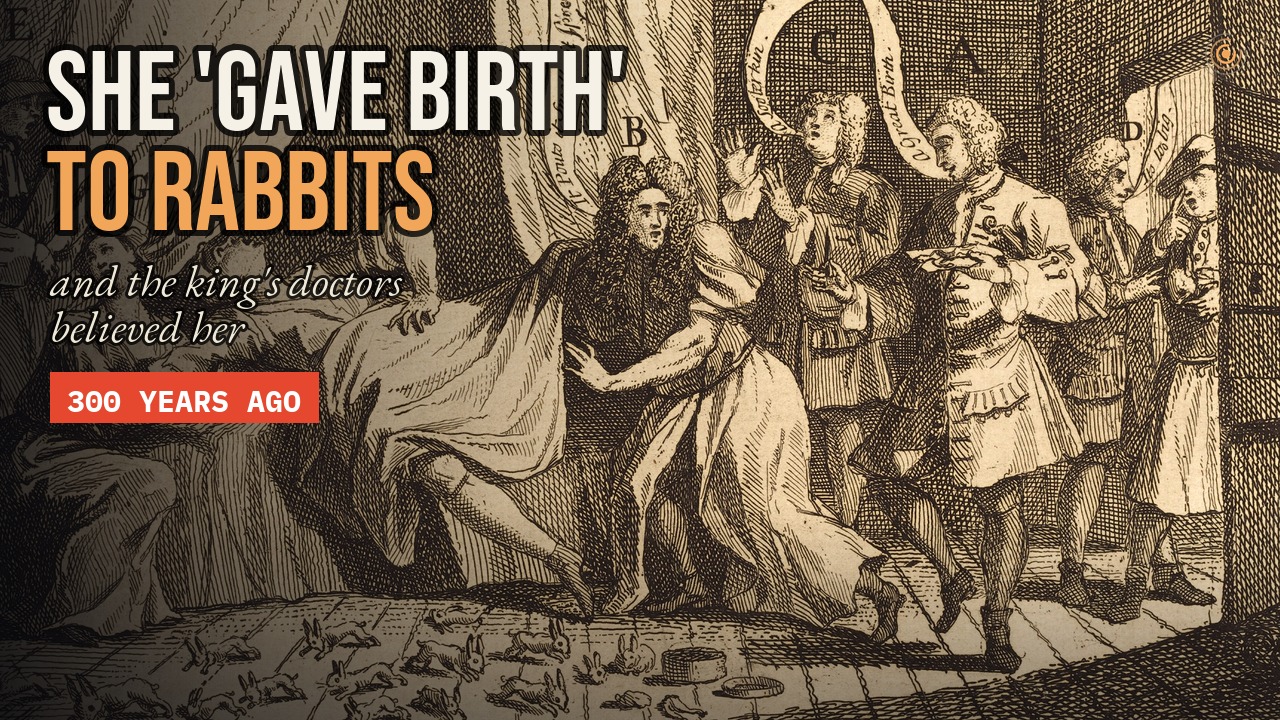
London laughed, but mostly at the doctors. The young William Hogarth engraved them in a print with a mock-Latin title, Cunicularii, or The Wise Men of Godliman in Consultation: a room full of experts, each sure of himself, around a woman in labour.
A pamphlet that mocked the man-midwives was signed Lemuel Gulliver, the hero of a book that had come out that autumn, Jonathan Swift's Gulliver's Travels. Songs, poems and plays followed.
St André never recovered. He was refused an audience with the king and lost his royal duties. He died in 1776, aged 96, and it was said that for 50 years he never ate rabbit again.
Samuel Molyneux died in 1728. The next year, James Bradley announced what their telescope at Kew had led him to: the aberration of light, the first direct proof that the Earth moves around the Sun. Molyneux did not live to share the credit.
Thirty-six years after the rabbits, Hogarth was still using her. In his print Credulity, Superstition and Fanaticism, from 1762, a woman lies on the floor with rabbits around her. Mary Toft had become a symbol of believing too easily.
Mary herself lived on in Godalming for another 36 years. In 1740 she was charged with receiving stolen fowls, and acquitted. She was buried there on 13 January 1763. No gravestone has ever been found.
Why It Matters
300 years on, it is easy to laugh at the rabbit doctors. But look closely at how they were fooled, because the same traps still catch clever people today.
One: authority. Once the king's own anatomist said it was real, other people stopped looking for themselves.
Two: commitment. The more publicly St André backed the story, the harder he defended it. He went to print even as the evidence turned against him. Psychologists call this escalation of commitment: the more we have staked on a claim, the harder it is to let it go.
Three: a story that fits. The rabbit in the field, the dream, the craving: it matched what the learned books already said. This is confirmation bias. We believe most easily what we already expect.
And four: the boring clue. Straw in a rabbit's gut is not exciting. It does not make a pamphlet sell. But it was the one fact in the room that could not lie.
James Douglas, the sceptic, asked for something simple. In his own words, he would
desire that People would suspend any farther Judgement for a little Time.
And at the centre of it all was the person with the least power in the room: a poor, sick woman from Godalming, whose pain was treated as evidence, and whose words were written down by the men who had examined her. Remember her too, when the next miracle cure, or impossible claim, comes along.
Epilogue
In the winter of 1726, some of the finest medical minds in England gathered around one frightened woman, and believed the impossible. The truth was in a rabbit's gut all along.
The science in this story
Key facts
- Mary Toft (née Denyer) was baptised in Godalming on 21 February 1703, married the journeyman clothier Joshua Toft in 1720 and was buried there on 13 January 1763; no gravestone has been found source ↗
- On 27 September 1726 she went into 'labour'; the Guildford man-midwife John Howard then recorded a rabbit's head, cat's legs and nine dead baby rabbits in one day source ↗
- On 15 November 1726 the king's anatomist Nathaniel St André and Samuel Molyneux arrived in Guildford; St André floated a piece of rabbit lung in water, it floated, and he still concluded the rabbits were bred in her fallopian tubes source ↗
- The surgeon Cyriacus Ahlers (20 November) found specimens apparently cut with an instrument and pieces of straw and grain in a rabbit's droppings, and told the king on 21 November that it was a cheat source ↗
- St André's 40-page 'A Short Narrative of an Extraordinary Delivery of Rabbets' appeared on 3 December 1726; on 4 December a porter at Lacy's Bagnio, Leicester Fields, confessed he had been paid to smuggle in a rabbit, and she confessed on 7 December source ↗
- James Douglas's notes of her confessions (about 36 pages) survive at the University of Glasgow; historians, notably Karen Harvey, read them as evidence of pain, poverty and powerlessness source ↗
- Hogarth satirised the doctors in 'Cunicularii' (1726) and put Toft into 'Credulity, Superstition and Fanaticism' (1762) source ↗
Loading the quiz…
Sources
- St André (1726), A Short Narrative of an Extraordinary Delivery of Rabbets
- Manningham (1726), An Exact Diary...; Ahlers (1726), Some Observations...
- J. Douglas, notes of Mary Toft's confessions, Univ. of Glasgow MS Hunter D
- Karen Harvey (2020), The Imposteress Rabbit Breeder (Oxford UP)
- Public Domain Review: Mary Toft and her extraordinary delivery of rabbits
- Godalming Museum: Mary Tofts (1703–1763)
Where every picture, clip and sound in this story comes from
Keep scrolling: more true stories ↓
New mini-documentaries every week and a true story every day. Pick where you like to watch:
▶ Subscribe on YouTube Telegram TikTok Instagram Bluesky Threads ✉ Weekly email