The Plague Doctor Who Gave the World the Face Mask
Sent to a plague nobody understood, the 31-year-old, Penang-born, Cambridge-trained doctor Wu Lien-teh found the plague bacillus in a secret post-mortem and argued it was spreading through the air; a one-cent mask of gauze and cotton wool, quarantine in railway carriages and the cremation of the dead helped to end the Manchurian epidemic, while a French doctor who examined patients unmasked was dead within a week.
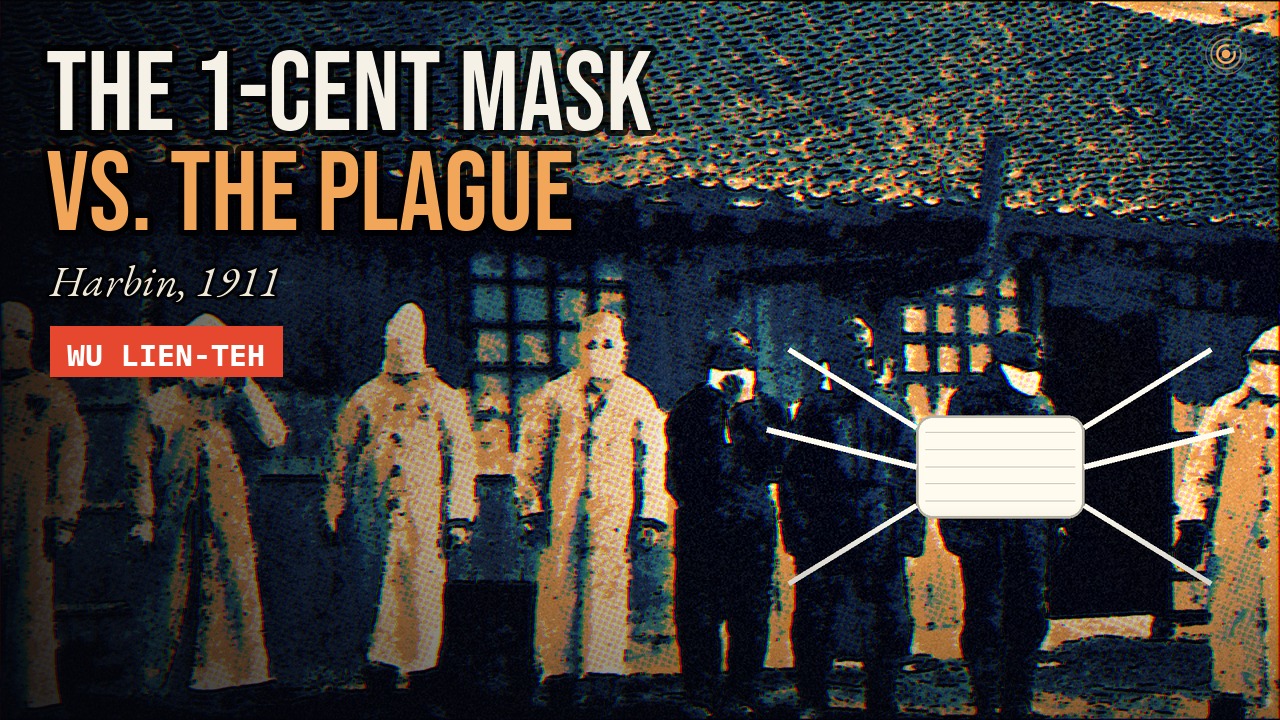 Premieres on YouTube Monday 16 November, 17:00 UTC · subscribe to get it
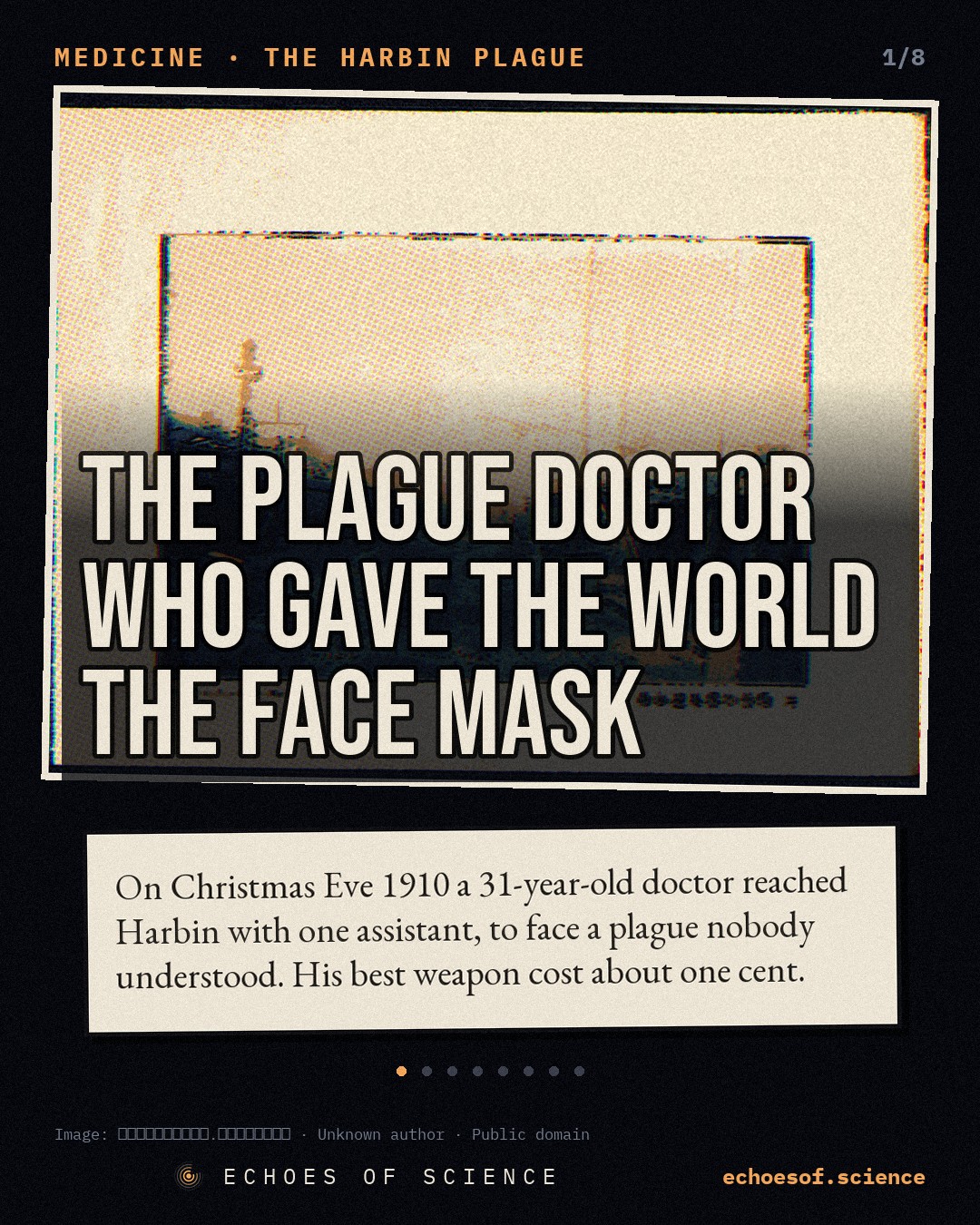
Harbin, Manchuria. Christmas Eve, 1910. A train pulls in from the south, out of a cold so deep that the thermometer reads −30 °C.
Two men step down onto the platform. One of them is a 31-year-old doctor, born in the tropics, trained at Cambridge, and sent here by the Chinese government with a microscope, a few instruments, and very little idea of what he is about to face.
In the town beside the railway, people are dying of a disease that kills almost everyone it touches. Within three days, this doctor will make a discovery about how it travels. Within three weeks, a famous French physician who ignores him will be dead. And by the spring, a simple pad of gauze and cotton will have helped to stop one of the deadliest epidemics of the twentieth century.
His name was Wu Lien-teh. This is the story of how he did it, and of the face mask that carries his name.
The Boy from Penang
Wu was born on 10 March 1879, in Penang, an island port off the west coast of the Malay Peninsula, then part of a British colony called the Straits Settlements. At the age of 7, he started at the Penang Free School.
The prize every clever pupil wanted was the Queen's Scholarship, which paid for a university education in Britain. Wu sat the examination again and again. On his fourth attempt, in 1896, aged 17, he won it.
He went to Emmanuel College, Cambridge, and graduated with first class honours. Then he trained in medicine at St Mary's Hospital in London, the first Chinese student it had ever accepted, and collected prizes in surgery, pathology and clinical medicine.
He studied tropical diseases in Liverpool under Ronald Ross, the man who had shown that mosquitoes carry malaria, and bacteriology at the Pasteur Institute and at Halle, in Germany. By 1903 he was back in Malaya, one of the best-trained young doctors in the region.
At home he campaigned against opium, and in 1906 he organised an anti-opium conference attended by some 3,000 people. The next year, an ounce of opium tincture was found in his dispensary, and he was convicted and fined. He left for China, and by 1908 he was vice-director of the Imperial Army Medical College in Tianjin.
A Plague on the Railway
Far to the north, in the autumn of 1910, two fur traders died at an inn in Manzhouli, a frontier town on the border between China and Russia.
Manzhouli lived on furs, and one of the most sought after came from the tarbagan, a large marmot of the Mongolian steppe. Dyed and finished, its fur could pass for far more expensive pelts, so prices rose, and inexperienced hunters poured in. Unlike the local hunters, they caught and handled animals that were already sick.
Most historians think that is where the disease came from, although the evidence is circumstantial. What is certain is how it spread: along the brand-new railway lines that cut across Manchuria.
The Chinese Eastern Railway, built and run by Russia, ran from Manzhouli to Harbin and on towards Vladivostok. In the south, Japan controlled the South Manchuria Railway. Third-class travel was cheap and crowded, and that winter, migrant workers would ride the trains home for the Chinese New Year.
Within weeks, the sickness reached Harbin, a Russian-built railway city, and Fujiadian, the crowded Chinese town beside it. By December, people there were dying every day.
This was a political crisis as well as a medical one. Russia and Japan both held railway zones in Manchuria, and the Qing court was wary that foreign powers would use the outbreak to tighten their grip on the region.
On 19 December, the Foreign Office in Peking sent for Wu. His instructions were short.
Proceed to that region to investigate the cause, and to suppress it, if possible.
He travelled for three days and nights, and reached Harbin late on Christmas Eve, with a single assistant.
What the Microscope Saw
Wu needed to know exactly what he was fighting, and that meant examining a victim. But in China at that time, post-mortem examinations were almost unheard of, and families were deeply opposed to anything that disturbed the dead.
On his third day in Harbin, a woman died of the disease at an inn in Fujiadian. She was Japanese, the wife of a Chinese innkeeper. Wu was able to carry out a quiet, preliminary post-mortem, and he took samples of blood and tissue back to his microscope.
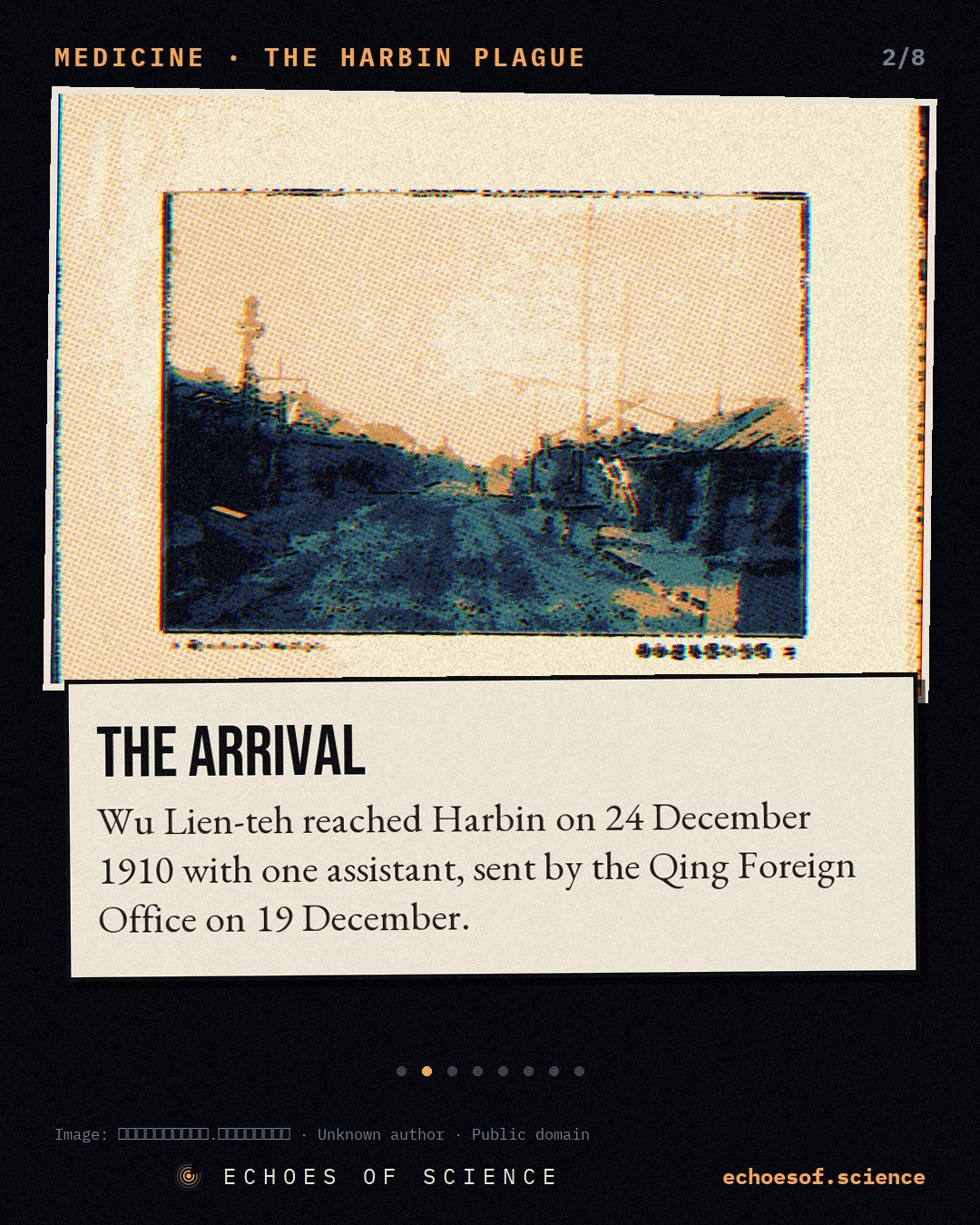
There, in the stained samples, he saw them: tiny rod-shaped bacteria, darker at each end, like little safety pins. Yersinia pestis. The bacterium of plague.
Plague was not new. In the 1890s it had swept through southern China and on to India, and in Hong Kong, in 1894, Alexandre Yersin had identified the bacterium that now carries his name. Doctors knew that plague usually lived in rats, and reached people through the bites of their fleas.
But this was the middle of a Manchurian winter, when rats and fleas could hardly explain such a fast, deadly spread. And the victims were not showing the swollen glands of bubonic plague. They were coughing. The infection was in their lungs.
Wu concluded that this was pneumonic plague: plague of the lungs, passing directly from person to person, through the air, in the droplets of a cough.
Plague takes three main forms. In bubonic plague, bacteria from a flea bite travel to the lymph nodes. In septicaemic plague, they multiply in the blood. And when they settle in the lungs, they can be coughed out in tiny droplets, and breathed in by the next person. That is pneumonic plague, the form that spreads easily between people.
Today, the World Health Organization says that untreated pneumonic plague can kill within 18 to 24 hours of the first symptoms. It can be cured with antibiotics, if they are given early. In 1910, there were no antibiotics. Almost no one who caught it survived.
The Mask and the Frenchman
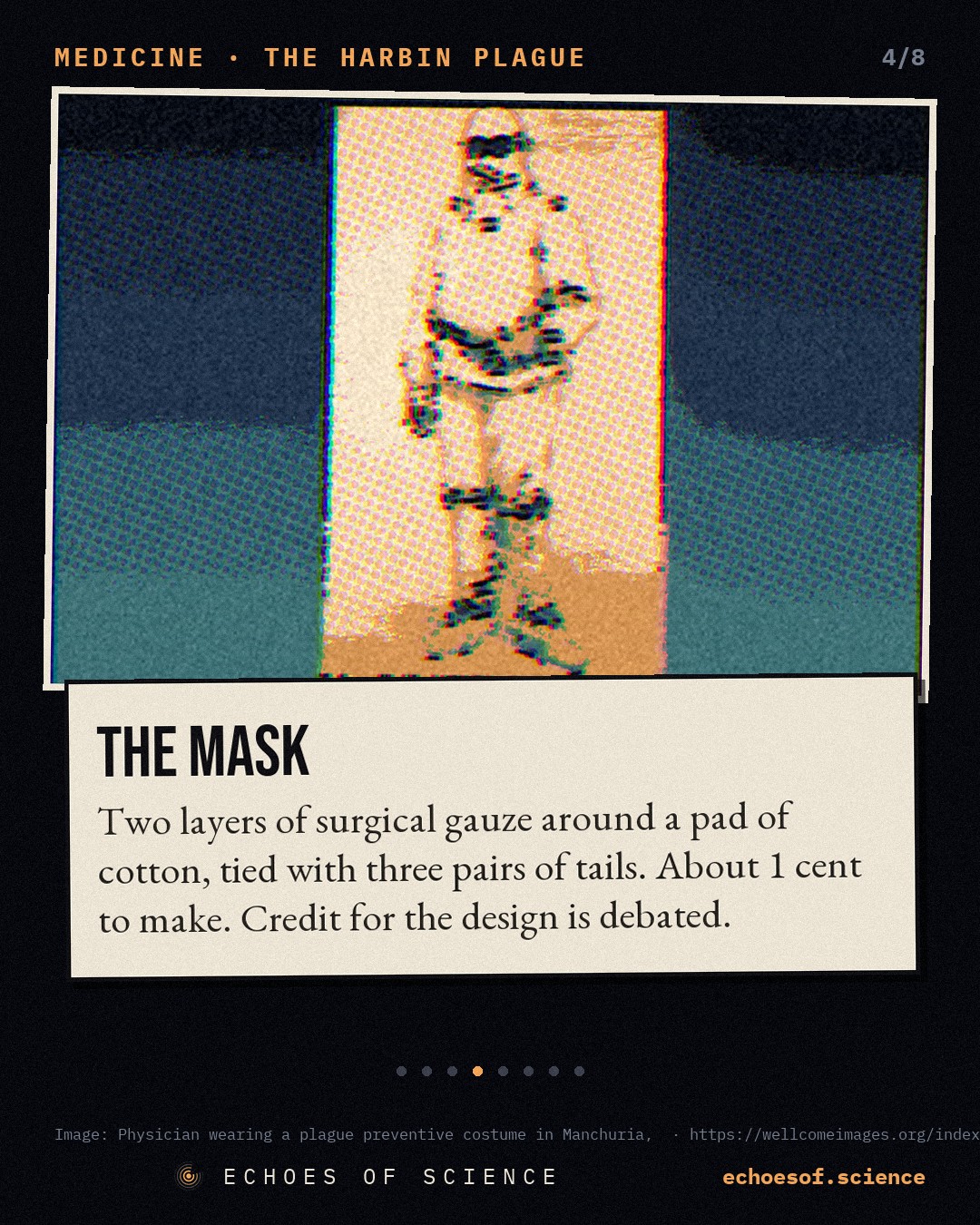
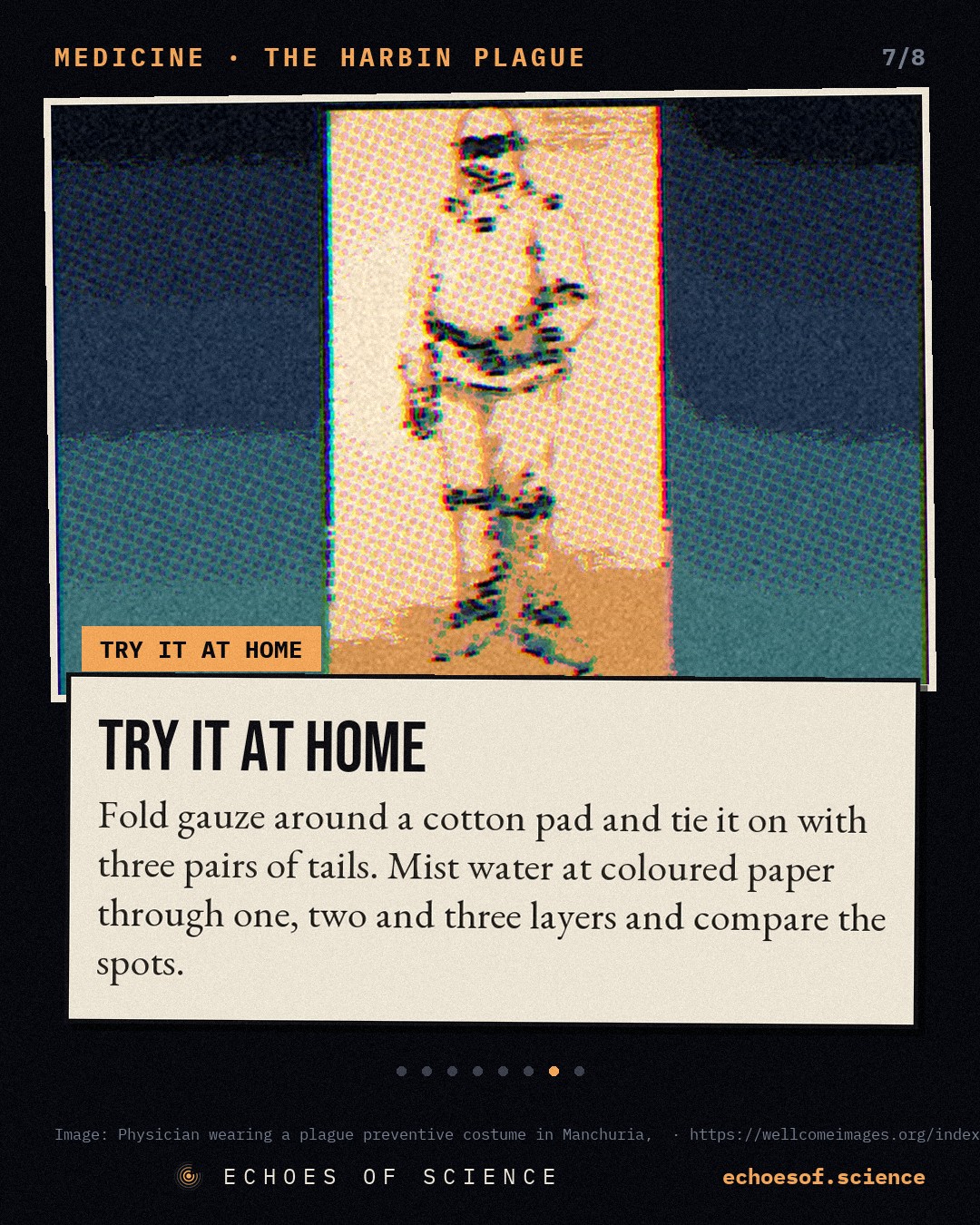
If the plague was travelling through the air, then the air was what had to be blocked. The answer was disarmingly simple: two layers of surgical gauze, with a flat pad of absorbent cotton wool between them, about the size of a hand.
The gauze was cut into a long strip and split at each end into three tails. The top pair tied above the ears, the bottom pair below them, and the middle pair went over the crown of the head, so the pad could not slip down. It cost about 1 cent to make, and anyone could make one at home.
Not everyone was convinced. Many doctors still believed that plague was a disease of rats and fleas, and that a cloth over the face was a waste of time.
In early January, a senior French physician arrived in Harbin: Gérald Mesny, a professor at the medical college in Tianjin, who had experience of bubonic plague and expected to take charge. He did not accept that this plague was spreading through the air.
Decades later, in his autobiography, Wu remembered that Mesny lost his temper with him, used a racial insult, and told him not to contradict his superior. It is Wu's account, written long afterwards, but it shows the kind of resistance he faced.
A few days later, Mesny went to examine patients at a plague hospital, without a mask. About three days after that, he fell ill. Within the week, he was dead.
A newspaper in Portland, Oregon, carried the news under the headline: Heroic doctor is dead. It reported that he had isolated himself in his room in a hotel, drafted his will, and written farewell letters.
Mesny's death shook the doctors in Harbin. After it, masks went on everywhere: on doctors and nurses, on soldiers and police, on the men who carried the sick and the dead. Volunteers made them by the thousand.
The photographs from that winter show something new: whole teams of people, and in places whole streets, with their faces covered in white, in an organised attempt to stop an epidemic.
Fire in the Snow
A mask alone was not enough. Fujiadian was divided into districts, each with its own doctors and inspectors. Teams went from house to house looking for the sick, and troops controlled who could move between the districts.
120 railway carriages became isolation wards. People who had been close to a victim were held there, and released if they showed no symptoms for 5 days.
In mid-January, passengers heading south through the Shanhai Pass, the gateway between Manchuria and the rest of China, were held in quarantine for 5 days, and some railway services were suspended.
Doctors and helpers died too. One of them was Arthur Jackson, a 26-year-old Scottish missionary doctor, who fell ill after inspecting and quarantining hundreds of labourers in Mukden, and died there that winter.
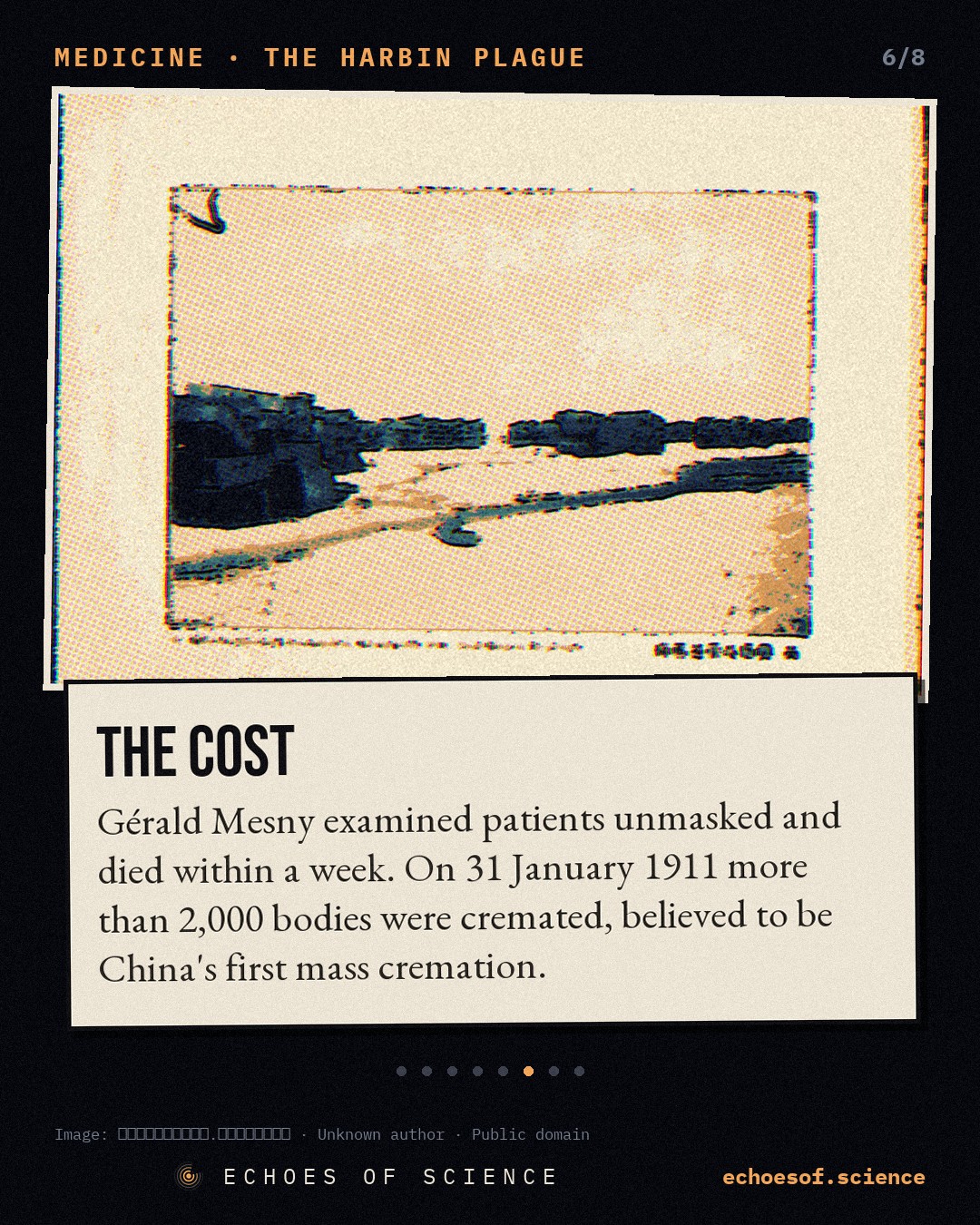
Then Wu came face to face with the hardest problem of all. Late in January, outside Fujiadian, he found the dead of the past weeks waiting in the snow, in coffins and without them, in rows that stretched for about a mile.
The ground was frozen solid, to a depth of about 2 metres. Nobody could bury them. And Wu worried that, left until the spring, they could become a source of new infection.
The answer was to burn them. But cremation went against deep traditions of respect for the dead. Wu persuaded the local officials, and a memorial was sent to the imperial throne. Three days later, an imperial edict gave permission.
On 31 January 1911, the second day of the Lunar New Year, the coffins were soaked in kerosene and set alight. More than 2,000 bodies were cremated; some accounts say 3,000. It is believed to have been the first mass cremation in Chinese history.
Wu later called it the turning point of the epidemic. The number of deaths began to fall. And on 1 March, 67 days after Wu stepped off the train, Harbin recorded its last case.
Across Manchuria and beyond, the epidemic had killed around 60,000 people, by most estimates. Without the quarantine, the cremations and the masks, it could have travelled much further, along the same railways that had carried it in.
The World Comes to Mukden
A month later, on 3 April 1911, scientists from 11 countries gathered in Mukden, the city now called Shenyang. They came from the United States and Britain, from France, Germany, Italy, Austria-Hungary and the Netherlands, from Russia, Japan and Mexico, and from China. Wu Lien-teh presided.
It was the first international scientific conference ever held in China. For more than three weeks, the delegates compared laboratory results and case records. They agreed that this plague had passed from person to person through the air. And they gave their verdict on the mask.
The best form of mask is a simple, three-tailed, gauze and cotton-wool pad, which should be destroyed, or disinfected, after each tour of duty.
The next year, the new Republic of China set up the North Manchurian Plague Prevention Service, with hospitals and laboratories across the region, and Wu as its director.
In 1920, pneumonic plague came back to Manchuria. This time the Service was ready. Its laboratory in Harbin made 60,000 masks. The second epidemic killed about 9,300 people, far fewer than the first.
Wu wrote that one Russian medical team at Manzhouli had been, in his words,
most untrained, very careless about wearing masks in the presence of the sick and the dead.
3 of that team's nurses and 15 of its attendants died. The Plague Prevention Service lost no one.
How Do We Know?
How much of this story can we trust? Much of it comes from Wu himself: his reports, his Treatise on Pneumonic Plague of 1926, and his autobiography, Plague Fighter, published in 1959, almost half a century after the events.
The quarrel with Mesny, for example, rests largely on Wu's memory. Mesny's death itself is beyond doubt: newspapers on the other side of the world reported it within days.
The name Wu mask is also more complicated than it sounds. Surgeons had worn gauze masks since the 1890s. Historians have found that Chinese plague workers in Harbin were already making gauze and cotton masks, and at Mukden, a member of the Harbin team presented the design as the team's work. It was Wu's writings that fixed his name to it.
And it was not perfect. In experiments after the epidemic, the American researchers Richard Strong and Oscar Teague sprayed fine mists carrying a harmless bacterium at the mask, and found that some got through. It worked, but only up to a point.
Even the death toll is uncertain. Estimates range from about 40,000 to 60,000, partly because many deaths in remote places were probably never recorded.
What the evidence does show is that Wu was right about the most important thing. This plague was travelling through the air, and the measures built on that idea helped to stop it.
A Filter for the World
So why does a pad of cotton work at all? Not like a sieve. The gaps between its fibres are far bigger than a bacterium. Instead, it works like a maze.
Big droplets, carried on the breath, cannot follow the air as it swerves around a fibre, and they slam straight into it. That is called impaction. Smaller ones, drifting past, brush against a fibre and stick. That is interception. And the very smallest particles are jostled by air molecules until they wander into a fibre. Every extra layer gives a droplet more chances to be caught.
Wu's pad was thick and tangled. Modern respirators use the same three tricks with far finer fibres, and with a close seal around the face, because air that leaks around the edge is not filtered at all.
Gauze masks spread from Manchuria to operating theatres, and to city streets during the influenza pandemic of 1918. The historian Christos Lynteris has called Wu's design the first modern respirator, a distant ancestor of the masks the world wore again during COVID-19.
Plague has not gone away. It still lives in wild rodents in parts of Africa, Asia and the Americas, and the World Health Organization still advises isolating patients with pneumonic plague, and protecting the people who care for them, just as Wu insisted.
In 1935, Wu was nominated for the Nobel Prize in Physiology or Medicine. The nomination, from a professor of medicine in Canton, praised his
work on pneumonic plague, and especially the discovery of the role played by the tarbagan in its transmission.
He did not win. But he was the first person from Malaya ever to be nominated.
Epilogue
Wu Lien-teh spent the rest of his career building public health in China, and died at home in Penang in January 1960, aged 80. He did not invent the idea of covering the face. What he did was harder. In a frozen city, against fear, tradition and his own superiors, he showed that a disease was in the air, and persuaded a whole city to put something simple between it and themselves.
The science in this story
Key facts
- Wu reached Harbin late on Christmas Eve, 24 December 1910, with one assistant, sent by the Qing Foreign Office on 19 December source ↗
- On his third day he carried out a preliminary post-mortem on the Japanese wife of a Chinese innkeeper and found Yersinia pestis: pneumonic plague source ↗
- The mask: two layers of surgical gauze around a pad of absorbent cotton, tied with three pairs of tails; about 1 cent to make. Harbin's Chinese plague workers were already making such masks, and credit for the design is debated source ↗
- French physician Gérald Mesny examined patients without a mask, fell ill about three days later and died within the week; the Morning Oregonian reported it on 16 January 1911 source ↗
- 120 railway carriages became isolation wards; contacts were released after 5 days without symptoms source ↗
- With the ground frozen about 2 m deep, an imperial edict allowed cremation; on 31 January 1911 more than 2,000 bodies (some accounts say 3,000) were cremated, believed to be China's first mass cremation source ↗
- Harbin's last case was on 1 March 1911; the epidemic killed around 60,000 people (estimates 40,000-60,000) source ↗
- The International Plague Conference met in Mukden from 3 to 28 April 1911, with delegates from 11 countries and Wu presiding source ↗
- The 1920-21 epidemic killed about 9,300; the Harbin lab made 60,000 masks and the Plague Prevention Service lost no staff source ↗
- Nominated for the 1935 Nobel Prize in Physiology or Medicine by W. W. Cadbury of Canton, for work on pneumonic plague and the tarbagan's role source ↗
In pictures

Loading the quiz…
Sources
- Wu Lien-teh: Treatise on Pneumonic Plague (1926); Plague Fighter (1959)
- Report of the International Plague Conference, Mukden (1912)
- BiblioAsia, NLB Singapore (2012, 2020) · Lynteris (2018) · HKU MMEA
- Michaleas et al. (2022) · WHO plague fact sheet · Nobel archive
Where every picture, clip and sound in this story comes from
Keep scrolling: more true stories ↓
New mini-documentaries every week and a true story every day. Pick where you like to watch:
▶ Subscribe on YouTube Telegram TikTok Instagram Bluesky Threads ✉ Weekly email