They Blew Up a Whale. It Went Badly.
In 1970 Oregon's highway engineers tried to clear a rotting whale off a beach with half a ton of dynamite. A bystander with wartime explosives training had warned them.
"The blast blasted blubber beyond all believable bounds." Paul Linnman, a young reporter for Portland's KATU television, delivered that line from a beach near Florence, Oregon, on 12 November 1970. He was not exaggerating much. A few minutes earlier, at 3:45 in the afternoon, the Oregon State Highway Division had pressed a plunger and set off about half a ton of dynamite packed against a dead whale.
A problem nobody had trained for
The whale had washed ashore a few days before, on 9 November. It was a sperm whale about 45 feet (14 metres) long, and its weight was estimated at around 8 tons. Early reports, including Linnman's, called it a grey whale; the marine biologist Bruce Mate, who was there, later confirmed it was a sperm whale. It was rotting, it smelled, and it lay on a public beach.
Oregon's beaches came under the State Highway Division, so the job fell to highway engineers. They had moved boulders and landslides, not whales. According to Mental Floss's account, burying it risked the tide uncovering it again, burning it was impractical and nobody volunteered to cut it up. After consulting the US Navy, the engineer in charge, George Thornton, settled on explosives. The idea was to break the carcass into pieces small enough for gulls, crabs and other scavengers to clear away.
Thornton admitted on camera that nobody was sure how much dynamite it would take. The crew used about twenty cases, roughly half a ton (about 450 kg).
The warning
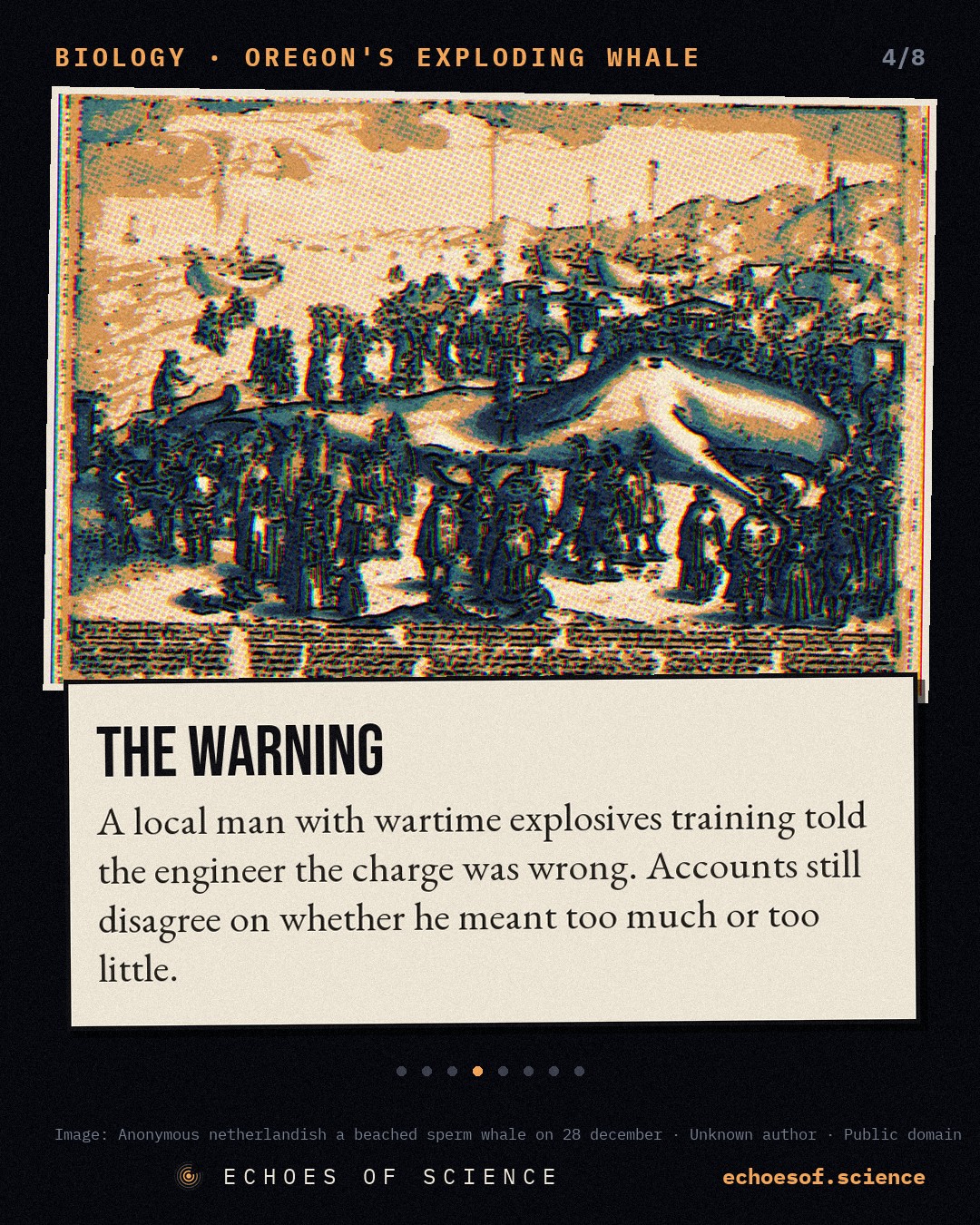
Among the onlookers was Walter Umenhofer, a local man who had trained with explosives during his Second World War service. He said he warned Thornton that the charge was wrong and was brushed aside. Days earlier he had bought a brand-new car, and he had driven it to the beach.
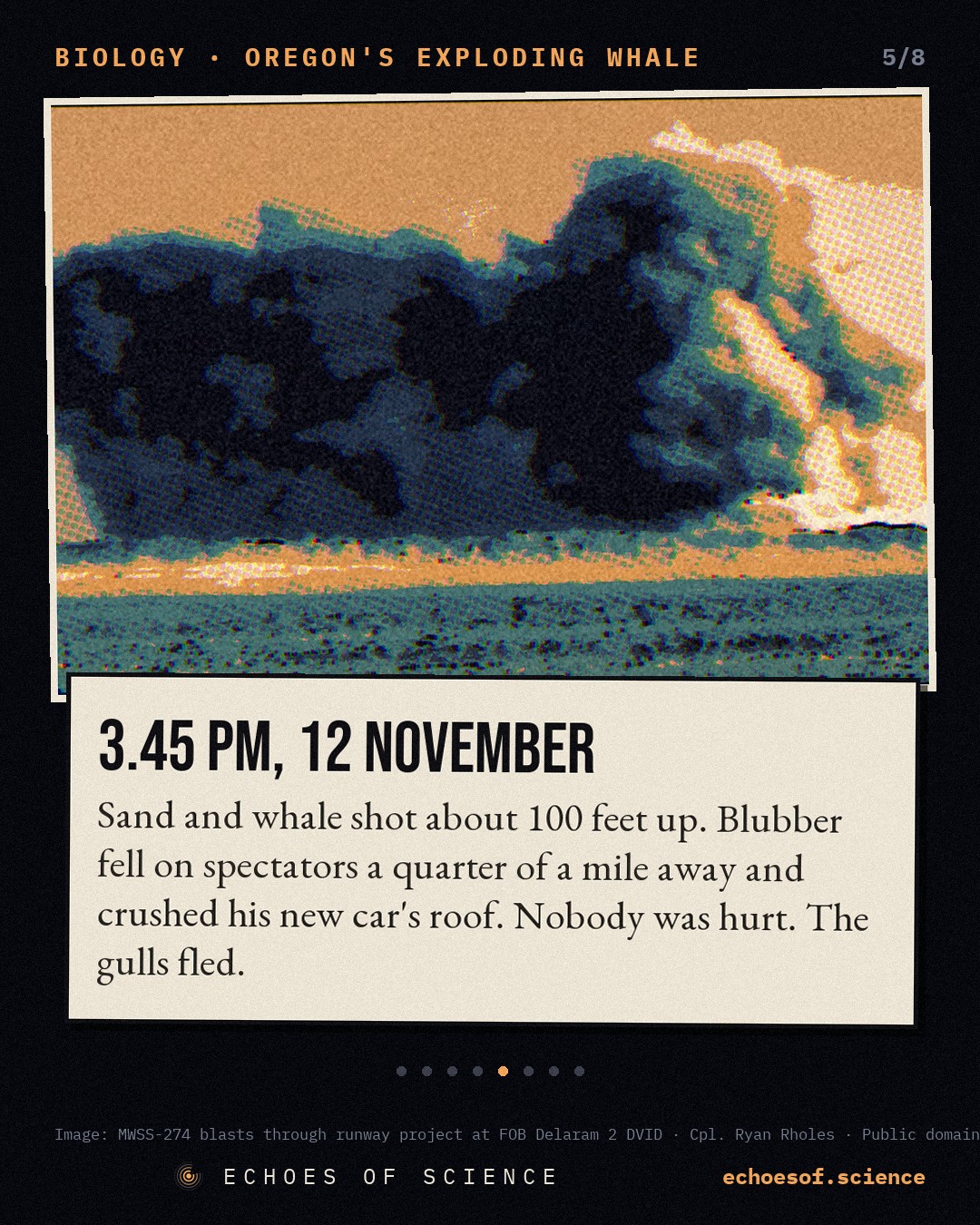
Police moved about 75 spectators back roughly a quarter of a mile. Then the charge went off. A column of sand and whale rose about 100 feet. Chunks of blubber fell among the crowd and on the car park; one large slab crushed the roof of Umenhofer's car. Live Science reports that nobody was hurt, but everyone nearby was spattered. The gulls, frightened by the bang, stayed away. Most of the whale was still on the beach, and the crew buried what was left.
Thornton told the Eugene Register-Guard the next day that it "went just exactly right", although, he added, the blast had dug a hole under the whale and thrown some pieces back towards the spectators. He was promoted to the Medford office a few months later.
How do we know?
Unusually for a 1970 local story, the whole thing was filmed. Cameraman Doug Brazil's 16 mm footage for KATU survives and was restored for the 50th anniversary. Newspapers covered it at the time, and Linnman later wrote a book about it. Some details still differ between accounts. Sources disagree on the make of Umenhofer's car, and, more interestingly, on what his warning was: Offbeat Oregon argues half a ton was too little to destroy an 8-ton carcass, while other retellings say he thought it was far too much and that about twenty sticks would have done. What everyone agrees on is that he warned them, and that the result was not what the engineers had planned.
The story became famous twice. In 1990 the humorist Dave Barry described the video in his newspaper column; in the 1990s a copy of that column circulated online without its date, and, as the Siuslaw News recalls, Oregon's transport department found itself fielding fresh calls about a whale that had been gone for a quarter of a century.
The science: a whale is a pressure vessel
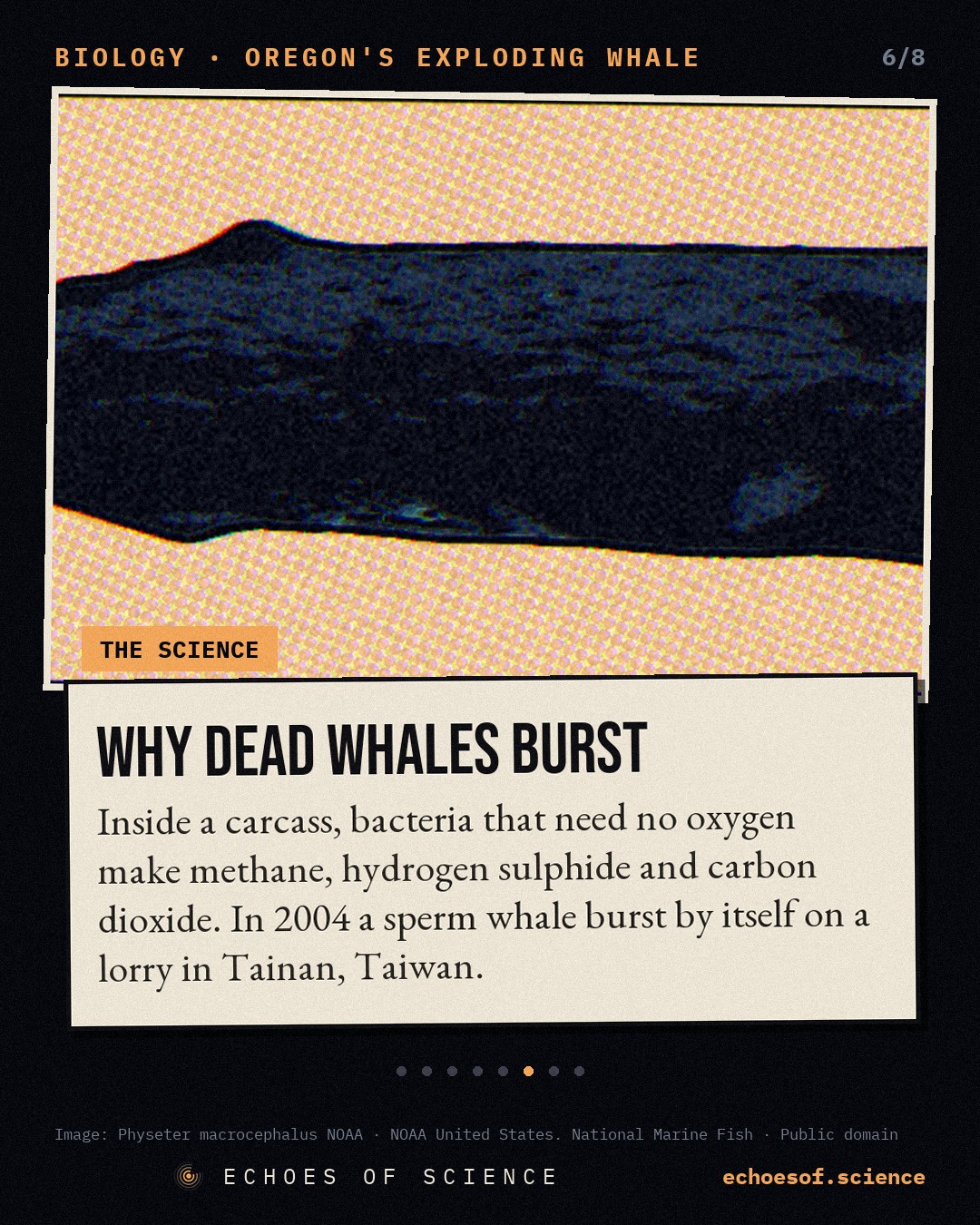
A stranded whale is a hard thing to get rid of, and not only because of its size. Under its blubber, decomposition starts at once. When the oxygen in the tissues runs out, bacteria that live without oxygen take over, many of them from the gut. In this stage, called putrefaction, they produce (as the standard account of decomposition describes) gases such as hydrogen sulphide, carbon dioxide, methane and nitrogen. The body swells, and if the pressure gets high enough while the skin weakens, it can tear open.
In a whale this can happen without any dynamite at all. In January 2004 a 56-foot sperm whale burst on the back of a lorry in a busy street in Tainan, Taiwan, while it was being driven away for a post-mortem. Reports at the time put it down to the gas built up inside by decomposition.
Explosives add a second lesson. The expanding gases of an explosion escape along the easiest path. Packed against one side of a soft, heavy carcass on loose sand, the charge did what Thornton described: it dug a crater beneath the whale and threw part of it up and back, while most of the body stayed where it was. Pieces large enough to crush a car roof were far too big for any gull.
Why it matters today
Oregon learned. When 41 sperm whales stranded near Florence in 1979, no dynamite was used; they were burned and buried. Today the state's normal practice is to bury a whale where it lies, or move it if the sand is too shallow. Across the United States, NOAA's guidance lists burial, towing out to sea, sinking, leaving remote carcasses for scavengers, and removal to landfill, compost or rendering. Explosives are not on the list.
Florence, meanwhile, has made peace with its most famous afternoon. In 2020 residents voted to name a riverside park Exploding Whale Memorial Park, and every 12 November the town marks Exploding Whale Day. It is a cheerful reminder of something engineers take seriously: before you scale up a method that works on rock, check that your problem is really a rock.
The science in this story
Key facts
- A sperm whale about 45 feet (14 m) long and roughly 8 tons washed ashore near Florence, Oregon, on 9 November 1970; early reports called it a grey whale. source ↗
- After consulting the US Navy, the Oregon State Highway Division set off about half a ton of dynamite (some 20 cases) at 3:45 pm on 12 November, hoping scavengers would eat the pieces. source ↗
- Walter Umenhofer, who had explosives training from his Second World War service, says he warned engineer George Thornton; accounts differ on whether he thought the charge too big or too small. source ↗
- About 75 spectators were moved back a quarter of a mile; the plume rose about 100 feet and a slab of blubber crushed Umenhofer's new car. Nobody was hurt. source ↗
- Thornton told the Register-Guard it "went just exactly right" and was promoted to the Medford office months later. source ↗
- Decomposing carcasses fill with gases such as hydrogen sulphide, carbon dioxide, methane and nitrogen made by anaerobic bacteria; the pressure can rupture the body. source ↗
- In January 2004 a 56-foot sperm whale burst from built-up decomposition gas on a lorry in Tainan, Taiwan. source ↗
- In 2020 Florence voted to name Exploding Whale Memorial Park (439 of 856 votes); today Oregon buries stranded whales, and NOAA's disposal options do not include explosives. source ↗
In pictures


Stir a sachet of dried yeast and two spoons of sugar into a bottle of warm water and stretch a balloon over the neck: within an hour the gas made by living cells inflates it.
Loading the quiz…
Where every picture, clip and sound in this story comes from
Keep scrolling: more true stories ↓
New mini-documentaries every week and a true story every day. Pick where you like to watch:
▶ Subscribe on YouTube Telegram TikTok Instagram Bluesky Threads ✉ Weekly email