The Enslaved 12-Year-Old Who Unlocked Vanilla
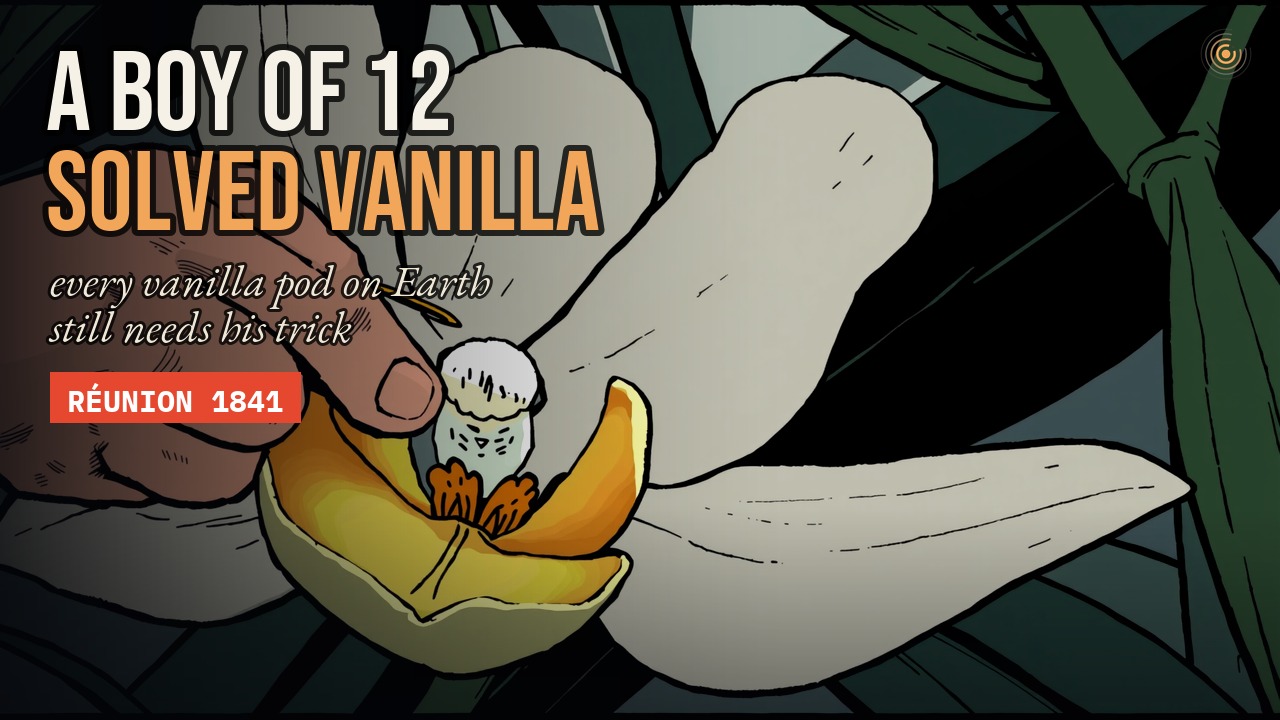
For centuries almost every vanilla pod came from Mexico: elsewhere the orchid flowered and never fruited. In 1841 on Réunion, Edmond, an enslaved boy of 12, found how to hand-pollinate the flower in seconds by lifting the rostellum and pressing the pollen onto the stigma. Farmers still use his gesture on almost every vanilla vine on Earth; he died poor in 1880.
 Premieres on YouTube Thursday 12 November, 17:00 UTC · subscribe to get it
A garden on a tropical island in the Indian Ocean, one morning in 1841. A planter is walking between his vines with a boy of 12. The boy is enslaved. His name is Edmond.
The planter stops at one old vine. It is a vanilla orchid. It has grown here for about 20 years. It has flowered again and again, and it has never made a single pod. This morning, two green pods are hanging from it.
Edmond says that he did it. With his own hands. The planter does not believe him. So the boy shows him.
What Edmond showed him takes a few seconds. It is still done today, on almost every vanilla vine on Earth, one flower at a time. So why could the world's favourite flavour not make fruit on its own? And how did a child crack a problem that Europe's botanists had only half solved?
The Black Flower
Vanilla is an orchid: a climbing vine from the tropical forests of Mexico and Central America. There are about 30,000 kinds of orchid. Only a few give us a spice, and almost all the vanilla in the world comes from this one species: Vanilla planifolia.
On the Gulf coast of Mexico, the Totonac people grew it, and learned to cure its pods. The Aztecs, who took vanilla from them as tribute, gave it a name that means black flower, after the colour of the cured pod.
Mixed with cacao, maize and honey, it flavoured the thick chocolate drink of the Aztec court. The Spanish soldier Bernal Díaz described that chocolate being served to Moctezuma. Soon Spain was making vanilla chocolate of its own.
In 1602, Hugh Morgan, apothecary to Queen Elizabeth the First, suggested using vanilla on its own, as a flavouring. Europe fell for it. But for more than two centuries, almost every vanilla pod in the world still came from Mexico.
It was not for want of trying. Cuttings travelled to greenhouses in Europe and to tropical colonies. Many took root. Some even flowered. But away from Mexico, the flowers simply withered and fell. Not one pod.
Something in Mexico was doing a job that nothing anywhere else could do. To find out what, we have to look inside the flower.
The Locked Flower
A vanilla flower is pale yellow-green, and it opens in the early morning. In most varieties it lasts a single day. If it is not pollinated by then, it wilts and drops, and that chance is gone.
In the middle of the flower is a column, where the male and female parts are joined into one. At its tip sits the anther, with the pollen packed into sticky clumps under a little cap. Just below it is the stigma, the surface that has to receive that pollen.
They are almost touching. But between them lies a thin flap of tissue called the rostellum. It works like a lid. It stops the flower's own pollen from reaching its own stigma.
For an orchid, that makes sense. A lid against self-pollination favours cross-pollination: an insect carries pollen from one flower to another, and mixes the genes. But it also means that without the right visitor, nothing happens at all.
So which visitor? You will often read that vanilla is pollinated by one Mexican bee, a stingless bee called Melipona. It is a lovely story. It may not be true.
In 2024, a team in Yucatán, in Mexico, watched vanilla flowers closely. They even placed a colony of Melipona bees right beside the vines. The bees ignored the flowers. Small stingless bees landed now and then, but never in a way that would pollinate them. Orchid bees buzzed around nearby, and did not visit at all.
In their experiments, only about 5 flowers in 100 set fruit without human help. Even at home in Mexico, vanilla is pollinated rarely, and nobody is quite sure by whom. Far from home, the chance was zero. Someone would have to do the visitor's job.
A Professor in Liège
The first person to do it on purpose was a Belgian. Charles Morren was professor of botany in Liège. A vanilla plant had first flowered in a heated greenhouse there in 1829.
Morren studied the flowers for years. In 1836 he worked out how to fertilise them by hand, and in 1837 his vine gave him 54 pods. A second plant gave about 100. In Liège, a small glass vial still holds two pods from that first harvest.
He called vanilla a delicate flower that needs the help of people. And in 1839, a British journal printed his paper, with a title that said it all:
On the production of vanilla in Europe.
But Morren's method was slow and fiddly, a job for a scientist with fine tools. One modern expert puts it at around 20 minutes a flower. A plantation opens its flowers by the thousand, and each one lasts a day.
So the science was solved. The farming was not. The answer would come from an island almost 10,000 km away, and from someone no botanist had heard of.
The Boy and the Vine
Réunion lies in the Indian Ocean, east of Madagascar. In the early 1800s it was a French colony called Bourbon: an island of coffee and sugar. In 1848, nearly 60% of its people were enslaved. They, or their parents, had been brought from Madagascar, East Africa, the Comoros and India.
In the late 1810s, a ship's captain brought vanilla cuttings to the island. In Sainte-Suzanne, on the wet north-east coast, a planter called Ferréol Bellier-Beaumont planted them in his garden. Only one vine survived. For two decades it climbed, and flowered, and bore nothing.
Edmond was born in Sainte-Suzanne in August 1829. His mother died giving birth to him. He grew up enslaved, and as a small boy he was sent to Bellier-Beaumont's estate, where the planter taught him about plants.
One of the things he learned was how to pollinate melons by hand, carrying pollen from the male flowers to the female ones. Some accounts say pumpkins. Either way, it is an old gardener's trick: when the insects don't come, you do their work yourself.
In 1841, at 12 years old, Edmond tried something like it on the vanilla. Nobody wrote down how he worked it out. But we know exactly what he did, because his gesture is still in use.
With a thin sliver of bamboo, or a pointed stick, he lifted the little flap of the rostellum out of the way. Then, with his thumb, he pressed the anther down onto the stigma. Pollen met stigma. The lock was open. It took seconds.
In the weeks that followed, the base of the flower began to swell into a long green pod, the pod that becomes a vanilla bean. Bellier-Beaumont saw more pods forming, watched the boy do it again, and understood what he was looking at.
Pollination is only the start. Each grain of pollen grows a tiny tube down into the flower's ovary, and fertilises the ovules waiting there. 7 to 9 months later, the pod is ripe, packed with tens of thousands of seeds, smaller than grains of sand. They are the black specks you see in real vanilla ice cream.
Green Gold
Word spread from estate to estate. According to later accounts, Edmond himself was sent round to teach it. Within a few years, vanilla flowers all over the island were being opened by hand, most of them by enslaved workers.
The numbers tell the rest. In 1848, Réunion sent about 50 kg of vanilla to France. Ten years later, about 2 tonnes. In 1867, 20 tonnes. And in 1898, 200 tonnes. The island had overtaken the country where vanilla was born.
Réunion's growers also perfected the curing, and that matters, because a fresh green pod hardly smells of vanilla at all. Its vanillin, the main flavour molecule, is locked up, bound to a sugar, in a molecule called glucovanillin.
Curing sets it free. The pods are dipped for a few minutes in hot water, at around 63 °C. Then they sweat for 2 or 3 days, wrapped in blankets in boxes. Then they dry slowly, for weeks, and rest for months. All the while, the pod's own enzymes are cutting the sugar away.
The finished bean is black and glossy, and only about 1 or 2% of it is vanillin. It takes about 6 kg of green pods to make 1 kg of cured vanilla. The island's old name stuck to the product: Bourbon vanilla.
And it spread. The hand method, the curing, and cuttings from the island's vines went on to Madagascar and the Comoros. By the early twentieth century, that corner of the Indian Ocean was growing most of the world's vanilla. It made fortunes. Just not for the boy who started it.
Whose Discovery?
So how do we know that it was Edmond? At the time, people fought over the question.
The French botanist Jean Michel Claude Richard later claimed that he had found the method himself, and that the boy must have watched him do it during a visit to the island.
Bellier-Beaumont answered in letters. He insisted that Edmond had found it, and asked how Richard could possibly have taught a small child years before. One of those letters dates from 1861.
Most of what we know comes from those letters, written 20 years after the event, by the man who had taken the boy in. That is worth remembering. But no rival claim has held up, and historians today generally credit Edmond.
Some details stay blurry. Accounts differ on his tool: bamboo, a stick, or a needle. And Morren, in Liège, had got there first. What Edmond found was the version fast enough for a farm.
In 1848, France abolished slavery in its colonies, and Edmond was freed. He was given a surname: Albius, from the Latin word for white. Why that name, we do not know.
Freedom did not bring comfort. He moved to Saint-Denis, the island's capital, and worked as a kitchen hand. In 1852 he was convicted of stealing jewellery and sentenced to 5 years of hard labour. Bellier-Beaumont pleaded for him, and he was released after about a year.
Bellier-Beaumont also asked the government to give Edmond a pension, for what he had done for the colony. The request was refused.
Edmond Albius went home to Sainte-Suzanne, married, and worked as a labourer. He died in 1880, aged 51, in poverty. The island's newspaper gave him one line:
He has died in the public hospital at Sainte-Suzanne.
The Flower Today
Today, most of the world's natural vanilla comes from the island next door. Madagascar grows around four-fifths of it, mostly on small family farms in the north-east.
And every one of those flowers is still opened the way Edmond showed. In the flowering season, around October and November, farmers walk their vines every morning, flower by flower, with a sliver of wood and a thumb.
A vine needs 3 or 4 years before it flowers at all, and keeps going for about 10 more. After the harvest come the hot water, the sweating and the months of drying, much as on Réunion in the 1850s.
It takes around 600 hand-pollinated flowers to make 1 kg of cured beans. That is a big reason why vanilla is the second most expensive spice in the world, after saffron.
It also makes the crop fragile. In March 2017, Cyclone Enawo tore across north-eastern Madagascar. Prices were already climbing: from about $50 a kilogram in 2013, vanilla rose to more than $600, dearer than silver. Farmers paid guards to watch their vines at night.
Then the prices fell. In recent years, many farmers have struggled to get even $100 a kilogram. For the families who grow it, vanilla swings between boom and bust.
Meanwhile, most vanilla flavour never comes near a flower. In 1874, the German chemists Ferdinand Tiemann and Wilhelm Haarmann made vanillin from the sap of conifer trees. Today, less than 1% of the world's vanilla flavour comes from the orchid. Most of it is synthetic vanillin, made mainly from petrochemicals.
There is a deeper weakness, too. A genetic study in 2008 found that most of the vanilla grown in the world comes from a single original plant, copied again and again by cuttings. Clones share the same weaknesses. A soil fungus that causes stem rot can kill up to two-thirds of the vines in a plantation.
In 2022, a team based on Réunion published the most complete map yet of the vanilla genome: more than 59,000 genes, a starting point for breeding vines that can resist disease and a changing climate.
So the future of vanilla is being worked out, once again, on the island where a 12-year-old first opened the flower.
Epilogue
In 1980, Sainte-Suzanne put up a plaque to Edmond Albius. In 2004, a statue followed. A school bears his name.
But his real memorial is a gesture. Somewhere this morning, in Madagascar, in Mexico, in Indonesia or on Réunion itself, someone is lifting a tiny flap inside a flower that will be gone by evening, and pressing it shut with a thumb. Every bean they make carries his idea.
Next time: how chemists made vanilla from the sap of pine trees, and why your ice cream probably tastes of it. And on our website, you can try to pollinate a vanilla flower before it closes.
The science in this story
Key facts
- Edmond (born 1829, Sainte-Suzanne) was 12 in 1841 when he showed Ferréol Bellier-Beaumont two pods on a vine that had not fruited in about 20 years. source ↗
- Réunion's vanilla exports: about 2 t (1858), 20 t (1867), 200 t (1898), when it overtook Mexico. source ↗
- Charles Morren hand-fertilised vanilla in Liège in 1836 and got 54 pods in 1837, but his method was slow. source ↗
- A 2024 study in Yucatán found about 5% natural fruit set and no legitimate flower visits by Melipona or orchid bees. source ↗
- Freed in 1848 and named Albius, he was convicted in 1852 (5 years' hard labour, released after about a year) and died poor in 1880; plaque 1980, statue 2004. source ↗
- About 600 hand-pollinated flowers make 1 kg of cured beans; less than 1% of vanilla flavour comes from the orchid. source ↗
- Most cultivated vanilla derives from a single original accession (Bory et al. 2008). source ↗
Loading the quiz…
Sources
- Linnean Society (2019) · Europeana / FME · Département de La Réunion
- Quezada-Euán et al., PLoS ONE (2024) · Bory et al., Am. J. Bot. (2008)
- Annals & Mag. Nat. Hist. 3 (1839) · CIRAD (2022) · UF/IFAS (2025)
- Scientific American · NYT (2018) · P. Rain, UNAM (2018)
Where every picture, clip and sound in this story comes from
Keep scrolling: more true stories ↓
New mini-documentaries every week and a true story every day. Pick where you like to watch:
▶ Subscribe on YouTube Telegram TikTok Instagram Bluesky Threads ✉ Weekly email