Why Japan's Asteroid Probe Will Never Land Again
Hayabusa2 brought 5.4 grams of an asteroid back to Earth. After a fault in its last working ion engine, Japan says it will never land again.
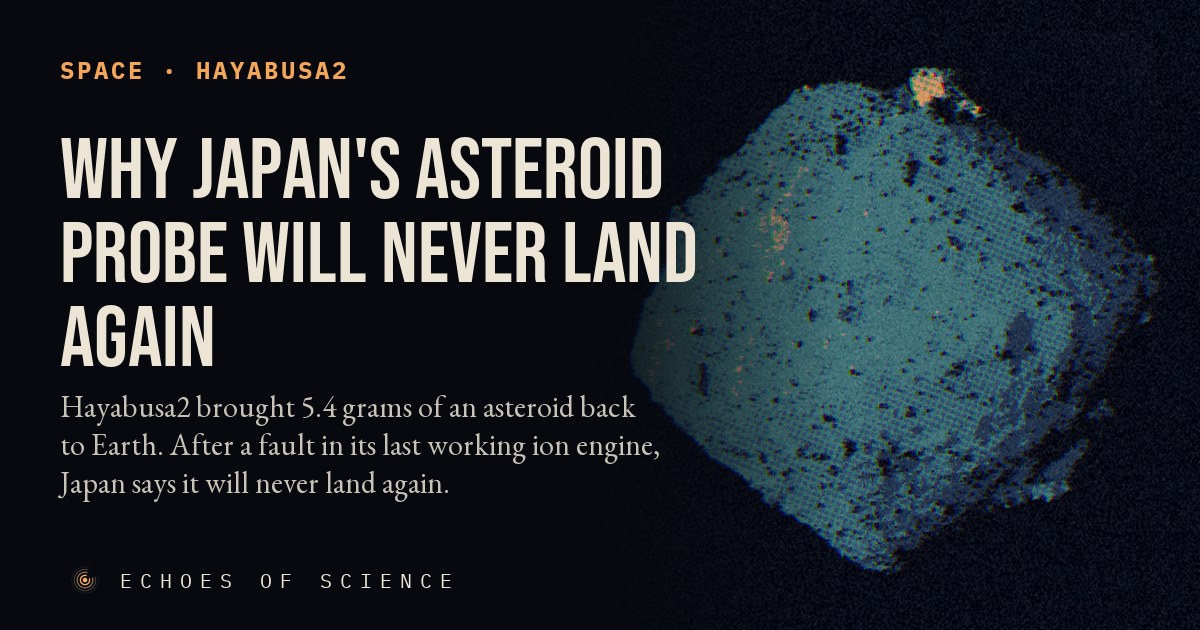
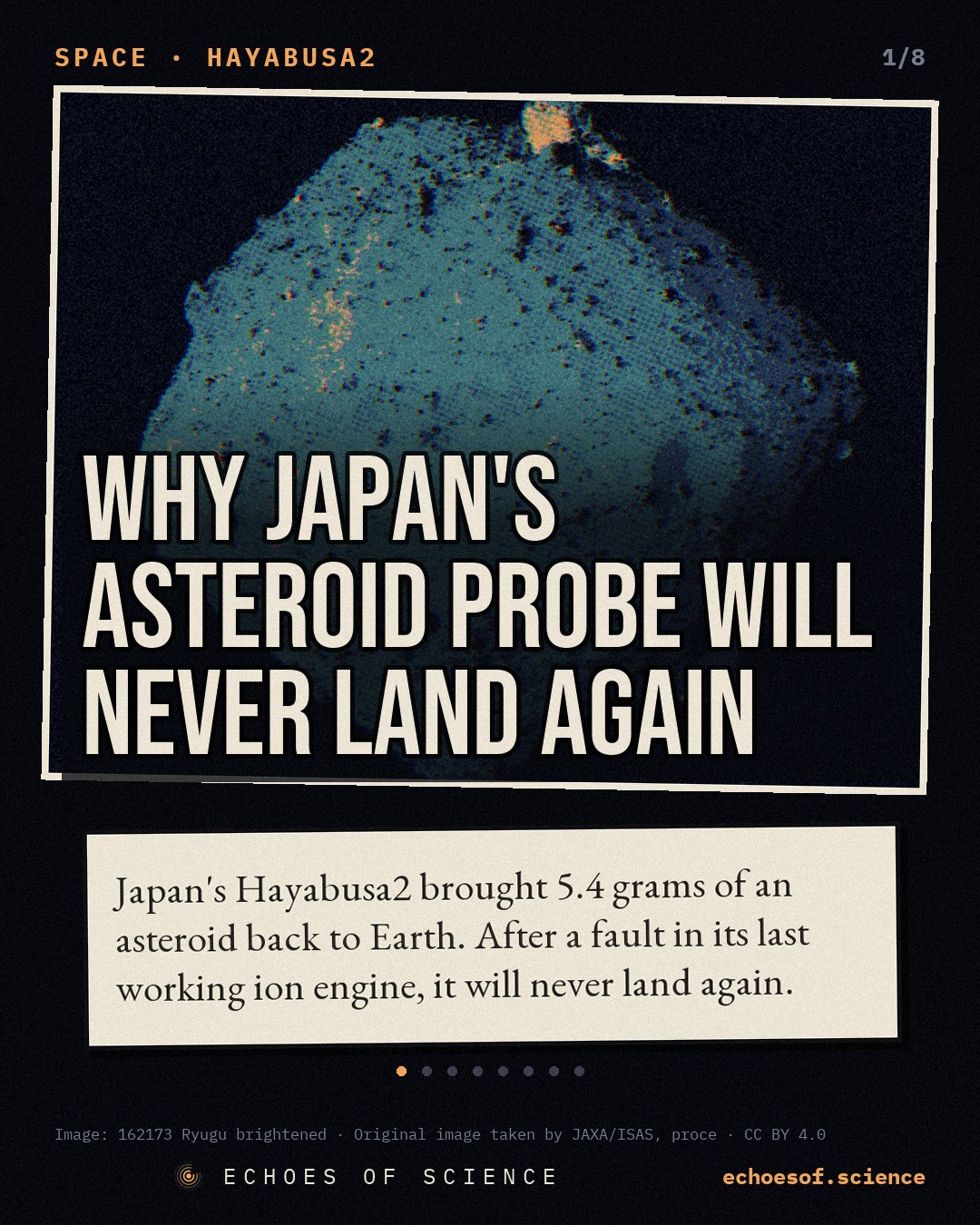
In December 2020 a small capsule fell out of the sky over the Australian outback, glowing as it hit the atmosphere and then drifting down under a parachute. Inside were 5.4 grams of rock and dust scooped from the asteroid Ryugu. The spacecraft that dropped it, Japan's Hayabusa2, did not come home with it. It steered away from Earth and headed back out into the Solar System for a second career. Six years later that career has had to change course, because of a part most people have never heard of.
A probe that would not retire
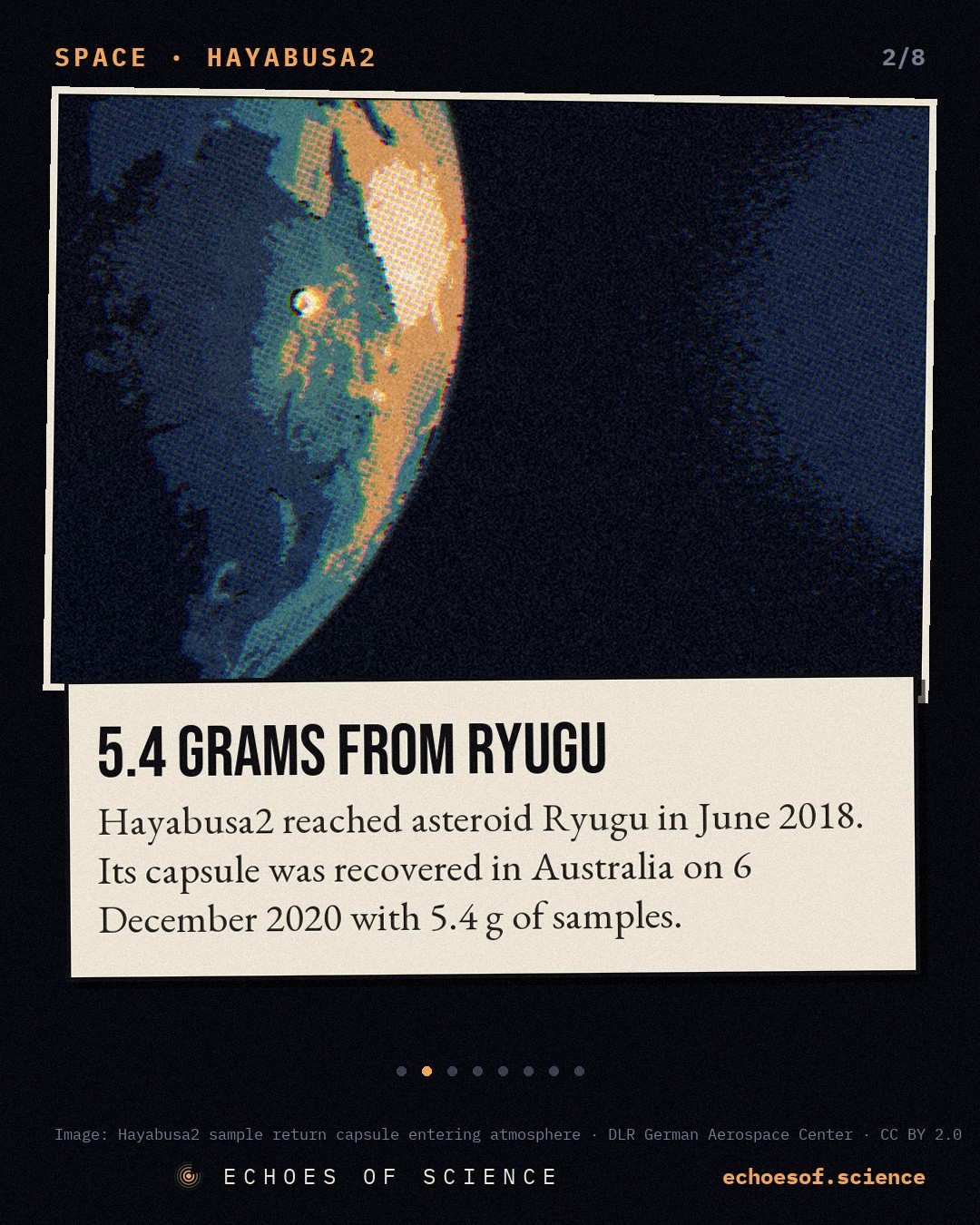
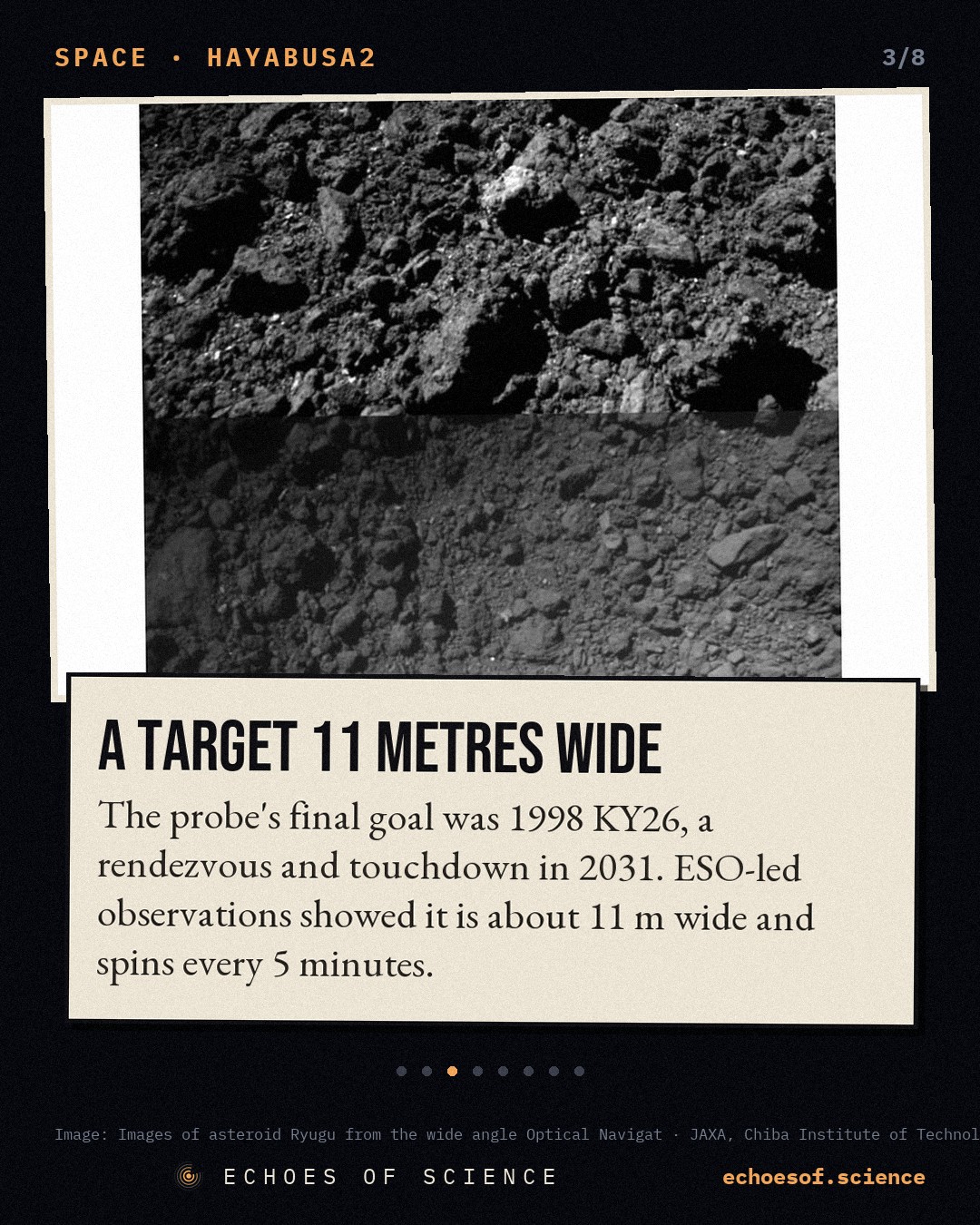
Hayabusa2 was launched on an H-IIA rocket in December 2014 and reached Ryugu in June 2018, according to the Japan Aerospace Exploration Agency (JAXA). It touched down twice, collected material, and sent its sample capsule back to Earth; the capsule was recovered in Australia on 6 December 2020, and the collected samples weighed 5.4 grams. The Planetary Society notes that it landed at Woomera, recovered with the Australian Space Agency.
With fuel to spare, JAXA gave the probe an extended mission. In July 2026 it raced past the asteroid Torifune (2001 CC21) at about 5 km/s. Its final goal was more ambitious: to meet and touch a tiny asteroid called 1998 KY26 in 2031. Observations led by the European Southern Observatory showed that KY26 is only about 11 metres wide and spins once every five minutes, three times smaller than earlier estimates, which already made a touchdown harder than planned.
The engines that sip gas
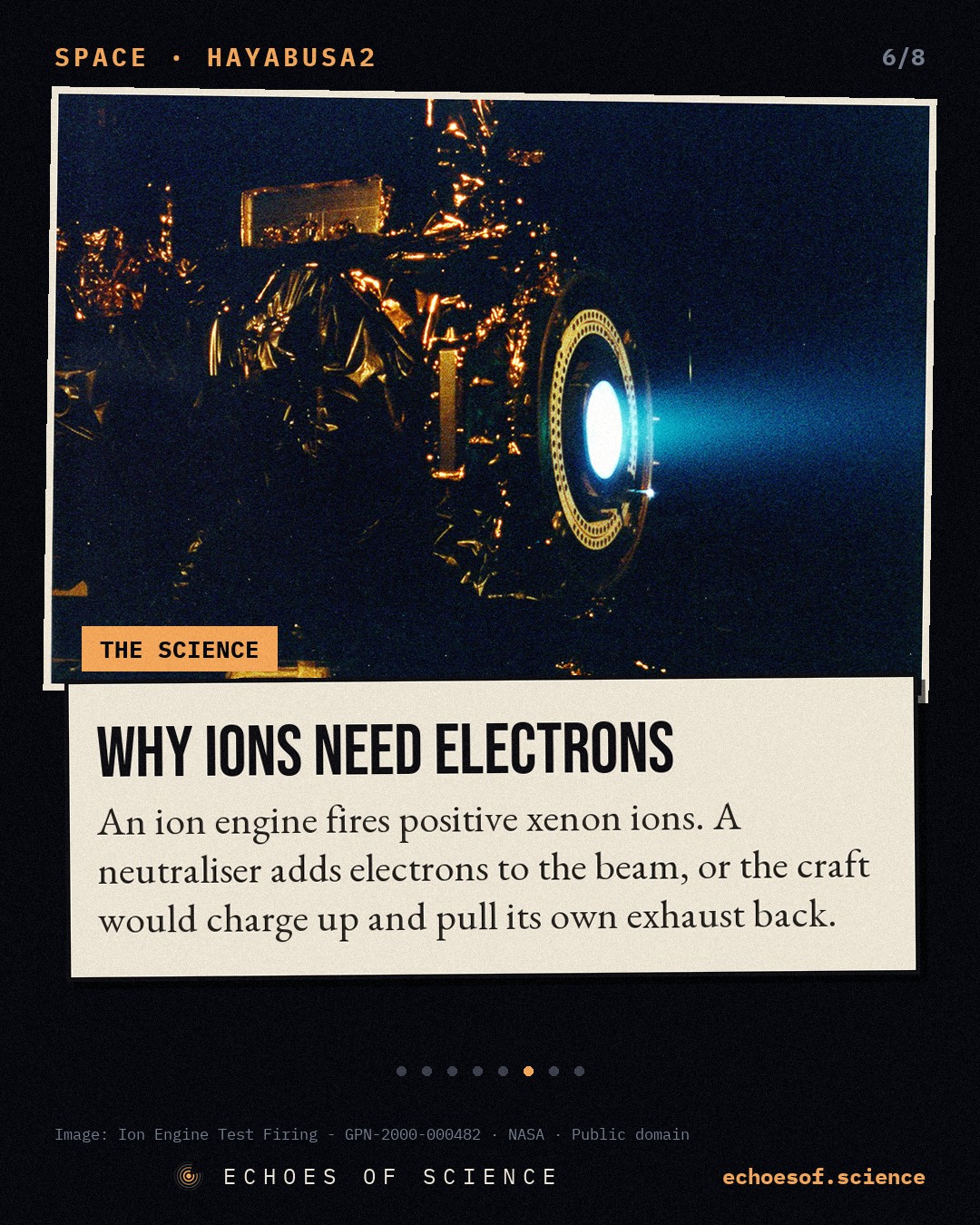
Hayabusa2 does not cross the Solar System on ordinary rocket burns. It uses ion engines: devices that strip electrons from xenon gas, accelerate the charged atoms through an electric field and fire them out of the back at very high speed. JAXA's microwave discharge engines, about 10 cm across, are described by ISAS as producing thrust measured in millinewtons; in tests the design reached up to 11.2 millinewtons. That is roughly the weight of a paper clip resting on your hand. The trick is patience: an ion engine can run for months, and over years its gentle push adds up to a change in speed that a chemical rocket of the same mass could never match.
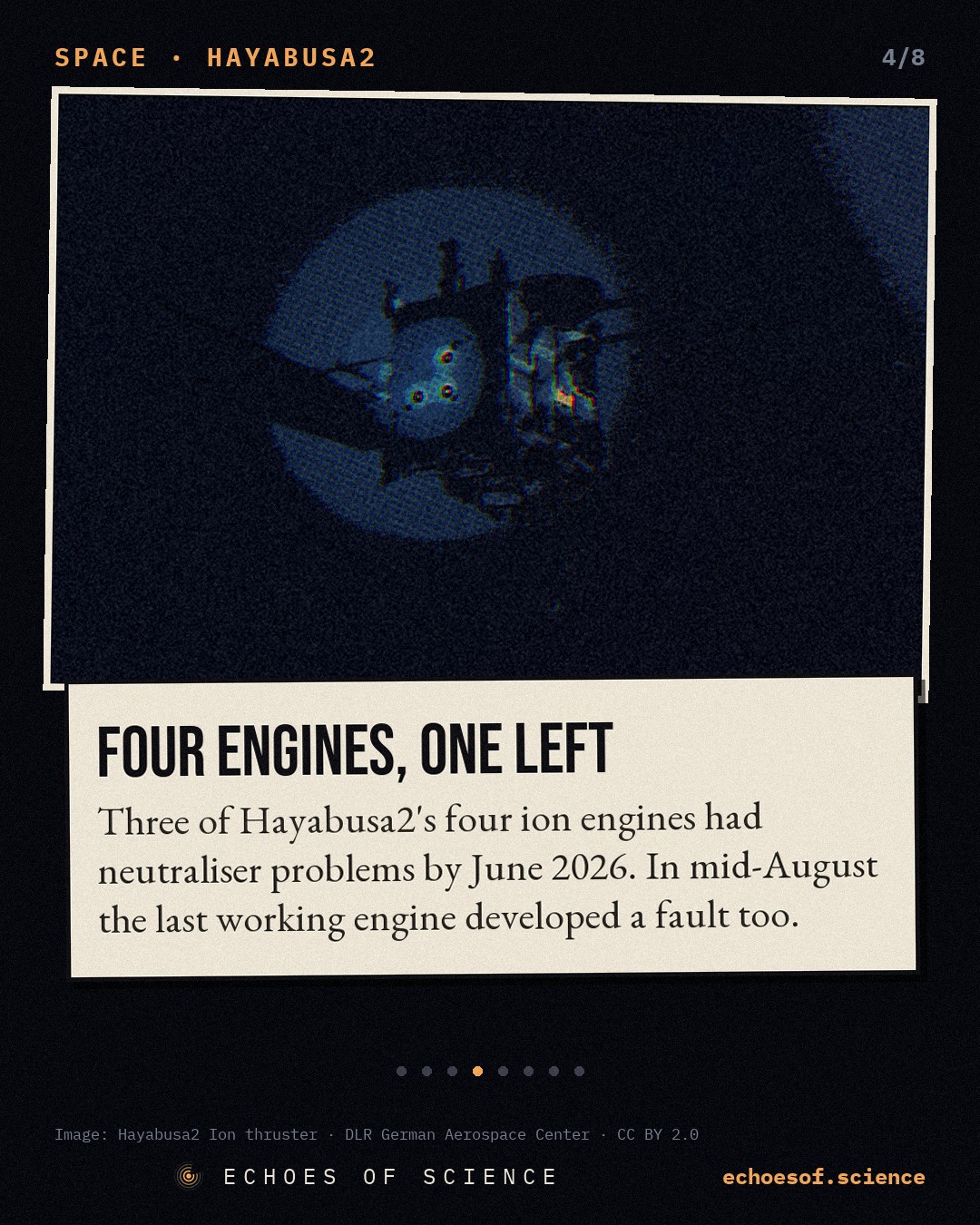
Every ion engine has a weak point, though. Firing positive ions out of the back leaves the spacecraft with extra electrons, so it would gradually charge up and start pulling its own exhaust back. A small device called a neutraliser solves this by spraying electrons into the departing beam. In June 2026 JAXA reported that the neutralisers of three of its four engines (A, C and D) had shown an unexpected rise in voltage, leaving engine B to do the work.
What went wrong
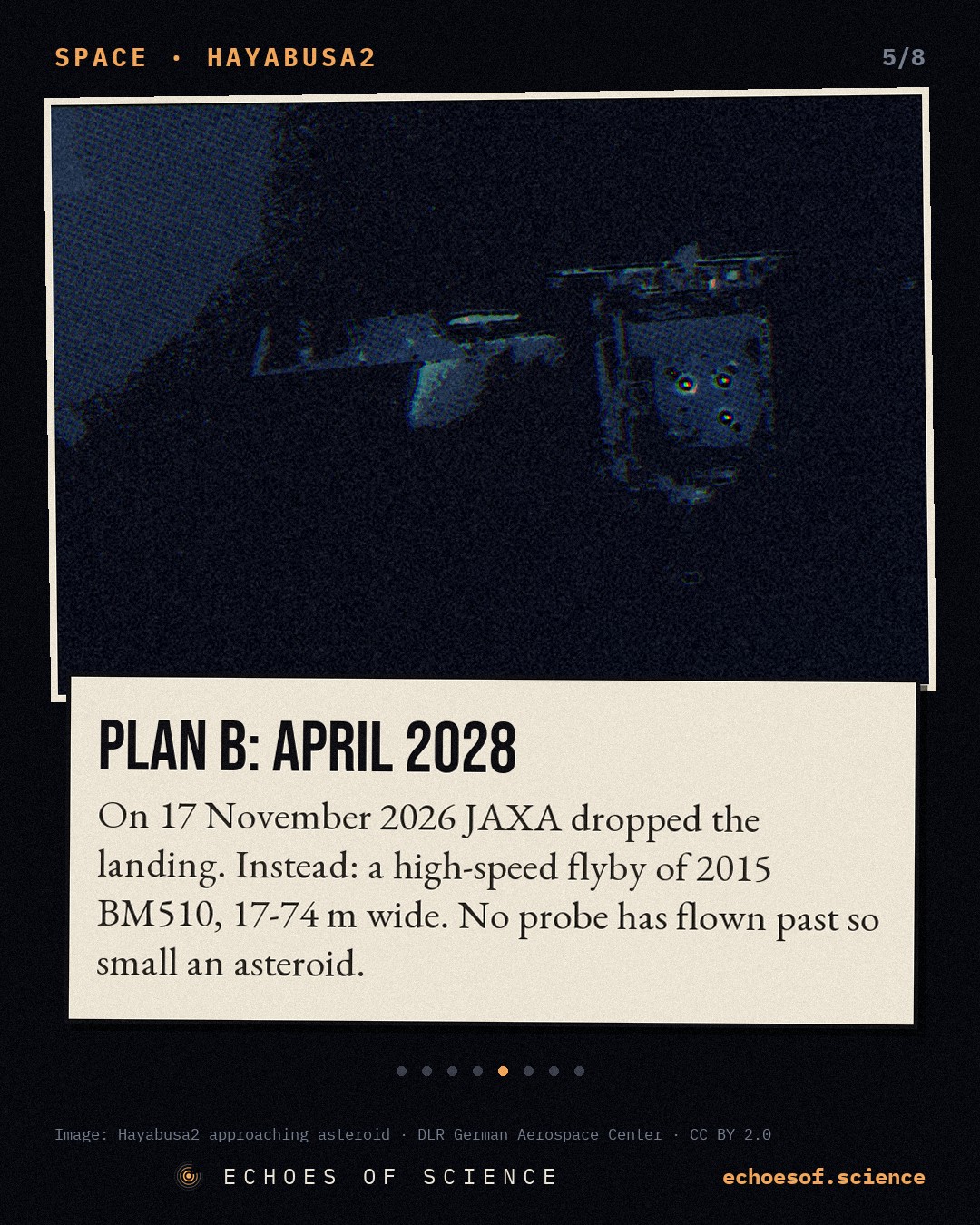
Then, in mid-August 2026, the last fully working engine developed a fault. At a press conference on 17 November, JAXA announced that the rendezvous with 1998 KY26 was off, Space.com reported. There will be no landing. Instead, Hayabusa2 will make a high-speed flyby of a different near-Earth asteroid, 2015 BM510, in April 2028. Extended-mission team leader Yuya Mimasu was quoted as saying that the deterioration of the onboard equipment "is becoming increasingly evident".
Why does a broken engine rule out a landing but not a flyby? Flying past an asteroid only requires being in the right place at the right moment; meeting one means matching its speed and path exactly, which takes a large change in velocity. Japanese reporting of JAXA's own estimates put the total needed to reach KY26 at hundreds of metres per second, far beyond what the small chemical thrusters can supply. Engineers have found a workaround, pairing one engine's ion source with another engine's neutraliser, but nobody can say how long such a combination will last.
How do we know?
The facts about the engines come from JAXA's own mission updates and from its November press conference as reported by Space.com and the Kyodo news agency. Some details, such as the exact speed change the KY26 trip required and the precise closest distance planned for 2028, have so far appeared only in press reports rather than in a published JAXA document, and may be refined. The size of 2015 BM510 is uncertain: Kyodo gives a range of 17 to 74 metres, because its size is worked out from its brightness, which depends on how dark its surface is. It is thought to be a dark D-type asteroid that spins fast.
Why it matters today
A flyby of 2015 BM510 would still be a first: according to Kyodo, no spacecraft has ever flown past an asteroid only tens of metres across. Small asteroids like this are far more numerous than large ones, yet we know them mainly as faint points of light. Hayabusa2 has already shown that ion propulsion can carry a probe to an asteroid and back again. Its last chapter is a reminder of the other side of that technology: the slow, efficient engines that make such journeys possible depend on small parts that wear out, and when they do, missions adapt rather than end. If the 2028 flyby works, a spacecraft launched in 2014, running on borrowed parts, will photograph a world smaller than a block of flats.
The science in this story
Key facts
- Hayabusa2 launched in December 2014 on H-IIA No. 26 and arrived at asteroid Ryugu in June 2018. source ↗
- Its sample capsule was recovered in Australia on 6 December 2020; the collected samples weighed 5.4 grams. source ↗
- 1998 KY26, the planned final target for a 2031 rendezvous, is only about 11 m wide and rotates once every five minutes, about three times smaller than thought. source ↗
- Hayabusa2 has four ion engines (A-D); by June 2026 A, C and D had shown an unexpected rise in neutraliser voltage, so only B was being operated. source ↗
- The final functioning ion thruster suffered a malfunction in mid-August 2026; at a press conference on 17 November JAXA abandoned the KY26 rendezvous: there will be no landing. source ↗
- The new plan is a high-speed flyby of near-Earth asteroid 2015 BM510 in April 2028. source ↗
- 2015 BM510 is a dark D-type asteroid estimated at 17-74 m across; no spacecraft has flown past an asteroid only tens of metres in size. source ↗
- JAXA's microwave discharge ion engine is about 10 cm across, runs on xenon, and in tests reached up to 11.2 mN of thrust. source ↗
In pictures
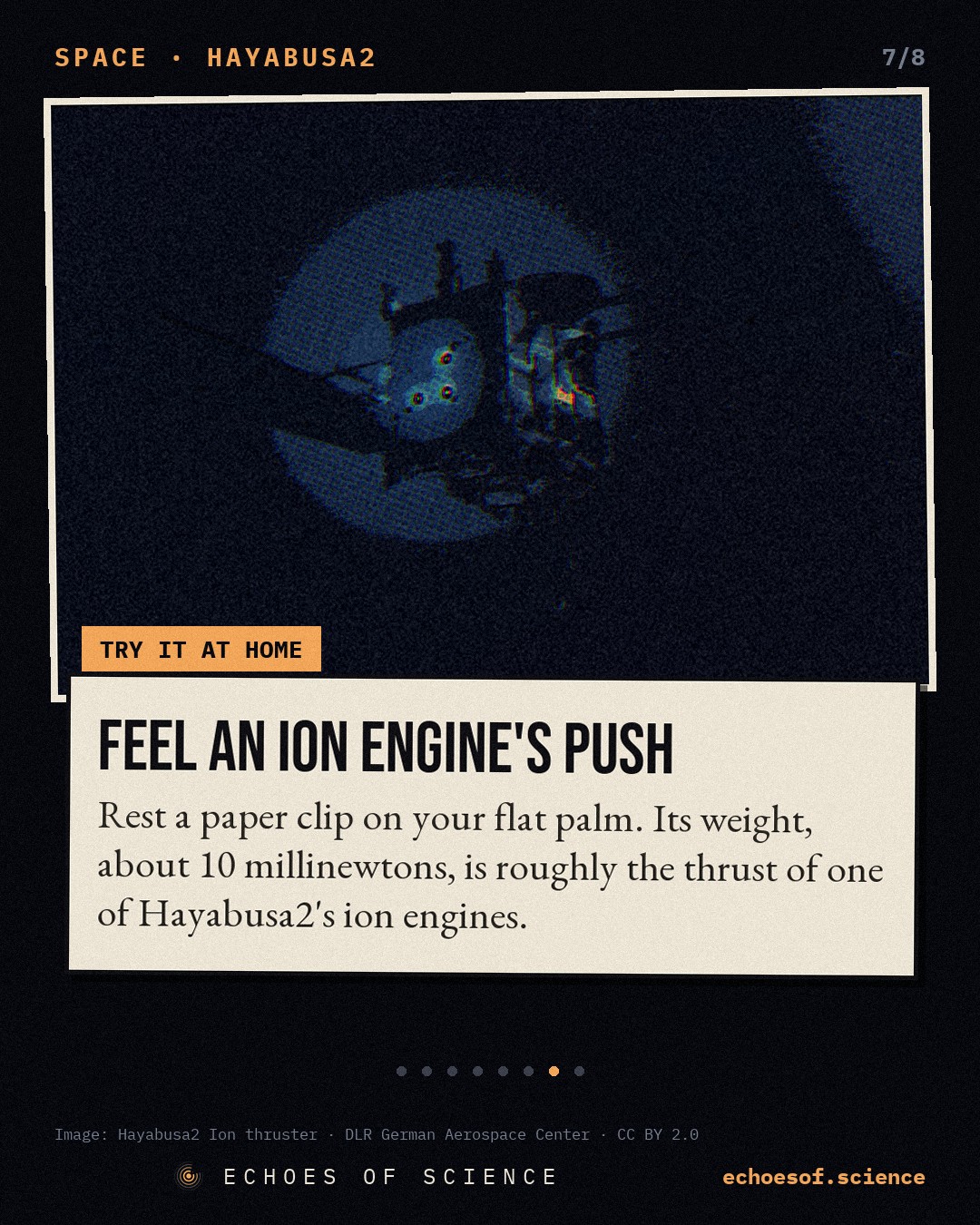

Paper-clip thrust: rest a standard paper clip (about 1 g) on your flat palm. Its weight, about 10 millinewtons, is roughly the push of one of Hayabusa2's ion engines. Now imagine that push, never stopping, for months on end.
Loading the quiz…
Where every picture, clip and sound in this story comes from
Keep scrolling: more true stories ↓
New mini-documentaries every week and a true story every day. Pick where you like to watch:
▶ Subscribe on YouTube Telegram TikTok Instagram Bluesky Threads ✉ Weekly email
Everything here is free and stays free. If you would like to help us make more: 🪐 Shop: calendars, posters, mugs & books