Orbital decay
The slow sinking of a satellite's orbit as thin air at the edge of space drags on it, until it falls back to Earth.
The atmosphere has no sharp edge. Hundreds of kilometres up, where many satellites and space stations orbit, a very thin trace of air remains. A spacecraft racing through it keeps hitting those few molecules, and the atmospheric drag takes a little energy on every orbit. The orbit gradually shrinks, the craft dips into denser air, the drag grows and the decline speeds up. This is orbital decay, and it ends in re-entry.
The Sun has a big say in how fast it happens. When solar activity is high, extra energy heats the upper atmosphere and makes it swell outwards, so a satellite at a given height meets denser air and comes down sooner. NASA's Skylab space station was a famous casualty. Higher-than-predicted solar activity in the late 1970s increased the drag on it; an earlier estimate had it lasting until 1983, but on 11 July 1979 the 169,000-pound station came down over the Indian Ocean and Australia, scattering debris along a footprint about 2,450 miles long.
Large spacecraft in low orbit, such as the International Space Station, fire their engines from time to time to boost themselves back up.
A common misconception is that friction with the air is what heats a spacecraft or meteor on re-entry. Most of the heat comes from the air in front of it being violently compressed.
See it in action
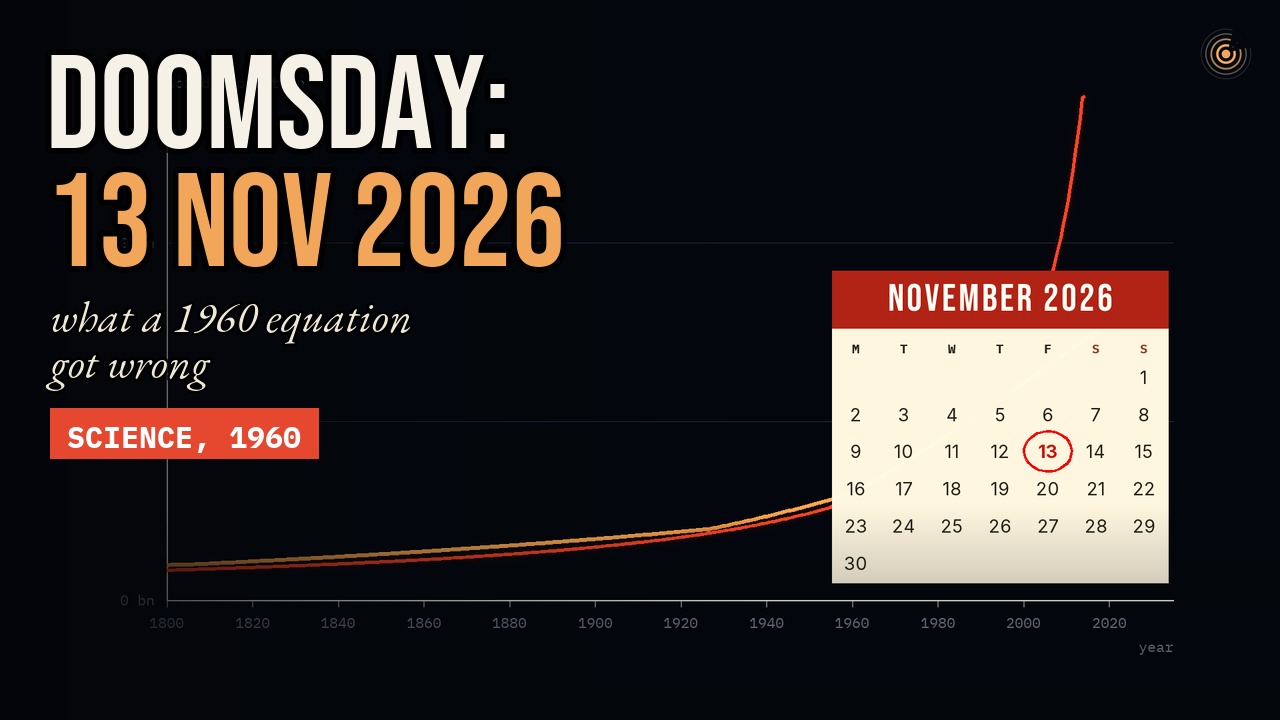 Watch nowThe Doomsday Equation | Friday 13 November 20264 Nov 1960 · University of Illinois, Urbana
 Coming soonApollo 12 Made Its Own Lightning1969 · Kennedy Space Center, Florida
Coming up in future stories
- John Glenn's Heat Shield Scare Was a Bad Switch 20 Feb 1962 · Friendship 7, Earth orbit
- NASA Got a Littering Ticket From Space 1979 · Esperance, Western Australia