What Came Before the Big Bang? Maybe Nothing. Not Even Time
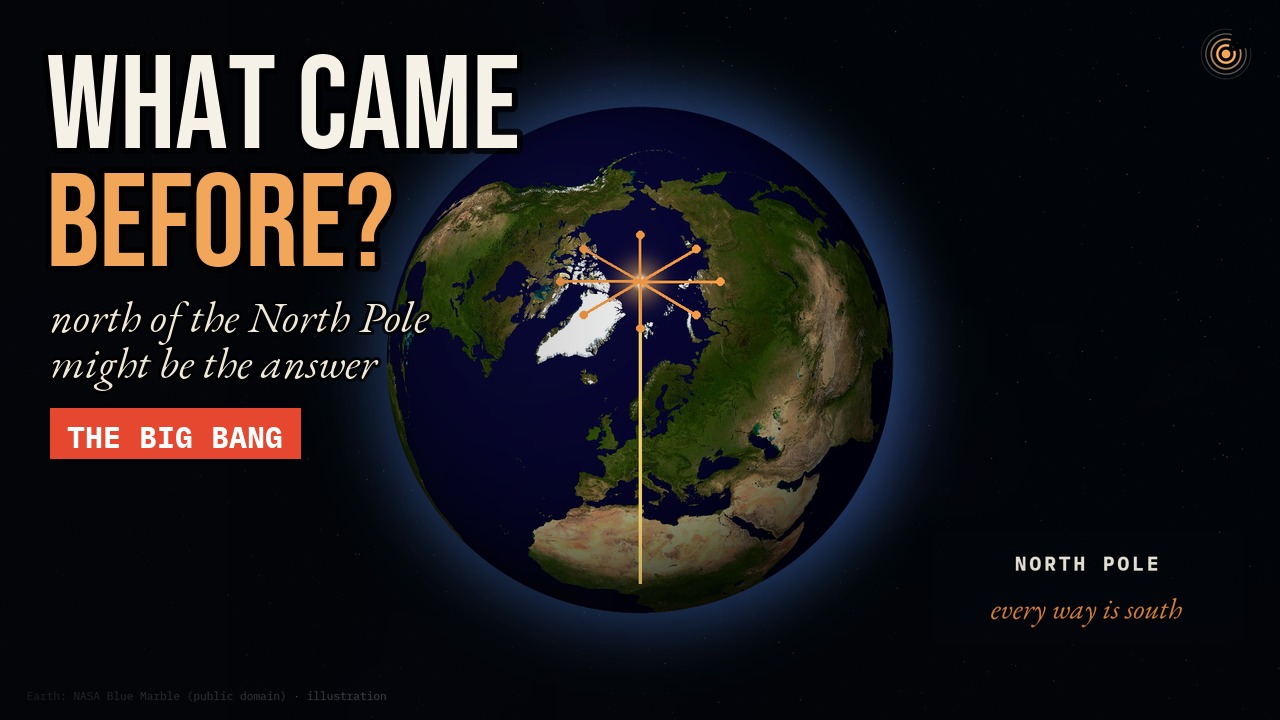
What came before the Big Bang? Asking may be like asking what lies north of the North Pole. A calm, honest documentary about the beginning of the universe and the strangest question in physics: what time actually is, and whether the universe experiences it at all.
 Premieres on YouTube Saturday 28 November, 17:00 UTC · subscribe to get it
13.8 billion years ago, everything we can see today was packed into a tiny, searing point of space. Hotter than any star. Denser than anything we can imagine.
Then it expanded. It cooled. It became stars, planets, oceans... and eventually, people who look up and ask a very strange question.
What came before?
To answer that, we first have to ask something even stranger. Not what happened before the beginning, but what time actually is. And whether the universe experiences it at all.
What the Big Bang Really Is
First, a correction. The Big Bang was not an explosion. Nothing burst outward into empty space, because there was no empty space to burst into. Space itself stretched, everywhere at once. There is no centre, and there is no edge.
Think of raisins in rising bread. No raisin is the middle. Each one sees all the others moving away. And the farther away, the faster.
That is exactly what astronomers see. Distant galaxies recede from us in proportion to their distance. Run that motion backward, and everything converges on a hot, dense past.
The second clue is light. About 380,000 years after the beginning, the universe cooled enough for atoms to form, and light could travel freely for the first time.
That light is still arriving. Stretched into microwaves, a faint glow about 2.7 degrees above absolute zero, coming from every direction in the sky.
The third clue is the recipe of the universe itself. In its first few minutes, the cosmos was a nuclear furnace. Theory predicts it should have made about three parts hydrogen to one part helium, by mass, with a trace of lithium. That is close to what we measure.
Three independent lines of evidence. One story. This part of cosmology is about as solid as science gets.
But the story has a problem on its very first page.
The Singularity Problem
If you take Einstein's general relativity and run the clock backward, the universe gets smaller, hotter, denser... until, at time zero, density becomes infinite. Physicists call that point a singularity.
But most physicists don't believe the singularity was a real thing. When an equation spits out infinity, it is usually telling you the theory has gone past the edge of where it works.
Near that first instant, the universe was small enough that quantum effects should dominate. And we do not yet have a theory that unites gravity with quantum mechanics.
So the honest picture is this. The singularity is where our map runs out. Not necessarily where the territory begins.
And the map has other gaps. Most of the universe seems to be made of dark matter and dark energy: names for things we can measure, but cannot yet identify.
Different ways of measuring how fast the universe is expanding disagree with each other, a puzzle known as the Hubble tension. These may be small cracks. Or signs of something deeper.
Either way, it leaves the biggest question wide open.
What Came Before? Four Ideas
Nobody knows what came before the Big Bang. But physicists have serious ideas. And each one changes what the question even means.
One. There was no before. If time itself began with the universe, then asking what came before is like asking what lies north of the North Pole.
In the early 1980s, James Hartle and Stephen Hawking proposed that near the beginning, time behaves more like a direction in space. The universe has no sharp starting edge. It simply rounds off, like the bottom of a bowl.
Two. Inflation came first. Many cosmologists think that before the hot Big Bang, space went through a brief, violent burst of expansion, called inflation.
In some versions, inflation never stops everywhere at once. Bubble universes keep forming, and ours is just one of them. That pushes the question back a step. But it doesn't answer it.
Three. A bounce. Maybe an earlier universe contracted, and quantum effects stopped the collapse before it reached infinite density, sending it rebounding into the expansion we see. Loop quantum cosmology, and several cyclic models, work this way.
Four. An endless cycle of aeons. Roger Penrose suggests that the far future of a previous universe, cold, empty, nothing left but light, becomes the Big Bang of the next. It is elegant, controversial, and a minority view.
None of these has been confirmed. The extreme conditions of the early universe may have erased most of the clues.
The best hope lies in faint fingerprints: subtle patterns in the cosmic microwave background, or ripples of gravitational waves from the first instant, that could favour one door over another.
And all four ideas lead to the same deeper problem. You can't ask what came before, without knowing what time is.
What Is Time?
We experience time as a river. There is a now, it moves forward, and the past is gone. Einstein showed that this picture is wrong. Or at least, it is not the universe's picture.
In relativity, there is no universal now. Two observers moving differently will disagree about whether two events happened at the same moment.
One sees lightning strike both ends of the train at once. The other sees one strike first. Neither is mistaken.
If there is no single now shared by everyone, then there is no single line between past and future either. That leads many physicists to a startling picture: the block universe.
In the block universe, past, present and future all exist together, as one four-dimensional structure. The year 1200 is as real as today. So is the year 3000.
The feeling of time flowing is like a spotlight moving across the block. A feature of how observers experience it, not of the block itself.
In this picture, the Big Bang isn't an event that happened, and is now gone. It is more like an edge of the block. Always there, in the same way every moment is always there.
Which means a strange sentence becomes almost reasonable. The beginning both exists... and never happened at all.
Time Disappears
It gets stranger. In the late 1960s, John Wheeler and Bryce DeWitt tried to write an equation for the quantum state of the entire universe. When they did, something vanished from it. Time.
The universe as a whole doesn't evolve. It simply is. Physicists call this the problem of time. If the universe has no clock, where does our experience of change come from?
One answer: time is relational. It doesn't exist for the universe as a whole. It exists between parts of the universe. Split the world into a clock, and something that changes relative to it, and time reappears.
In 2013, physicists in Turin, Italy, tested a miniature version of this with two entangled particles of light. Seen from outside, the system was static. Seen from inside, one photon "aged" relative to the other.
Then there is the arrow of time. The basic laws of physics barely care which way time runs. What gives time its direction is entropy: the tendency of things to become more disordered.
And that only works because the universe began in an extraordinarily ordered state. In other words, the reason you remember yesterday, and not tomorrow, may be a fingerprint of the Big Bang itself.
Some physicists, like Carlo Rovelli, go further. They argue time may be like temperature: real and useful at our scale, but not fundamental.
Zoom in on temperature, and you find only molecules moving. Zoom in on time, and you may find only relationships between events. Which one can influence which.
So perhaps the structure of time, cause before effect, belongs to the universe. And the flow of time belongs to us.
Your Worldline
If the block universe is right, it changes how you might think about a human life.
Physicists describe every object's path through spacetime as a worldline. Yours begins at your birth, and ends at your death. Before and after, that part of the block holds no you.
But your life doesn't disappear when it's over. It isn't erased. It is simply located. A fixed, permanent part of the structure of reality.
Einstein took this seriously. In March 1955, his lifelong friend Michele Besso died. Einstein wrote to Besso's family that his friend had left this strange world a little ahead of him, and that this meant nothing.
For those who believe in physics, he wrote, the difference between past, present and future is only an illusion, however persistent.
A few weeks later, Einstein died too.
There are two ways to feel about this. One is comfort. Nothing that has happened can be undone. Every good moment you've lived is still part of the fabric of the universe.
The other is unease. If everything is already laid out, what about choice? And why does consciousness seem to move through the block at all?
That second question is still unanswered. Many philosophers argue that the present really is special, and the future really is open. The debate is far from over.
Epilogue
So, what came before the Big Bang?
Maybe nothing, because there was no before. Maybe another universe, collapsing and rebounding. Maybe an endless foam of inflating bubbles.
Or maybe the question only looks like a question. Because time needs change, and change needs something to compare against. And at the very edge of the universe, there may be nothing left to compare.
What we can say is this. The hot, expanding early universe is real. The very first moment, and whether there even was a first moment, is still one of the deepest open questions we have.
We tend to think of time as the thing that takes everything away from us. But in the strangest picture physics offers, time takes nothing away at all. It is simply the direction in which things, stars, galaxies, and lives, extend.
Everything that has ever happened... is still there.
On our website, play Same Moment: race two flashes of lightning along a speeding train, and find out why the universe has no single now.
The science in this story
Loading the quiz…
Sources
- Planck 2018 VI (arXiv:1807.06209) · Hubble, PNAS 15 (1929) · PDG review: Big-Bang nucleosynthesis · Riess et al. 2022 (SH0ES)
- Hartle & Hawking, Phys. Rev. D 28 (1983) · Penrose, Cycles of Time (2010) · Ashtekar & Singh (2011)
- DeWitt, Phys. Rev. 160 (1967) · Moreva et al., arXiv:1310.4691 / PRA 89 (2014) · Rovelli, The Order of Time (2018)
- Einstein Archives 7-245 (21 March 1955), via Quote Investigator (2024) · Isaacson, Einstein (2007)
Where every picture, clip and sound in this story comes from
Keep scrolling: more true stories ↓
New mini-documentaries every week and a true story every day. Pick where you like to watch:
▶ Subscribe on YouTube Telegram TikTok Instagram Bluesky Threads ✉ Weekly email