The Entire History of Earth, and the Rocks That Prove It
The oldest piece of Earth ever found is a zircon crystal a quarter of a millimetre across, 4.4 billion years old, with a chemical hint of liquid water inside. Rewind the whole planet, and for almost every chapter there is a witness like it: river grains that never rusted, stripes of iron, boulders dropped by tropical ice, a fossil a teacher said could not exist, a thin layer of iridium clay.
 Premieres on YouTube Saturday 05 December, 17:00 UTC · subscribe to get it
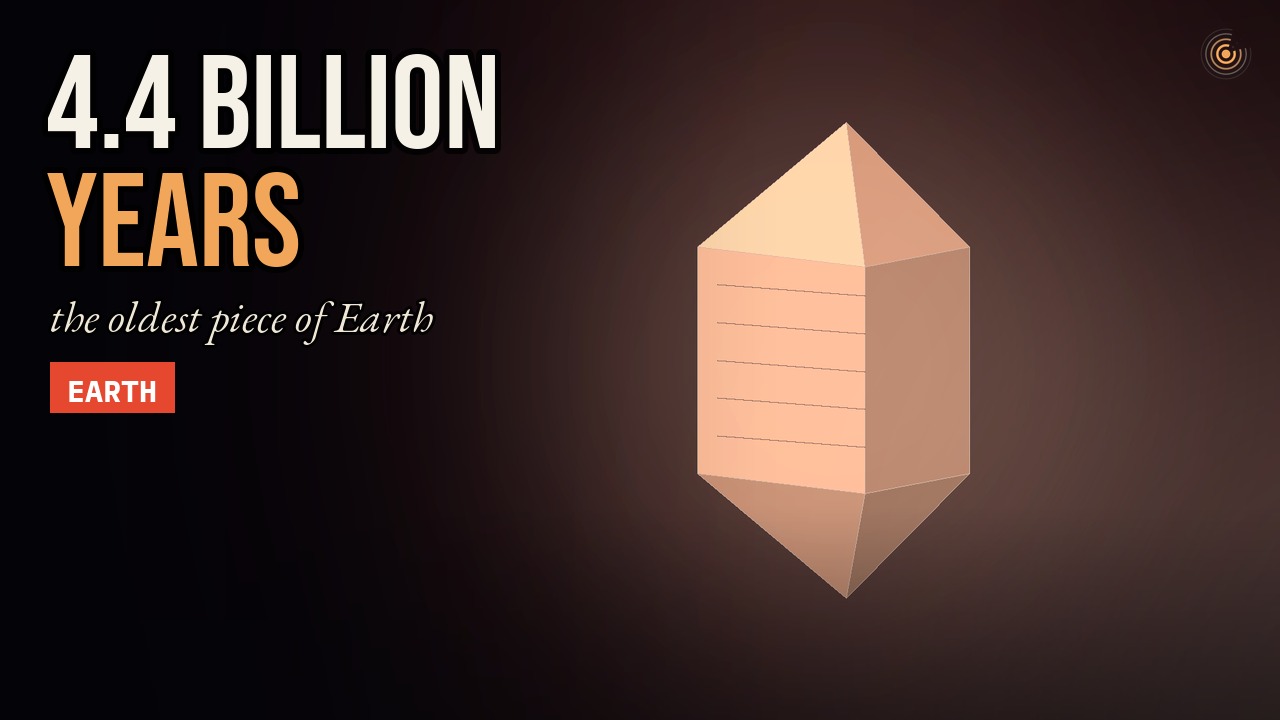
This crystal is the oldest piece of Earth anyone has ever found.
It is about a quarter of a millimetre across, and it formed 4.4 billion years ago.
Locked inside it is a chemical hint that should not be there: a sign of liquid water on the surface, less than 200 million years after the Earth formed.
How can one grain tell us that? Because it is a witness. And almost every chapter of Earth's history has one.
So let's rewind the planet, 4.5 billion years, and at every step ask: how do we actually know?
The Clock in the Rocks
To rewind a planet, you first need a clock. And for most of history, nobody could agree how old the Earth was.
In 1862, the physicist William Thomson, later Lord Kelvin, calculated how long a molten Earth would take to cool: somewhere between 20 and 400 million years.
He was wrong. The real clock was hiding inside the rocks. Some atoms are unstable: uranium slowly turns into lead, at a rate that never changes.
Half of any uranium-238 decays in about 4.5 billion years. So the more lead a crystal has built up beside its uranium, the older it is. An hourglass, made of atoms.
In the early 1950s, the American chemist Clair Patterson set out to time the Earth itself.
Earth's own rocks have been melted and recycled again and again; none go back to the start. So Patterson measured meteorites instead: leftovers from the birth of the solar system, among them iron from the meteorite that blasted Meteor Crater, in Arizona.
His measurements kept going wrong. There was lead everywhere: in the air, on the equipment, on people. So he built one of the first laboratory clean rooms.
In 1956, he published the answer. 4.55 billion years, give or take 70 million.
Today's figure is 4.54 billion years, uncertain by less than 1%. And Patterson's stray lead, he later showed, came largely from leaded petrol.
Now there was a clock. The problem was finding anything on Earth old enough to time.
A World Without Rocks
The first eon is the Hadean, after Hades, the Greek underworld. Its start was never formally fixed. In practice, it begins with the solar system, 4.567 billion years ago.
It earned its name. About 4.5 billion years ago, something about the size of Mars hit the young Earth. The debris made our Moon. The blow would have melted much of the planet: an ocean of magma, under a sky of rock vapour.
For a long time, that was the whole picture: hundreds of millions of years of hell. Almost no rock survives to argue otherwise.
Almost. In the Jack Hills of Western Australia, ancient sedimentary rocks hold tiny crystals of a tough mineral called zircon.
Zircon is close to indestructible, surviving erosion, burial and heat. When it forms, it takes in uranium but shuts lead out. So every grain starts with an empty hourglass.
In 2001, a team led by Simon Wilde, in Perth, dated one Jack Hills grain at 4.404 billion years: older than any rock on Earth. But its oxygen was the real surprise.
Oxygen atoms come in light and heavy forms. Rock altered by liquid water at low temperatures becomes richer in the heavy kind. And this crystal's oxygen was heavy.
The team argued that it grew from material once touched by liquid water at the surface. Perhaps even oceans, less than 200 million years after the Earth formed.
Not everyone was convinced. Lead atoms can wander inside a crystal, and make it look older than it is.
In 2014, John Valley's team, in Wisconsin, took another Jack Hills grain apart, almost atom by atom. The lead had not moved far enough to fool the clock. Its age held: about 4.37 billion years.
So the Hadean may not have been pure hell. Perhaps there was crust, and water, surprisingly early. How much, and how early, is still argued.
But a crystal is only a fragment. To see an actual landscape, you need whole rocks. So where are the oldest ones?
Life Moves in
The Archean eon officially begins 4.031 billion years ago: the age of the oldest intact rocks we know.
They are in Canada's Northwest Territories: the Acasta Gneiss, up to 4.03 billion years old.
Rocks in northern Quebec, at Nuvvuagittuq, may be older still, perhaps 4.28 billion years. But that age comes from a method other geologists dispute.
4 billion years ago, the Sun shone with only about three-quarters of its present brightness. And yet the rocks keep showing liquid water. What kept the young Earth warm enough is still debated.
There was also no oxygen to breathe. One clue: in South Africa's Witwatersrand basin, rounded grains of uraninite, a uranium mineral, about 3.2 billion years old, rolled along river beds.
In oxygen-rich water, uraninite like this tends to dissolve away. Many geologists read those grains as a sign of air with almost no oxygen. Not everyone agrees.
And yet life was already here. In the Pilbara region of Western Australia are layered rock mounds called stromatolites.
Living ones still grow at Shark Bay: mats of microbes, trapping sediment one thin layer at a time.
In the Strelley Pool Formation, they are about 3.43 billion years old; in the nearby Dresser Formation, about 3.48 billion. The case that microbes built them is strong.
Others claim older. In 2016, a team reported stromatolites 3.7 billion years old at Isua, in Greenland. In 2018, another team concluded the shapes came from squeezed rock, not life.
That is how this science works: every 'oldest' gets attacked.
And some of those Archean microbes were about to change the planet more than any asteroid ever would.
The Great Rusting
The Proterozoic eon begins 2.5 billion years ago. And its signature is all around you. Iron.
Much of the world's iron ore comes from banded iron formations: stripes of rusty red iron oxide and grey silica, stacked like the pages of a book.
Some are as old as 3.8 billion years. But many of the biggest formed between 2.7 and 1.8 billion years ago.
To build them, the oceans had to be full of dissolved iron. That only works when there is little oxygen. Then something began to pull the iron out, as rust.
That something was most likely oxygen, released by cyanobacteria: microbes that split water using sunlight, and give off oxygen as waste. When they first appeared is still debated.
For a long time, their oxygen was soaked up by iron and volcanic gases. Then, roughly 2.4 billion years ago, it began to build up in the air: the Great Oxidation Event.
The sharpest evidence is in sulphur. Before oxygen, ultraviolet sunlight split sulphur gases high in the air, leaving an odd fingerprint in the sulphur atoms of the rocks.
In 2000, James Farquhar and colleagues showed that this fingerprint vanishes between about 2.45 and 2.09 billion years ago.
Other clues agree. River-rolled grains of pyrite, fool's gold, disappear. Rusty red soils appear.
But it was not a single switch. In 2021, Simon Poulton's team at Leeds found that oxygen first rose about 2.43 billion years ago, then flickered for some 200 million years.
In their reading, it became permanent only around 2.22 billion years ago. And for a very long stretch, the air probably held less than 1% of today's oxygen.
Around the time the oxygen arrived, ice sheets reached close to the equator. It would happen again. But how can ice reach the tropics?
Snowball Earth
In 1992, the Caltech geologist Joseph Kirschvink gave a strange idea its name, in a short article buried in an enormous book. Snowball Earth.
Here is the puzzle. On almost every continent, in rocks about 720 to 635 million years old, there are glacial deposits.
Jumbled boulders, dumped by ice. Stones that dropped from floating ice into soft mud.
Rocks also remember where they formed. Tiny magnetic grains line up with Earth's magnetic field, and their angle records the latitude. Some of these glacial rocks formed near the equator.
Ice at sea level, in the tropics. If ice got that far, Kirschvink argued, it may have covered almost the whole planet.
But then, how do you escape a snowball? White ice reflects sunlight back into space. Once frozen, the Earth should have stayed frozen.
The way out is volcanoes. They kept breathing out carbon dioxide. And with the oceans sealed under ice, almost nothing could take it back out of the air.
In 1998, Paul Hoffman and colleagues made the case in the journal Science, from rocks in Namibia. By their estimate, carbon dioxide built up to about 350 times today's level. Then the ice melted fast, into a hothouse.
The evidence sits right on top of the glacial rocks: thick layers of carbonate, the kind of rock that forms in warm water. Ice, and then, immediately, heat.
There were at least two of these great freezes, the Sturtian and the Marinoan. The last ended about 635 million years ago.
Did the whole ocean freeze, or did a belt of open water survive near the equator, a 'slushball'? That is still argued. Life made it through, somehow.
And when the last of that ice melted, something new appeared in the sea.
The First Animals
In 1946, the Australian geologist Reg Sprigg was exploring the Ediacara Hills, in South Australia's Flinders Ranges. In the sandstone he found strange impressions. Discs. Fronds. Quilted shapes.
But how old were they? The rocks of Ediacara were hard to date. In England, the answer came from children.
In the summer of 1956, a schoolgirl, Tina Negus, spotted a fern-like fossil in Charnwood Forest, near Leicester. Those rocks were known to be older than the Cambrian. Her teacher said rocks that old had no fossils.
The next spring, a schoolboy, Roger Mason, saw it too. He made a rubbing, and it reached a Leicester geologist, Trevor Ford.
Ford named it Charnia masoni. A complex living thing, in rock that was undeniably Precambrian.
In 2004, geologists gave this age its own name, the Ediacaran Period: the first new period added to the time scale in more than a century.
Its official starting line, a golden spike, is at Enorama Creek, back in the Flinders Ranges: at the base of a cap carbonate, the warm-water rock laid down as the snowball melted.
At Mistaken Point, in Newfoundland, whole sea floors of these creatures were buried by volcanic ash. A Precambrian Pompeii.
But were they animals at all? No mouths, no legs, no shells.
In 2018, a team led by Jochen Brocks tested a Dickinsonia fossil from the White Sea coast of Russia, about 558 million years old. It still held traces of fat molecules called cholesteroids. A hallmark of animals.
Then, about 539 million years ago, the Cambrian began. Within some tens of millions of years, the seas filled with animals with eyes, legs, shells and guts. The Cambrian explosion.
We can see them in astonishing detail, soft parts and all, in the Burgess Shale in the Canadian Rockies, and at Chengjiang, in China. Both are about half a billion years old.
From here on, life leaves fossils everywhere. So the rocks can also record death on a planetary scale.
The Close Calls
The Phanerozoic eon, the age of visible life, is the one we live in. It is scarred by mass extinctions. Two stand out.
About 252 million years ago, at the end of the Permian, most species in the sea vanished: somewhere from about 80 to more than 90%. It is the worst extinction we know of.
The leading suspect: the Siberian Traps, floods of lava, layer on layer, pouring out gases on a vast scale. By one precise dating, the dying took only about 60,000 years. In geology, an instant.
Life recovered. Dinosaurs rose. And then, 66 million years ago, came the most famous layer of clay in the world.
In the 1970s, the geologist Walter Alvarez was studying limestone near Gubbio, in Italy. Between the last Cretaceous rock and the first rock after it lies a thin band of clay.
With his father Luis, a Nobel-winning physicist, and the chemists Frank Asaro and Helen Michel, he measured a rare metal in it. Iridium.
In 1980 they reported about 30 times the normal amount at Gubbio, and similar spikes in Denmark and New Zealand. Iridium is rare in Earth's crust, but more common in asteroids.
Their conclusion: an asteroid about 10 km across had hit the Earth.
The crater was identified in 1991, buried under Mexico's Yucatán Peninsula: Chicxulub, about 180 km across.
The impact ended the age of the dinosaurs, except for the birds. Estimates of how many species were lost range from about half to three-quarters or more.
And it opened the way for mammals. Our own species arrives very late: the oldest known Homo sapiens fossils, from Jebel Irhoud in Morocco, are about 315,000 years old. How late is that?
Earth in One Day
So squeeze the whole story into a single day. The Earth forms at midnight.
The oldest zircon crystallises at about 00:45. The first convincing signs of life appear at about 05:30. Oxygen starts to build up in the air soon after 11:00.
The snowball melts at about 20:40. The Cambrian explosion begins after 21:00. The asteroid hits at about 23:40.
Homo sapiens arrives about 6 seconds before midnight. All of written history fits into the last tenth of a second.
Is that tenth of a second already a layer in the rocks? Scientists proposed a new epoch, the Anthropocene, starting around 1950, marked in the mud of Crawford Lake, in Canada.
In March 2024, the geologists' committee that decides voted it down. 4 for, 12 against. The argument about our own layer is not over.
Epilogue
Every chapter has a witness. River grains that never rusted. Stripes of iron. Boulders dropped by tropical ice. A fossil a teacher said could not exist. A thin layer of clay.
And at the very start, one speck of zircon that has outlasted almost everything else the young Earth ever made.
Earth takes its place on our map. Next: Venus. Born almost the same as the Earth, and now hot enough to melt lead.
On our website, try it yourself: read the atomic clock inside a zircon.
The science in this story
Key facts
- Wilde et al. (Nature, 2001) dated a Jack Hills zircon at 4,404 ± 8 million years; its heavy oxygen suggests material altered by liquid water at low temperature. source ↗
- Patterson (1956) dated the Earth at 4.55 ± 0.07 billion years from meteorite lead, including Canyon Diablo; today's figure is 4.54 billion years (< 1% uncertainty). source ↗
- The mass-independent sulphur-isotope signal disappears between 2.45 and 2.09 billion years ago (Farquhar, Bao & Thiemens, Science 2000); oxygen first rose ~2.43 Ga and became permanent ~2.22 Ga (Poulton et al., Nature 2021). source ↗
- The 1980 Alvarez team found about 30 times the normal iridium in the K-Pg clay at Gubbio (about 160x in Denmark, 20x in New Zealand) and proposed an asteroid of about 10 km. source ↗
Loading the quiz…
Sources
- Patterson, GCA 1956 · USGS 'Age of the Earth' · Kelvin 1862 · Wilde et al., Nature 2001 · Mojzsis et al., Nature 2001 · Valley et al., Nat. Geosci. 2014
- Bowring & Williams 1999 · O'Neil et al., Science 2008 · Allwood et al., Nature 2006 & 2018 · Djokic et al., Nat. Commun. 2017 · Nutman et al., Nature 2016
- Farquhar, Bao & Thiemens, Science 2000 · Poulton et al., Nature 2021 · Lyons et al., Nature 2014 · Kirschvink 1992 · Hoffman et al., Science 1998 · Hyde et al. 2000
- Ford 1958 / Mercian Geologist 2011 · Knoll et al. 2006 (Ediacaran) · UNESCO Mistaken Point · Bobrovskiy et al., Science 2018 · ICS chart 2024
- Stanley, PNAS 2016 · Burgess et al., PNAS 2014 · Alvarez et al., Science 1980 · Hildebrand et al., Geology 1991 · Hublin et al., Nature 2017 · IUGS, 20 Mar 2024
Where every picture, clip and sound in this story comes from
Keep scrolling: more true stories ↓
New mini-documentaries every week and a true story every day. Pick where you like to watch:
▶ Subscribe on YouTube Telegram TikTok Instagram Bluesky Threads ✉ Weekly email
Everything here is free and stays free. If you would like to help us make more: 🪐 Shop: calendars, posters, mugs & books