Hypervelocity impact
When an asteroid or meteorite hits at many kilometres per second, the shock melts rock instantly and forges minerals found almost nowhere else.
A large space rock can strike the ground at many kilometres per second, so fast that the collision behaves less like a thud and more like an explosion. This is a hypervelocity impact. In a fraction of a second a shock wave drives into the ground at pressures beyond anything a volcano can produce, melting and vaporising rock and blasting out a crater far wider than the impactor.
The shock leaves fingerprints. Under a microscope, quartz grains from impact sites show sets of fine parallel lines called planar deformation features: shocked quartz. Extreme pressure can also turn quartz into rare dense forms of silica, coesite and stishovite, which need more than 2 gigapascals, around 20,000 times atmospheric pressure. Eugene Shoemaker showed that shocked quartz occurs in impact craters such as Barringer (Meteor) Crater in Arizona, and it is now one of the main tests of whether a crater was made by an impact. Lightning can produce similar features on a small scale, so geologists look for several lines of evidence.
Molten rock thrown out of the crater can freeze in flight into tiny glass beads, impact spherules, which rain down far away, and desert sand at an impact site can melt into natural glass.
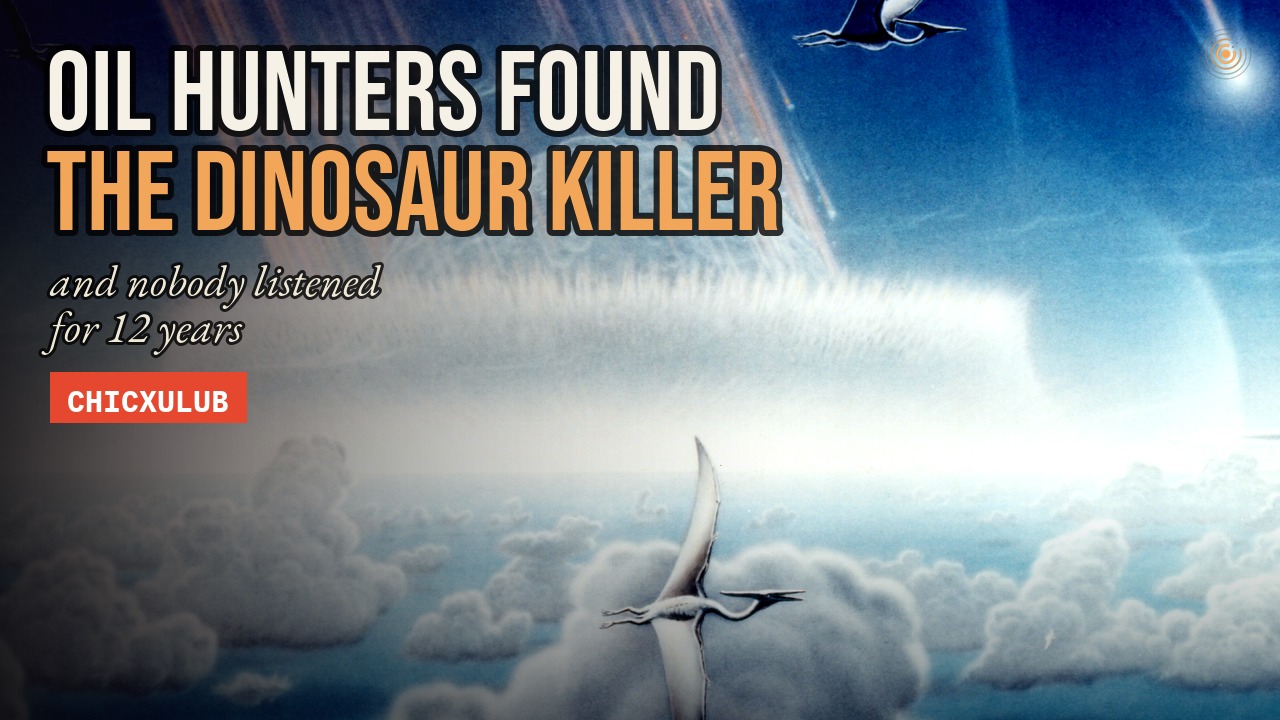
A thin layer found worldwide at the boundary between the Cretaceous and Paleogene periods, when the dinosaurs died out, contains shocked quartz and unusually high levels of iridium: evidence that a giant impact caused the extinction.
See it in action
Coming up in future stories
- He Went Looking for a Lost City and Found a Meteorite 1932 · Rub' al Khali, Saudi Arabia