Iron meteorite
Meteorites of nickel-iron metal from the cores of shattered asteroids, recognisable by criss-cross crystal patterns grown over millions of years.
An iron meteorite is a lump of metal from space, made mostly of iron alloyed with nickel. Most are thought to be fragments of the metal cores of early asteroids, which melted and separated into a metal core and rocky outer layers much as Earth did, and were later smashed apart in collisions.
Cut one, polish it and etch it with acid, and many reveal a striking criss-cross pattern of bands, the Widmanstätten pattern. It is made of two nickel-iron minerals interleaved in thin plates: kamacite, with about 5 to 15 per cent nickel, and taenite, with up to about 50 per cent. The plates grow only when the metal cools extremely slowly, roughly 100 to 10,000 degrees per million years, deep inside an asteroid. That is why the structure cannot be reproduced in a laboratory, and why it is a clear sign of an origin in space. William Thomson described it in 1804, and Count Alois von Beckh Widmanstätten saw it independently in 1808.
Before people could smelt iron from ore, meteoric iron was the only metallic iron available, and it was prized. Its high nickel content can reveal that an ancient iron object was made from it, as with a dagger buried with the Egyptian king Tutankhamun.
Iron meteorites are a small minority of the meteorites seen to fall, but they resist weathering and stand out from ordinary rocks, so they are well represented among large finds.
See it in action
 Premieres 19 NovHow the Solar System Was Born4,567 million years ago · Allende, Mexico, 1969
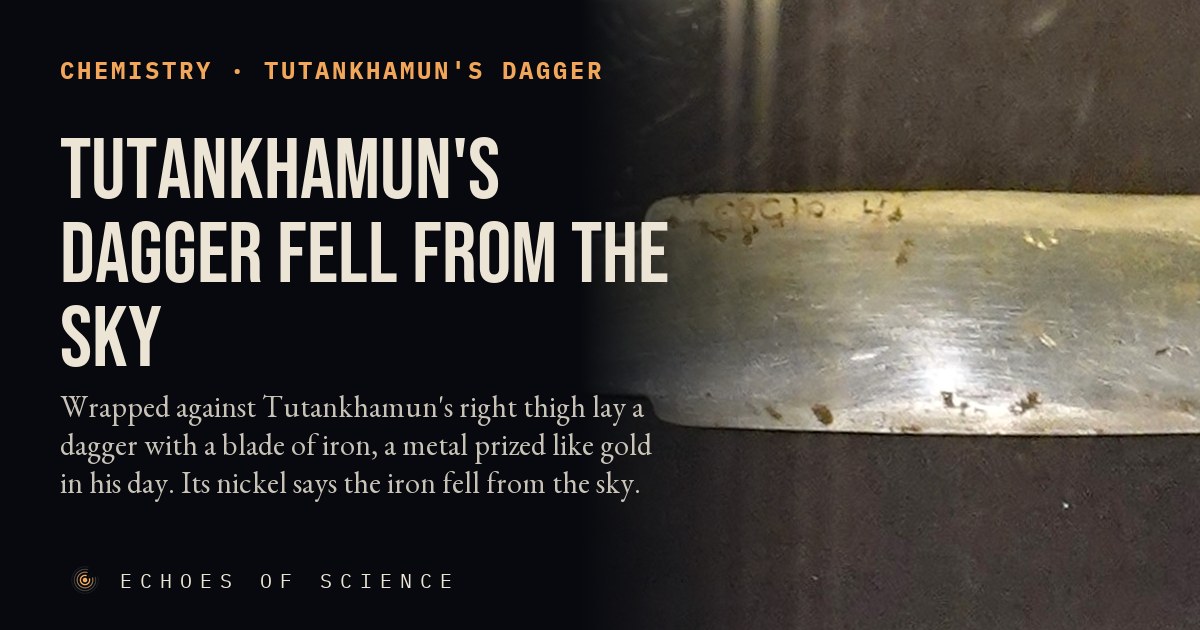 Coming soonTutankhamun's Dagger Fell From the Skyc. 1323 BC · Valley of the Kings, Egypt