Tutankhamun's Dagger Fell From the Sky
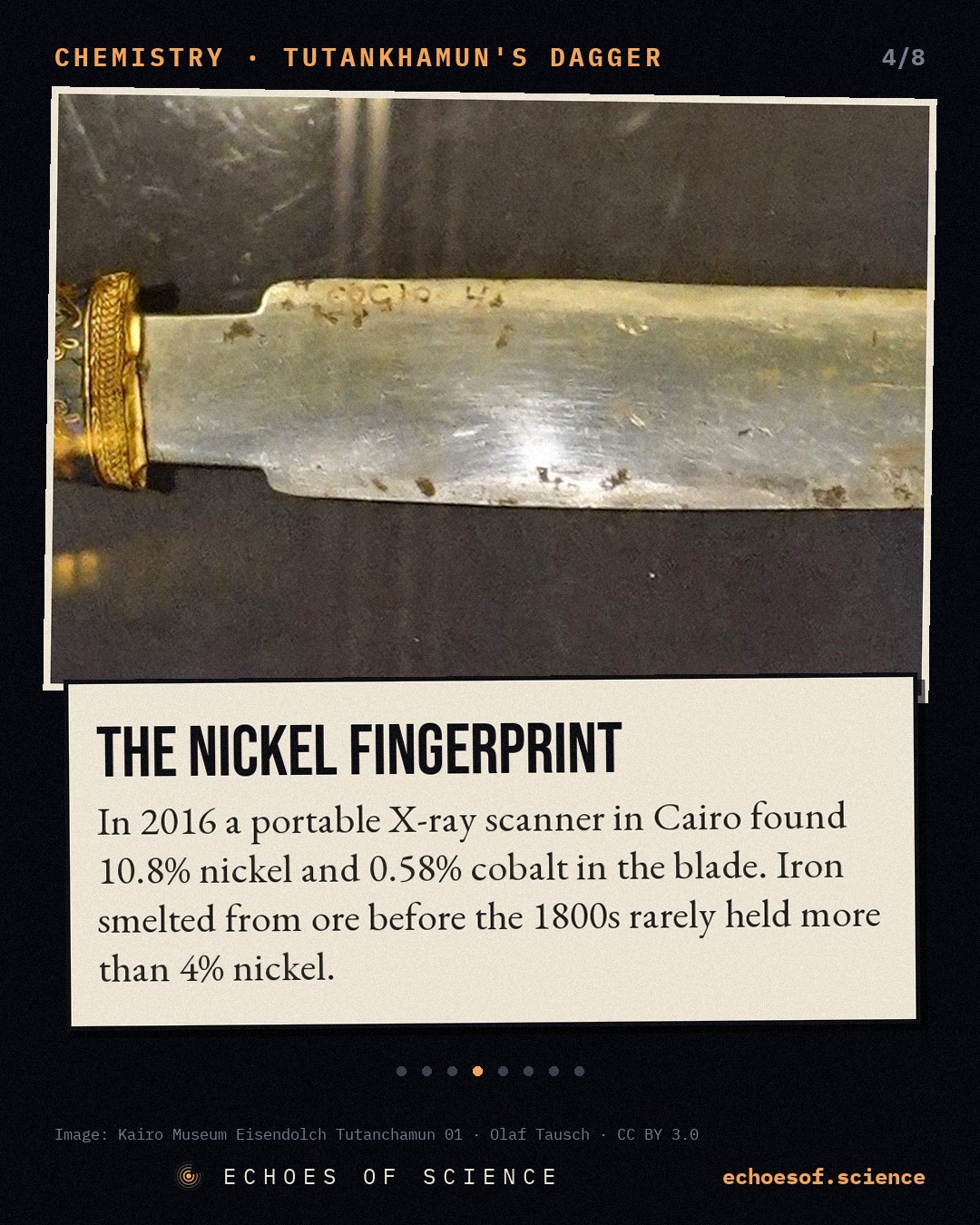
Wrapped against Tutankhamun's right thigh lay a dagger with a blade of iron, a metal prized like gold in his day. Its nickel says the iron fell from the sky.
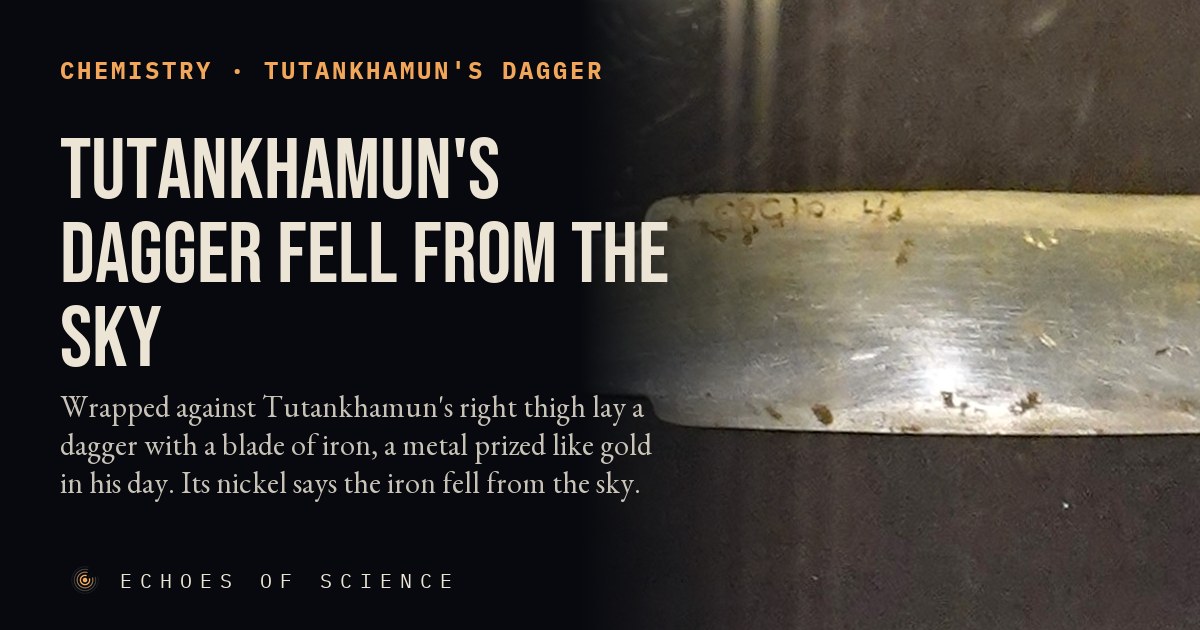
The handle is gold, worked with fine granulation and inlays of coloured glass and stone, topped with a knob of crystal. The blade is the surprise. It is iron, plain and grey, and when Howard Carter's team lifted it from the wrappings of Tutankhamun's mummy it was, in Carter's words, "quite plain and clean save a few rust spots". In the 14th century BC, iron was a rare and precious metal. And this iron, it turns out, had not come out of the ground at all.
A blade in the bandages
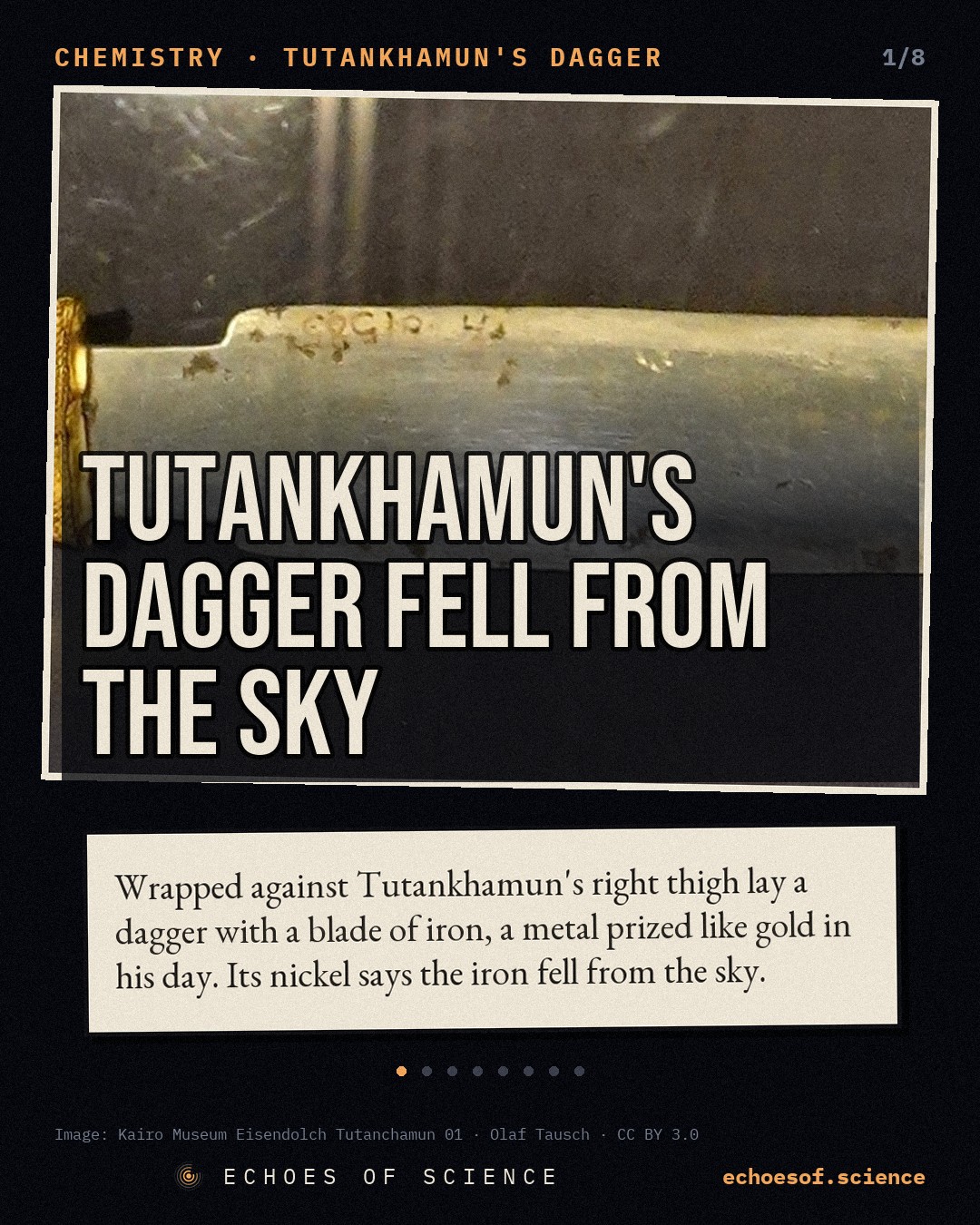
The first step down to Tutankhamun's tomb was uncovered on 4 November 1922; Carter's diary entry for the day reads simply "First steps of Tomb Found", as History Hit recounts. Three years of clearing later, the team reached the king himself. The anatomical examination, led by Douglas Derry and Saleh Bey Hamdi of the Cairo medical school, began on 11 November 1925 and lasted nine days. According to the Griffith Institute in Oxford, which holds Carter's archive, more than 100 objects were found inside the linen, among them two daggers: one with a blade of gold and one with a blade of iron.
Carter's object card for the iron dagger, number 256k, records that it lay "along right thigh", its point "over inner side above knee". Its sheath is sheet gold, ending in a jackal's head. The whole dagger is about 34 cm long, and the edge, Carter noted, was still "very sharp".
Iron before the Iron Age
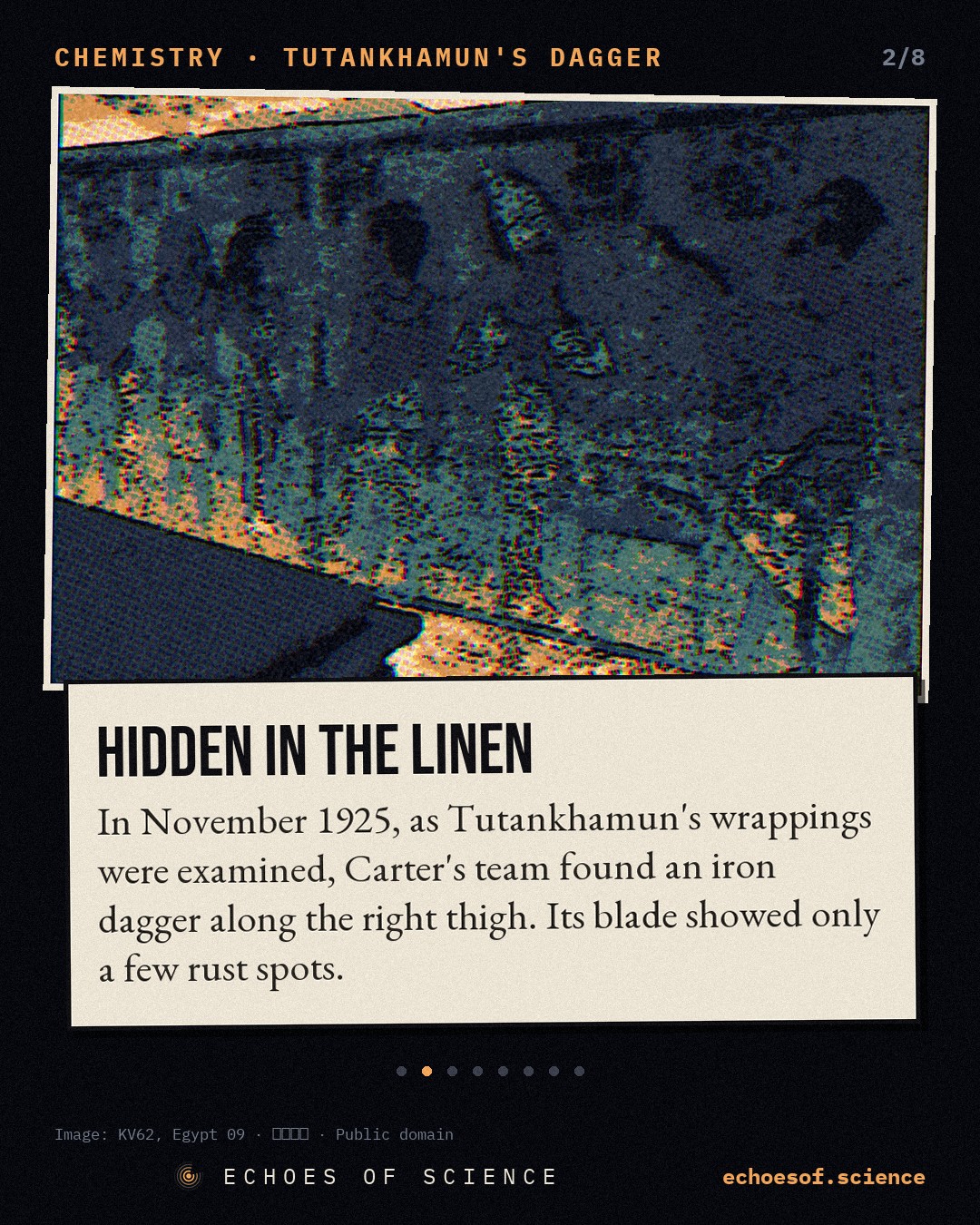
Egypt had little iron ore and little wood to burn, and iron weapons did not become common there until around 700 to 800 BC, Eos reports. Yet older iron objects exist, and they share a secret. Egypt's earliest, small beads buried around 3200 BC in a cemetery at Gerzeh, south of Cairo, turned out to be hammered from meteorite iron. In 2017 Albert Jambon of Sorbonne University tested Bronze Age iron from Egypt, Turkey, Syria and China, including the dagger, a bracelet and a headrest from Tutankhamun's tomb; each one was made of meteoric iron. A few decades after Tutankhamun's death, Egyptian scribes began writing iron with a new compound word, bi-A-n-pt, which researchers at the Open University render as "iron from the sky".
How do we know?
In 2016 a team led by Daniela Comelli of the Politecnico di Milano took a portable X-ray fluorescence spectrometer to the Egyptian Museum in Cairo and analysed the blade without touching it. They measured about 10.8% nickel and 0.58% cobalt, a result that, in the words of their paper in Meteoritics & Planetary Science, "strongly supports its meteoritic origin". Iron smelted from ore before the 1800s typically holds less than 4% nickel.
"The beauty of this [new] paper is that they've put it beyond doubt that this is meteoritic iron." Thilo Rehren, archaeometallurgist, speaking to Eos
In 2022 Takafumi Matsui and colleagues from Japan and Egypt went further, mapping the elements across the blade. Bands of nickel hinted at a Widmanstätten pattern, the structure typical of the meteorites called octahedrites, and sulphur-rich black spots looked like the remains of troilite, a meteorite mineral. For such traces to survive, the smith must have worked the metal at a fairly low temperature, below about 950 °C. The authors themselves describe their numbers as semi-quantitative and their classification as tentative.
A royal gift?
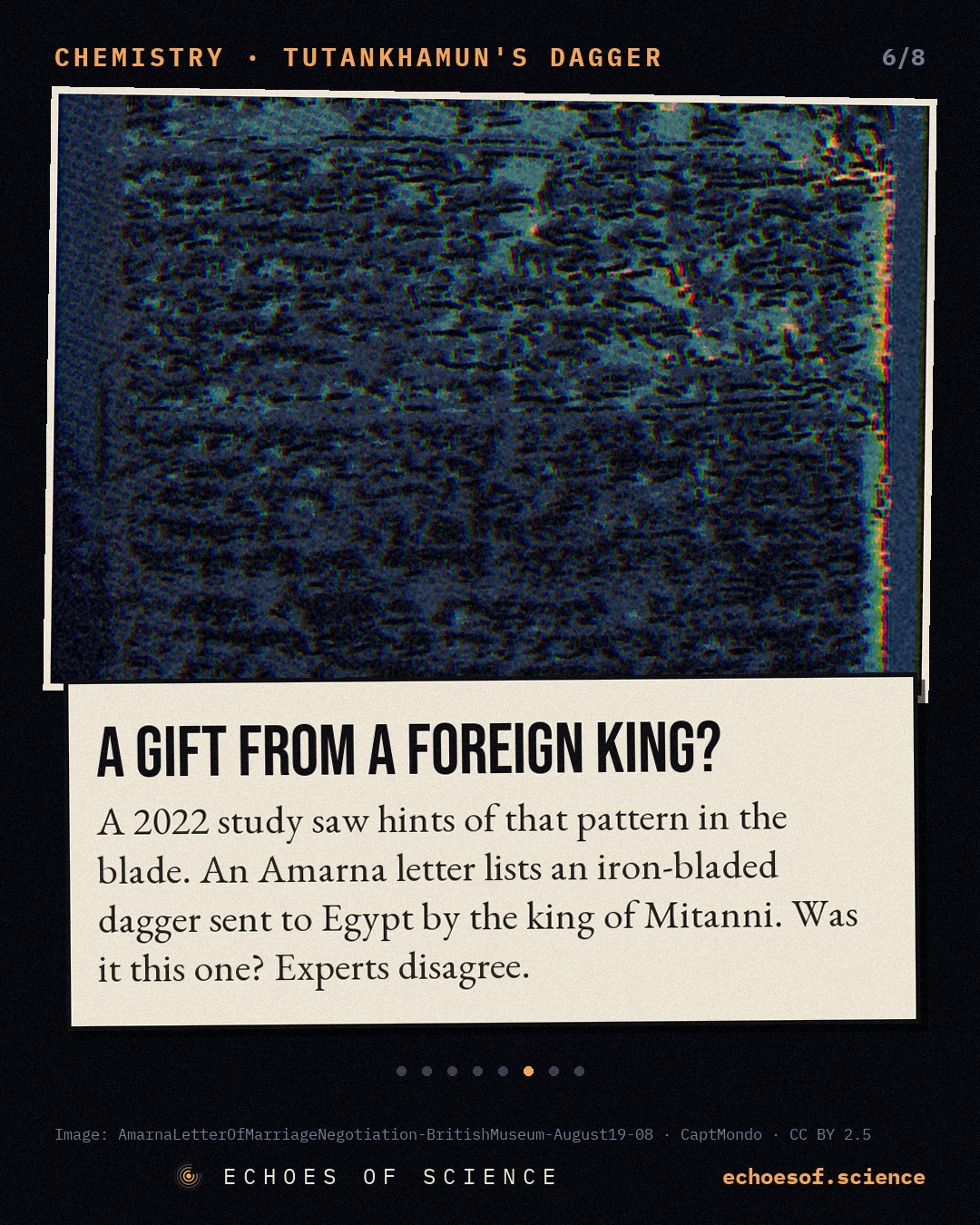
The gold hilt held calcium but no sulphur, which Matsui's team read as lime plaster used as glue, a material they say Egypt did not use until Ptolemaic times. They pointed to the Amarna letters, diplomatic tablets sent to Tutankhamun's grandfather Amenhotep III and his successor. In letter EA 22 Tushratta, king of Mitanni in what is now northern Syria, lists wedding gifts that include "1 dagger, the blade of which is of iron, its guard, of gold, with designs". The dagger, they suggest, may have come from abroad.
Not everyone is persuaded. Jambon told Live Science that the calcium could be left over from limestone powder used to clean objects in the 1920s, and that "the hilt and the blade are two separate parts", which could have been made in different places. A 2022 book on the tomb's iron concluded that the dagger's origin cannot yet be determined. For now, the honest answer is that we know what the blade is made of, but not where it was made.
The science: crystals grown inside an asteroid
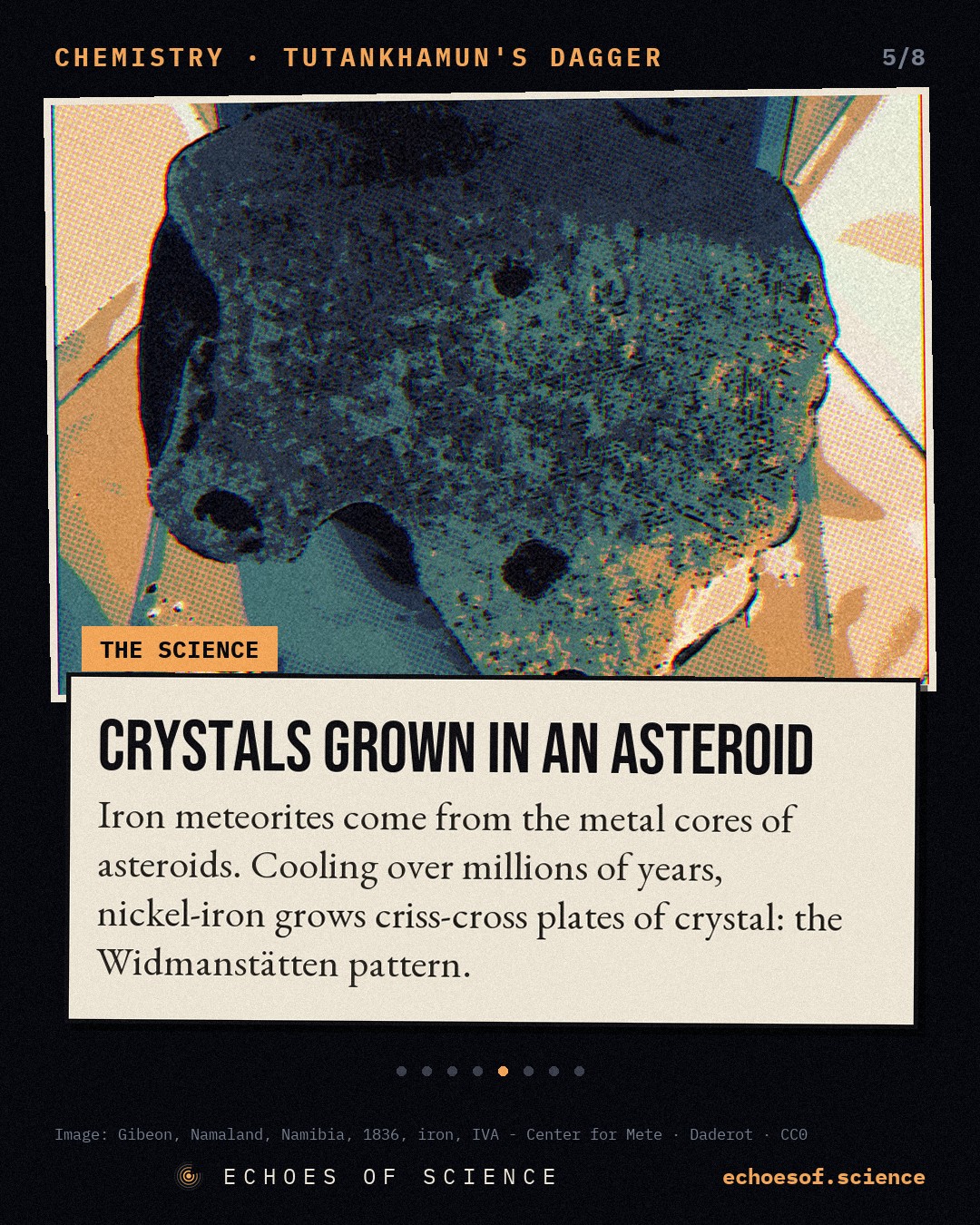
Iron meteorites are pieces of the metal cores of asteroids that melted early in the history of the solar system and later broke apart. As molten nickel-iron cools in such a core, it first hardens into an alloy called taenite. As it cools further, plates of a second alloy, kamacite, grow through it. The American Museum of Natural History explains that the pattern "forms only deep inside planetary bodies that take millions of years to cool". Cut and etch a slice, and the plates appear as criss-cross bands: the Widmanstätten pattern, one of the surest signs of an iron meteorite.
The X-ray test works because every element has its own fingerprint. A beam of X-rays knocks electrons out of the inner shells of atoms; when other electrons drop in to fill the gaps, they give off X-rays at energies that belong to that element alone, as Carleton College's geochemistry guide explains. Measure those energies and their strength, and you can read the recipe of a metal without cutting a sample.
Why it matters today
The dagger is a reminder that the first iron people worked was collected, not made: fallen metal, hammered into shape long before anyone smelted ore on a large scale. Jambon found that Tutankhamun's three iron objects came from at least two different meteorites, which, as Scientific American notes, suggests people actively searched for this rare metal. And both studies left the blade untouched: an object more than 3,300 years old, examined with a beam of X-rays, could still tell us where its metal was born.
The science in this story
Key facts
- In November 1925 Howard Carter's team found an iron dagger along the right thigh of Tutankhamun's mummy; Carter noted the blade was clean 'save a few rust spots'. source ↗
- The examination of the mummy ran from 11 to 19 November 1925; more than 100 objects, including a gold-bladed and an iron-bladed dagger, were found in the linen. source ↗
- A 2016 portable X-ray fluorescence study measured about 10.8% nickel and 0.58% cobalt in the blade, strongly supporting a meteoritic origin. source ↗
- Iron smelted from ore before the 1800s typically holds less than 4% nickel; iron weapons became common in Egypt only around 700-800 BC. source ↗
- Egypt's oldest iron objects, beads buried around 3200 BC at Gerzeh, were hammered from meteorite iron. source ↗
- In 2017 Albert Jambon found that every Bronze Age iron object he analysed, including Tutankhamun's dagger, bracelet and headrest, was made of meteoric iron. source ↗
- A 2022 study (Matsui et al.) found nickel banding suggesting a Widmanstätten pattern, low-temperature forging below about 950 °C and lime plaster in the hilt, and linked the dagger to an iron-bladed gift listed in an Amarna letter from Tushratta of Mitanni. source ↗
- Other experts dispute the gift idea: the calcium may be 1920s cleaning residue, and a 2022 book concluded the dagger's origin cannot yet be determined. source ↗
- The Widmanstätten pattern forms only deep inside bodies that take millions of years to cool, such as the metal cores of asteroids. source ↗
In pictures
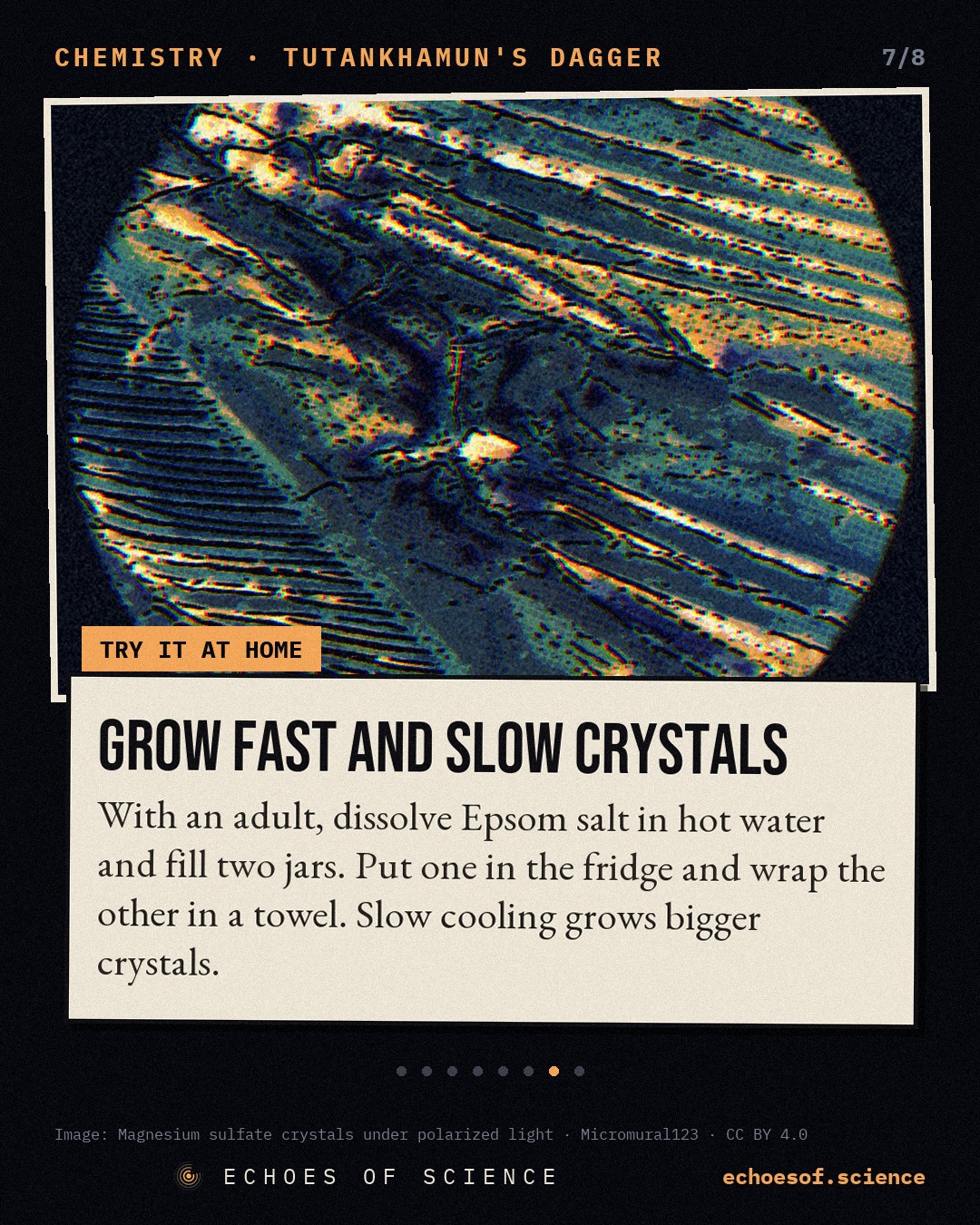

Grow fast and slow crystals: with an adult, dissolve Epsom salt in hot water and fill two jars. Put one in the fridge and wrap the other in a towel. The slowly cooled jar grows bigger crystals, as metal does inside an asteroid core.
Loading the quiz…
Where every picture, clip and sound in this story comes from
Keep scrolling: more true stories ↓
New mini-documentaries every week and a true story every day. Pick where you like to watch:
▶ Subscribe on YouTube Telegram TikTok Instagram Bluesky Threads ✉ Weekly email