X-ray fluorescence
A way to read which elements an object contains by hitting it with X-rays and measuring the X-rays its atoms give back.
X-ray fluorescence (XRF) identifies the chemical elements in a material without cutting it open. A beam of X-rays strikes the sample and knocks electrons out of the innermost shells of its atoms. Electrons from outer shells then drop into the gaps, and each drop releases a new X-ray with a precise energy. Because those energies differ from element to element, the returning X-rays form a fingerprint: iron, nickel and cobalt each show their own peaks, and the height of each peak shows how much is there.
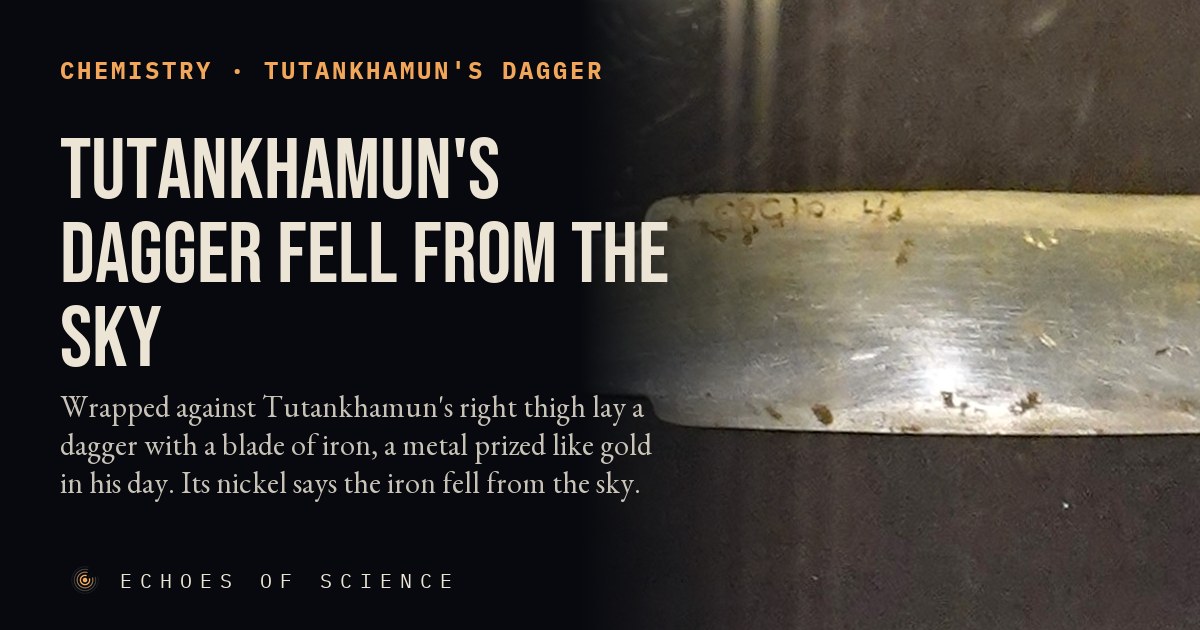
Geologists use XRF on rocks and soils, and museums use handheld versions on objects too precious to sample. In 2016 a portable instrument found about 10.8% nickel in the iron blade of Tutankhamun's dagger, far more than iron smelted from ore usually contains.
A common misconception is that XRF can detect everything. Ordinary instruments struggle with the lightest elements, those lighter than sodium (atomic number 11), and XRF cannot tell isotopes of the same element apart. Results are also compared with standards of known composition, so the numbers are only as good as the calibration.
See it in action
Coming up in future stories
- The Viking Map Drawn in 1920s Ink 1960s acquired, 2021 confirmed · Yale University, USA