Stonehenge's Altar Stone Has No Home
The six-tonne stone at the heart of Stonehenge probably came from Scotland, at least 750 km away. A new study shows that none of the places checked so far is its source.
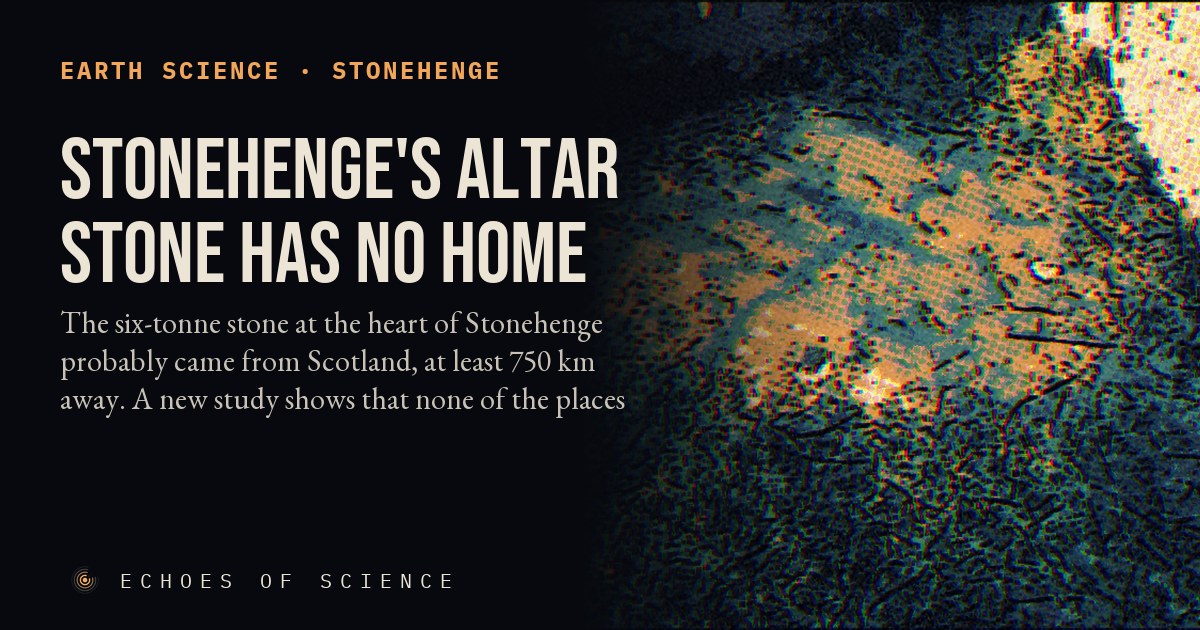
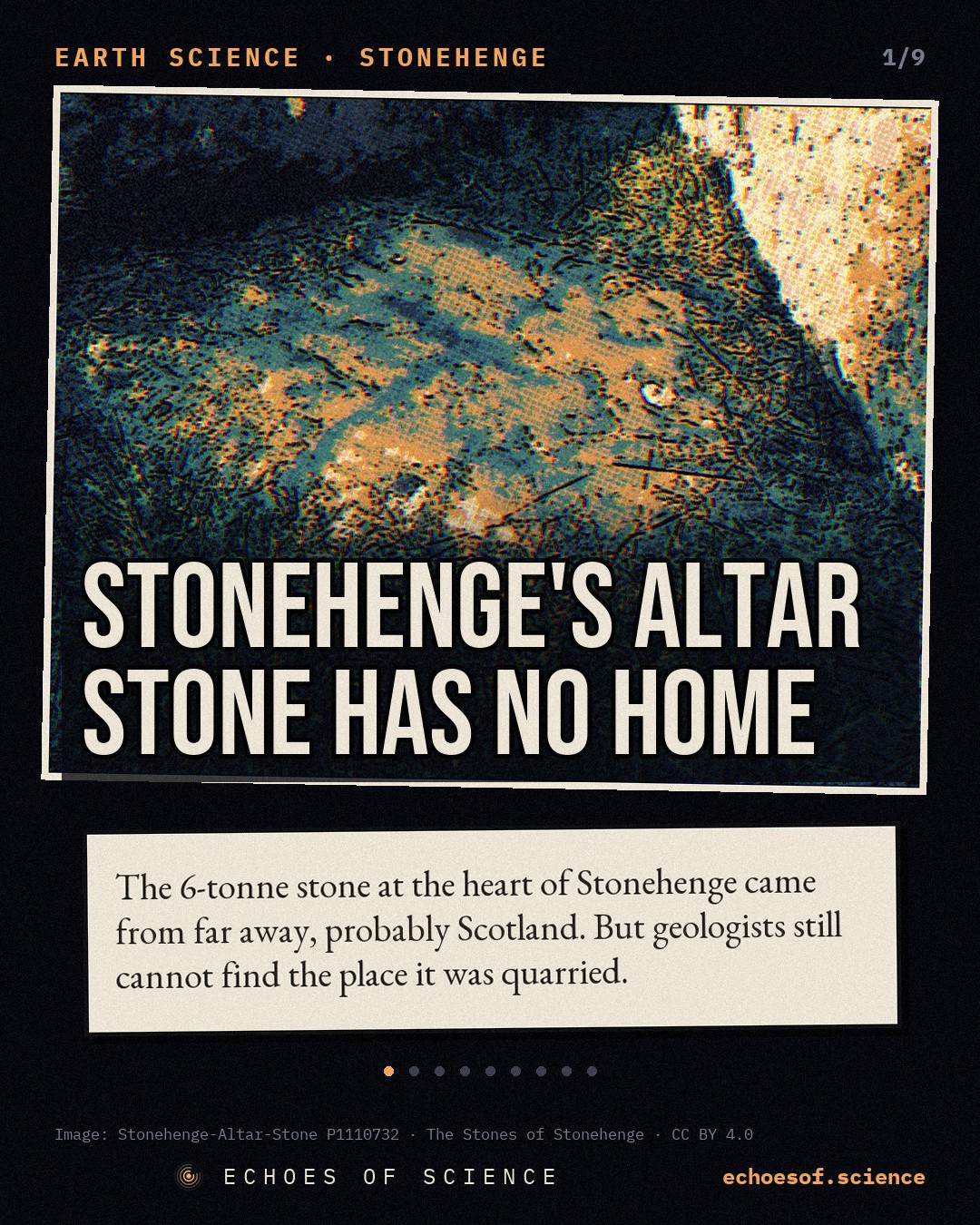
Walk into the middle of Stonehenge and, at your feet, half hidden under two toppled giants, lies the monument's odd one out. The Altar Stone is not grey sarsen like the great uprights, nor one of the bluestones from west Wales. It is a slab of greenish sandstone, 4.9 metres long, a metre wide and half a metre thick, weighing about six tonnes. English Heritage describes it as partly buried beneath fallen stones of the tallest trilithon. And after two years of dramatic discoveries, nobody can say where it came from.
From Wales to Scotland
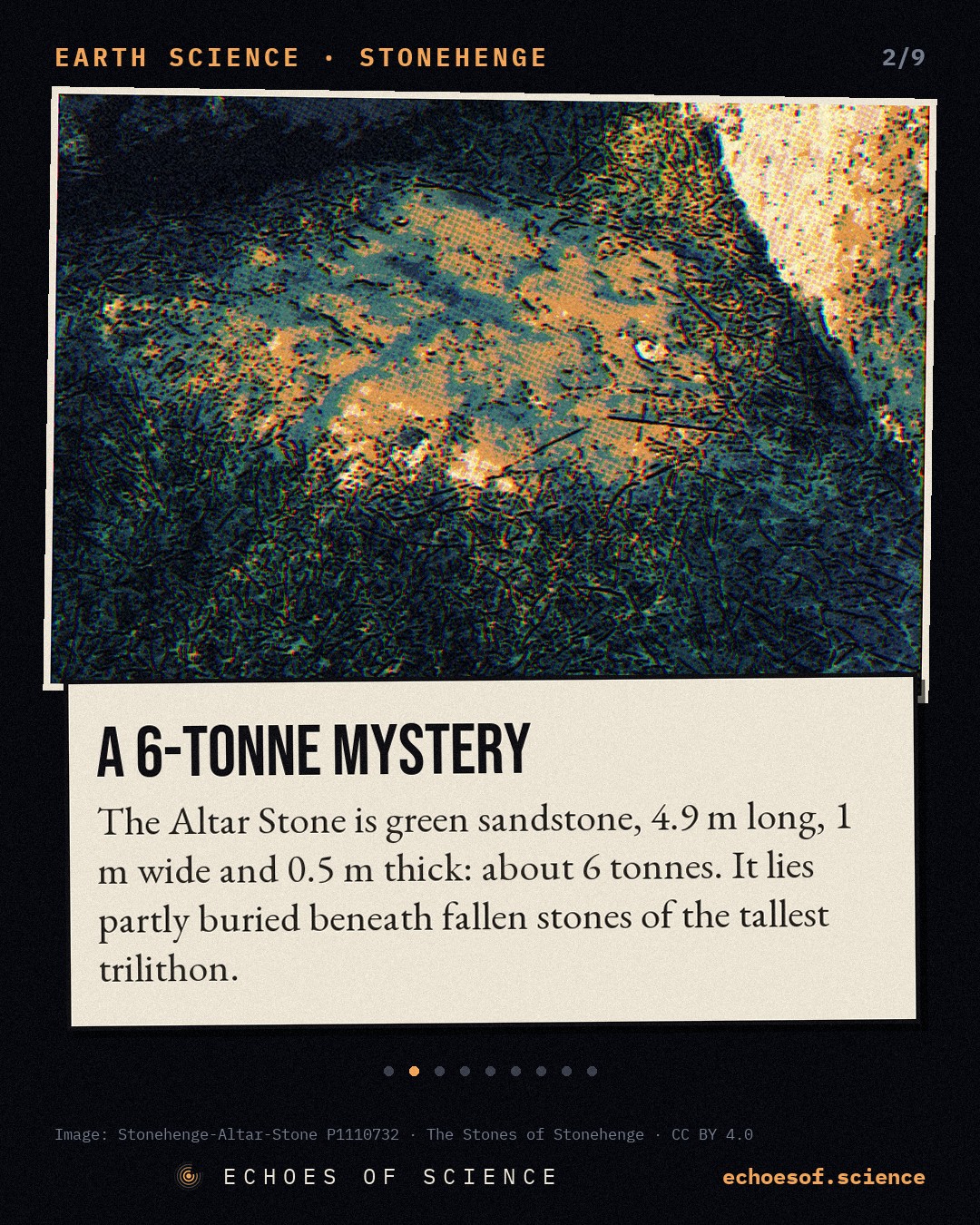
For about a century the answer seemed settled: the Altar Stone was Old Red Sandstone from Wales, a short hop from the source of the bluestones. In August 2024 that answer collapsed. A team publishing in Nature, dated individual mineral grains inside fragments of the stone. Zircon grains gave ages clustering between roughly 1,050 and 1,790 million years; apatite and rutile grains gave a younger group near 460 million years. That combination of ages did not fit Welsh sandstone. It showed, in the paper's words, a remarkable similarity to the Old Red Sandstone of the Orcadian Basin in north-east Scotland.
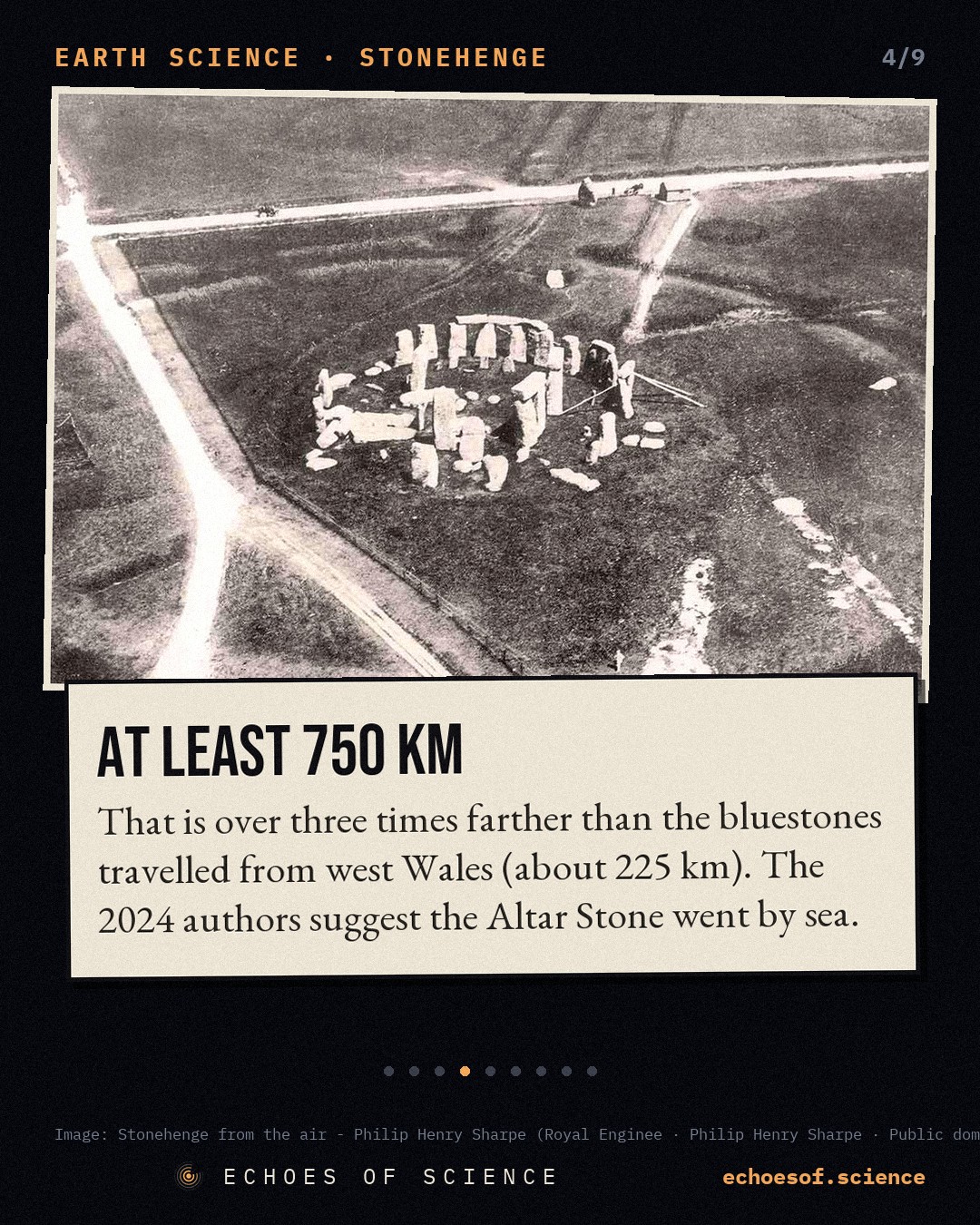
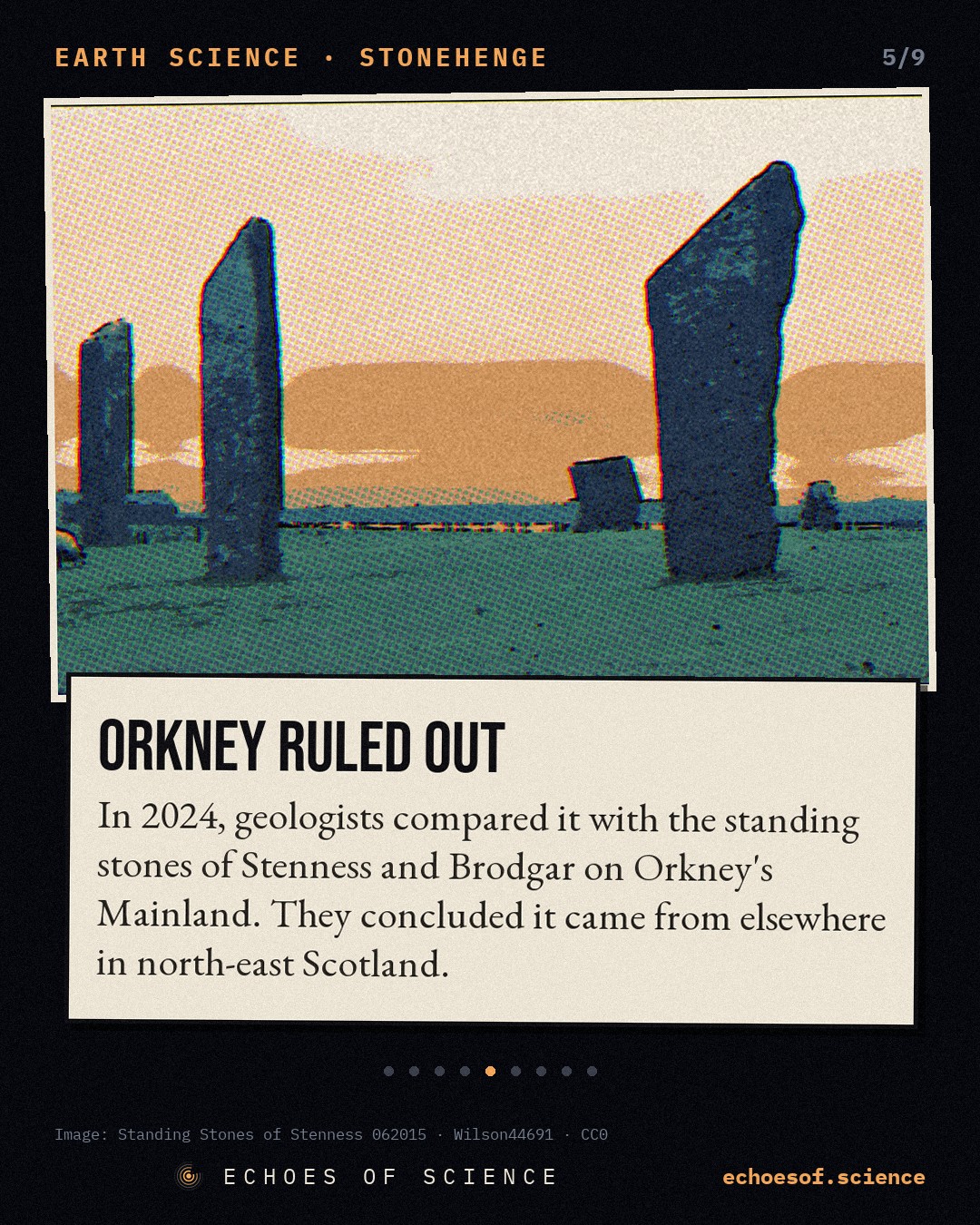
The implication was startling. A six-tonne block had been moved at least 750 kilometres, more than three times the distance of the bluestones' journey of about 225 kilometres, and the authors suggested it went by sea. Weeks later, a second team ruled out Mainland Orkney: they compared the stone with the standing stones of Stenness and the Ring of Brodgar, which are similar in size and rock type, and concluded the Altar Stone came from elsewhere in north-east Scotland.
The 2026 study: narrowing, not finding
On 5 November 2026, geologists and archaeologists from the UK, Canada, Italy and Sweden published the most detailed portrait of the stone yet in the Journal of the Geological Society. Led by Duncan Pirrie, emeritus professor at the University of South Wales, they examined eight fragments held in museums and took portable X-ray readings from small exposed patches of the stone itself. They looked at its texture, minerals, chemistry and isotopes.
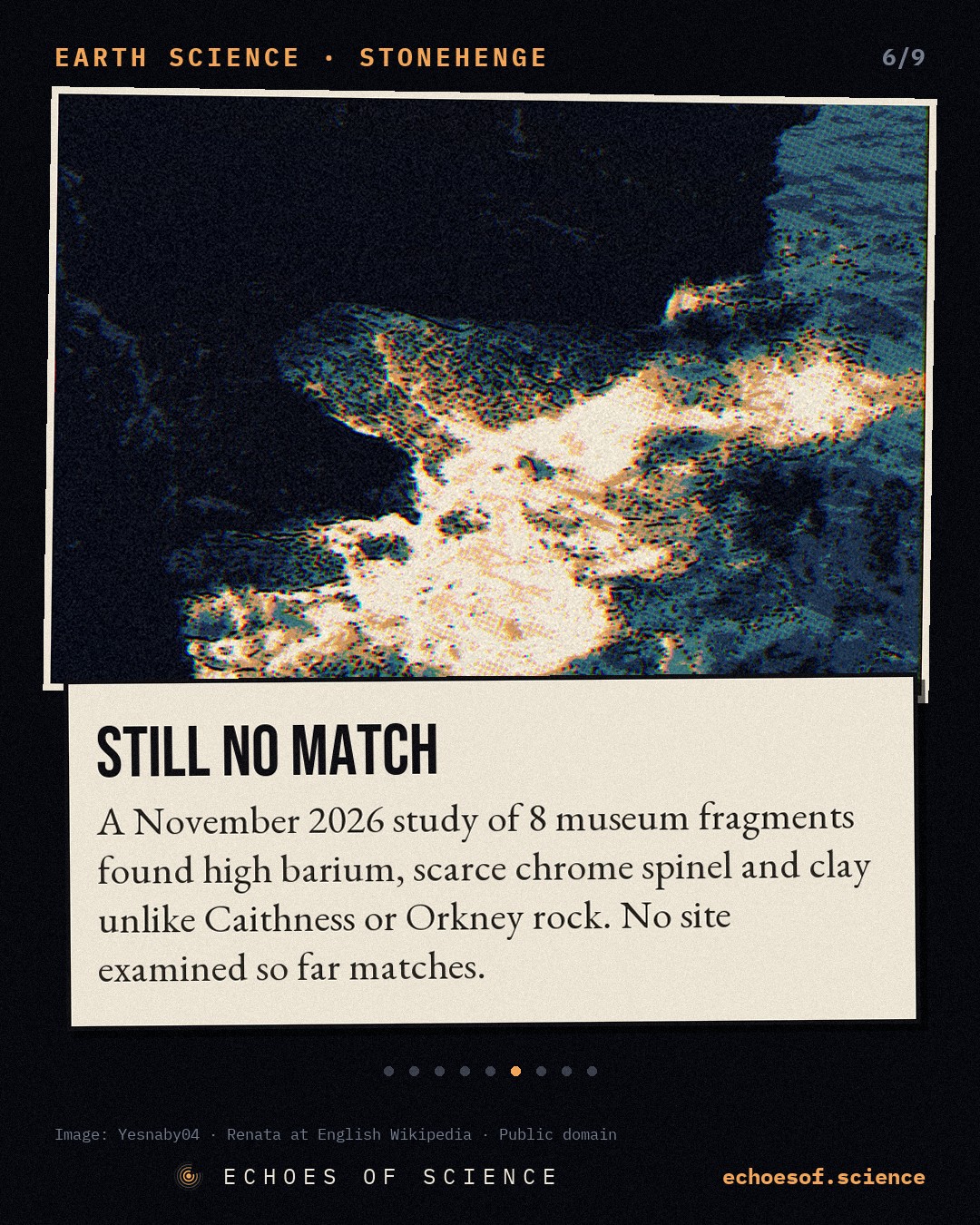
The result, as Aberystwyth University put it, is that the mystery deepens as the search narrows. According to Sci.News, the stone is rich in barium, held in the mineral baryte; it contains very little chrome spinel, a mineral that is common in Orcadian Basin sandstones; and its mixed-layer clay has about 20% expandable layers, against less than 10% in sandstones from Caithness and Orkney. The absence of low-grade metamorphism rules out the Southern Uplands, and the Midland Valley's sandstones are too full of rock fragments.
"So far, none of the locations examined have the same set of characteristics as the Altar Stone." Duncan Pirrie
How do we know?
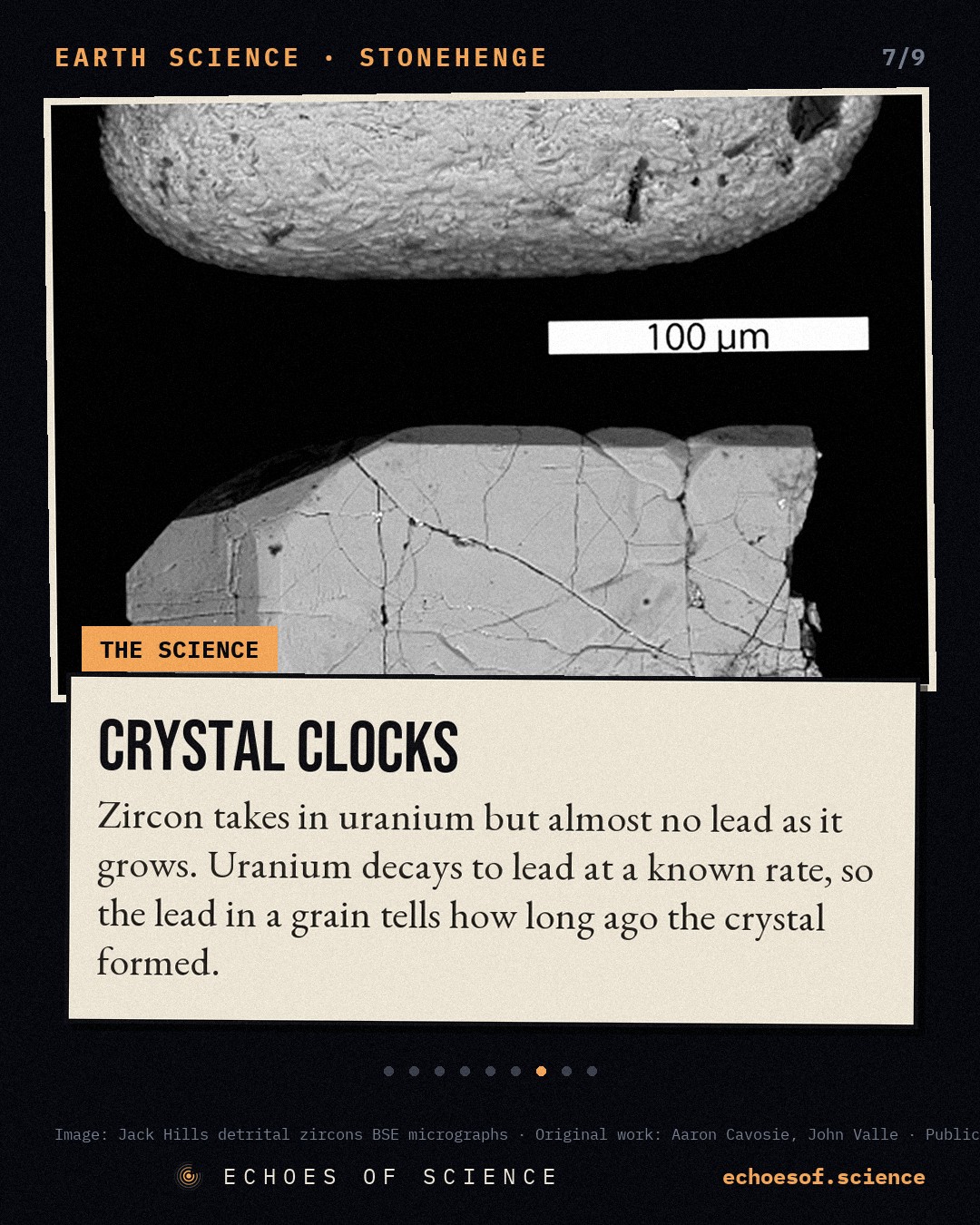
Two kinds of evidence are at work. The first is a set of mineral clocks. When a zircon crystal grows in cooling magma, it takes in uranium but almost no lead. Uranium then decays to lead at a fixed rate, so measuring the two in a single grain gives the crystal's age. Sand is made of grains eroded from older rocks, so the mix of ages in a sandstone is a fingerprint of the mountains that fed it. The Altar Stone's fingerprint points north.
The second is the stone's later history. Clay minerals change as sediment is buried and warmed: one of them, smectite, gradually turns into illite. The proportion of "expandable" smectite layers left over acts as a rough record of how hot the rock once got. That is why the clay counts against Caithness and Orkney. The uncertainty is real, though. The 2026 authors have not ruled out north-east Scotland as a whole, and the age fingerprint still favours it; they have shown that none of the outcrops sampled so far is the source. As Nick Pearce of Aberystwyth University put it, "ruling out potential source areas is just as important as identifying new ones."
Why it matters today
Stonehenge was built in stages between about 3000 and 1600 BC. If its central stone really came from the far north of Britain, it is evidence of long-distance links, planning and seafaring by Neolithic communities that are easy to underestimate. Pinning down the exact outcrop would tell archaeologists where to look for a quarry, for the people who used it and for the route the stone took. Until then, the Altar Stone is a reminder that good science often moves forward by saying "not here", one place at a time.
The science in this story
Key facts
- The Altar Stone is a slab of green micaceous sandstone measuring about 4.9 × 1.0 × 0.5 m and weighing about 6 tonnes. source ↗
- It lies partly buried beneath fallen stones of Stonehenge's largest trilithon. source ↗
- In August 2024, uranium–lead dating of zircon, apatite and rutile grains matched the stone to the Old Red Sandstone of the Orcadian Basin in north-east Scotland, at least 750 km from Stonehenge; the authors suggest it was moved by sea. source ↗
- Zircon grains in the stone cluster at about 1,047–1,790 million years; apatite and rutile record a younger group near 450–470 million years. source ↗
- In September 2024, comparison with the standing stones of Stenness and the Ring of Brodgar ruled out Mainland Orkney as the source. source ↗
- A study published on 5 November 2026 in the Journal of the Geological Society, led by Duncan Pirrie, found that none of the locations examined so far matches the stone. source ↗
- The 2026 study found high barium (baryte), scarce chrome spinel and illite/smectite clay with about 20% expandable layers, against under 10% in Caithness and Orkney sandstones. source ↗
- The bluestones travelled about 225 km from west Wales; Stonehenge was built in stages between about 3000 and 1600 BC. source ↗
In pictures
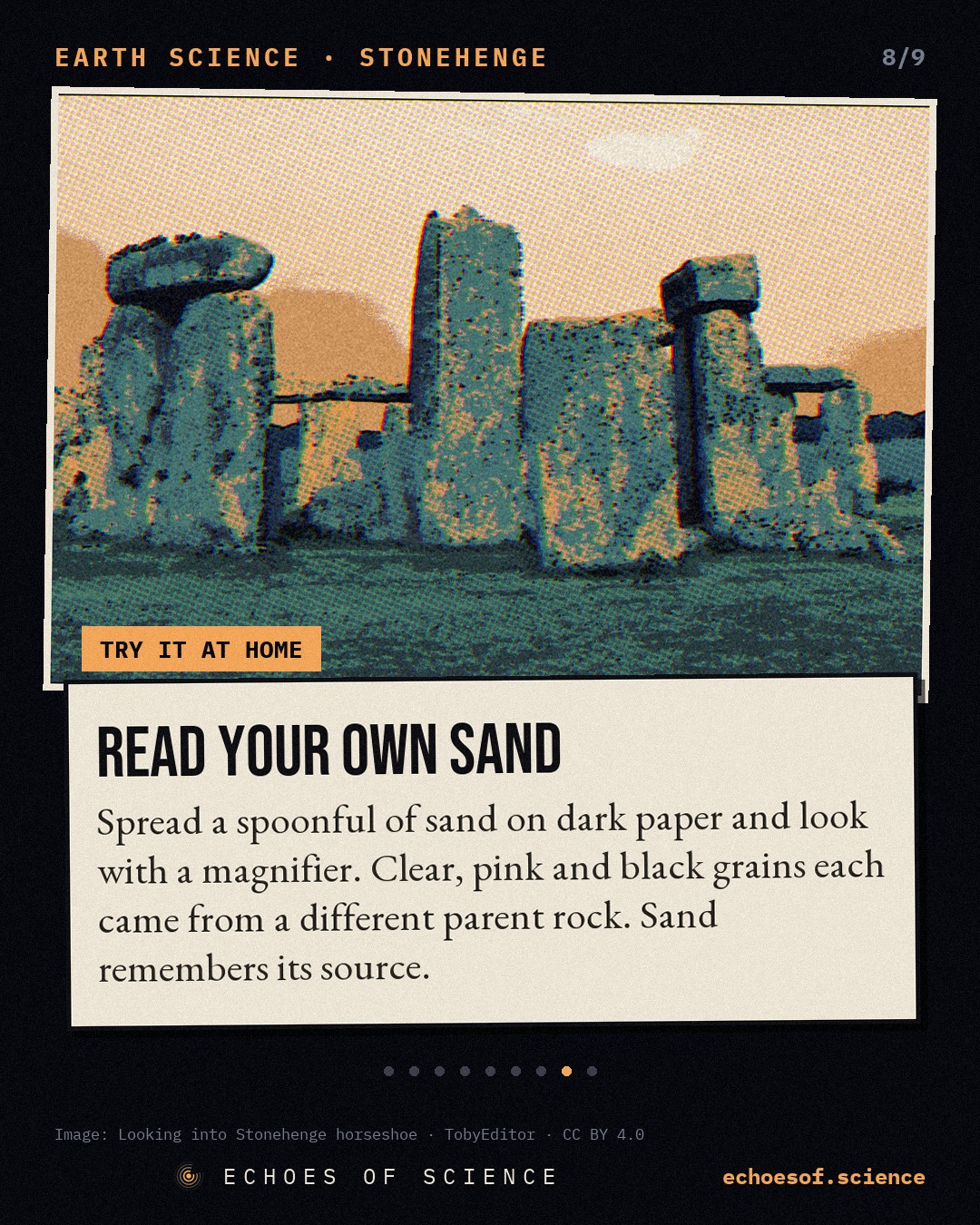
Spread a spoonful of sand on dark paper and look at it with a magnifying glass. Sort the grains by colour: clear quartz, pink feldspar, dark minerals. Each kind came from a different parent rock; try sand from two places and compare the mix.
Loading the quiz…
Where every picture, clip and sound in this story comes from
Keep scrolling: more true stories ↓
New mini-documentaries every week and a true story every day. Pick where you like to watch:
▶ Subscribe on YouTube Telegram TikTok Instagram Bluesky Threads ✉ Weekly email
Everything here is free and stays free. If you would like to help us make more: 🪐 Shop: calendars, posters, mugs & books