The Lost Hippo Lake of the Empty Quarter
125,000 years ago, hippos wallowed in a deep freshwater lake in what is now Saudi Arabia's Empty Quarter. On its shore, people left stone spear points that carry traces of what may be the oldest known arrow poison.
Today the Rub' al-Khali, the Empty Quarter of southern Arabia, is one of the largest sand seas on Earth. About 125,000 years ago, part of it was a lake deep enough for hippos. A study published in Science this month describes that lake, the animals that lived around it and the people who camped on its shore, and it suggests those people may have tipped their spears with poison.
A lake in the Empty Quarter
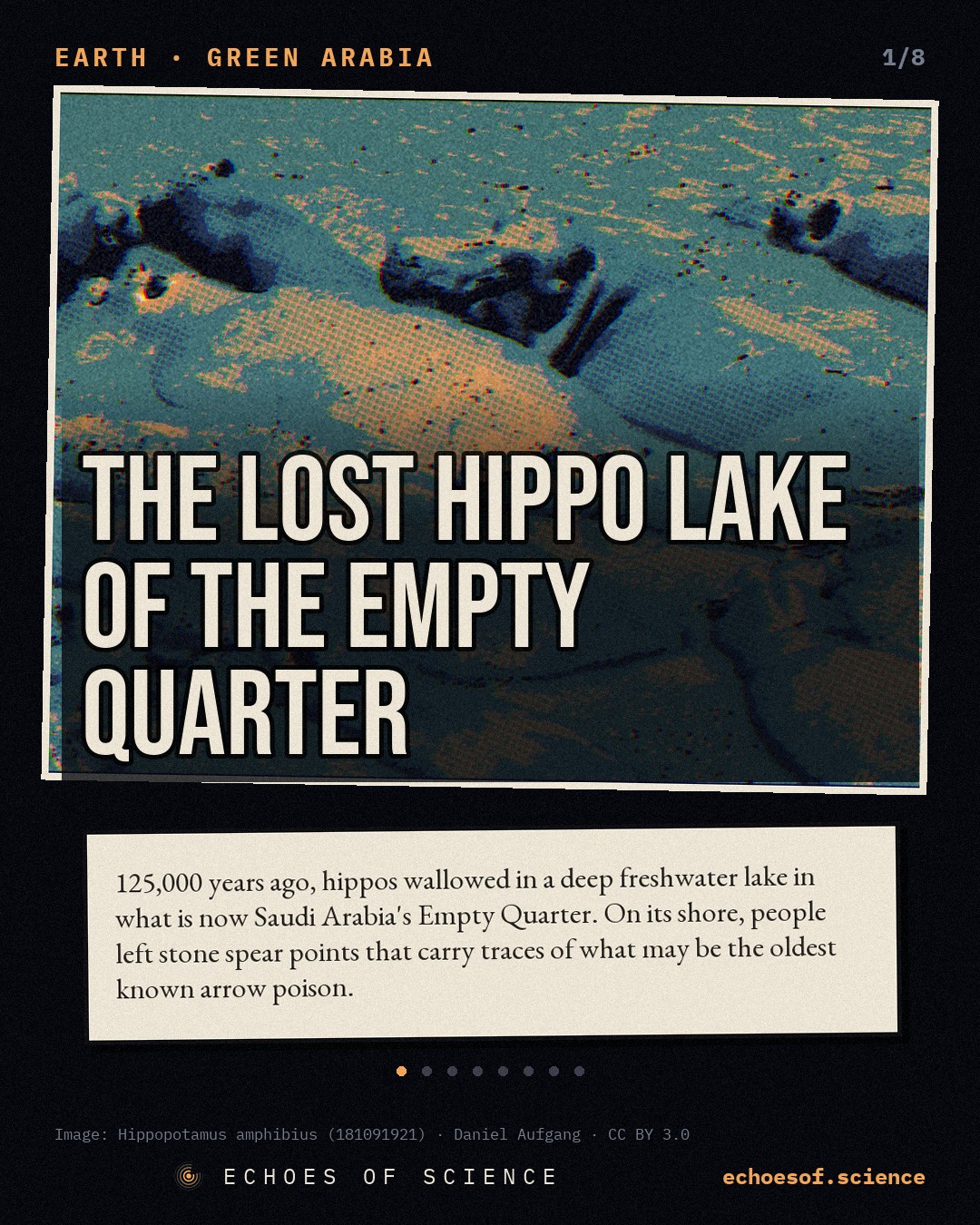
The lake sat in the Mundafan basin in what is now southern Saudi Arabia. Using satellite terrain models, the team led by King Abdullah University of Science and Technology (KAUST), the Saudi Heritage Commission and Griffith University reconstructed a freshwater lake of about 340 square kilometres, up to 29 metres deep, bordered by grassland. It belongs to the Last Interglacial, a warm spell when the region was far wetter than today.
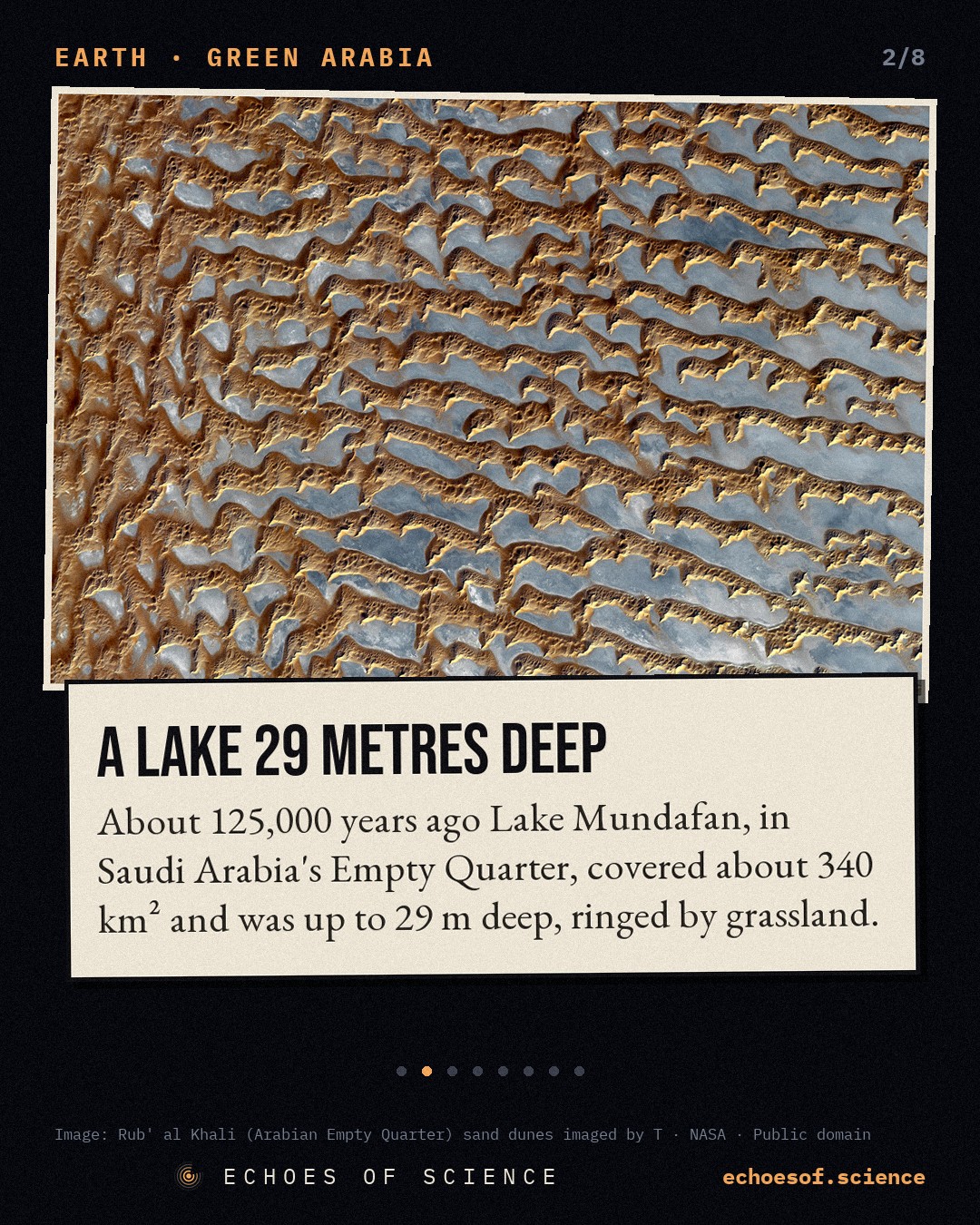
Around one ancient shoreline site, Uruq al-Julaybah, the researchers documented more than 500 animal and plant specimens from more than 130 locations: hippos, extinct long-horned buffaloes, camels, Arabian oryx, gazelles and ostriches. The hippos matter most. Hippos spend the day submerged in deep water and come out at dusk to graze, so their remains are a sign of substantial, lasting fresh water, not a seasonal puddle.
Spears on the shore
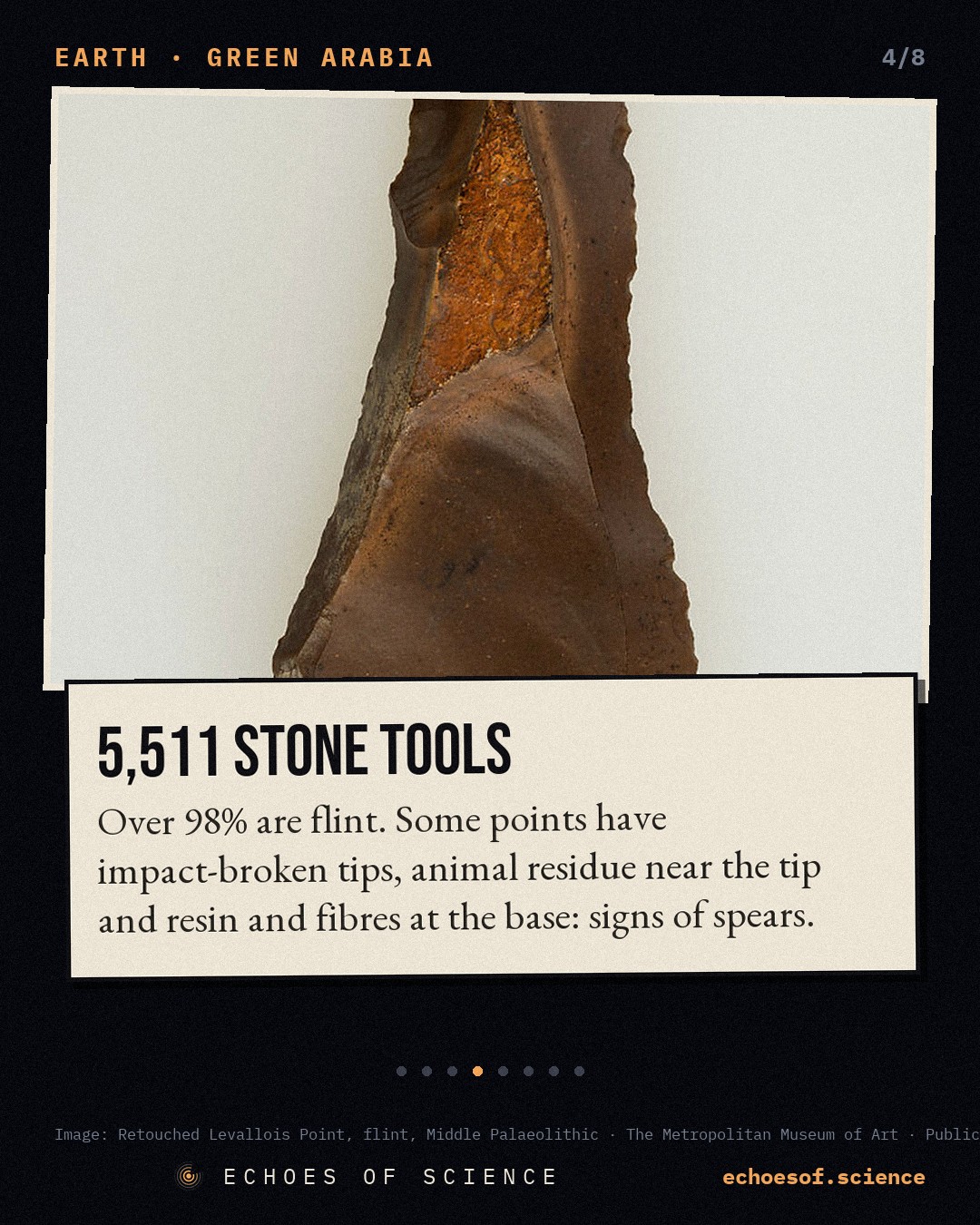
The people left far more than footprints. The main study area yielded 5,511 stone tools longer than 2 centimetres, over 98% of them flint, many made with the Levallois technique, in which a core is shaped so that a ready-made point can be struck off in one blow. Some flakes fit back together, marking the spots where tools were made.
Under the microscope, several points told a sharper story. Their tips were broken in a way that matches impact against large animals; animal fats and protein survived near the tip; and resin and plant fibres clung to the base, where the stone was glued and bound to a shaft. Other tools carried palm fibres, reeds and traces of underground plant parts: the lakeshore was a workshop as well as a hunting ground.
Traces of an arrow poison
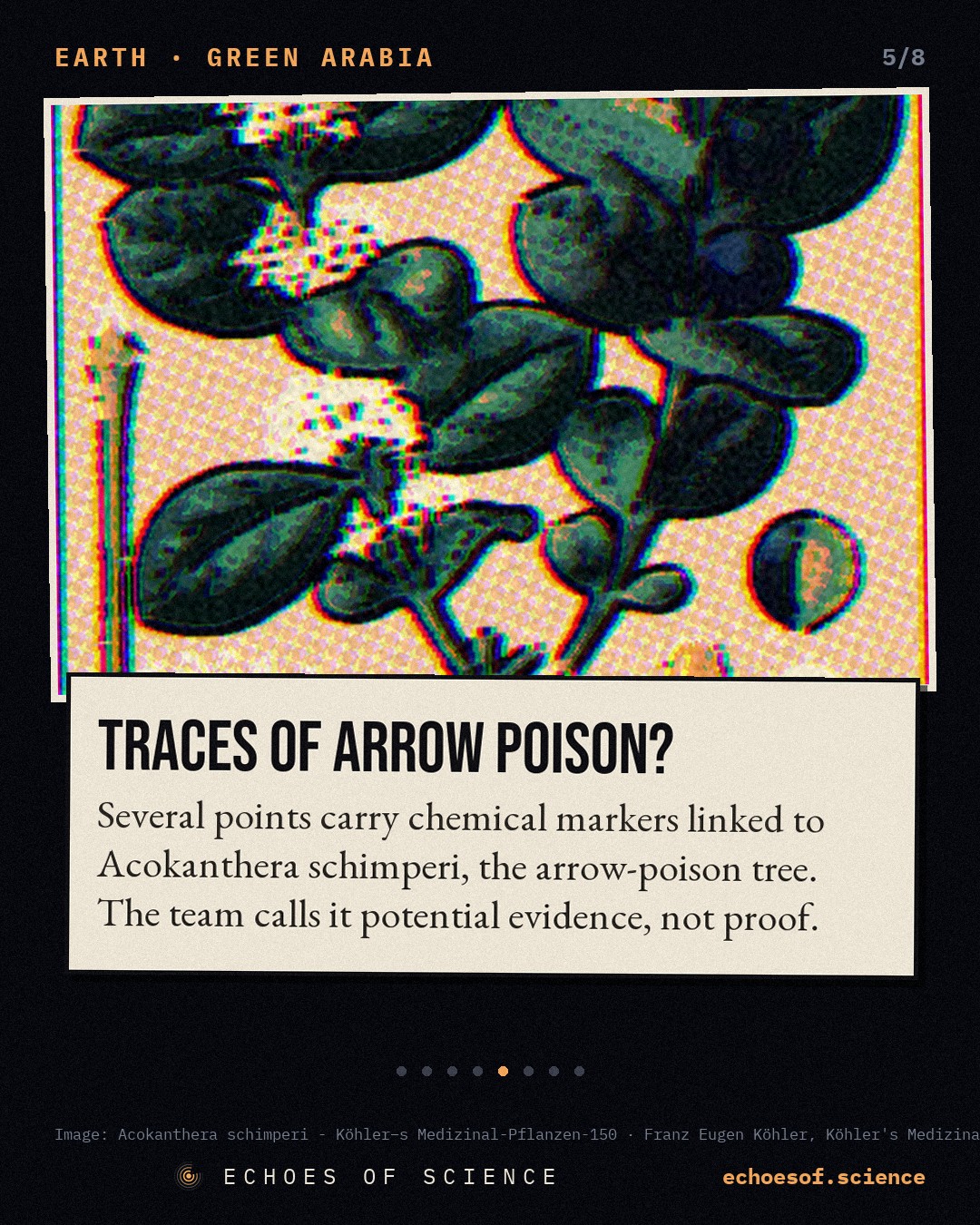
The most striking claim is chemical. Several points carried biomarkers linked to Acokanthera schimperi, the arrow-poison tree, which is known for cardiac glycosides: heart toxins that in eastern Africa were boiled down into a tar-like arrow poison within recorded history. One of them, ouabain, takes its name from the Somali word for "arrow poison".
If the reading is right, these are the oldest poisoned weapons yet found. Until now that record belonged to 60,000-year-old quartz arrowheads from Umhlatuzana Rock Shelter in South Africa, poisoned with the bulb of the gifbol plant. Mundafan would push the practice back by about 65,000 years.
How do we know?
The age comes mainly from luminescence dating of sand buried in the lake and shore deposits, with hippo teeth providing supporting evidence. The tools carry a maximum age tied to the lake, so the dates describe when people could have been there rather than the moment each spear was used.
The team is careful about the rest. They call the poison "potential evidence": nobody has shown how it was prepared, or whether it worked, and it is not known how hunters avoided poisoning themselves when they ate the meat, as one report notes. No human bones have been found, so the toolmakers' species is an inference: our own species, Homo sapiens, had already left Africa by then. And although hippo bones lie among the tools, they show no butchery marks, so whether anyone hunted hippos here remains open.
The science: clocks in sand and poisons in the heart
Luminescence dating treats sand like a tiny battery. Quartz and feldspar grains, the commonest minerals in Earth's crust, are charged by natural radiation from uranium, thorium and potassium around them, and by cosmic rays. Sunlight drains that charge. Once a grain is buried in the dark, it starts charging again. In the laboratory, light makes the grain release its stored energy as a faint glow; comparing that glow with the glow from a known laboratory dose, and dividing by the yearly dose at the site, gives the time since burial. The method reaches back a few hundred thousand years.
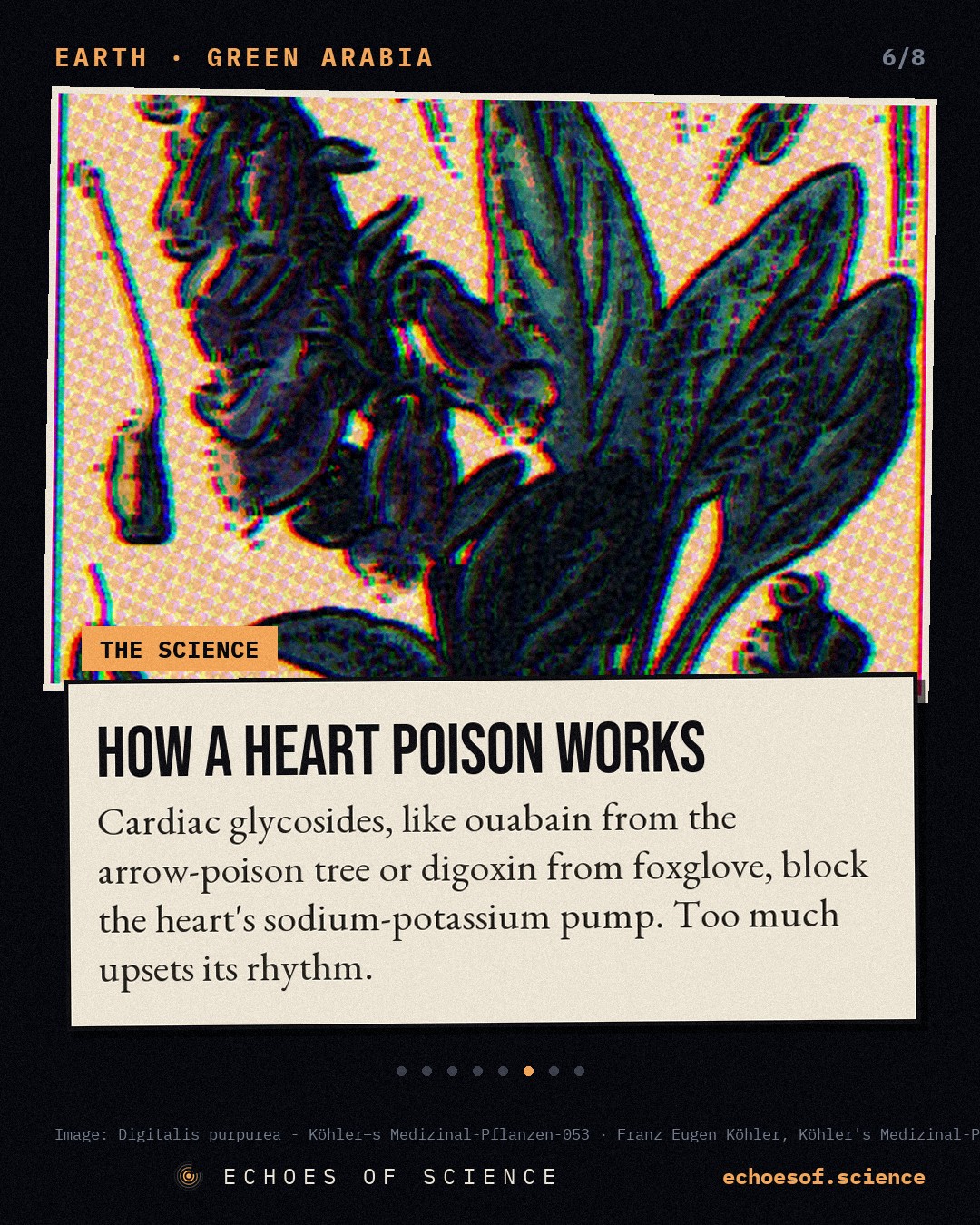
The suspected poison works on the heart. Cardiac glycosides block the sodium-potassium pump in heart muscle cells. Sodium builds up inside the cell, which in turn raises calcium, so the heart contracts harder; in larger doses the rhythm breaks down. Doctors still use a milder relative, digoxin from foxglove, in carefully measured doses.
Why it matters today
Arabia sits between Africa and Eurasia, and its deserts were not always a barrier. Stalagmites from Saudi caves show repeated wet phases over the past eight million years, fed by monsoon rain, when hippos and crocodiles could live there; earlier work found tools at dozens of ancient lakes in the Nefud Desert. Each green phase opened a corridor for animals and people. Mundafan shows what life in one of those corridors looked like: a lake, a savanna, and hunters with composite, perhaps poisoned, weapons, long before the desert returned.
The science in this story
Key facts
- About 125,000 years ago, during the Last Interglacial, a freshwater lake at Mundafan in the Empty Quarter of southern Saudi Arabia covered about 340 km² and was up to 29 m deep. source ↗
- Animals at the lakeshore site of Uruq al-Julaybah included hippos, extinct long-horned buffaloes, camels, Arabian oryx, gazelles and ostriches; more than 500 specimens came from more than 130 locations. source ↗
- The main study area yielded 5,511 stone tools larger than 2 cm, over 98% of them flint, made with Levallois techniques. source ↗
- Some points had impact damage, animal residues near the tip and resin and plant fibres at the base, suggesting they were hafted as hunting weapons. source ↗
- Several points carried chemical biomarkers linked to Acokanthera schimperi, the arrow-poison tree, known for toxic cardiac glycosides; the team describes poison use as possible, not proven. source ↗
- The site was dated with luminescence dating of buried sand grains, with hippo teeth giving supporting evidence. source ↗
- No human bones were found; the team thinks Homo sapiens made the tools. The hippo bones show no butchery marks. source ↗
- The previous oldest evidence of poisoned weapons was on 60,000-year-old quartz arrowheads from Umhlatuzana Rock Shelter, South Africa, poisoned with gifbol (Boophone disticha). source ↗
- Cave deposits show that Arabia had repeated wet phases fed by monsoon rain over the past 8 million years; hippos and crocodiles lived there about 400,000 years ago. source ↗
- Ouabain, a cardiac glycoside used as an arrow poison in eastern Africa, occurs in large amounts in Acokanthera schimperi; its name comes from the Somali word waabaayo, 'arrow poison'. source ↗
In pictures
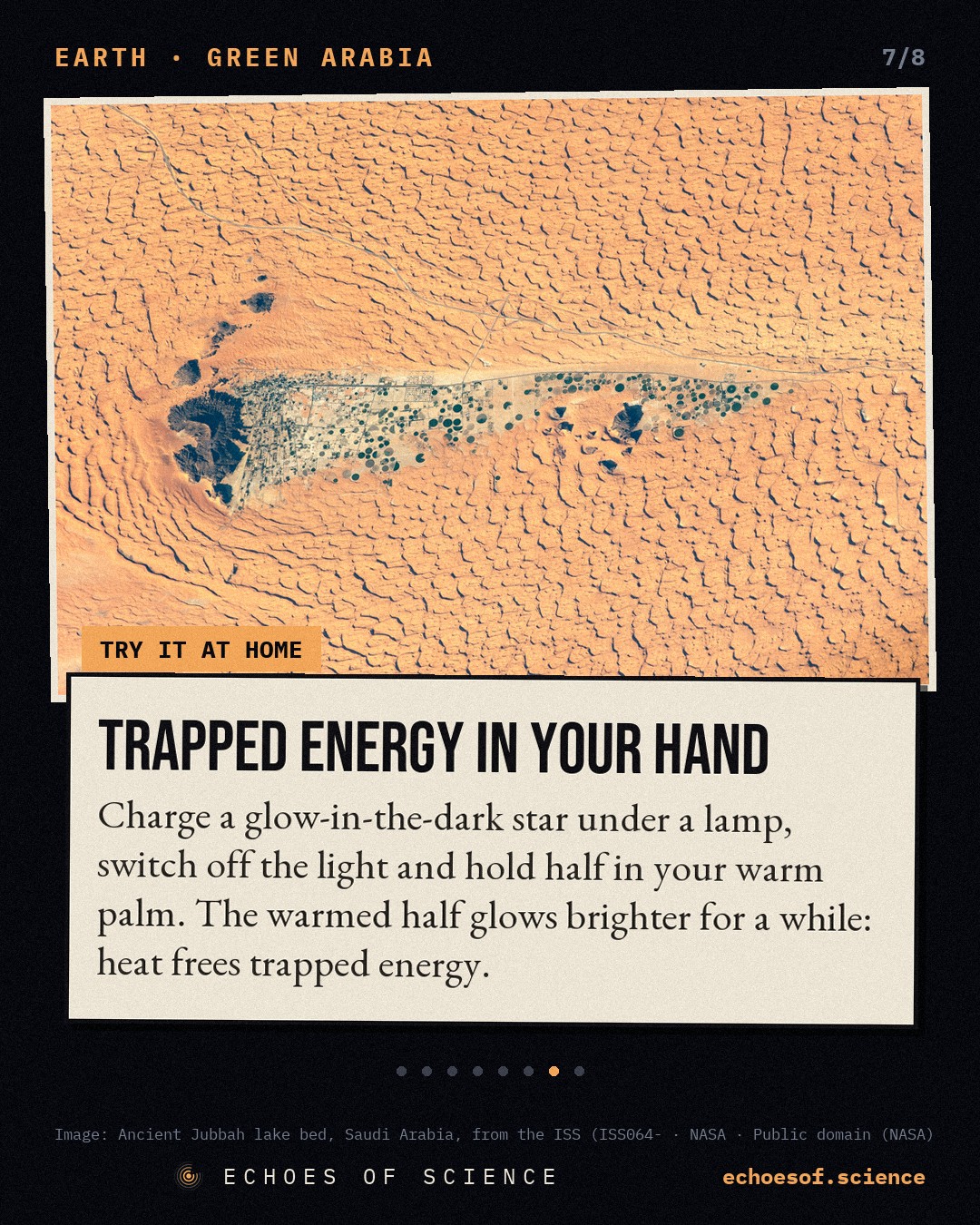
Charge a glow-in-the-dark star under a bright lamp, switch off the light and hold half of it in your warm palm for a minute. The warmed half glows brighter: heat frees trapped electrons faster. Luminescence dating reads the same kind of trapped energy in sand grains, using light or heat.
Loading the quiz…
Where every picture, clip and sound in this story comes from
Keep scrolling: more true stories ↓
New mini-documentaries every week and a true story every day. Pick where you like to watch:
▶ Subscribe on YouTube Telegram TikTok Instagram Bluesky Threads ✉ Weekly email
Everything here is free and stays free. If you would like to help us make more: 🪐 Shop: calendars, posters, mugs & books