Why Voyager 1 Gets Closer to Us Every Spring
Voyager 1 is now one light-day from Earth, so far that its signals take a whole day to reach us. Yet every spring, for a few weeks, it comes closer.

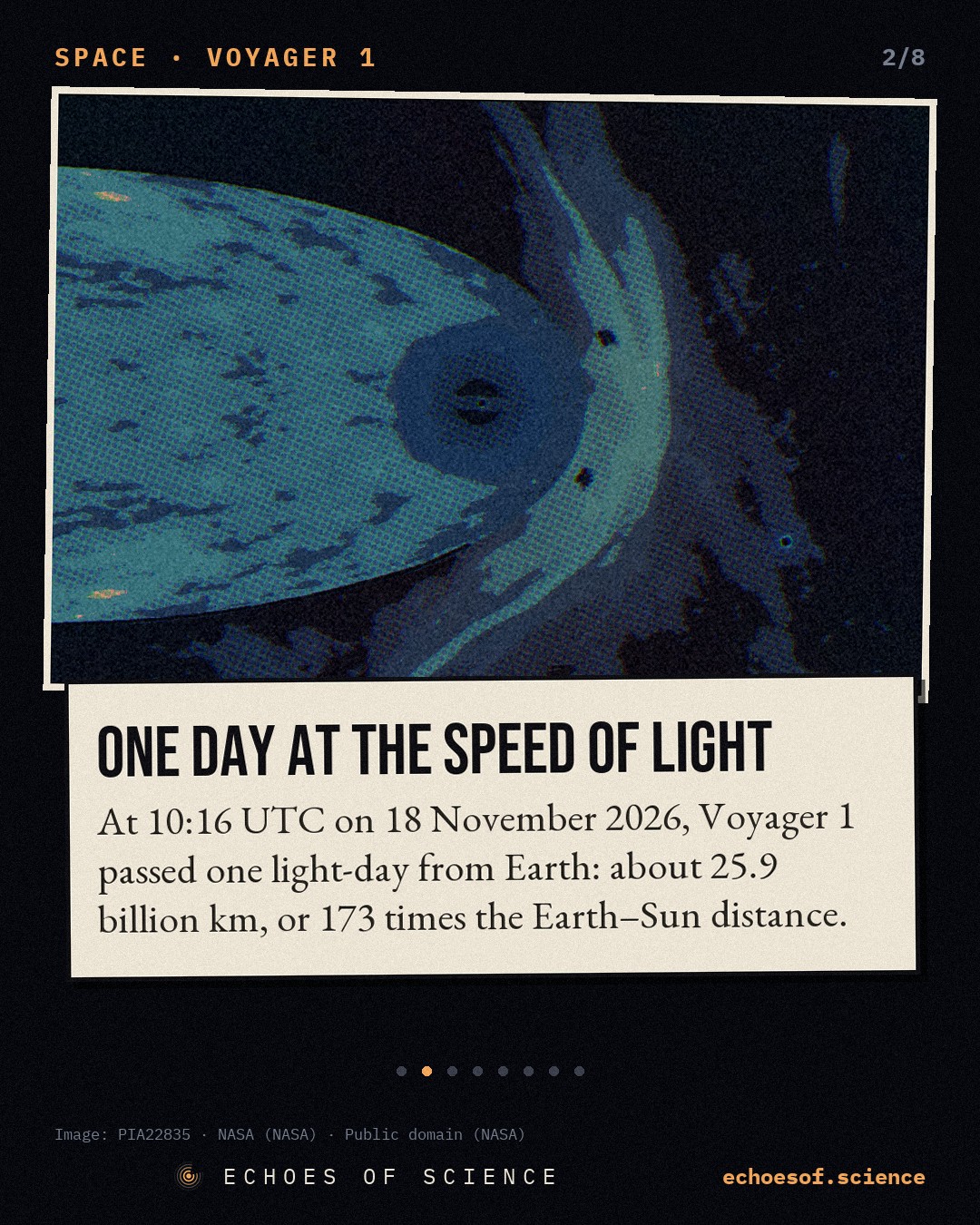
On 18 November 2026, a message sent to a small spacecraft beyond the planets began to need a full day to arrive. At 10:16 UTC that day, Voyager 1 became the first human-made object to sit one light-day from Earth: so far away that light, the fastest thing there is, needs 24 hours to cross the gap.
That headline went round the world. A stranger fact got less attention. For a few weeks every year, Voyager 1, a probe that has been leaving the Solar System for almost half a century, gets closer to us.
A day at the speed of light
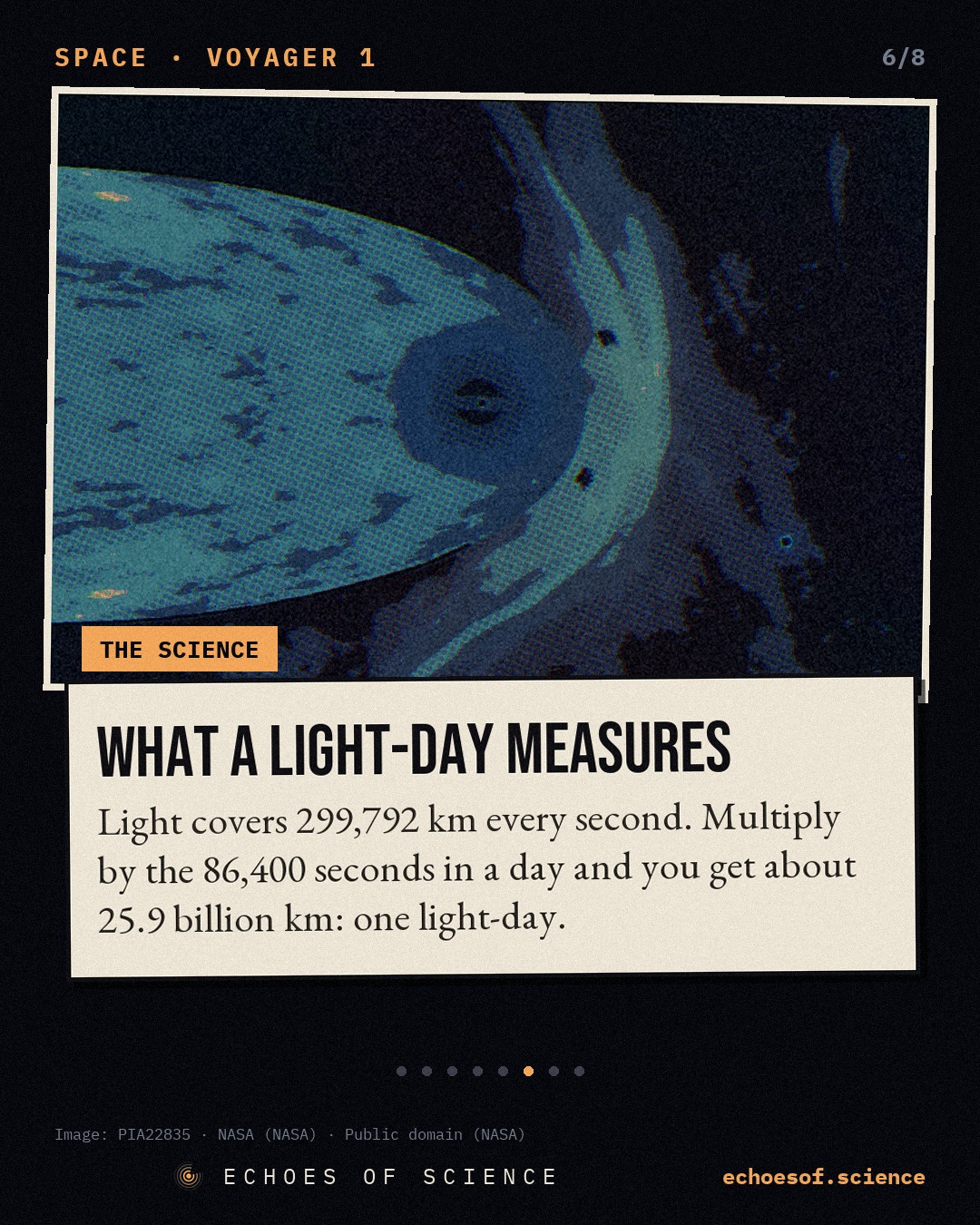
A light-day sounds like a unit of time, but it is a distance. Light in a vacuum covers 299,792 kilometres every second. A day has 86,400 seconds. Multiply the two and you get about 25.9 billion kilometres, which NASA rounds to 16.1 billion miles. Astronomers usually measure the Solar System in astronomical units, the average distance between Earth and the Sun; one light-day is about 173 of them.
Voyager 1 was launched on 5 September 1977, two weeks after its twin, Voyager 2. It flew past Jupiter and Saturn, and in August 2012 it crossed the heliopause, the edge of the bubble of solar wind that surrounds our star, into interstellar space. Light travel time now shapes every conversation with it. In the words of Voyager project manager Suzanne Dodd:
Even traveling at the speed of light, signals now take 24 hours to reach the spacecraft and 24 hours to reach us.
Why the distance counter runs backwards
NASA's mission pages show a live counter of how far each Voyager is from Earth. People who watch it closely sometimes report a bug: the number goes down. NASA's own frequently asked questions answer that this is often true and not an error.
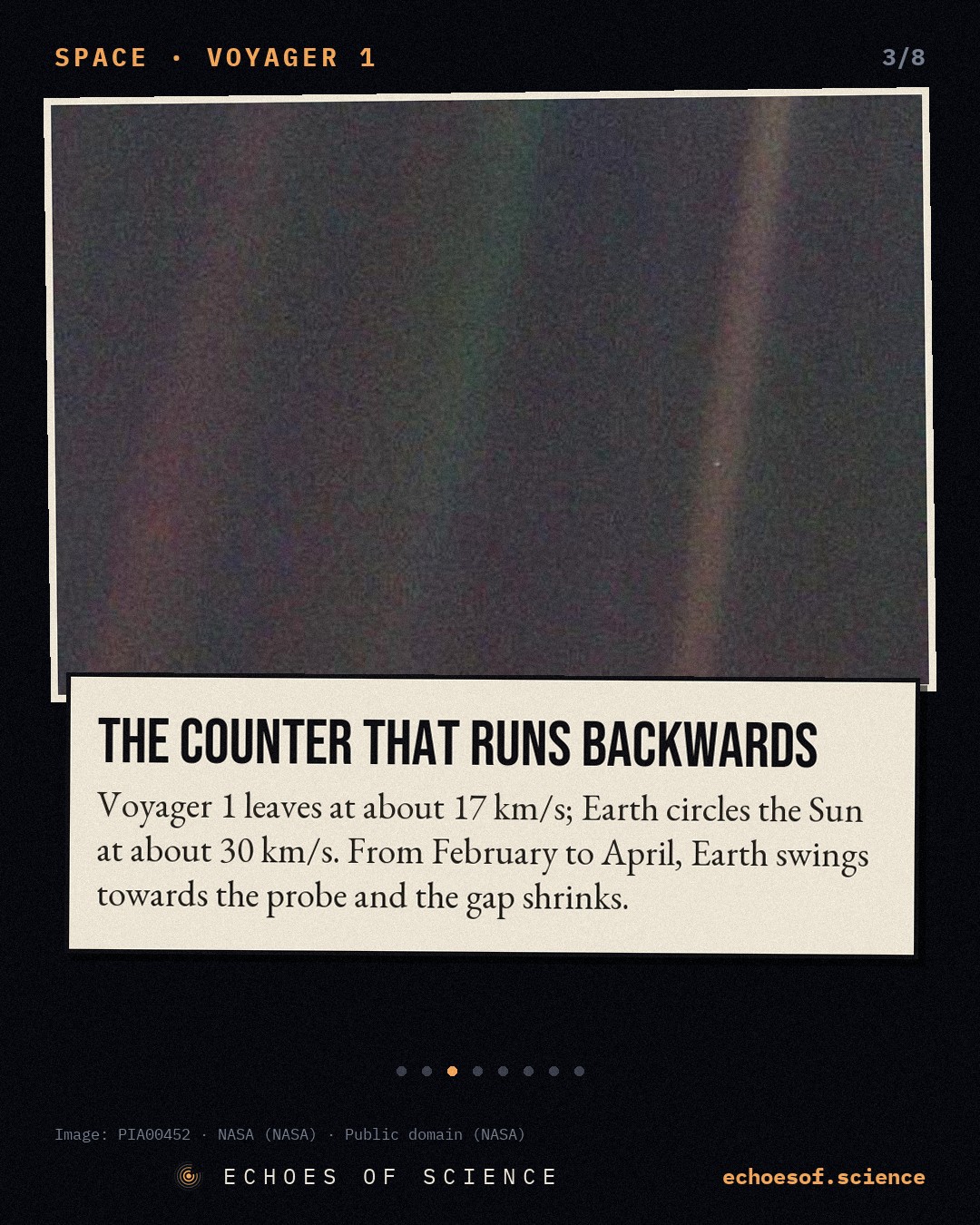
The reason is relative motion. Voyager 1 is coasting outwards at about 17 kilometres per second. Earth is not standing still, though: it circles the Sun at about 30 kilometres per second. For half of each orbit, Earth is moving broadly away from the part of the sky where Voyager 1 lies; for the other half, it is moving towards it. When Earth's motion towards the probe is faster than the probe's motion away, the gap shrinks. According to EarthSky, that happens from about February to April each year.
Picture walking slowly across a park while a friend jogs a wide circle around the place you started. You never stop walking away, yet for part of every lap your friend gets nearer. Over a whole lap, though, you are further apart than before. Voyager is the walker, Earth is the jogger, and the Sun is the centre of the circle.
Will it slip back inside a light-day?
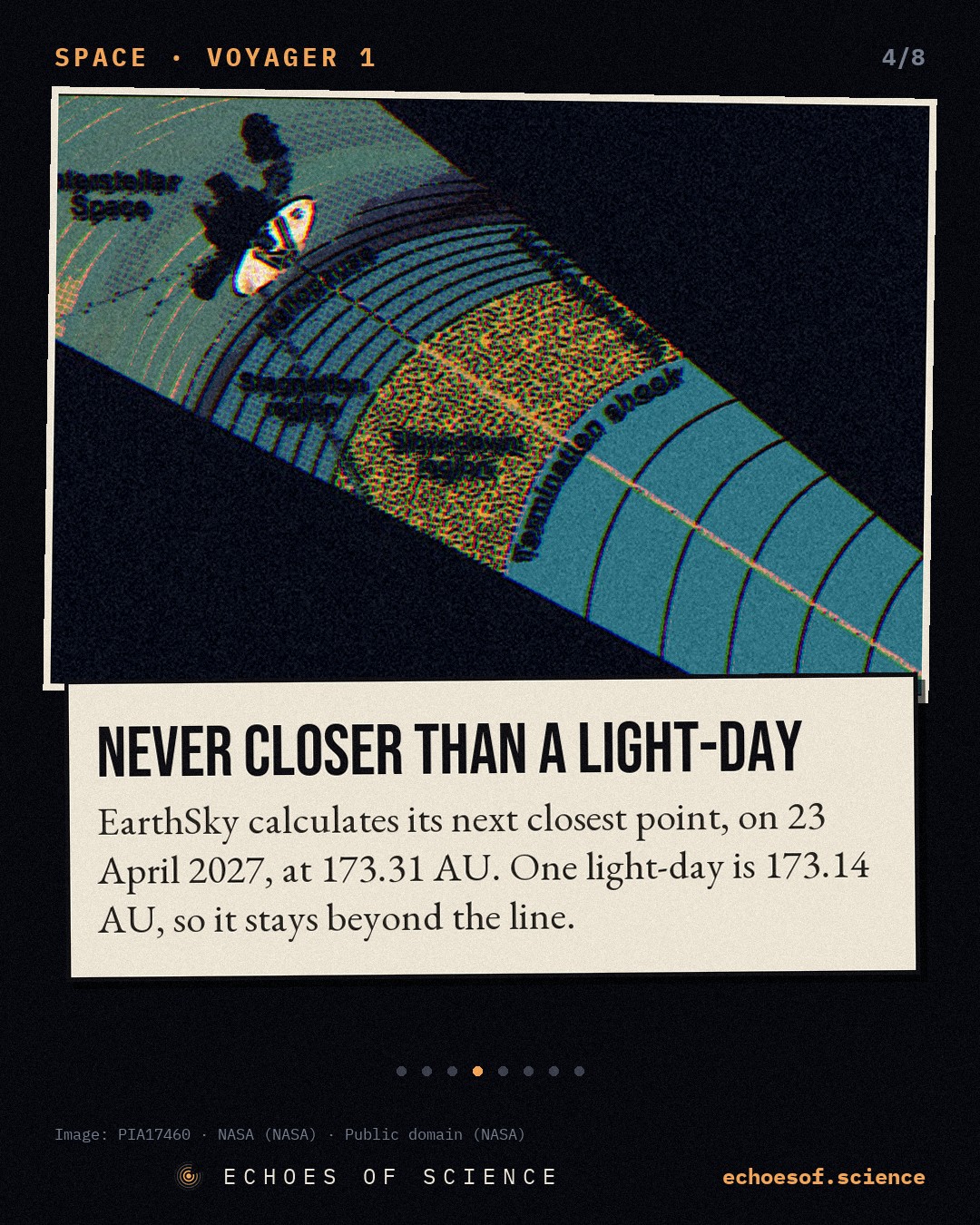
This is a fair question. If the distance shrinks every spring, could Voyager 1 dip back under the line it has just crossed? EarthSky worked through the numbers and says no. By the end of January 2027 the probe should be about 173.58 astronomical units from Earth. Its closest point in the following spring, on 23 April 2027, should be 173.31 units, while one light-day is 173.14. That margin is roughly 25 million kilometres, so the crossing of 18 November was a one-way door. Each year the probe gains about 3.5 astronomical units, and the spring dip is too small to undo that.
How do we know where it is?
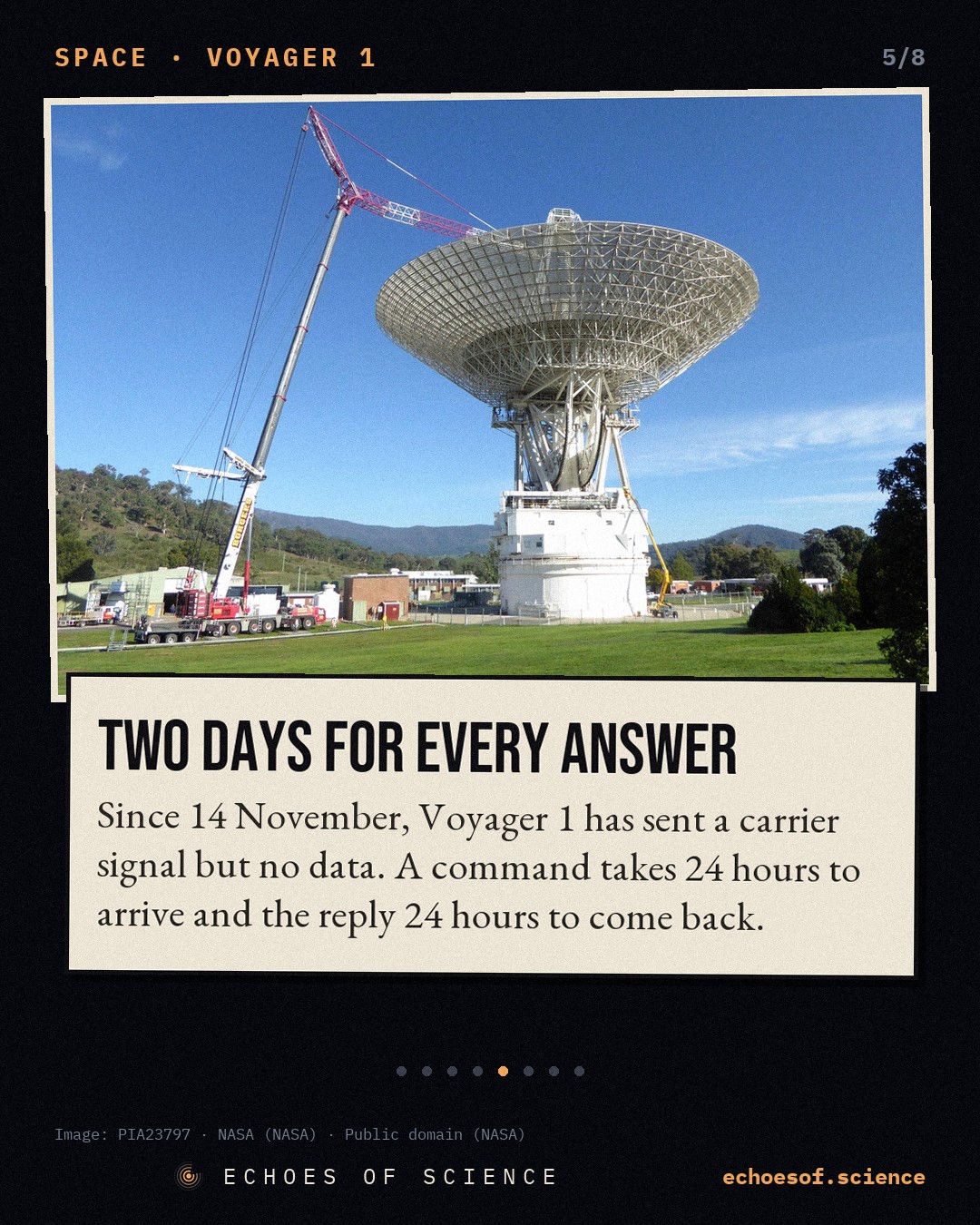
Nobody can see Voyager 1. Its position comes from tracking: the giant dishes of NASA's Deep Space Network, in California, Spain and Australia, measure the timing and the Doppler shift of its radio signal, and navigators combine those measurements with its known trajectory. NASA said it confirmed the light-day crossing on 19 November using the carrier signal and trajectory calculations.
That detail matters, because the probe is having trouble. On 14 November, NASA's antenna in Canberra locked on to Voyager 1 and received a carrier signal, but no science or engineering data. The engineers' reading is that the computer that points the spacecraft is working, and that the fault probably lies with the computer that collects the data. NASA has warned that with a two-day round trip, diagnosing the problem may take weeks or longer. There is hope in the record: in 2023, a similar silence was traced to one of the onboard computers and fixed from Earth. At the time of writing, NASA had not announced whether this fault has been solved.
Why it matters today
The probe is ageing. Its radioisotope power source, which turns the heat of decaying plutonium into electricity, loses about 4 watts a year, and the team has switched off instruments and other devices to keep the rest running. Every spring dip, every day of silence and every recovered byte reminds us how much engineering it takes to talk to a 49-year-old machine across a light-day of space.
It also gives us a new way to picture distances. The Sun is about eight light-minutes away. Neptune is about four light-hours. Voyager 1, our farthest messenger, is now one light-day out. The nearest star beyond the Sun, Proxima Centauri, is about 4.24 light-years away: more than 1,500 times further. Voyager 2 is expected to reach its own light-day in November 2035.
The science in this story
Key facts
- Voyager 1 passed one light-day from Earth at 10:16 UTC (5:16 a.m. EST) on 18 November 2026; NASA confirmed it on 19 November using the carrier signal and trajectory calculations. source ↗
- A light-day is the distance light travels in 24 hours: about 25.9 billion km (16.1 billion miles), or about 173.14 astronomical units. source ↗
- Voyager 1 was launched on 5 September 1977, two weeks after its twin Voyager 2, and entered interstellar space in August 2012. source ↗
- Voyager 1 travels at roughly 61,000 km/h (about 17 km/s), while Earth orbits the Sun at about 30 km/s. source ↗
- Because Earth moves round the Sun faster than either Voyager moves away, the distance between Earth and each Voyager decreases at certain times of the year; NASA's distance counters really do roll backwards. source ↗
- EarthSky calculates that Voyager 1's next closest approach to Earth, on 23 April 2027, will be 173.31 AU, still more than one light-day, and that it will never again be closer than a light-day. source ↗
- Since 14 November 2026 the Deep Space Network antenna in Canberra has received a carrier signal from Voyager 1 but no science or engineering data; NASA said diagnosing the issue may take weeks or longer. source ↗
- Signals take 24 hours to reach Voyager 1 and 24 hours to come back. Its nuclear power source loses about 4 watts a year. source ↗
- Voyager 2 is expected to reach one light-day from Earth in November 2035. source ↗
In pictures
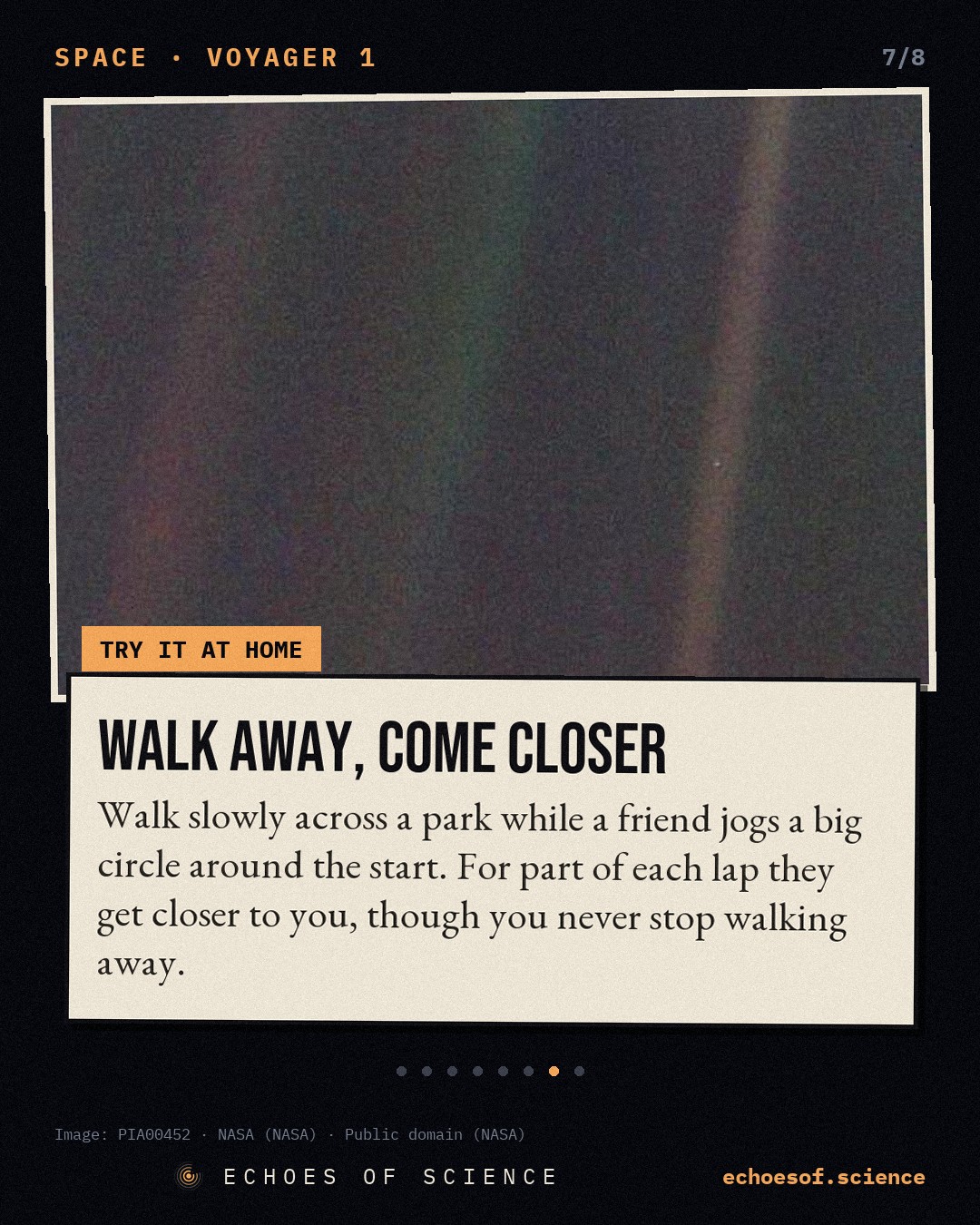

Walk slowly across a park while a friend jogs a wide circle around your starting point. For part of each lap they get closer to you, though you never stop walking away; over a full lap you end up further apart.
Loading the quiz…
Where every picture, clip and sound in this story comes from
Keep scrolling: more true stories ↓
New mini-documentaries every week and a true story every day. Pick where you like to watch:
▶ Subscribe on YouTube Telegram TikTok Instagram Bluesky Threads ✉ Weekly email
Everything here is free and stays free. If you would like to help us make more: 🪐 Shop: calendars, posters, mugs & books