How a Moon of Jupiter Revealed the Speed of Light
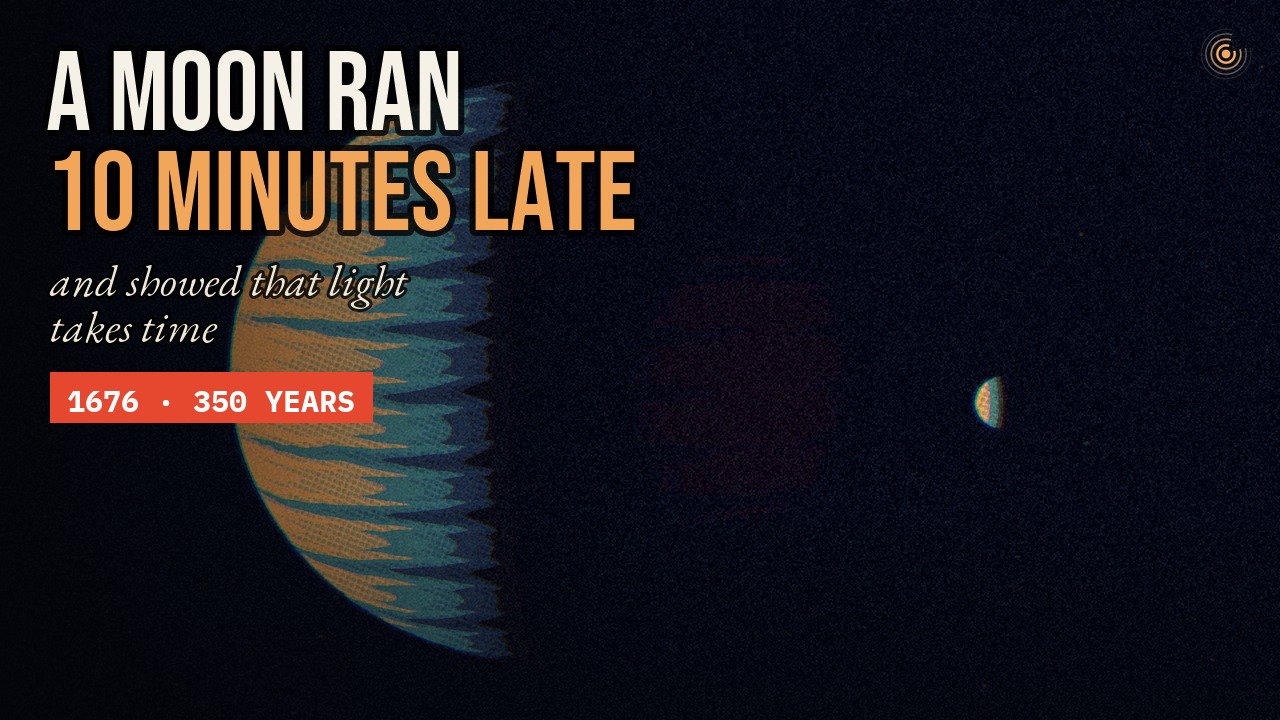
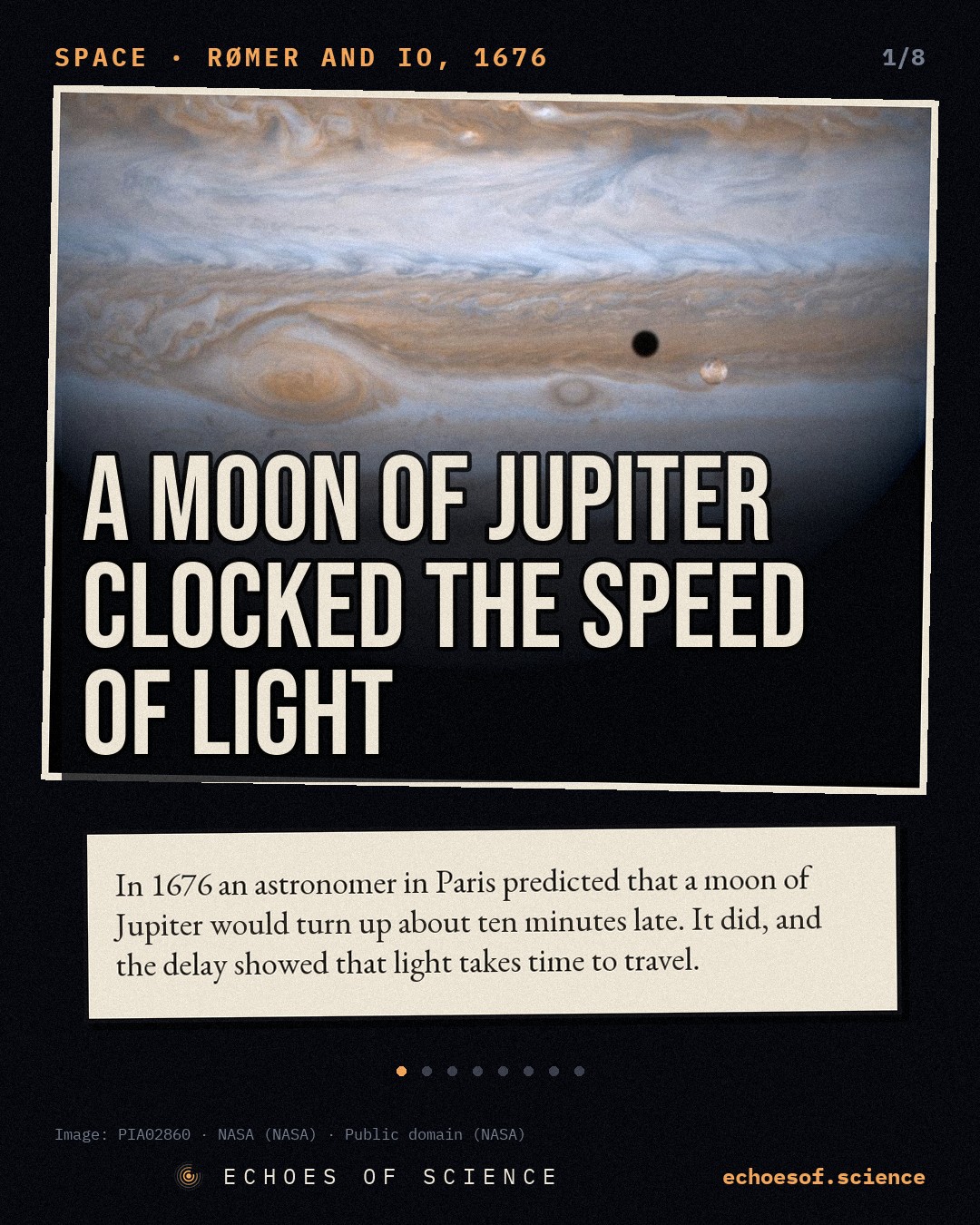
In 1676 an astronomer in Paris predicted that a moon of Jupiter would turn up about ten minutes late. It did, and the delay showed that light takes time to travel.
 Premieres on YouTube Friday 20 November, 17:00 UTC · subscribe to get it
Paris, November 1676. In a brand-new observatory on the edge of the city, an astronomer points a long telescope at Jupiter. Beside the planet sit four tiny points of light: the moons that Galileo discovered 66 years before.
Tonight, all eyes are on the innermost moon, Io. It has slipped into Jupiter's shadow, and the tables say exactly when it should come out again. The tables are good. Moons are the most regular clocks anyone knows.
But a young Danish astronomer at the observatory has made a very odd prediction. Io, he says, will be late. About 10 minutes late.
The time in the tables comes, and goes. 1 minute. 5. 8. Nothing but darkness beside the planet.
Then, a speck of light. Io is about 10 minutes behind the time worked out from the summer's eclipses. Just as the Dane had said.
A moon cannot be late. So what was? His answer was one of the boldest ideas of the century. The moon was right on time. It was the light, carrying the news across space, that needed time to reach us.
350 years later, this very month, a spacecraft is so far away that its signals take a whole day to reach the Earth. This is the story of Ole Rømer, and how we first found out that light has a speed at all. All it took was a moon, a clock, and a great deal of patience.
A Clock in the Sky
It starts with a problem that wrecked ships. At sea, you can find your latitude from the height of the Sun, or of the Pole Star. But longitude, how far east or west you are, is really a question of time.
The Earth turns 15 degrees every hour. If you know the time back home, and the local time where you are, the difference gives you your longitude. But in the 1600s, no clock could keep good time on a rolling ship.
Then, in January 1610, Galileo turned his telescope on Jupiter, and saw little stars beside it that moved from night to night. They were moons, circling another world. And they offered something else: a clock in the sky that anyone, anywhere, could read at the same moment.
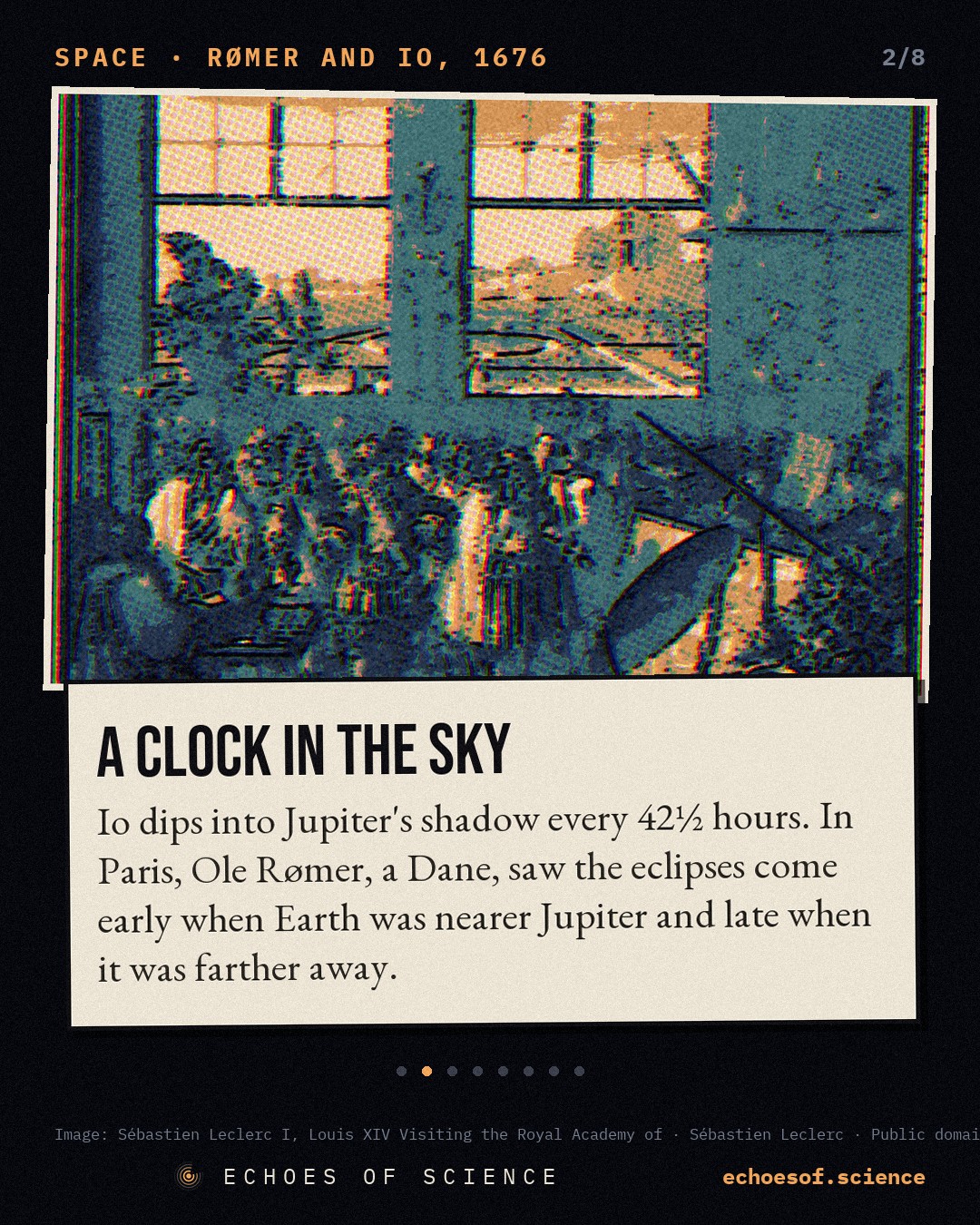
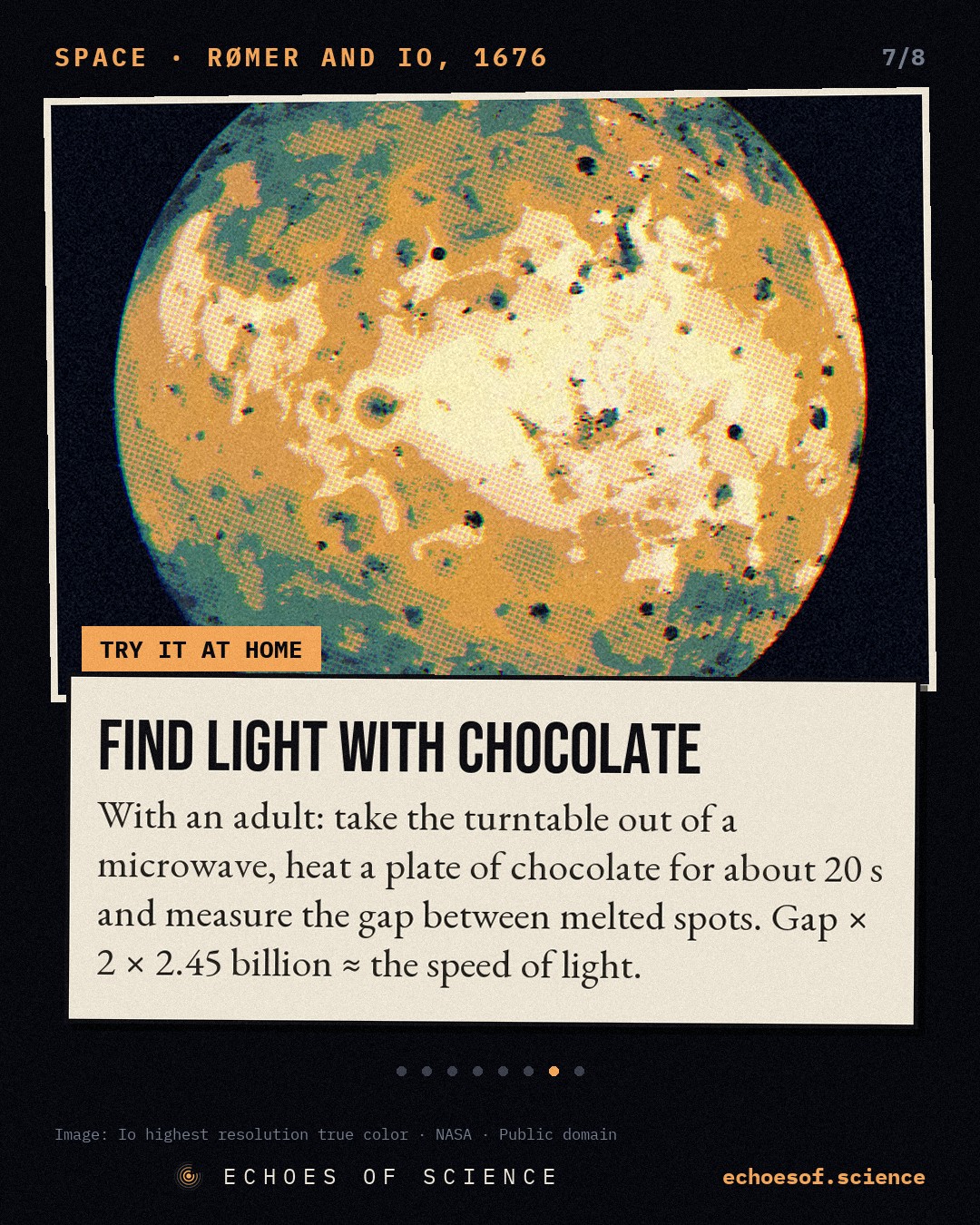
Io, the innermost of the four, goes round Jupiter in about 42.5 hours. On every orbit it passes into the giant planet's shadow, and vanishes. With a table of when those eclipses happen in one city, an observer somewhere else can compare local times, and work out the longitude.
On a pitching deck, holding a long telescope steady on a tiny moon was close to hopeless. But on land, for the makers of maps, it worked. And to make it work, you needed better tables.
In 1667, Jean-Baptiste Colbert, minister to King Louis XIV, founded a Royal Observatory in Paris. Its leading astronomer was the Italian Giovanni Domenico Cassini, whose tables of Jupiter's moons were the best in the world. The observatory began timing their eclipses almost as soon as it existed.
But to compare clocks across Europe, Paris needed a second observer, far away. It found one on a small island in Denmark.
The Island of the Sky Castle
The island is Hven, in the strait between Denmark and Sweden. A century earlier, the astronomer Tycho Brahe had built Uraniborg there, a castle for watching the sky, and made the most precise measurements of the stars before the telescope.
By 1671, Tycho's castle had crumbled. But the French astronomer Jean Picard travelled north to measure exactly where it had stood, so that Tycho's old observations could be tied to the map of Paris. His method: time the eclipses of Io on Hven, while Cassini timed the same eclipses in Paris.
Picard needed help. The Copenhagen professor Rasmus Bartholin came along, with the young man who lived in his house and edited Tycho's papers: Ole Rømer, from the town of Aarhus. That autumn, on Hven, they watched Io vanish and return, again and again.
And the sky clock worked. For one eclipse, the clocks of Hven and Paris differed by 42 minutes and 10 seconds. That difference in time is a difference in longitude: about 10.5 degrees around the globe.
Picard went home with two treasures: Tycho's original books of observations, and the young Dane himself. Rømer arrived in Paris in 1672, and was given rooms in the new observatory.
He became Cassini's assistant. He taught mathematics to the king's son, worked on the fountains of Versailles, and invented ingenious instruments. But above all, night after night, he timed the eclipses of Io.
The Moon That Ran Late
And Io would not behave. Month by month, the eclipses drifted away from the tables. Sometimes they came early. Sometimes they came late. And the errors added up to many minutes.
There was a pattern, though. While the Earth, on its orbit, was swinging towards Jupiter, the eclipses came a little earlier each time. While the Earth was moving away from Jupiter, they came later. As if the moon's clock ran fast for half the year, and slow for the other half.
Cassini had noticed the pattern too. He even considered an explanation: perhaps light does not arrive instantly. Perhaps it needs time to cross the extra distance when the Earth is far from Jupiter. And then he rejected the idea.
Cassini was in good company. Most scholars believed light was instant. The philosopher René Descartes had pictured light as a kind of pressure, passed on through space in no time at all, and many followed him.
Galileo had tried to test it. In a book published in 1638, he imagined two people on distant hills, with covered lanterns. One uncovers his lamp. The other uncovers his the moment he sees the other's light. Galileo could not detect any delay. His verdict on light:
If not instantaneous, extraordinarily rapid.
He was right that it was rapid. Across a few kilometres, light takes a few millionths of a second. No human reflex could ever catch that. To see light's delay, you would need a distance so huge that even light would need minutes to cross it. You would need the solar system.
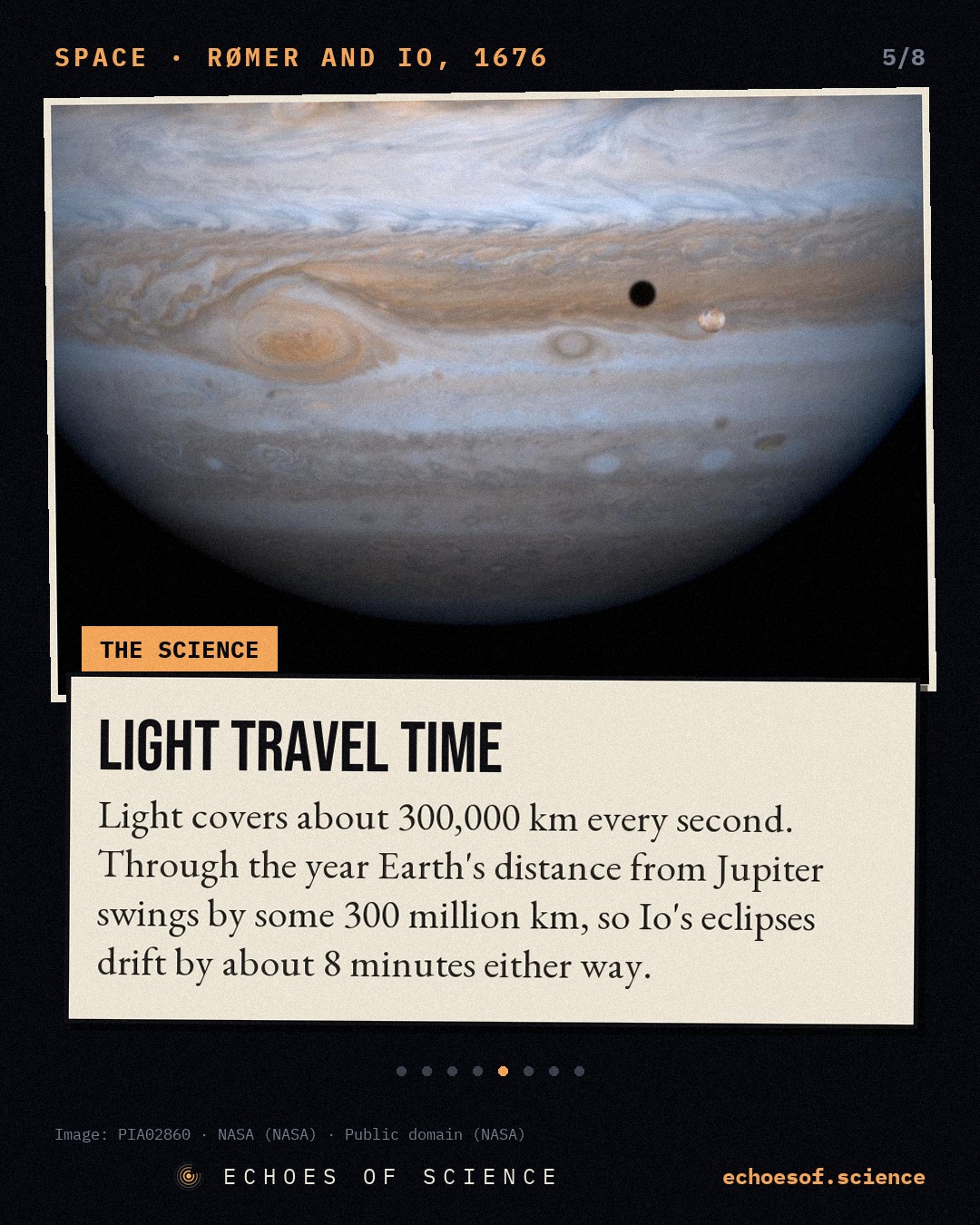
Rømer had exactly that. Over a year, the distance between Earth and Jupiter changes by about 300 million km: the whole width of the Earth's orbit. If light needed time to cross it, the eclipses would arrive late by exactly the time light took.
Ten Minutes
Rømer worked through the numbers. From one orbit of Io to the next, the extra delay is tiny, far too small to see. But add up 40 orbits while the Earth moves away, and the seconds pile up into minutes.
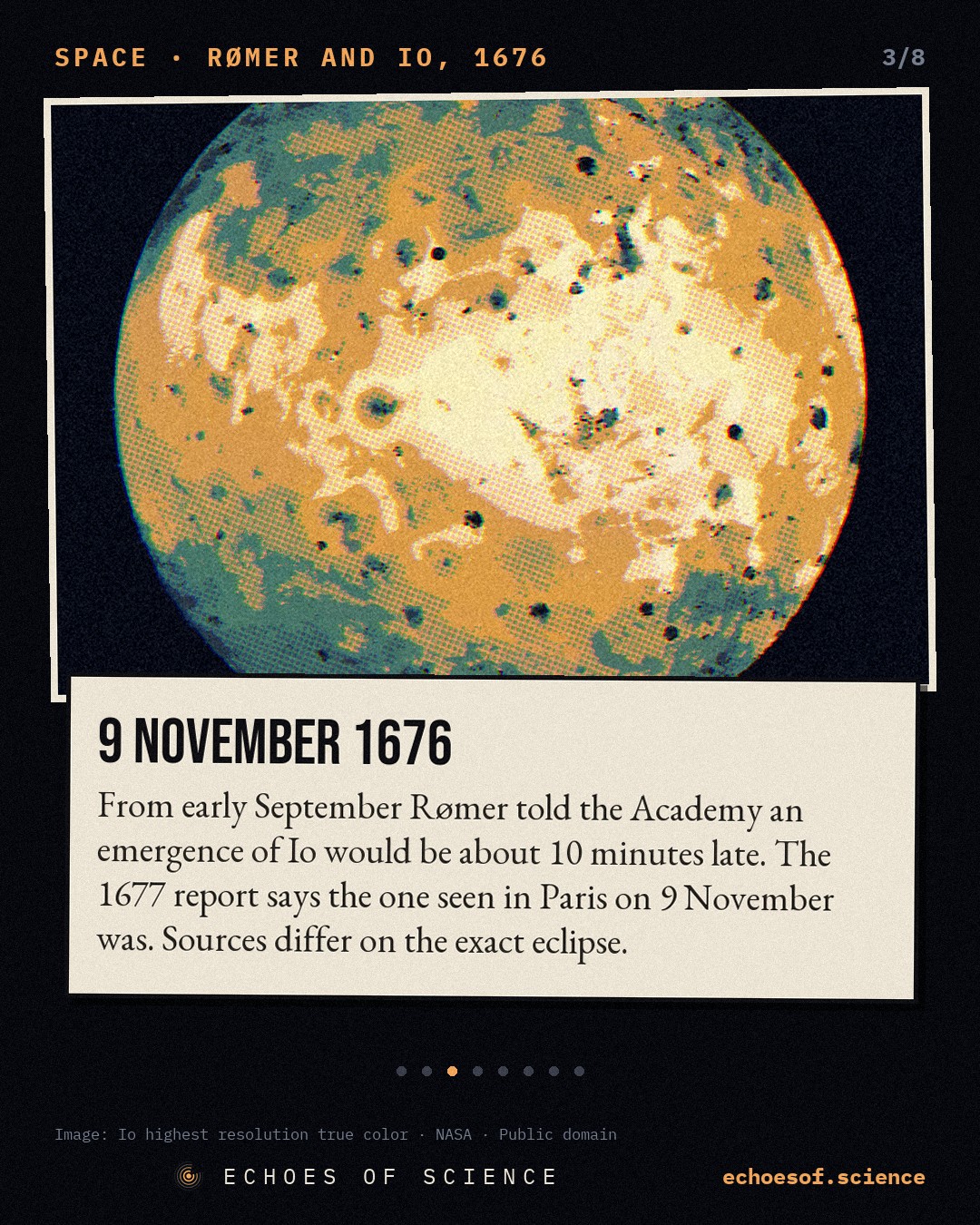
Starting in early September 1676, he told the Royal Academy of Sciences what to expect. One emergence of Io, due in November, would come about 10 minutes later than the tables said.
Then came the evening of 9 November, the night we began with. According to the report printed a few weeks later, Io was 10 minutes late.
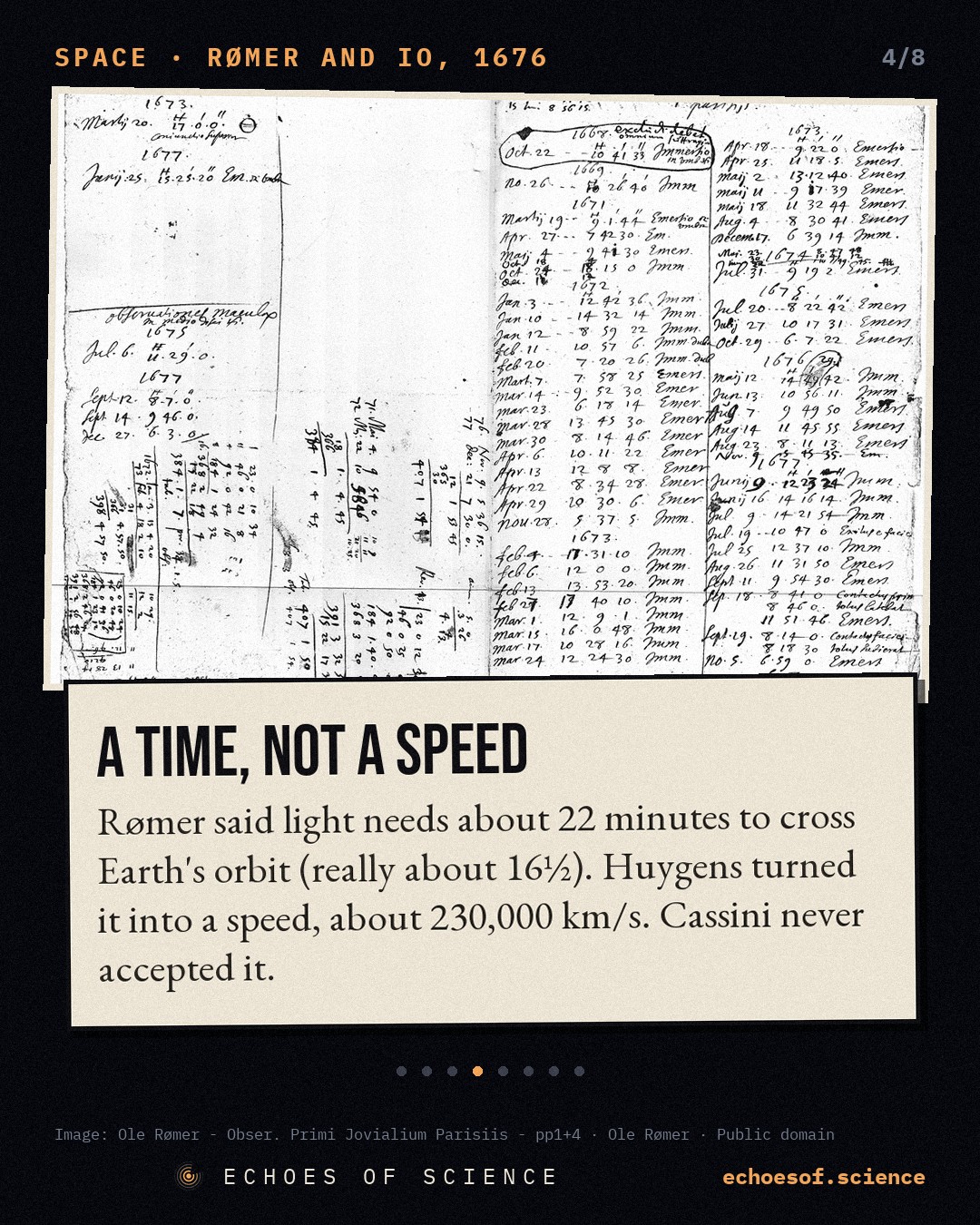
On 21 November 1676, Rømer explained his reasoning to the Academy. Light, he said, needs about 22 minutes to cross the whole width of the Earth's orbit.
A little over two weeks later, the Journal des Sçavans, one of Europe's first scientific journals, printed an unsigned report of the discovery. The next summer, the Royal Society in London printed it in English. It opens with the oldest question about light: does it reach distant places in an instant, or does it need time?
The answer, the report said, came from a moon of Jupiter.
Here is the idea in one picture. Io is like a lighthouse that flashes every 42.5 hours. When we are close to Jupiter, each flash reaches us after a short trip. Months later, with the Earth on the far side of its orbit, every flash must travel an extra 300 million km. The flashes are not late. The news of them is.
And this is the beautiful part. Rømer did not need to know how fast light was to show that it had a speed. But how fast was it? And did anyone believe him?
How Do We Know?
So how sure can we be of all this? Less sure than the textbooks suggest. Rømer never published a full account himself. What we have is the unsigned report, some letters, and a few notes.
Most of his papers were lost in the great Copenhagen fire of 1728. One surviving manuscript lists about 60 eclipses of Io, observed between 1668 and 1678. Historians still argue over the details: exactly which eclipse he predicted, and how much credit belongs to Cassini, who saw the pattern first, and walked away from it.
And one popular claim is not quite right. Rømer is often said to have measured the speed of light. He never gave a speed. He gave a time: about 11 minutes for light to travel from the Sun to the Earth. Half his 22.
The man who turned it into a speed was the Dutch physicist Christiaan Huygens. He wrote that he had seen, with much pleasure, the beautiful discovery of Mr Rømer. In his Treatise on Light, published in 1690, he combined Rømer's minutes with the best guess at the size of the Earth's orbit. The answer: a little over 200,000 km every second. That is around 600,000 times faster than sound.
The true figure is close to 300,000 km a second. Rømer's 22 minutes was too long: light really crosses the Earth's orbit in about 16.5. Why the gap? Io's own orbit wobbles, tugged by its sister moons. And nobody yet knew the true size of the solar system. But the idea, and the scale, were right.
Not everyone was convinced. Cassini objected that Jupiter's other moons did not show the same delay clearly, and he never accepted the theory. For half a century, the idea that light has a speed remained a respectable minority opinion.
In 1704, Isaac Newton wrote in his Opticks that light takes 7 or 8 minutes to reach us from the Sun. Then, in 1729, the English astronomer James Bradley explained a tiny shift in the positions of the stars. It was caused by the Earth's motion through their light, the way falling rain seems to slant when you run. His figure: about 8 minutes and 12 seconds. 53 years after Rømer, the argument was over.
In 1849 the French physicist Hippolyte Fizeau finally measured the speed of light on the ground, with a spinning toothed wheel and a distant mirror. And since 1983, we no longer measure the speed of light at all. We define it. Exactly 299,792,458 metres per second. The metre itself is now measured by light.
The Police Chief of Copenhagen
Rømer himself had long since gone home. In 1681 he returned to Copenhagen as a professor, married into the Bartholin family, and became one of the busiest men in Denmark.
He gave the country its first national system of weights and measures. In 1700, he persuaded the king to switch to the Gregorian calendar. And as chief of the Copenhagen police, from 1705, he brought in the city's first oil street lamps.
He also made a thermometer, with a scale of his own. In 1708 a young instrument maker called Daniel Gabriel Fahrenheit came to visit him, and later based his own, far more famous scale on Rømer's.
Rømer died in 1710. Eighteen years later, the fire took most of his records. What survived, above all, was an idea: that whenever we look out into space, we are looking back in time.
One Light-day
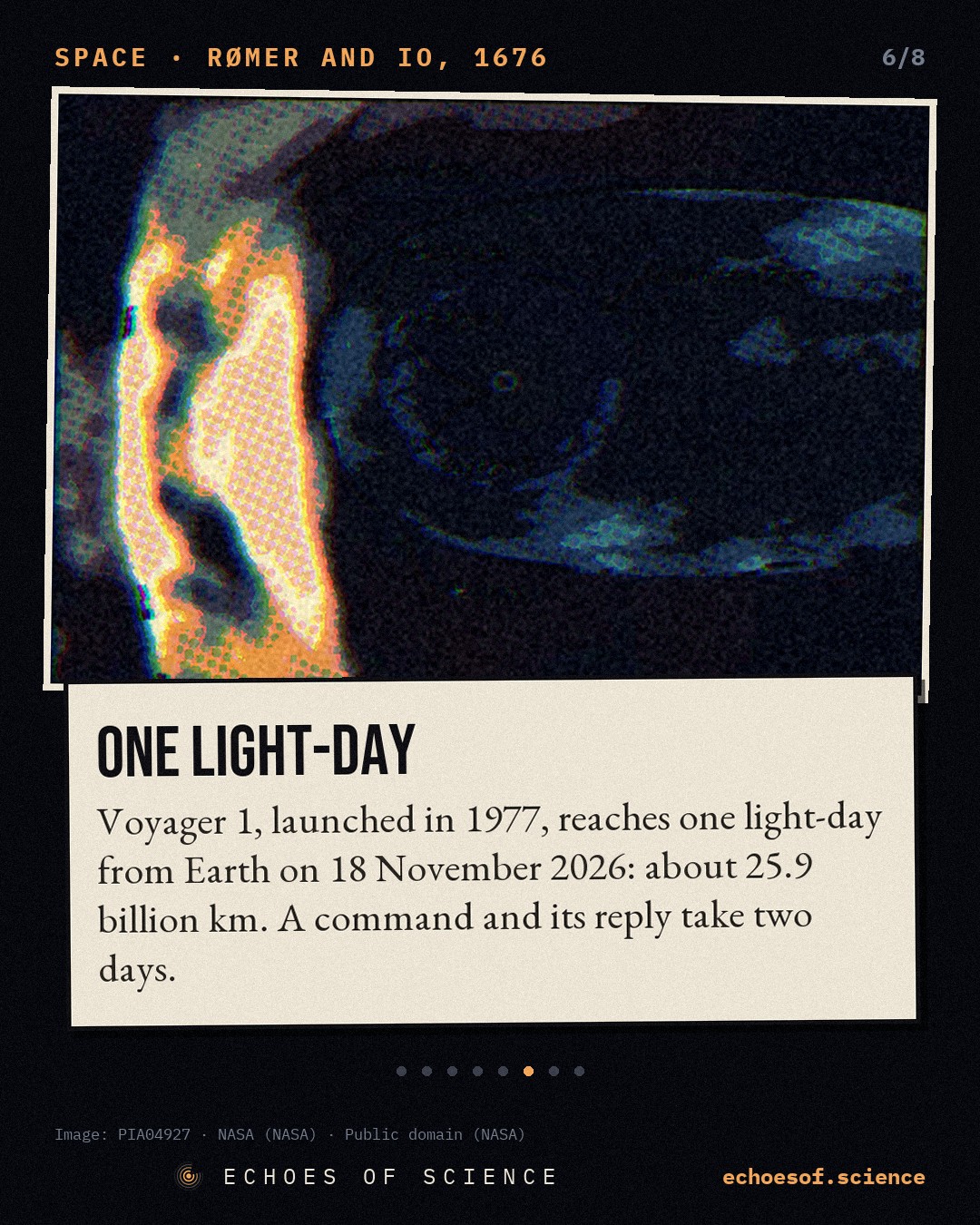
Which brings us back to this month. On 18 November 2026, NASA's Voyager 1, launched in September 1977, becomes the first spacecraft one light-day from Earth. It is now almost 26 billion km away. Its radio signal, moving at the speed of light, takes 24 hours to reach us.
Send it a command, and the answer comes back two days later. As the mission's project manager, Suzanne Dodd, puts it: you send your message, and then you go home, and you wait two days.
Every space mission lives with Rømer's delay. A signal to Mars takes between 3 and 22 minutes each way, so a rover there cannot be driven with a joystick: it has to look after itself. The sunlight on your face left the Sun about 8 minutes ago. And when you look at Jupiter tonight, you see it as it was more than half an hour ago.
Io still keeps Rømer's clock. With a small telescope, you can watch it slip into Jupiter's shadow yourself, and compare the moment with the predictions. Over a few months, the light delay is there for anyone patient enough to find it.
Epilogue
In Paris, the observatory where Io came out ten minutes late still stands. Rømer never knew the number we know today. But he was the first to catch light in the act of travelling. He trusted that the moon was keeping perfect time, and realised that the messenger took time.
Next time: the first hack, when two brothers in Bordeaux broke into France's telegraph, in 1834. And on our website, you can race Io's light across the solar system, and measure the speed of light yourself.
The science in this story
Key facts
- The Royal Society's 1677 report says the emersion of Io observed at Paris on 9 November 1676 came '10 minutes later than it was to be expected', as Rømer had forecast to the Academy since early September. source ↗
- Rømer explained his method to the Royal Academy of Sciences on 21 November 1676; a report appeared in the Journal des sçavans on 7 December. Some accounts say his forecast was for an eclipse on 16 November, for which no observation is recorded. source ↗
- Rømer estimated about 22 minutes for light to cross the diameter of Earth's orbit (about 11 minutes from the Sun); he gave a time, not a speed. source ↗
- Huygens turned it into a speed in his Treatise on Light (1690): about 600,000 times the speed of sound, around 230,000 km/s in modern units. source ↗
- Cassini, Rømer's superior, objected that the other moons did not show the same effect and never accepted the theory. source ↗
- In 1671 Picard, Bartholin and Rømer timed eclipses of Io on Hven to fix the longitude of Tycho's Uraniborg while Cassini timed them in Paris. source ↗
- Bradley's aberration of starlight (1729) gave about 8 min 12 s from the Sun and brought wider acceptance. source ↗
- Voyager 1 becomes the first spacecraft one light-day from Earth on 18 November 2026 (about 25.9 billion km); a command and its reply take two days. source ↗
In pictures
Loading the quiz…
Sources
- Phil. Trans. 12 (1677) 893–894 · Journal des sçavans, 7 Dec 1676
- Observatoire de Paris · encyclopedia.com (DSB): Römer
- Huygens, Traité de la lumière (1690) · Bradley (1729)
- NASA JPL: Voyager 1 one light-day (Nov 2026) · NIST
Where every picture, clip and sound in this story comes from
Keep scrolling: more true stories ↓
New mini-documentaries every week and a true story every day. Pick where you like to watch:
▶ Subscribe on YouTube Telegram TikTok Instagram Bluesky Threads ✉ Weekly email