Enron Booked $111 Million From a Deal That Was Dead in a Year
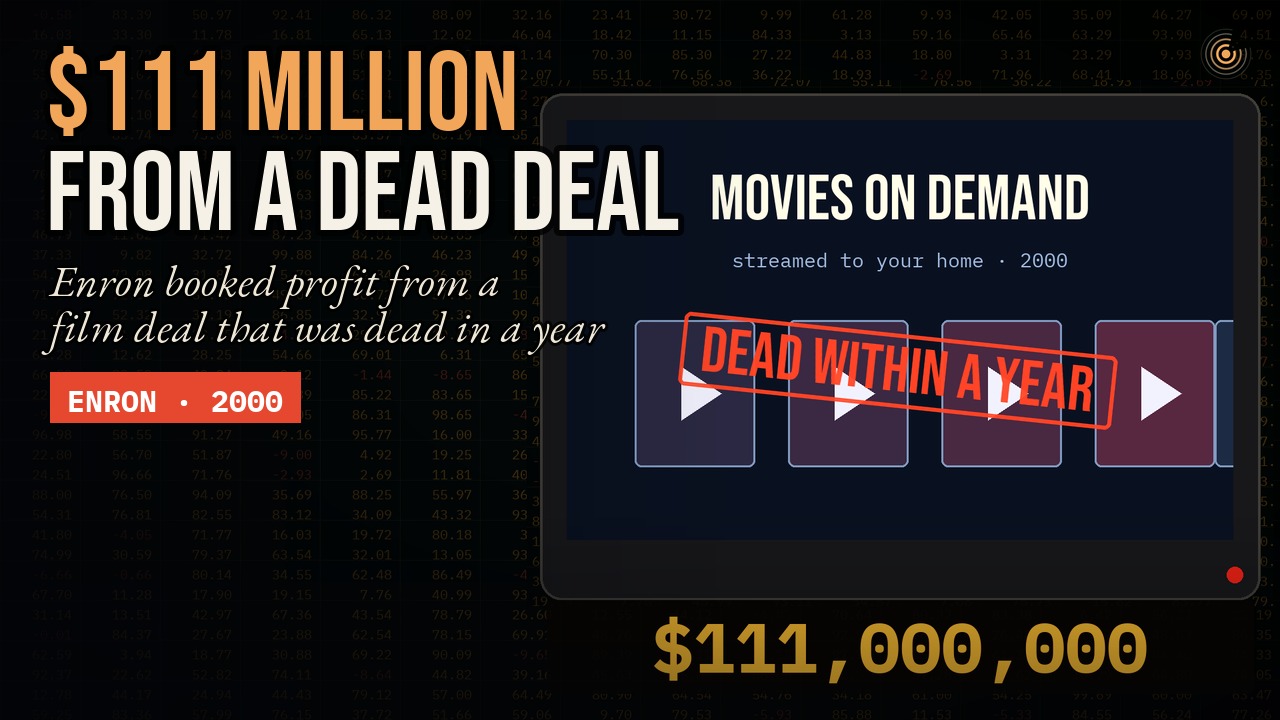
Enron booked $111 million of profit from a film-streaming deal with Blockbuster that was dead within a year. Fortune had called it America's most innovative company six years in a row; it hid debts in partnerships named after Star Wars characters and 'insured' its bets with its own shares.
 Premieres on YouTube Wednesday 25 November, 17:00 UTC · subscribe to get it
A company in Houston once booked $111 million of profit from a deal to stream films into people's homes. The deal was signed in 2000. Within a year, it was dead.
For six years in a row, Fortune magazine had named it America's most innovative company. Its name was Enron. And in December 2001, it collapsed into what was then the biggest bankruptcy in American history.
So how does a company that big hide its trouble in plain sight? It turns out you need surprisingly little maths.
The Black Box
March 2001. A young reporter at Fortune, Bethany McLean, asks the experts a simple question. How exactly does Enron make its money?
Enron's shares cost about 55 times what the company earned in a year. Goldman Sachs, the great Wall Street bank, traded at 17. Something had to justify that price.
If you figure it out, let me know.
That was an analyst at Standard and Poor's. Another, at the rating agency Fitch, answered her question with one of his own.
Do you have a year?
Enron, one analyst told her, was a big black box. Its chief executive, Jeffrey Skilling, brushed the doubters off: they had simply not studied the business in detail. It was hard to see inside. But not because it was clever.
Tomorrow's Profits, Today
Enron began in 1985 as a pipeline company, moving natural gas. Then it learned to trade gas, like shares, then electricity, then almost anything.
In January 1992, America's market regulator, the SEC, allowed Enron to use something called mark-to-market accounting for its gas trading. It sounds dull. It changed everything.
Here is the idea. Imagine a contract that you expect to earn $10 million a year, for 20 years. Normally, you would report $10 million in profit each year, as the money arrives.
Under mark-to-market, you estimate what all 20 years are worth today, and report it at once. Future money is worth a little less than money now. At 5% a year, those 20 years come to about $125 million. All of it profit, on the day you sign.
Now notice who makes the estimate. Assume $12 million a year instead of 10, and today's profit jumps to almost $150 million. Nothing real has changed. Only the forecast. Whoever controls the forecast controls the profit.
There is a catch. Next year, the profit has already been counted. To keep growing, you must sign bigger deals, with bolder forecasts, every single quarter.
Which brings us back to the films. In April 2000, Enron's broadband division agreed with Blockbuster to stream movies on demand. Enron booked $111 million, through a partnership funded by a Canadian bank. The profit was based on the venture's expected future.
In March 2001, Blockbuster walked away. The streaming service never took off. Years later, the SEC called the arrangement "a sham from its inception". And booking tomorrow's profits had another cost.
Hiding the Debt
Enron needed huge amounts of borrowed money, and debt on the books makes investors nervous. So the debt had to go somewhere else.
The tool was the special purpose entity: a separate company, set up for one job. Under the rules of the day, it could stay off Enron's books on one condition. An outside investor had to put in just 3% of its money, and carry the risk.
Enron built many of them, and named some after Star Wars: JEDI, Chewco, after Chewbacca, and Obi-1 Holdings. By late 2000, Enron had about $60 billion in assets. About $27 billion of it sat with companies it did not count as its own.
And Chewco broke the rule. Its outside money fell at least $6 million short of the 3%, and it was really run by an Enron employee.
Then came the Raptors. Enron owned shares in other companies, and those shares were falling. The Raptors were meant to protect it, like insurance. If an investment lost value, a Raptor would pay Enron the difference.
But where did the Raptors' money come from? Mostly from Enron's own shares. So the insurance only worked while the share price stayed high. If the shares fell, the investments and the insurance would fall together.
William Powers, the law dean who later led Enron's own investigation, put it simply.
Enron was essentially hedging with itself.
So what happens when the shares start to fall?
The Unravelling
In August 2001, after just six months as chief executive, Jeffrey Skilling resigned, for what the company called "personal reasons". The founder, Kenneth Lay, took charge again, and told Business Week there was nothing to worry about.
There are no accounting issues, no trading issues, no reserve issues.
That same month, a vice president, Sherron Watkins, sent Lay an anonymous letter. One sentence in it became famous.
I am incredibly nervous that we will implode in a wave of accounting scandals.
Two months later, it began. In October, Enron reported its first quarterly loss in over four years, and cut the value of its shareholders' stake by $1.2 billion. The SEC began asking about the partnerships.
In November, Enron admitted it had overstated its profits since 1997, by almost $600 million. Its credit rating fell to junk. A rival that had agreed to buy it walked away.
The share price told the whole story. $90.75 in August 2000. Less than a dollar by the end of November 2001.
On 2 December, Enron filed for bankruptcy, with $63 billion in assets. About 4,000 people lost their jobs that winter. Many employees had kept most of their retirement savings in Enron shares. Some lost their jobs and their savings together.
How Do We Know?
How do we know what really happened inside the black box? Because, unusually, it was opened, by several people at once.
His report for Enron's board, in February 2002, found "failures at many levels, by many people". Then he told Congress two things. In 15 months, Enron had inflated its earnings by more than $1 billion. And more than 70% of its reported earnings for that period were not real.
The Senate found that the board knew about the risky accounting. In court, a jury convicted Skilling on 19 counts, and Lay on 6. Lay died before he could be sentenced. The finance chief, Andrew Fastow, pleaded guilty.
Enron's auditor, Arthur Andersen, was convicted of obstruction, for shredding documents. The firm, with about 28,000 employees, collapsed. Three years later, the Supreme Court overturned the conviction. By then, there was no firm left to save.
The scandal changed the law. The Sarbanes-Oxley Act of July 2002 made chief executives and finance chiefs personally sign that their accounts are true, and made destroying records to obstruct an investigation a crime, with up to 20 years in prison.
And then there were the emails. Investigators collected more than 600,000 messages from 158 Enron employees, and made them public. For the first time, anyone could read how a company talked to itself, day by day, as it fell.
Why It Matters Today
Those emails had a strange second life. A computer scientist bought a copy for $10,000 and gave it to researchers. Real email in bulk was almost impossible to get, so Enron's inbox became a textbook for machines.
It was used to study how email is sorted, and how people write. It even ended up inside the Pile, a giant collection of text used to train artificial intelligence. Some of the language models built since have read Enron's mail.
In 2022, the man who had wound up Enron was called in to take over FTX, a collapsed crypto exchange. He told the court what he found.
Never in my career have I seen such a complete failure of corporate controls.
So here is the lesson the analysts gave in March 2001, without quite meaning to. If nobody, not even the experts, can explain in plain words how a company makes its money, that is not a sign of genius. It is a warning.
Enron's name lives on as a byword. But its real legacy is a simple piece of arithmetic. A forecast is not a fact. And insurance paid for with your own shares is no insurance at all.
America's most innovative company did invent something. Not the future of energy. A new way of borrowing from it.
Next time: the first X-ray of a person, and the woman who said, "I have seen my death." And on our website, play The Shell Game: hide the debts, keep the share price up, and see how long you last.
The science in this story
Key facts
- The SEC approved mark-to-market accounting for Enron's gas trading on 30 January 1992 source ↗
- Enron recognised $111 million from its Blockbuster video-on-demand venture (Project Braveheart); Blockbuster ended the deal on 9 March 2001; the SEC called it 'a sham from its inception' source ↗
- Fortune, 5 March 2001: Enron traded at about 55 times trailing earnings; asked how it made money, a Fitch analyst replied 'Do you have a year?' source ↗
- Chewco (after Chewbacca) fell at least $6 million short of the 3% outside-equity rule and was controlled by an Enron employee source ↗
- Powers told Congress Enron inflated earnings by more than $1 billion in 15 months and 'was essentially hedging with itself' source ↗
- Enron filed for bankruptcy on 2 December 2001 with $63.4 billion in assets; its shares fell from $90.75 (Aug 2000) to $0.61 (28 Nov 2001) source ↗
- FERC made 600,000+ emails of 158 employees public; the Enron Corpus became a research dataset and is part of The Pile source ↗
Loading the quiz…
Sources
- Fortune, 'Is Enron Overpriced?' (5 March 2001) · SEC v. Howard & Krautz (2003)
- Powers testimony, House Energy & Commerce, 5 Feb 2002 · US Senate PSI report (July 2002)
- CNN Money Enron timeline (2002) · Wikipedia: Enron scandal, Chewco, Arthur Andersen, Enron Corpus
- Klimt & Yang, CMU (2004) · FTX first-day filing (Nov 2022)
Where every picture, clip and sound in this story comes from
Keep scrolling: more true stories ↓
New mini-documentaries every week and a true story every day. Pick where you like to watch:
▶ Subscribe on YouTube Telegram TikTok Instagram Bluesky Threads ✉ Weekly email