The 194-Year-Old Tortoise Whose Genes Stayed Young
Jonathan the tortoise was already fully grown in photographs from the 1880s, and he is still alive. A study of his DNA suggests why.
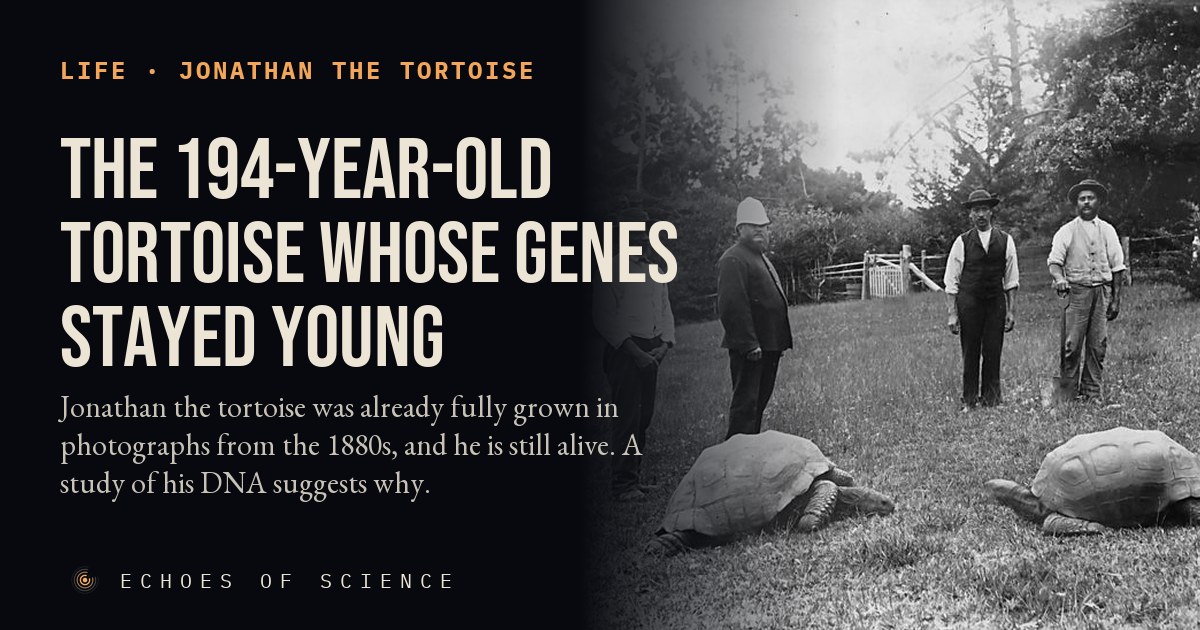
In a photograph from 1886, a giant tortoise stands on the lawn of Plantation House, the governor's residence on the South Atlantic island of St Helena, with islanders posing beside him. He is already fully grown. Everyone else in that picture is long gone. The tortoise, Jonathan, is still grazing on the same lawn.
Jonathan is the oldest known living land animal, and in October 2026 he became something else as well: the first giant tortoise whose epigenome has been studied. What researchers found offers a glimpse of how a body can stay in working order for almost two centuries.
A tortoise older than the photograph
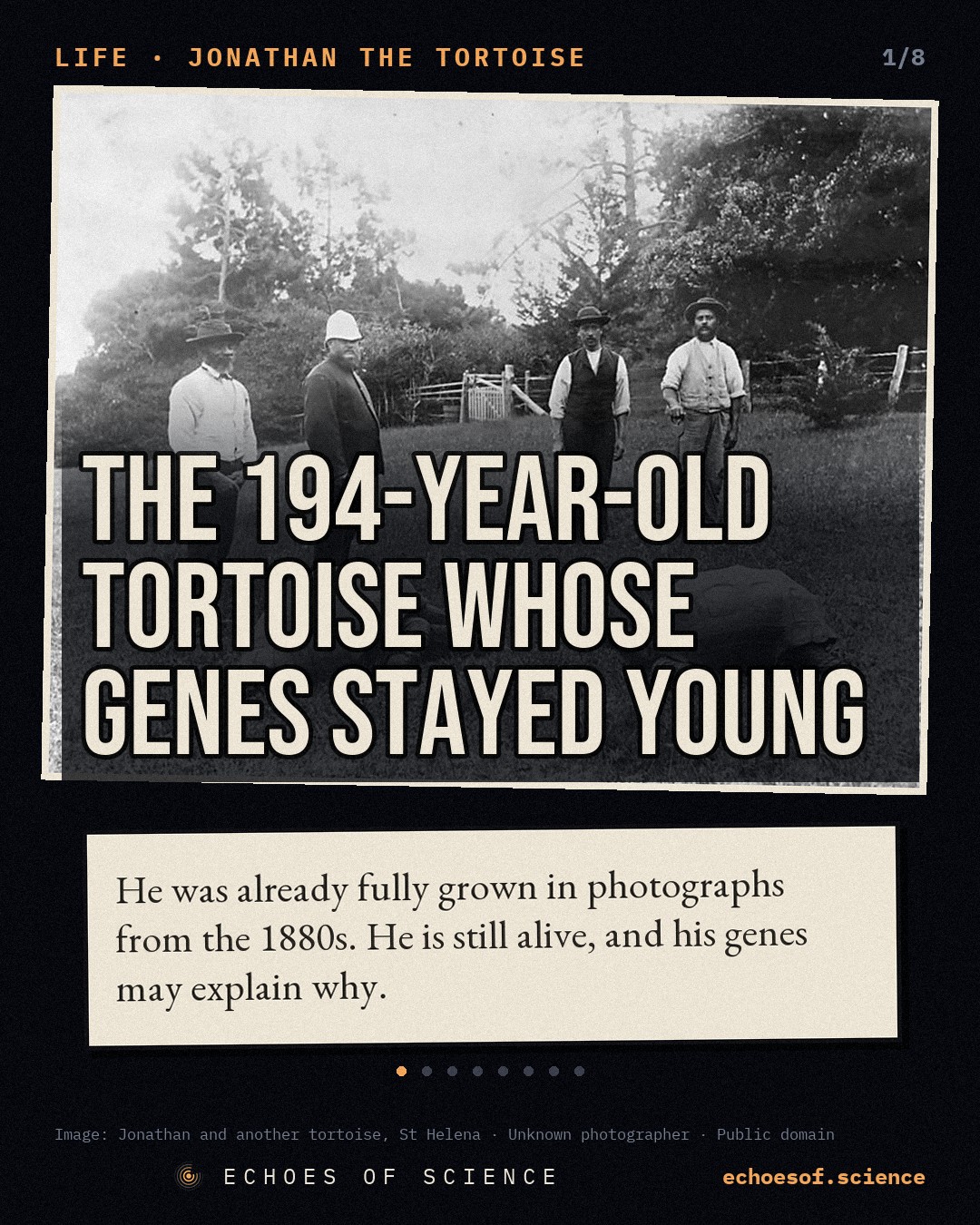
Jonathan is an Aldabra giant tortoise, a species from the Seychelles in the Indian Ocean. He was brought to St Helena in 1882, a gift to the governor. Because he was already fully mature when he arrived, and Aldabra giant tortoises take decades to reach full size, he must have been at least 50 years old. That gives a hatching date of around 1832, which makes him about 194 in 2026. Guinness World Records calls this a conservative estimate, meaning he may well be older.
The 1886 photograph matters here. It was once thought to date from 1902, but it has since been dated to four years after his arrival, and it shows him already fully grown. In 2021 he overtook Tu'i Malila, a radiated tortoise from Tonga that lived to at least 188, as the oldest chelonian on record. The island's government gave him an official birthday, 4 December, in 2022.
Old age has not left him untouched. His vet described him in 2023 as virtually blind from cataracts and without a sense of smell, so he is hand-fed once a week with fruit and vegetables. His hearing, though, is said to be excellent.
What his DNA revealed
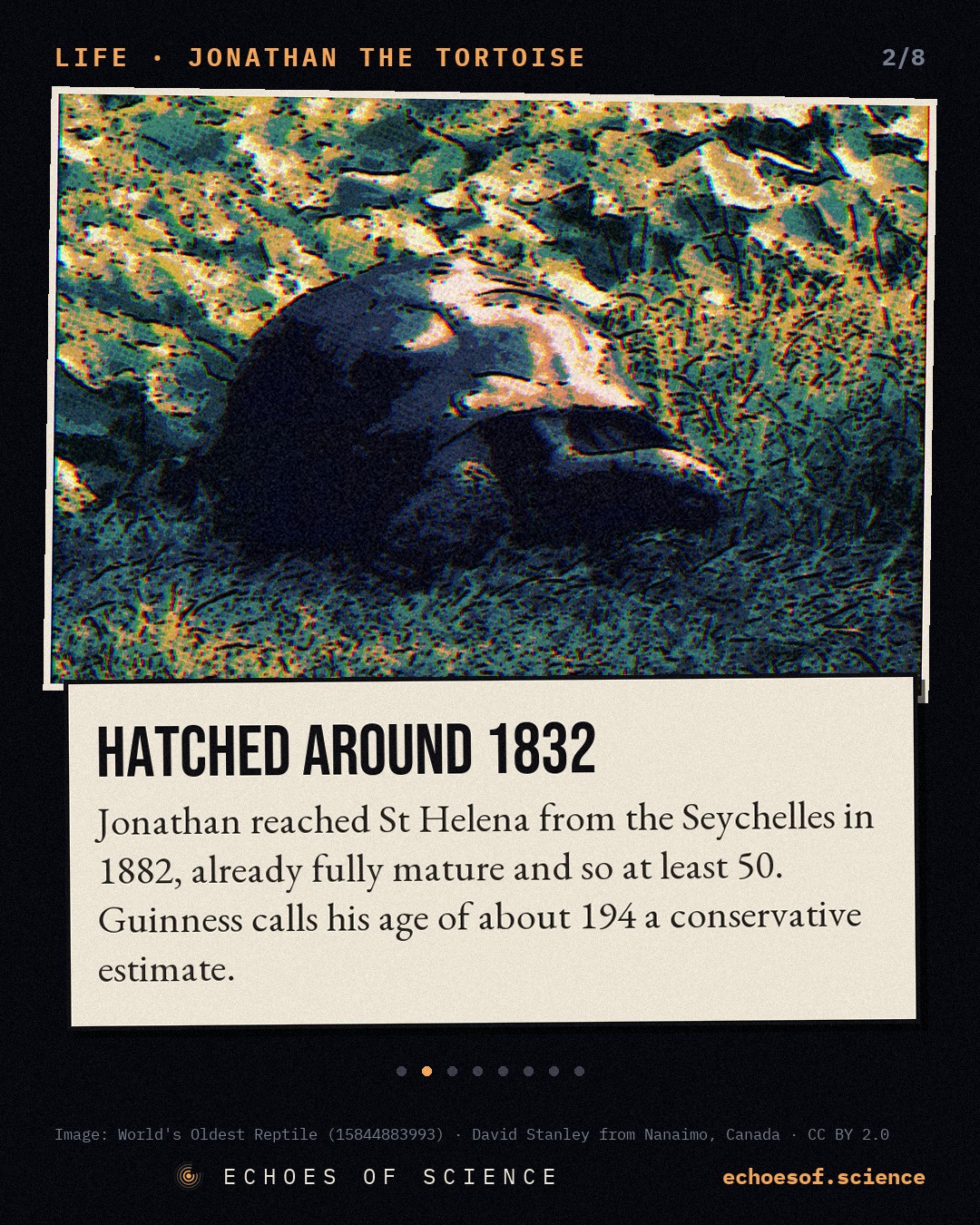
The new study, published in Science Advances on 7 October 2026, was led by Kallel, a US non-profit that studies longevity, with the tortoise specialist Dr Justin Gerlach of Peterhouse, University of Cambridge, among the authors. According to the University of Cambridge announcement, the team found 287 unique gene variants in Jonathan that are linked to reducing the usual effects of ageing. They affect four kinds of work inside cells: repairing damaged DNA, keeping inflammation in check, regulating insulin and suppressing cancer.
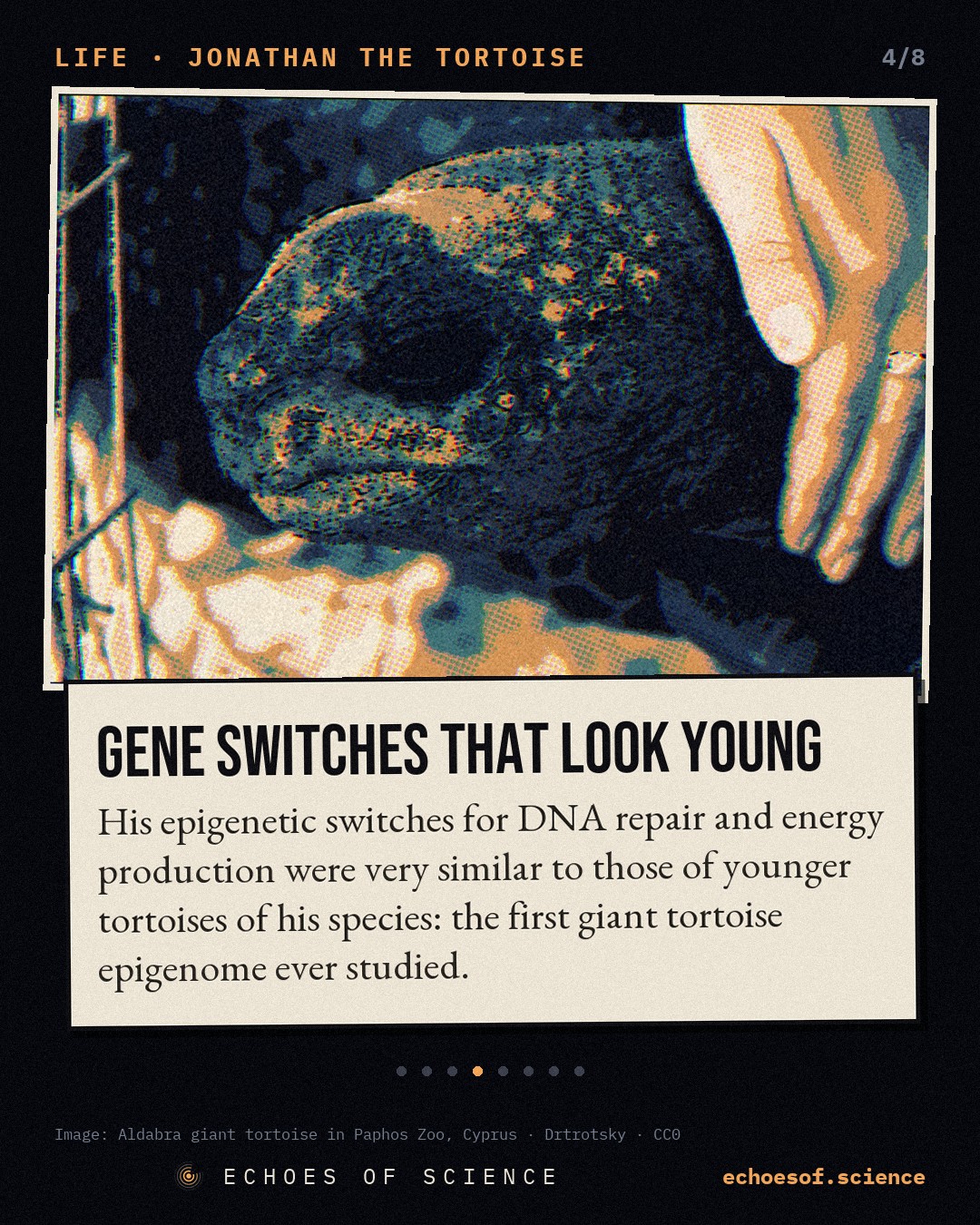
The team then looked at his epigenome and compared it with younger Aldabra giant tortoises of the same species. As Gerlach put it:
We found that the gene regulators involved in energy production and DNA repair have remained incredibly stable in Jonathan over almost two centuries.
That surprised the researchers, Popular Science reported, because the epigenome normally changes over a lifetime.
How do we know, and what don't we know?
Two different things are being claimed, and they rest on different evidence. Jonathan's age comes from history: the 1882 arrival, the 1886 photograph and what we know about how slowly his species grows. Nobody recorded his hatching, so the figure of 194 is a minimum, not a birth certificate.
The genetic findings come from comparing his DNA and its chemical tags with those of other tortoises. The public summaries of the study do not say how many tortoises were compared or how old they were, and a study of one exceptional individual cannot show on its own that any single variant makes an animal live longer. The authors themselves present the work as a starting point: the Cambridge release talks about what the results suggest, and turning them into anything useful for people will need much more research.
The science: switches on the genome
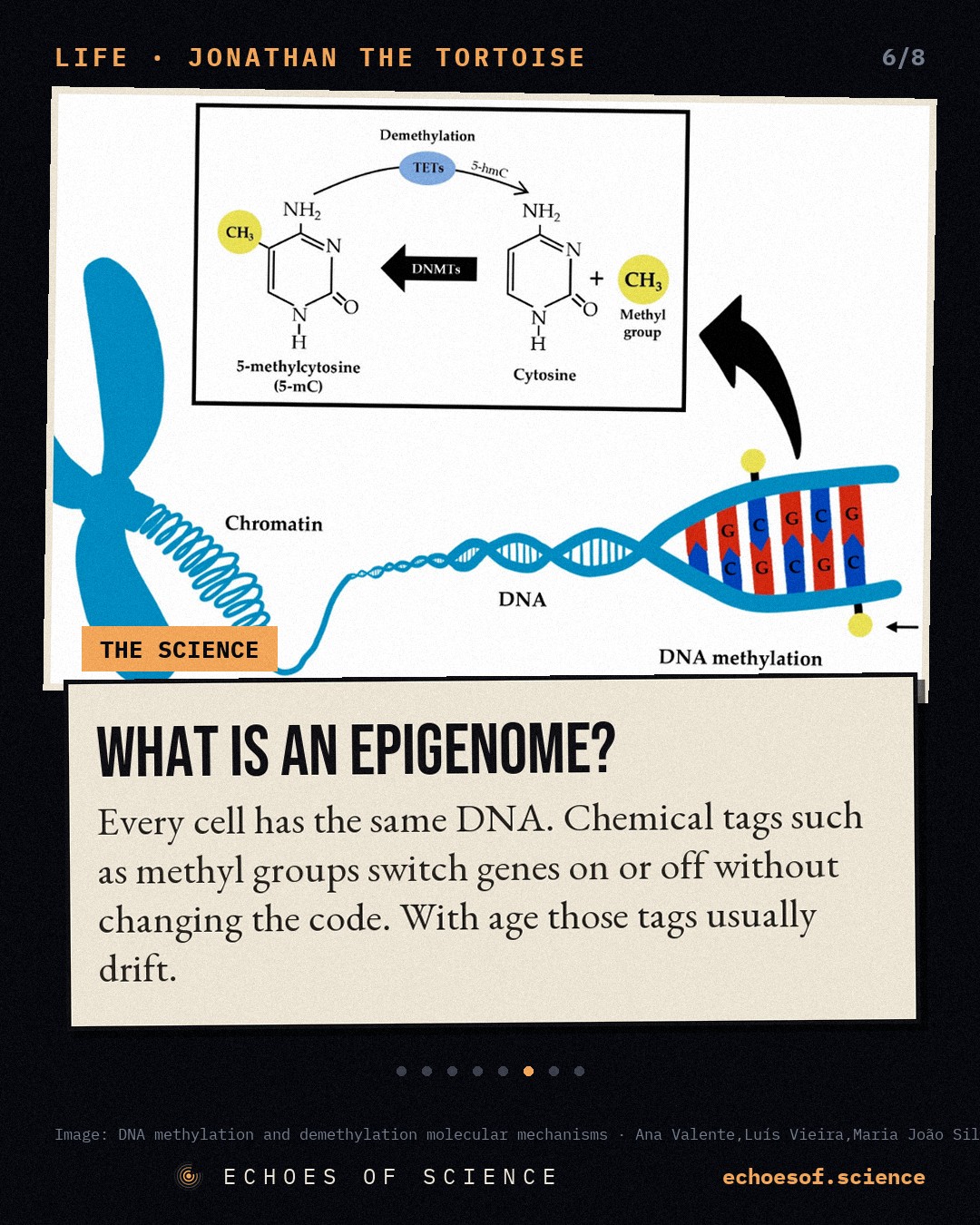
Almost every cell in an animal carries the same DNA, yet a liver cell and a skin cell behave very differently. The difference lies in which genes are switched on. Epigenetics, in the words of the US National Human Genome Research Institute, is the study of changes in DNA that do not involve alterations to the underlying sequence. One of the best known is DNA methylation, in which small chemical tags called methyl groups attach to DNA; when found in DNA, methylation can alter gene expression.
In most animals, these tags drift as the years pass, so much so that scientists can estimate an animal's age from them. Finding that Jonathan's switches for DNA repair and energy production still resemble those of a young tortoise suggests that his cells are holding on to good maintenance habits.
Jonathan's species is not unusual in this. In 2022, two large studies in Science looked at ageing in reptiles and amphibians. One, using records from zoos and aquariums, examined 52 species of turtles and tortoises: 75% showed extremely slow senescence, and 80% aged more slowly than modern humans. The other, using data from 77 species in the wild, found that animals with protective armour such as shells tend to age more slowly, with turtles standing out as a group.
Why it matters today
Ageing is the biggest single risk factor for many human diseases, from cancer to heart disease. Animals that seem to sidestep part of that decline are natural experiments, run over centuries, in how cells can resist wear and tear. Aldabra giant tortoises are listed as vulnerable, but some 180,000 still live on Aldabra Atoll, so there are many more to learn from.
For now, Jonathan's lesson is modest and remarkable at the same time. A tortoise who was already fully grown in the reign of Queen Victoria still keeps his DNA in good repair. On 4 December, St Helena will celebrate his birthday again.
The science in this story
Key facts
- Jonathan, an Aldabra giant tortoise, is believed to have hatched around 1832, because he was fully mature, and hence at least 50, when he was brought from the Seychelles to St Helena in 1882; Guinness calls this a conservative estimate. source ↗
- Guinness World Records lists Jonathan as the oldest living land animal and, since 2021, the oldest chelonian on record, a title previously held by Tu'i Malila, a radiated tortoise that lived to at least 188. source ↗
- The earliest known photograph of Jonathan, once thought to date from 1902, is now dated to 1886 and shows him already fully mature in the grounds of Plantation House, the governor's residence on St Helena. source ↗
- A study published in Science Advances on 7 October 2026 (DOI 10.1126/sciadv.adw8887), led by the US non-profit Kallel with Dr Justin Gerlach of Peterhouse, Cambridge, found 287 unique gene variants in Jonathan linked to DNA repair, inflammation, insulin regulation and cancer suppression. source ↗
- The study was the first of a giant tortoise's epigenome; the switches controlling Jonathan's DNA repair and metabolism genes were very similar to those of younger tortoises of the same species. source ↗
- In 2023 Jonathan was described as virtually blind from cataracts and without a sense of smell, and was hand-fed once a week with fruit and vegetables. source ↗
- A 2022 Science study of 52 turtle and tortoise species in zoos and aquariums found that 75% show extremely slow senescence and 80% age more slowly than modern humans. source ↗
- The largest population of Aldabra giant tortoises, some 180,000 animals, lives on Aldabra Atoll in the Seychelles; adult males average about 250 kg. source ↗
In pictures
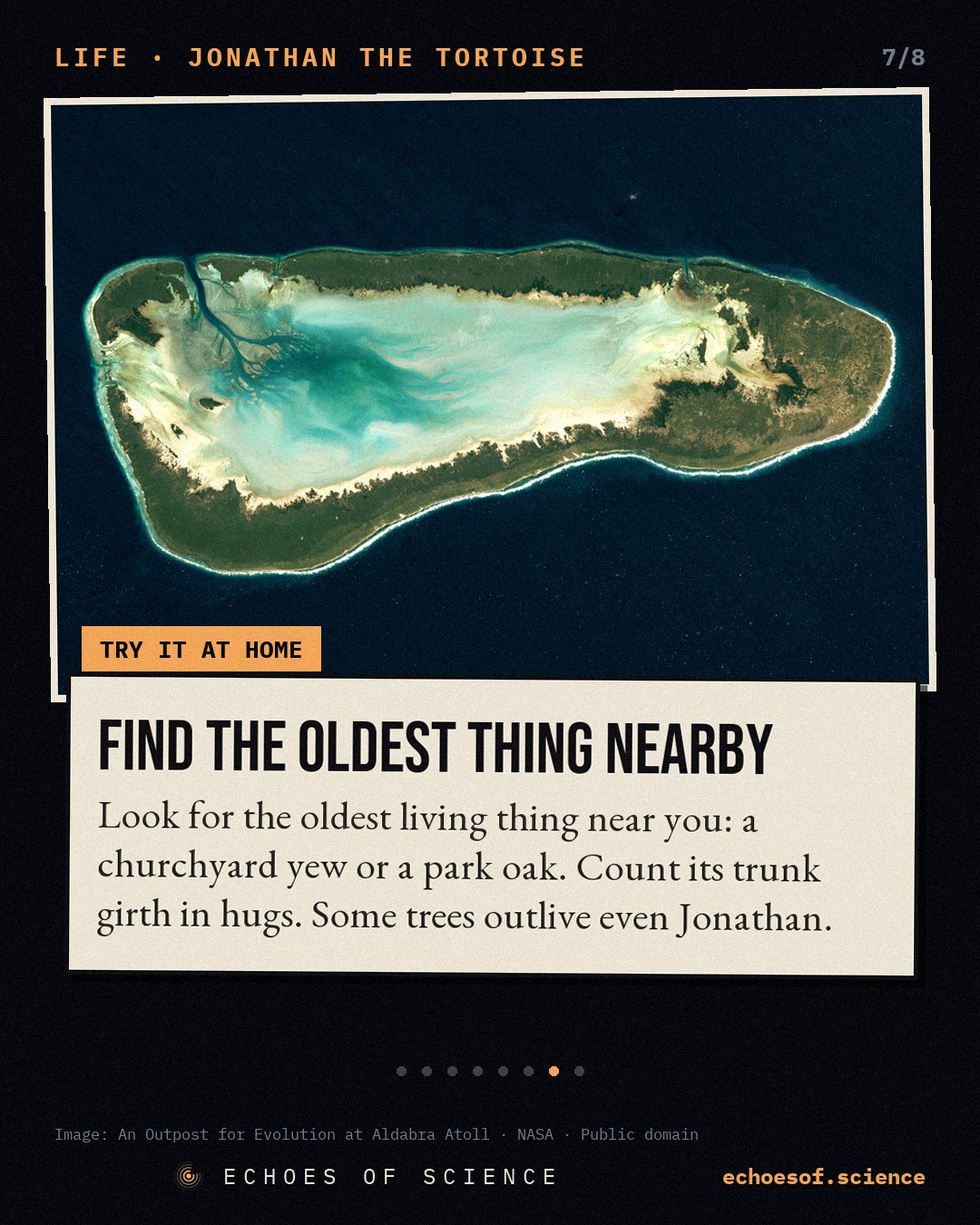
Find the oldest living thing near you: a churchyard yew, a park oak or a big chestnut. Measure the trunk's girth with a tape at chest height and look up a girth-to-age guide for that species. Some trees outlive even Jonathan.
Loading the quiz…
Where every picture, clip and sound in this story comes from
Keep scrolling: more true stories ↓
New mini-documentaries every week and a true story every day. Pick where you like to watch:
▶ Subscribe on YouTube Telegram TikTok Instagram Bluesky Threads ✉ Weekly email
Everything here is free and stays free. If you would like to help us make more: 🪐 Shop: calendars, posters, mugs & books